
Updated September 2026
Plastic material properties are measured values reported by specified tests in defined circumstances. Density, heat deflection, flame class, resistivity, water uptake, haze and vapor barrier each answer a different question about a part in service. This guide classifies these by the exposure a component is likely to encounter and provides a standard behind each value.
Plastic material properties fall into eight families: physical, thermal, flammability, electrical, environmental, optical, barrier and mechanical. Each value is valid only under its test standard’s stated conditions, so read the standard, the condition and the grade before comparing two numbers.
Key Takeaways
- A resin can melt near 250 °C and still deflect under load at 65 to 80 °C: PET’s heat deflection temperature at 1.82 MPa sits far below its melting point.
- At the same price per kilogram, polypropylene gives about 43 to 61 percent more volume than rigid PVC on the table ranges (up to about 77 percent on wider quoted ranges), because density decides how much material a kilogram holds.
- Per millimeter of thickness, one published compilation puts PET film at about 42 times lower oxygen permeability than HDPE film but about 6.5 times higher water vapor permeability, and the ratios vary by source and test condition.
- The UL 94 class describes a small laboratory specimen, and the standard says it shall not be assumed to correlate with end-use fire performance.
Quick Specs
| Property families | 8, from physical to mechanical |
| Density span of ten resins compared | 0.90 g/cm³ (polypropylene) to 2.2 g/cm³ (PTFE) |
| Heat deflection stresses | 0.455 MPa and 1.82 MPa under ASTM D648 |
| Current flame standard | UL 94 Edition 7, revised 2 July 2026 |
Plastic Property Families and the Standard Behind Each Number
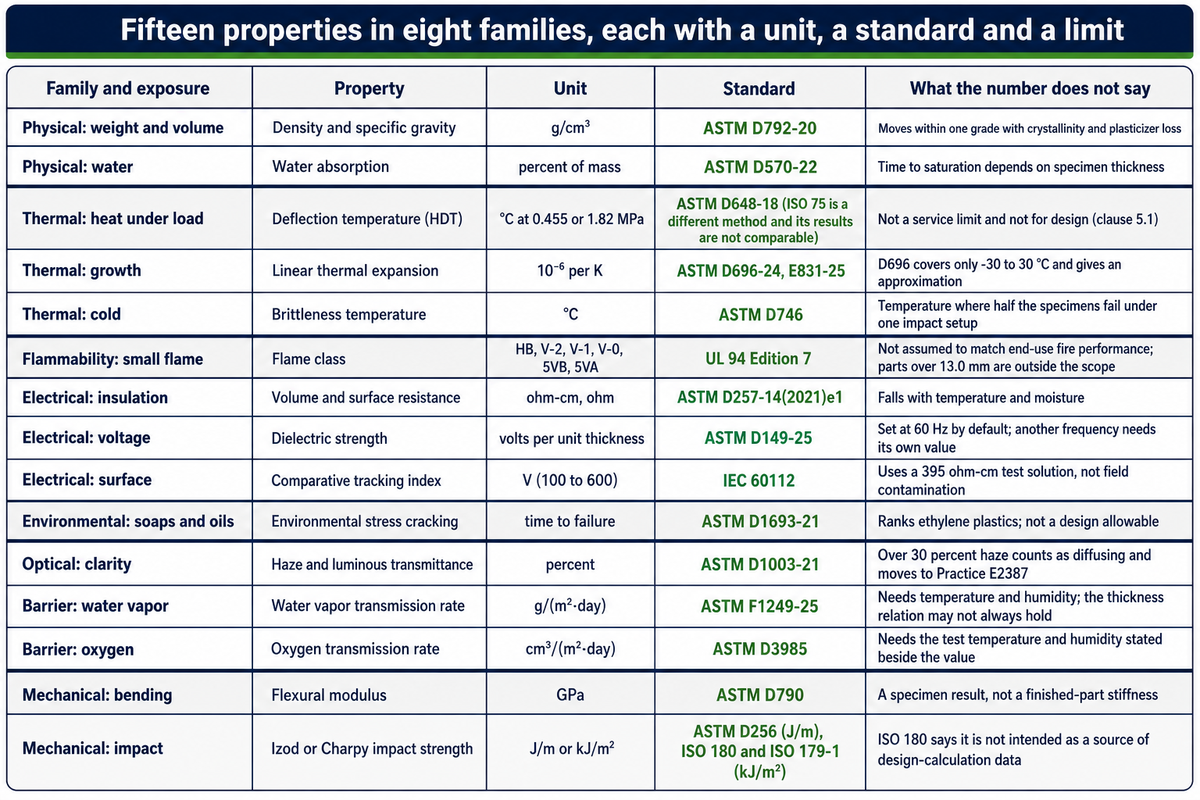
Plastic material properties group into eight families, and each family has a named test that fixes what the number means: ASTM D792 for density, D648 for heat deflection, UL 94 for flame class, D257 for resistance, D1693 for ethylene-plastic stress cracking, D1003 for haze and F1249 for water vapor. Without its named test, a number is a label, not data.
Exposure-First Property Index
The Exposure-First Property Index lists fifteen properties by the exposure a part meets, with the unit, the test standard and the limit of each number. Read as a plastic material properties chart, it says which row to check first for a given exposure.
| Family and exposure | Property | Unit | Standard | What the number does not say |
|---|---|---|---|---|
| Physical: weight and volume | Density and specific gravity | g/cm³ | ASTM D792-20 | Moves within one grade with crystallinity and plasticizer loss |
| Physical: water | Water absorption | percent of mass | ASTM D570-22 | Time to saturation depends on specimen thickness |
| Thermal: heat under load | Deflection temperature (HDT) | °C at 0.455 or 1.82 MPa | ASTM D648-18 (ISO 75 is a different method and its results are not comparable) | Not a service limit and not for design (clause 5.1) |
| Thermal: growth | Linear thermal expansion | 10⁻⁶ per K | ASTM D696-24, E831-25 | D696 covers only -30 to 30 °C and gives an approximation |
| Thermal: cold | Brittleness temperature | °C | ASTM D746 | Temperature where half the specimens fail under one impact setup |
| Flammability: small flame | Flame class | HB, V-2, V-1, V-0, 5VB, 5VA | UL 94 Edition 7 | Not assumed to match end-use fire performance; parts over 13.0 mm are outside the scope |
| Electrical: insulation | Volume and surface resistance | ohm-cm, ohm | ASTM D257-14(2021)e1 | Falls with temperature and moisture |
| Electrical: voltage | Dielectric strength | volts per unit thickness | ASTM D149-25 | Set at 60 Hz by default; another frequency needs its own value |
| Electrical: surface | Comparative tracking index | V (100 to 600) | IEC 60112 | Uses a 395 ohm-cm test solution, not field contamination |
| Environmental: soaps and oils | Environmental stress cracking | time to failure | ASTM D1693-21 | Ranks ethylene plastics; not a design allowable |
| Optical: clarity | Haze and luminous transmittance | percent | ASTM D1003-21 | Over 30 percent haze counts as diffusing and moves to Practice E2387 |
| Barrier: water vapor | Water vapor transmission rate | g/(m²·day) | ASTM F1249-25 | Needs temperature and humidity; the thickness relation may not always hold |
| Barrier: oxygen | Oxygen transmission rate | cm³/(m²·day) | ASTM D3985 | Needs the test temperature and humidity stated beside the value |
| Mechanical: bending | Flexural modulus | GPa | ASTM D790 | A specimen result, not a finished-part stiffness |
| Mechanical: impact | Izod or Charpy impact strength | J/m or kJ/m² | ASTM D256 (J/m), ISO 180 and ISO 179-1 (kJ/m²) | ISO 180 says it is not intended as a source of design-calculation data |
Basis: standard scope pages read on 20 September 2026 (ASTM D1693-21, ASTM D1003-21, ASTM F1249-25, ASTM E831-25, ASTM D257, ASTM D149-25). Ratings are family-level screens; a datasheet for the exact grade governs.
Every value in the table is a specimen result under stated conditions. The ASTM D648 page says its data are not intended for use in design, and ISO 180 says its impact result is not intended as a source of data for design calculations. Grade, conditioning state, specimen thickness and test temperature must travel with the number. The plastic material test data hub collects the checks on this site that sit behind these families.
What Are the Properties of Plastic Materials?
The properties of plastic are the measurable responses of the materials to a range of stimuli (weight, heat, fire, electricity, moisture, chemicals, light, gas and load). Plastic is a synthetic material, usually a polymer with additives, so the same family name such as polyethylene can cover several grades whose material properties are different.
Thermoplastics soften when heated and can be reshaped. Thermoset plastics harden permanently. Therefore, the melting-point data given in the following HDT tables are for the thermoplastic only. The common plastic families named here, from polyethylene and polypropylene to polycarbonate and nylon, are used in many applications. Each application makes use of a different property family. For classification by response to heat and molecular order, the guide to how plastics are classified and identified covers the other part of the classification that this article has left out.
The properties of plastic are usually read together, because a stiff, clear grade can still crack in oil or soften near a warm engine. The rest of this guide will take the families in the order that they’re encountered.
Plastic material selection works best from the exposure side, and plastic material types are easier to compare that way: plastic material properties and applications are matched one exposure at a time. A housing with a flame rule, a hot engine bay and a wash-down routine has three specific requirements, and none of them is answered by the name of a type of plastic. Different types of plastic bear a family name, but can vary by grade, so one type of polymer can appear as a neat resin on one datasheet and a filled blend on the next. There is no ideal material in the abstract. Only a grade that meets the exposure list for a given product design.
Density and Specific Gravity: Why Price per Kilogram Misleads
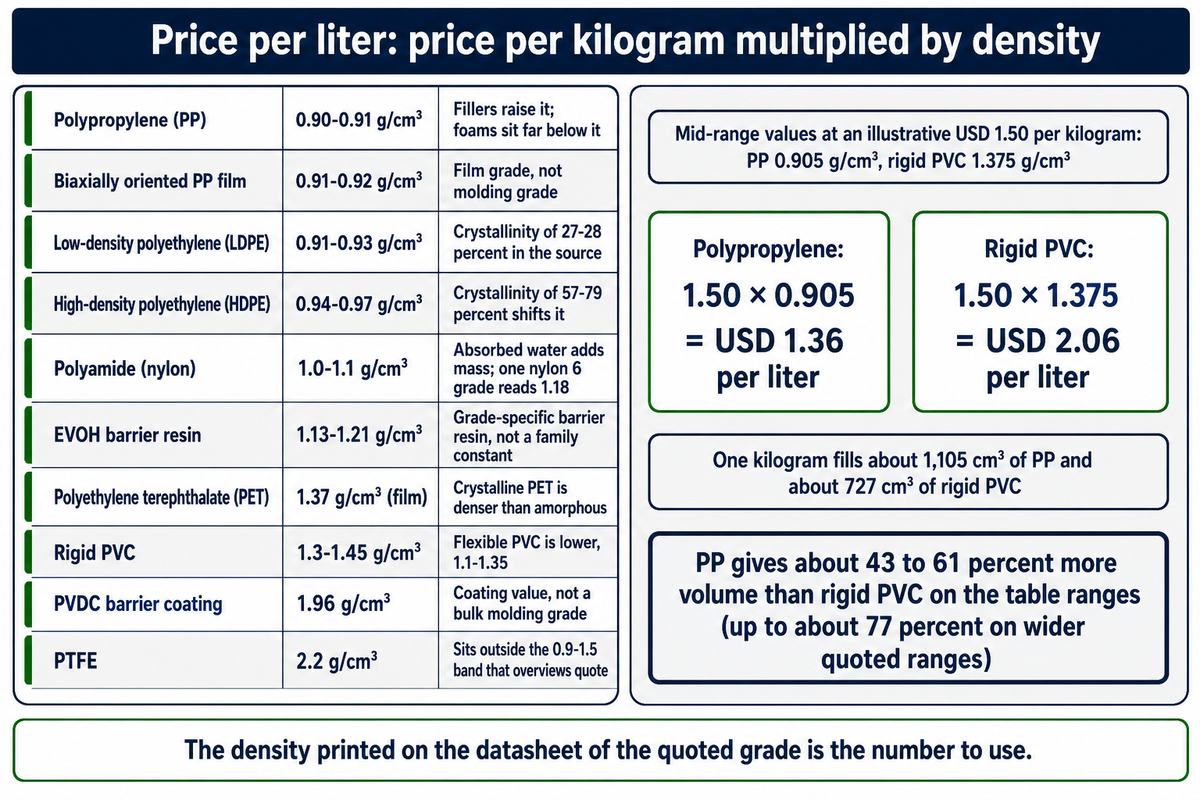
Plastic density, measured as specific gravity by ASTM D792, spans the resins compared here from approximately 0.90 g/cm³ for polypropylene to approximately 2.2 g/cm³ for PTFE, so an equal cost per kilogram does not equate to equal volume. What matters for a molded part is the price per liter: price per kilogram multiplied by density.
ASTM D792 establishes the method, and its significance clause names the reason a density is never a constant: “Changes in density of a single material are due to localized differences in crystallinity, loss of plasticizer, absorption of solvent, or to other causes.” (ASTM D792-20). Ranges below are grade-dependent screens, and the density printed on the datasheet of the quoted grade is the number to use.
| Resin | Density, g/cm³ | Source | Limitations |
|---|---|---|---|
| Polypropylene (PP) | 0.90–0.91 | PMC7726165; 0.895–0.93 in Wikipedia | Fillers raise it; foams sit far below it |
| Biaxially oriented PP film | 0.91–0.92 | PMC10892516, Table 2 | Film grade, not molding grade |
| Low-density polyethylene (LDPE) | 0.91–0.93 | PMC10892516, Table 2 | Crystallinity of 27–28 percent in the source |
| High-density polyethylene (HDPE) | 0.94–0.97 | PMC7726165; 0.952–0.965 at University of Illinois | Crystallinity of 57–79 percent shifts it |
| Polyamide (nylon) | 1.0–1.1 | PMC10892516, Table 2 | Absorbed water adds mass; one nylon 6 grade reads 1.18 in PMC10708457 |
| EVOH barrier resin | 1.13–1.21 | PMC10892516, Table 2 | Grade-specific barrier resin, not a family constant |
| Polyethylene terephthalate (PET) | 1.37 (film) | PMC10892516, Table 2 | Crystalline PET is denser than amorphous |
| Rigid PVC | 1.3–1.45 | Wikipedia; 1.35–1.45 in PMC7726165 | Flexible PVC is lower, 1.1–1.35 |
| PVDC barrier coating | 1.96 | PMC10892516, Table 2 | Coating value, not a bulk molding grade |
| PTFE | 2.2 | Wikipedia | Sits outside the 0.9–1.5 band that overviews quote |
Basis: grade or family ranges as printed by each source; ASTM D792 test, water or another liquid. PVC values differ among sources (1.30–1.58 rigid at Illinois), hence showing a range rather than a single value.
Liter-Price Correction for a Per-Kilogram Quote
The Liter-Price Correction estimate converts from a kilogram based quote to a per liter price: multiplying price per kilogram with density in g/cm³ provides the price per liter of a solid material. Let’s look at polypropylene at 0.905 g/cm³ and rigid PVC at 1.375 g/cm³ (mid-range values) that are quoted at an illustrative price of USD 1.50 per kilogram as an example. The price of polypropylene would be 1.50 × 0.905 = USD 1.36 per liter and the price of PVC would be 1.50 × 1.375 = USD 2.06 per liter.
The math works the same for the quantity in liters. One kilogram of polypropylene fills about 1,105 cm³ and one kilogram of rigid PVC about 727 cm³, so across the polypropylene 0.90–0.91 and rigid PVC 1.3–1.45 ranges in the table, polypropylene delivers 43 to 61 percent more volume per kilogram (1.3 ÷ 0.91 at the low end, 1.45 ÷ 0.90 at the high end), and the wider ranges in the basis note widen the gap to roughly 40 to 77 percent. Budgets approved against a per-kilogram price will read a resin change as a price change when it is a volume change, so restate the quote per liter or per part before comparing.
What Are the Physical Properties of Plastic?
The physical properties of plastic describe the material without changing its chemistry: density, water absorption and dimensional change due to temperature and moisture. Density fixes weight and material volume, water absorption moves dimensions and electrical resistance, and expansion sets clearances. Nylon 6 gains about 2.5–3 percent of its mass at 23 °C and 50 percent relative humidity (PMC8124584). Moldings that fit dry can bind once they have conditioned.
A resin that is easy to work in one machine can still behave differently from another route: injection molding, extrusion and 3D printing make plastic into various shapes under different conditions, so a remolded regrind or a 3D-printed part may not match the virgin resin. The plastic used for a sample can also differ from the plastic used in production, so state the manufacturing process next to a density or absorption figure when parts from two routes will be compared.
Foam illustrates the phenomenon from the other side. For example, polystyrene foam (often called styrofoam in everyday speech) has a gas-related bulk density and PE foam behaves in the same way, thus a density value must indicate if it’s referring to the solid resin or the foam.
A PTFE part and a polypropylene part of the same volume differ in mass by a factor of about 2.4 (2.2 ÷ 0.905 g/cm³); thus, the quoted cost of fluoropolymer material for each kilogram doesn’t give insight into the cost of a single part, and the quoted cost for each liter is the more appropriate value.
Thermal Limits: Heat Deflection, Vicat, Melting Point and Expansion
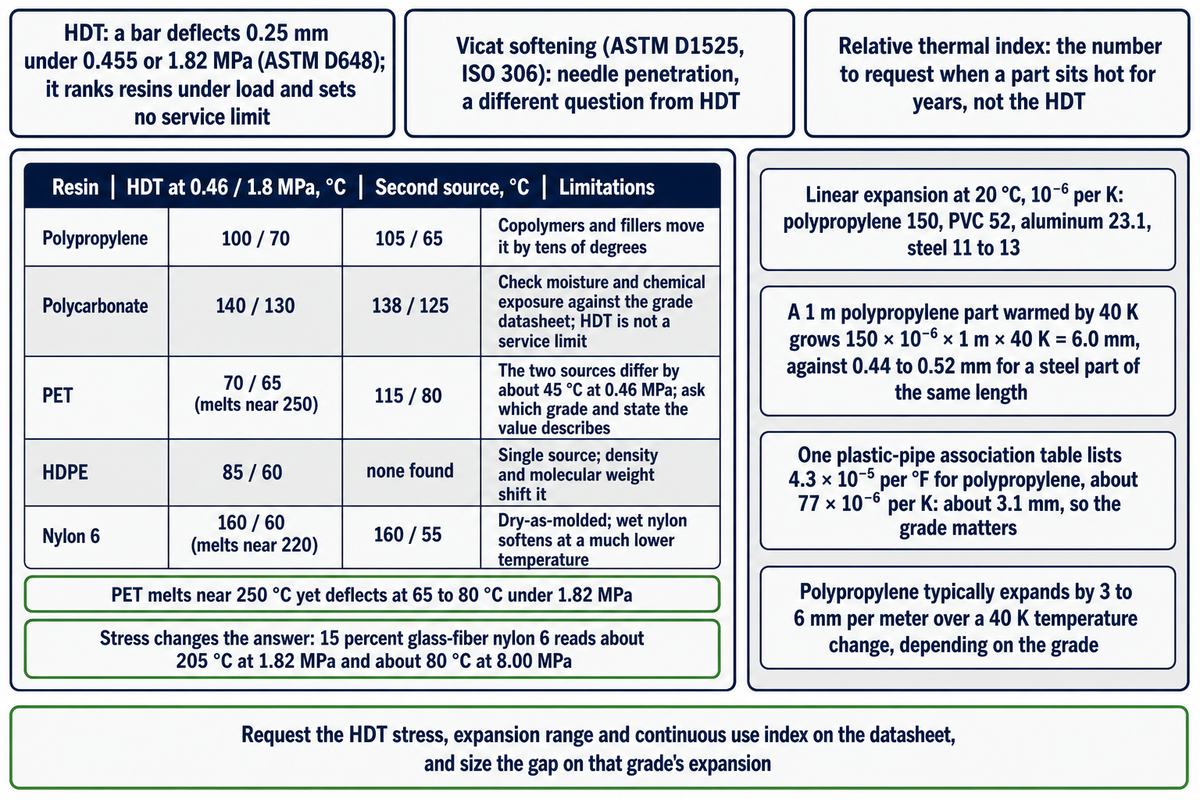
Heat deflection temperature (HDT) is the temperature at which a bar deflects 0.25 mm under a fixed flexural stress, 0.455 or 1.82 MPa under ASTM D648, so it ranks resins under load and sets no service limit. PET melts near 250 °C yet deflects at 65 to 80 °C under 1.82 MPa.
“The data are not intended for use in design or predicting endurance at elevated temperatures.”
The stresses are low by design: materials consultant Michael Sepe wrote in Plastics Technology that the 66 psi and 264 psi loads are “so low as to be laughable”, and ISO 75 adds a third stress of 8.00 MPa. Stress changes the answer. In Sepe’s example, a 15 percent glass-fiber nylon 6 reads about 205 °C at 1.82 MPa and about 80 °C at 8.00 MPa (Plastics Technology). That article also tells of an ABS drawing that demanded continuous exposure to 190 °F (87 °C), a temperature that turned out to be the published HDT.
| Resin | HDT at 0.46 / 1.8 MPa, °C | Second source, °C | Limitations |
|---|---|---|---|
| Polypropylene | 100 / 70 | 105 / 65 (PMC10005598) | Copolymers and fillers move it by tens of degrees |
| Polycarbonate | 140 / 130 | 138 / 125 (PMC11244106) | Check moisture and chemical exposure against the grade datasheet; HDT is not a service limit |
| PET | 70 / 65 (melts near 250) | 115 / 80 (PMC11244106) | The two sources differ by about 45 °C at 0.46 MPa; ask which grade and state the value describes |
| HDPE | 85 / 60 | none found | Single source; density and molecular weight shift it |
| Nylon 6 | 160 / 60 (melts near 220) | 160 / 55 (PMC7435725) | Dry-as-molded; wet nylon softens at a much lower temperature |
Basis: grade averages from MatWeb, checked against PMC11244106 and PMC10005598; specimens 3 mm or thicker per ASTM D648-18. ASTM prints the stresses as 0.455 and 1.82 MPa; MatWeb rounds them to 0.46 and 1.8. The nylon second source (PMC7435725) reproduces a supplier datasheet.
The melting point of plastic material is the wrong screen for load. Thermoplastic and thermoset plastics differ here as well: a thermoplastic softens and melts, while a thermoset sets permanently and has no melting point to quote, and a low melting resin is not automatically the weaker choice in a warm store, because a melting point says nothing about deflection under load. Take a polyester with a melting point near 250 °C and a 65 to 80 °C HDT under 1.82 MPa: it shows the gap, and a nylon that is dry-as-molded loses stiffness once wet, because its glass transition falls from about 60 °C dry to about -20 °C water-saturated (PMC8124584). Glass transition and melting ranges by resin family are tabulated in the guide to how plastics are classified and identified, so this article treats them only as limits. Vicat softening (ASTM D1525, ISO 306) is a needle-penetration test, a different question from the bending-bar HDT, and Wikipedia gives heat distortion of traditional PVC product as beginning near 60 °C in service while listing a Vicat B of 65 to 100 °C for rigid PVC (Wikipedia).
Continuous use is a third question. UL Prospector’s definition of a relative thermal index is the “maximum service temperature for a material where specific properties are not unacceptably compromised” (UL Prospector), with the aging test ending at 50 percent property retention (UL Solutions). That’s the number to request when a part sits hot for years, and it isn’t the HDT.
Expansion sets the clearance. Linear thermal expansion at 20 °C is 150 × 10⁻⁶ per K for polypropylene, 52 for PVC, 23.1 for aluminum and 11 to 13 for steel (Wikipedia). At the Wikipedia figure, a 1 m polypropylene part warmed by 40 K grows 150 × 10⁻⁶ × 1 m × 40 K = 6.0 mm, against 0.44 to 0.52 mm for a steel part of the same length. One plastic-pipe association table lists 4.3 × 10⁻⁵ per °F for polypropylene, about 77 × 10⁻⁶ per K, which would give about 3.1 mm, so the grade matters (PPFA bulletin UB-20). ASTM D696-24 measures only from -30 °C to +30 °C and gives an approximation, and thermomechanical analysis under ASTM E831-25 covers a scanned range.
It’s more complicated than just the service temperature. Parked trucks and warm stores can push a part’s temperature toward its HDT, where a part under load can warp. And mating steel or aluminum housings expand far less than the plastic inside them. Therefore, an assembly clearance drawn at room temperature can close or open by several millimeters. Request the HDT stress, expansion range, and continuous use index on the datasheet and size the gap based on the expansion of that grade.
Polypropylene typically expands by 3 to 6 mm per meter over a 40 K temperature change, depending on the grade, while its HDT at 1.82 MPa is in the range of 65 to 70 °C. So a part that stays inside its heat limit can still outgrow a clearance drawn at room temperature.
Electrical Properties and Fire Ratings: UL 94, Resistivity and Tracking Index
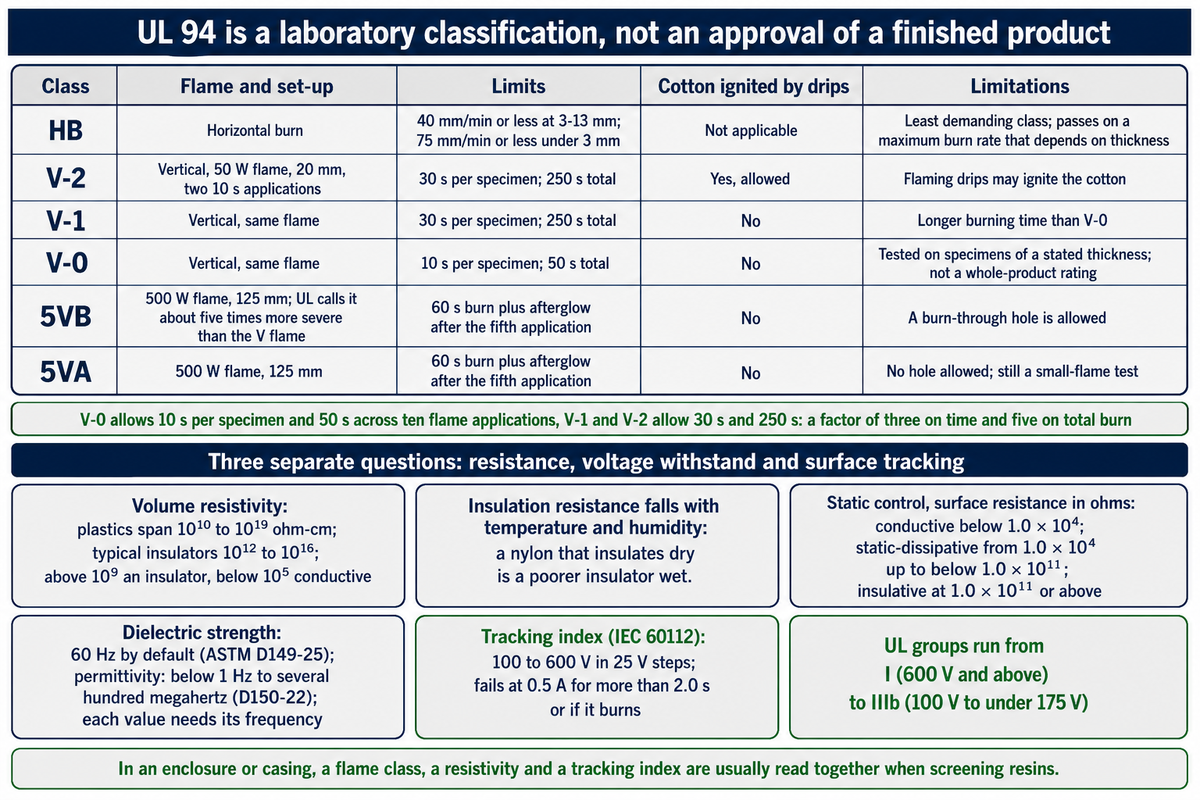
A UL 94 flame class such as V-0 or HB is a laboratory classification of a small specimen burned with a small flame, not an approval of a finished product, and the standard states that its performance level shall not be assumed to correlate with end-use performance. Electrical properties include three separate questions: resistance, voltage withstand and surface tracking.
“The performance level of a material determined by these methods shall not be assumed to correlate with its performance in end-use application.”
ANSI/UL 94 Edition 7 was published on 28 February 2023 and last revised on 2 July 2026, when it added a Flame Stabilization Time to the flame test method. Its scope excludes parts thicker than 13.0 mm or larger than 1 m², and it does not evaluate flame spread, smoke or heat release. UL’s code-authority note, a 2019 reprint of a 2007 newsletter, states that model codes did not recognize the small-scale UL 94 ratings as a substitute for the ratings they specify, so confirm against the code edition in force (UL Code Authorities).
| Class | Flame and set-up | Limits | Cotton ignited by drips | Limitations |
|---|---|---|---|---|
| HB | Horizontal burn | 40 mm/min or less at 3–13 mm; 75 mm/min or less under 3 mm | Not applicable | Least demanding class; passes on a maximum burn rate that depends on thickness |
| V-2 | Vertical, 50 W flame, 20 mm, two 10 s applications | 30 s per specimen; 250 s total | Yes, allowed | Flaming drips may ignite the cotton |
| V-1 | Vertical, same flame | 30 s per specimen; 250 s total | No | Longer burning time than V-0 |
| V-0 | Vertical, same flame | 10 s per specimen; 50 s total | No | Tested on specimens of a stated thickness; not a whole-product rating |
| 5VB | 500 W flame, 125 mm; UL calls it about five times more severe than the V flame | 60 s burn plus afterglow after the fifth application | No | A burn-through hole is allowed |
| 5VA | 500 W flame, 125 mm | 60 s burn plus afterglow after the fifth application | No | No hole allowed; still a small-flame test |
Basis: UL Solutions combustion-test table; the vertical limits agree with a University of Texas fire research group table. Datasheets state the specimen thickness a class was tested at.
Read a V-0 line together with its thickness. Datasheets state the thickness a class was tested at, even the HB limits change with thickness, and the UL 94 scope points small components to a separate standard for their “minimum use thickness”. One practitioner thread on Eng-Tips shows the confusion: an engineer holding a datasheet that read “UL94-V0 at 1.6mm” asks whether thicker and thinner walls also pass. Datasheet entries and UL listings answer that, and no rule of thumb does. Color and formulation are also worth checking on the listing, because no UL page read for this guide ties a class to them either way.
Electrical insulation has its own numbers. Plastics span 10¹⁰ to 10¹⁹ ohm-cm in volume resistivity, with typical insulators between 10¹² and 10¹⁶ ohm-cm, above 10⁹ counting as an insulator and below 10⁵ as conductive (SpecialChem, citing the Plastics Technology Handbook). ASTM D257 covers DC insulation resistance, volume resistance and surface resistance (ASTM D257-14(2021)e1), and insulation resistance falls with temperature and humidity, so a nylon that insulates dry is a poorer insulator wet. State the humidity beside every resistivity figure.
Static control is usually specified in ohms of surface resistance, not volume resistivity in ohm-cm. The ESD Association glossary defines three classes in ohms: conductive below 1.0 × 10⁴, static-dissipative from 1.0 × 10⁴ up to below 1.0 × 10¹¹, and insulative at 1.0 × 10¹¹ or above (ESD Association). An older edition of the glossary used ohms per square, so do not mix the two conventions. Dielectric strength under ASTM D149-25 is set at 60 Hz by default, and permittivity under D150-22 spans frequencies from below 1 Hz to several hundred megahertz, so each electrical value needs its frequency.
Tracking is a surface property. The comparative tracking index of IEC 60112 drops a 20 mm³ drop of a 395 ohm-cm solution between electrodes at 100 to 600 V in 25 V steps, and a material fails at 0.5 A for more than 2.0 s or if it burns. UL’s table sorts results into groups from I (600 V and above) to IIIb (100 V to under 175 V) (UL Solutions). In an enclosure or casing, a flame class, a resistivity and a tracking index are usually read together when screening resins.
Class V-0 needs no more than 10 s of burning per specimen and 50 s across ten flame applications, while V-1 and V-2 allow 30 s and 250 s, so the class step is a factor of three on time and five on total burn.
Chemical Properties and Environmental Exposure: Water, Solvents and UV
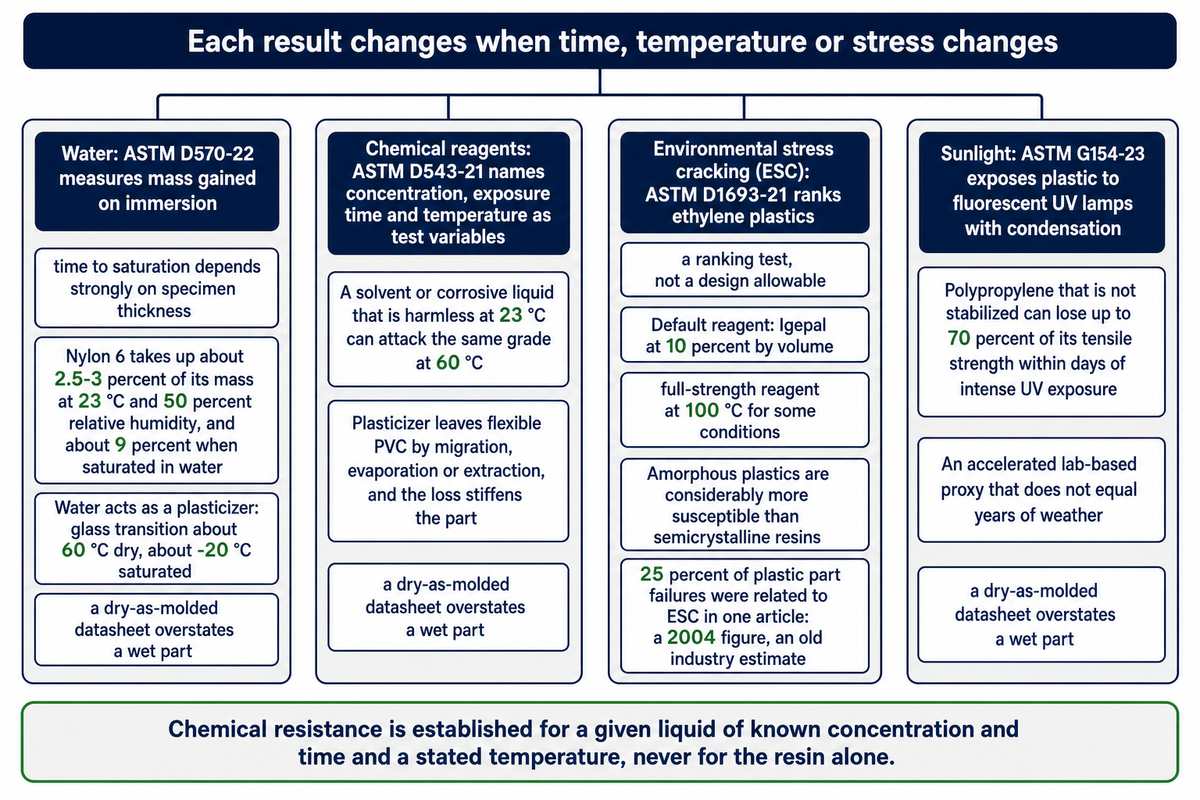
Chemical and environmental properties describe what water, chemicals under stress and sunlight do to a plastic after it is in service. ASTM D570 measures water absorption, ASTM D1693 ranks stress cracking of ethylene plastics, and ASTM G154 and D543 cover UV exposure and chemical reagents, and each result changes when time, temperature or stress changes. The behavior becomes dependent on changes of time, temperature and stress.
What Are the Chemical Properties of Plastic?
The chemical properties of plastic define its behavior as it interacts with liquids, gasses and light. They cover resistance to acids, solvents, oils, stress cracking and hydrolysis. The weathering and loss of additives also come under its purview. Plastic doesn’t rust as steel does, so its failures move to swelling, cracking, softening and aging. Chemical resistance is established for a given liquid of known concentration and time and a stated temperature. It’s never established for the resin alone.
ASTM D543 describes plastics’ resistance to certain reagents and their significance clauses outline concentration, exposure time and temperature as test variables (ASTM D543-21). Charts that rate a resin “resistant” without those three fields are a first screen, and a solvent or corrosive liquid that is harmless at 23 °C can attack the same grade at 60 °C. Ask for the temperature and the exposure time, and do not treat a rating for one grade as a rating for another. Plasticizer can leach as well: it leaves flexible PVC by migration, evaporation or extraction, and the loss stiffens the part (npj Materials Degradation), so a chemical rating must also say whether the contact fluid extracts additives.
“Under certain conditions of stress and in the presence of environments such as soaps, wetting agents, oils, or detergents, ethylene plastics may exhibit mechanical failure by cracking.”
This sentence describes environmental stress cracking (ESC), and the test for it is a ranking test, not a design allowable. ASTM D1693-21 names Igepal at 10 percent by volume as the default reagent, with full-strength reagent at 100 °C for some conditions. One failure-analysis article reported that 25 percent of plastic part failures were related to ESC, a figure from 2004 that should be read as an old industry estimate ( Madison Group ). The same source notes that amorphous plastics are considerably more susceptible to ESC than semicrystalline resins, and its case histories involve PC/ABS and ABS parts, so a polyethylene-only view understates the risk for a housing made of an amorphous resin such as polycarbonate or ABS.
Water changes plastics in two ways: it adds mass and swells the part, and it plasticizes the polymer. ASTM D570-22 measures the mass gained on immersion for plastics including rod, tube and sheet at least 0.13 mm thick, and warns that the time to saturation depends strongly on specimen thickness. Nylon 6 shows why: it takes up about 2.5–3 percent of its mass at 23 °C and 50 percent relative humidity and about 9 percent when saturated in water (PMC8124584 measured 8.83 percent in a water bath, and PMC7435725 reproduces a supplier datasheet that lists about 9.5 percent), figures for commercial grades. Water acts as a plasticizer: the same paper puts the glass transition at about 60 °C dry and about -20 °C saturated, which is why a dry-as-molded datasheet overstates a wet part.
Sunlight ravages the resin itself. Polypropylene that is not stabilized can lose up to 70 percent of its tensile strength within days of intense UV exposure, which is why stabilizers are added (PMC12855964; PMC7956639). ASTM G154 covers exposure to fluorescent UV lamps with condensation, an accelerated lab-based proxy that does not equal years of weather (ASTM G154-23). Outdoor storage of polypropylene strap is a practical case, and the sister-site guide to how PP and PET strapping differ in service covers the strap side. Laboratory equipment and medical devices need the same fields, the reagent, its concentration, the exposure time and the temperature, because a chemical rating without them cannot be reproduced.
Nylon 6 saturated in water holds about 9 percent of its own mass as water and its glass transition drops by about 80 °C, while at 23 °C and 50 percent relative humidity it gains about 2.5 to 3 percent, so a value measured dry can overstate a conditioned part.
Optical and Barrier Properties: Haze, Light Transmission, WVTR and OTR
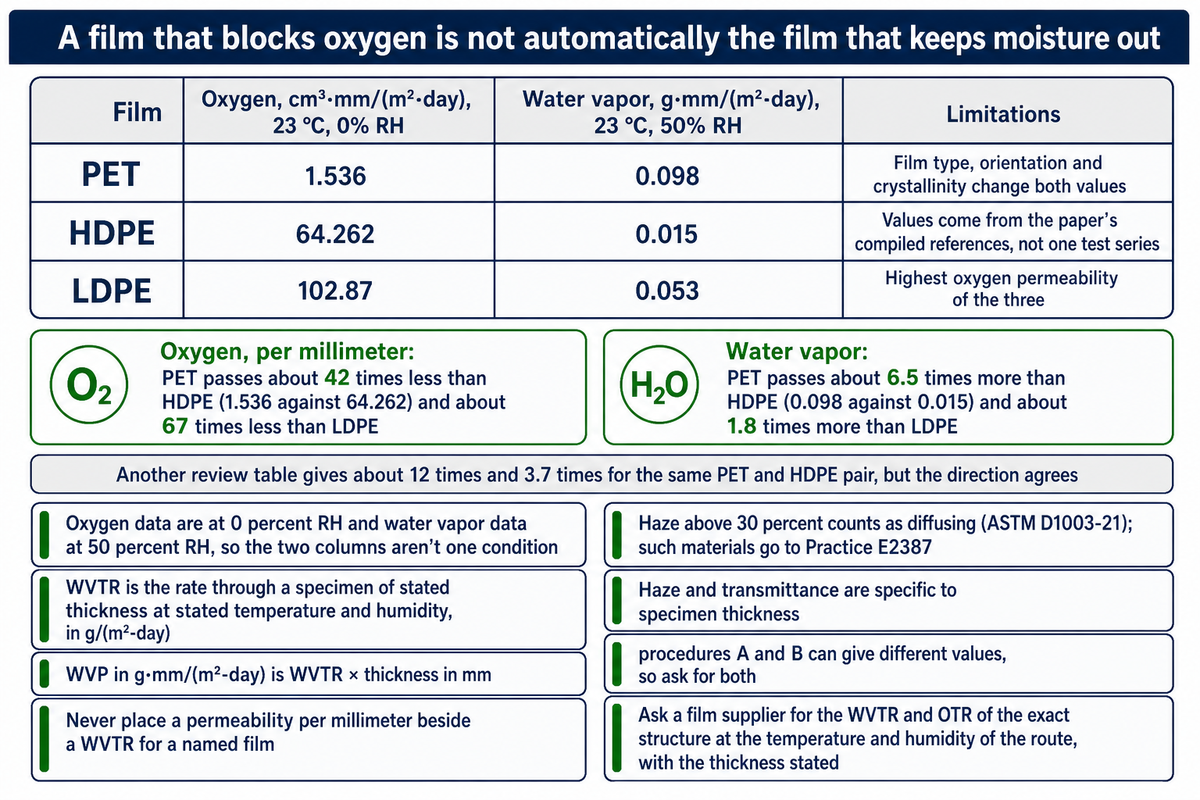
Optical properties describe how much light passes and how sharply, and barrier properties describe how much water vapor and oxygen pass. ASTM D1003 measures haze and luminous transmittance, ASTM F1249 measures water vapor transmission rate (WVTR), and ASTM D3985 measures oxygen transmission rate (OTR), each at one stated condition.
Clarity has a threshold in the standard: ASTM D1003-21 treats a haze above 30 percent as diffusing and sends such materials to Practice E2387 (ASTM D1003-21). Transmittance and haze figures are specific to the specimen thickness and the test procedure, since ASTM D1003 procedures A and B can give different values, so ask for both. Polycarbonate, made from bisphenol A (BPA), and acrylic are optical grades this applies to.
Barrier data hide three different quantities. WVTR is the rate through a specimen of stated thickness at stated temperature and humidity, in g/(m²·day). Permeability multiplies that rate by thickness, so the paper behind the table below computes WVP in g·mm/(m²·day) as WVTR × thickness in mm. ASTM F1249-25 covers film up to 3 mm thick, reports interlaboratory WVTR from 0.052 to 26 g/(m²·day), and warns in Note 1 that the inverse relationship of WVTR to thickness “may not always apply” (ASTM F1249-25). Never place a permeability per millimeter beside a WVTR for a named film.
| Film | Oxygen, cm³·mm/(m²·day), 23 °C, 0% RH | Water vapor, g·mm/(m²·day), 23 °C, 50% RH | Limitations |
|---|---|---|---|
| PET | 1.536 | 0.098 | Film type, orientation and crystallinity change both values |
| HDPE | 64.262 | 0.015 | Values come from the paper’s compiled references, not one test series |
| LDPE | 102.87 | 0.053 | Highest oxygen permeability of the three; one temperature and humidity only |
Basis: a review’s compilation of earlier studies, Table 2 of PMC10892516, values per millimeter of film thickness; two further tables (PMC9029979, PMC11819971) show the same direction. Oxygen data are at 0 percent RH and water vapor data at 50 percent RH, so the two columns aren’t one condition.
The table points against a common assumption that one barrier film is good against everything. In this compilation PET passes about 42 times less oxygen than HDPE per millimeter (1.536 against 64.262) and about 67 times less than LDPE, yet about 6.5 times more water vapor than HDPE (0.098 against 0.015) and about 1.8 times more than LDPE. The exact ratios differ by source, since another review table gives about 12 times and 3.7 times for the same PET and HDPE pair, but the direction agrees. Even a film that protects a dry powder from oxygen isn’t automatically the film that keeps moisture out, and shelf life is “closely linked to the barrier properties of the packaging materials used” (Foods, 2025). Test conditions decide comparability: 37.8 °C (100 °F) and 90 percent RH is a common WVTR pair, but Packaging World calls it one of many possible standardized pairs (Packaging World).
Ask a film supplier for the WVTR and OTR of the exact structure at the temperature and humidity of the route, with the thickness stated. The plastic film tensile testing page covers the mechanical side of the same film, which this article leaves aside.
Per millimeter of thickness, HDPE lets through 0.015 g of water vapor per square meter per day against 0.098 g for PET, a 6.5-fold gap that reverses for oxygen at 23 °C and 0 percent RH, where PET passes 1.536 and HDPE 64.262 cm³·mm/(m²·day).
Mechanical Properties in One Page: Flexural, Impact and Hardness
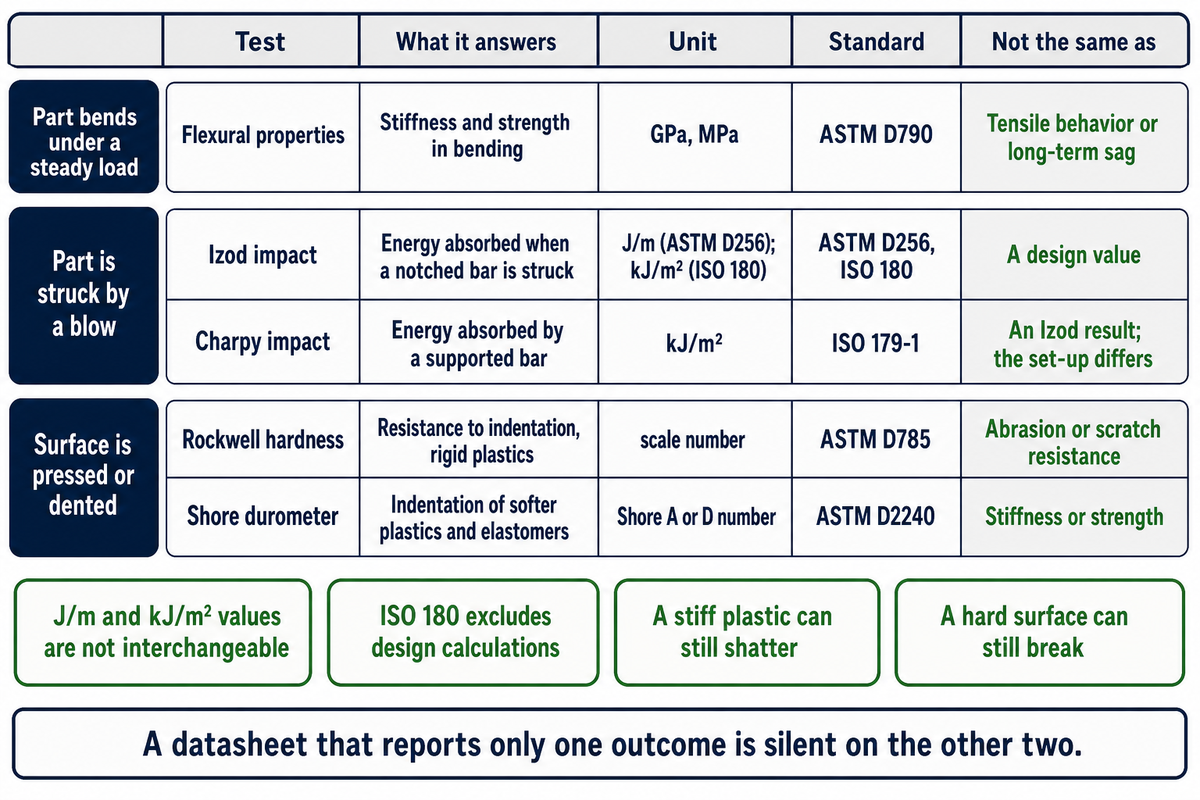
Three mechanical tests answer whether a part will bend, crack under a blow or dent: flexural properties under ASTM D790, Izod or Charpy impact under ASTM D256, ISO 180 and ISO 179-1, and hardness under ASTM D785 (Rockwell) or D2240 (Shore durometer). Tensile testing and cross-grade data comparison sit on this site’s mechanical data page, not here.
| Test | What it answers | Unit | Standard | Not the same as |
|---|---|---|---|---|
| Flexural properties | Stiffness and strength in bending | GPa, MPa | ASTM D790 | Tensile behavior or long-term sag |
| Izod impact | Energy absorbed when a notched bar is struck | J/m (ASTM D256); kJ/m² (ISO 180) | ASTM D256, ISO 180 | A design value; ISO 180 excludes design calculations, and J/m and kJ/m² values are not interchangeable |
| Charpy impact | Energy absorbed by a supported bar | kJ/m² | ISO 179-1 | An Izod result; the set-up differs |
| Rockwell hardness | Resistance to indentation, rigid plastics | scale number | ASTM D785 | Abrasion or scratch resistance |
| Shore durometer | Indentation of softer plastics and elastomers | Shore A or D number | ASTM D2240 | Stiffness or strength |
Basis: standard scope statements; ISO 180:2023 and ISO 179-1:2023 public previews (a newer ISO 179-1 edition is reported, so no edition year is given for it). Values are specimen results.
Buyers looking for “strength” may be offered a tensile number when the failure is caused by an impact, and a hard surface can still break. The ISO 180 scope says the result is not to be taken as data for design calculations, the same caution ASTM D648 gives for heat deflection. Comparing test data across grades, specimens and conditions is the duty of this site’s page on how to compare mechanical test data for plastics, and its engineering stress and strain calculator performs the tensile calculations.
The correlation between the test and the failure is essential. A part that is struck needs an impact value before a flexural one, because a stiff plastic can still shatter, and a grade sold as impact-resistant should show its impact value; a part that bends under a steady load needs the flexural modulus; and a surface that will be pressed or dented needs Rockwell hardness for rigid grades or Shore hardness for soft ones. Datasheets that report only one outcome are silent on the other two.
Plastic Against Glass and Metal: What Changes When a Part Switches Material
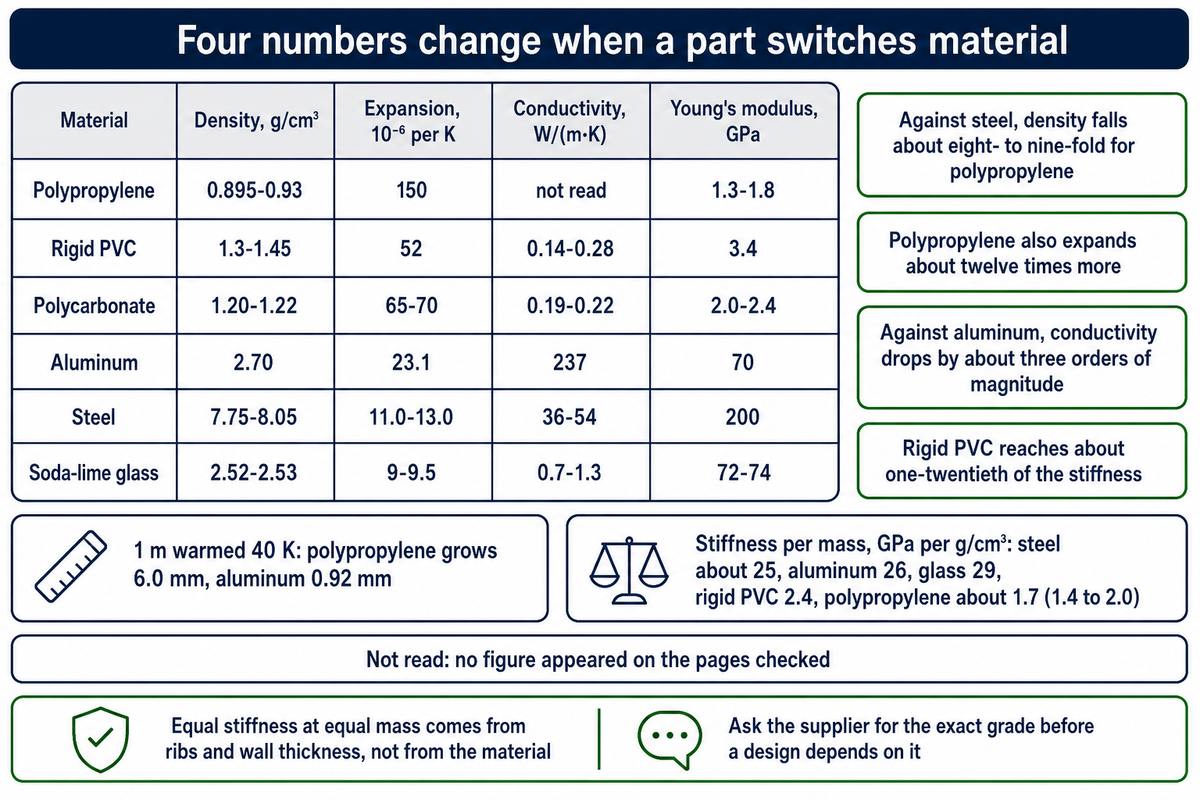
Moving a part made of steel or aluminum to plastic changes four numbers with large factors that depend on the resin. Against steel, density falls about eight- to nine-fold for polypropylene, which also expands about twelve times more. Against aluminum, conductivity drops by about three orders of magnitude and rigid PVC reaches about one-twentieth of the stiffness.
| Material | Density, g/cm³ | Expansion, 10⁻⁶ per K | Conductivity, W/(m·K) | Young’s modulus, GPa | Limitations |
|---|---|---|---|---|---|
| Polypropylene | 0.895–0.93 | 150 | not read | 1.3–1.8 | Fillers and copolymer grade shift every column |
| Rigid PVC | 1.3–1.45 | 52 | 0.14–0.28 | 3.4 | Flexible PVC is a different material with 1.1–1.35 g/cm³ |
| Polycarbonate | 1.20–1.22 | 65–70 | 0.19–0.22 | 2.0–2.4 | Neat resin; glass-filled grades stiffen and expand less |
| Aluminum | 2.70 | 23.1 | 237 | 70 | Pure metal; alloys shift the figures, conductivity most |
| Steel | 7.75–8.05 | 11.0–13.0 | 36–54 | 200 | Conductivity is for carbon steel and modulus for A36; stainless grades differ |
| Soda-lime glass | 2.52–2.53 | 9–9.5 | 0.7–1.3 | 72–74 | Expansion is quoted for about 100 to 300 °C |
Basis: Wikipedia property tables for polypropylene, PVC, polycarbonate, aluminum, steel and soda-lime glass, with expansion from the thermal expansion table, steel conductivity from the list of thermal conductivities and steel modulus from the Young’s modulus table. “Not read” means no figure appeared on the pages checked.
Most columns are either ranges or single source values because none of these are grades. Steel is a family whose density runs from 7.75 to 8.05 g/cm³, and the plastics move with fillers, so treat the table as the size of the gap and ask the supplier for the exact grade before a design depends on it. The four gaps are large enough that a part can’t be redrawn in plastic by simply copying the metal geometry. Glass vs plastic comparisons and any claim that plastic is stronger than steel need a named basis, and on stiffness per unit mass the plastics in the table sit at one-tenth of steel or less.
Two of the gaps combine into fit and stiffness. Warm a 1 m polypropylene part by 40 K and it grows 6.0 mm, while an aluminum mate grows 0.92 mm (23.1 × 10⁻⁶ × 1 m × 40 K), which leaves 5.1 mm of differential movement, more than ten times the 0.4 to 0.5 mm that an aluminum part and a steel mate would show over the same length and temperature rise. Dividing modulus by density yields a measure of stiffness per unit mass: about 25 for steel, 26 for aluminum and 29 for soda-lime glass, against 2.4 for rigid PVC and about 1.7 for polypropylene (1.4 to 2.0 spans the table range), in GPa per g/cm³.
Corrosion is one common reason to consider a switch, and plastic does not rust. It ages by the routes in the sections above instead. So a swap driven by corrosion trades one failure list for another. Automotive parts such as a bumper or an engine part, and aerospace brackets, have to re-establish clearances, stiffness and heat paths through geometry and grade when they move from sheet-metal fabrication to molded plastic, so review these gaps early. Approval can then depend on mating-part tolerances and requalification, which is why the gaps belong in the first review, not the last.
Rigid PVC delivers about 2.4 GPa of stiffness per g/cm³ of density where aluminum delivers about 26, a factor of roughly ten. So equal stiffness at equal mass has to come from ribs and wall thickness, not from the material.
Biodegradable, Compostable and Recyclable: Claims About Plastic, Not Properties of It
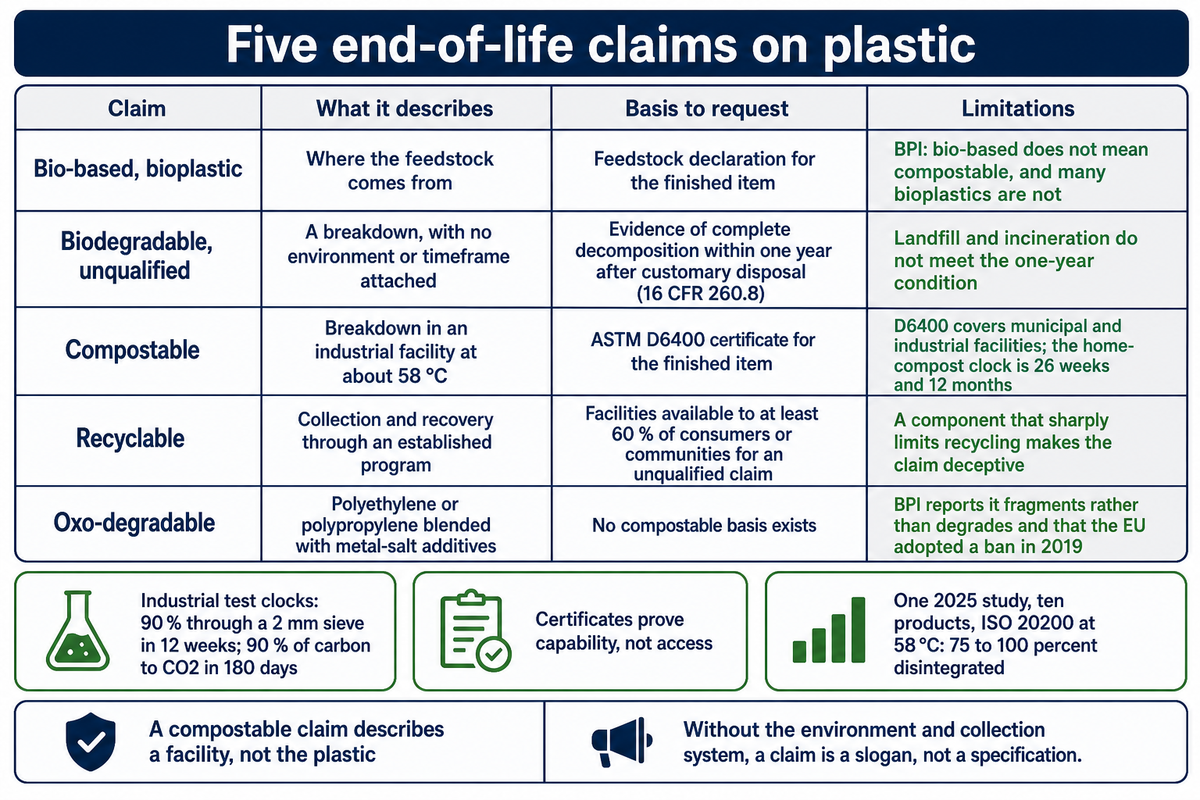
Biodegradable, compostable and recyclable describe what happens to a plastic in a stated environment and collection system, not what the plastic is. Each of these must be specified along with an environment and a place of disposal, in order to provide sufficient information for a regulator or a test to evaluate the claim.
“It is deceptive to make an unqualified degradable claim for items entering the solid waste stream if the items do not completely decompose within one year after customary disposal.”
That sentence contains the one fixed value in the Green Guides pertaining to degradable claims and is subject to a restriction: landfills, incinerators, and recycling facilities don’t allow for complete decomposition to occur in one year. According to the eCFR as current as of September 17, 2026, Part 260 still cites the October 2012 version, and the FTC solicited comments on revisions in December 2022. The Guides pertain to deception and the Biodegradable Products Institute (BPI) states that they don’t require third-party verification, thus the documented basis has to come from the entity that makes the claim.
| Claim | What it describes | Basis to request | Limitations |
|---|---|---|---|
| Bio-based, bioplastic | Where the feedstock comes from | Feedstock declaration for the finished item | BPI: bio-based does not mean compostable, and many bioplastics are not |
| Biodegradable, unqualified | A breakdown, with no environment or timeframe attached | Evidence of complete decomposition within one year after customary disposal (16 CFR 260.8) | Landfill and incineration do not meet the one-year condition |
| Compostable | Breakdown in an industrial facility at about 58 °C | ASTM D6400 certificate for the finished item; 90 % through a 2 mm sieve in 12 weeks, 90 % of carbon to CO2 in 180 days | D6400 covers municipal and industrial facilities; the home-compost clock is 26 weeks and 12 months |
| Recyclable | Collection and recovery through an established program | Facilities available to at least 60 % of consumers or communities for an unqualified claim (16 CFR 260.12) | A component that sharply limits recycling makes the claim deceptive |
| Oxo-degradable | Polyethylene or polypropylene blended with metal-salt additives | No compostable basis exists; the Green Guides list it among degradable claims | BPI reports it fragments rather than degrades and that the EU adopted a ban in 2019 |
Basis: 16 CFR Part 260; BPI, a certifier with a commercial interest; a Michigan State University packaging guide by its author; ASTM D6400-26, current since 15 June 2026. Test clocks are as described in the two guides; the standards themselves are behind a paywall.
Plastic waste is the context in which these words appear on packs, and the vocabulary is easy to misread. Biodegradability and recyclability are outcomes of a system, not fixed traits of a resin. And a plastic made from renewable feedstock can be entirely conventional in its disposal behavior, as BPI puts it.
Composting claims are not about the material in isolation; they incorporate the material and the environment, according to the author of the Michigan State University guide. Polylactic acid hydrolyzes meaningfully only above roughly 58 °C, so it can pass industrial composting and still fail in a home pile or the sea. Home compost runs at ambient 20 to 30 °C, with 90 percent disintegration within 26 weeks and 90 percent biodegradation within 12 months under the EN 17427 route, which is not an ASTM D6400 test. Certificates also prove capability, not access: the same guide notes that most consumers in the United States cannot reach a facility that accepts compostable packaging, and 16 CFR 260.7 asks for a qualification when facilities are unavailable to a substantial majority of the places where the item is sold.
Real products show the spread. One 2025 study in Scientific Reports ran ten commercial biodegradable products through ISO 20200 at 58 °C, 55 percent moisture and 90 days, and disintegration ranged from 75 to 100 percent, with five products complete. One plate holding EN 13432 certification reached 75 percent in that laboratory test, and one product labeled 100 percent biodegradable never stated the environment in which it would biodegrade. Synthetic polymer and cellulose products alike need the claim tested in the environment named on the pack, and recycling claims need the collection system, so an environmental impact statement without those is a slogan and not a specification.
Industrial composting tests run at about 58 °C, with 90 percent of a sample passing a 2 mm sieve within 12 weeks and 90 percent of its carbon converted to CO2 within 180 days, so a compostable claim describes a facility, not the plastic.
Failure Modes Traced to a Property Nobody Checked
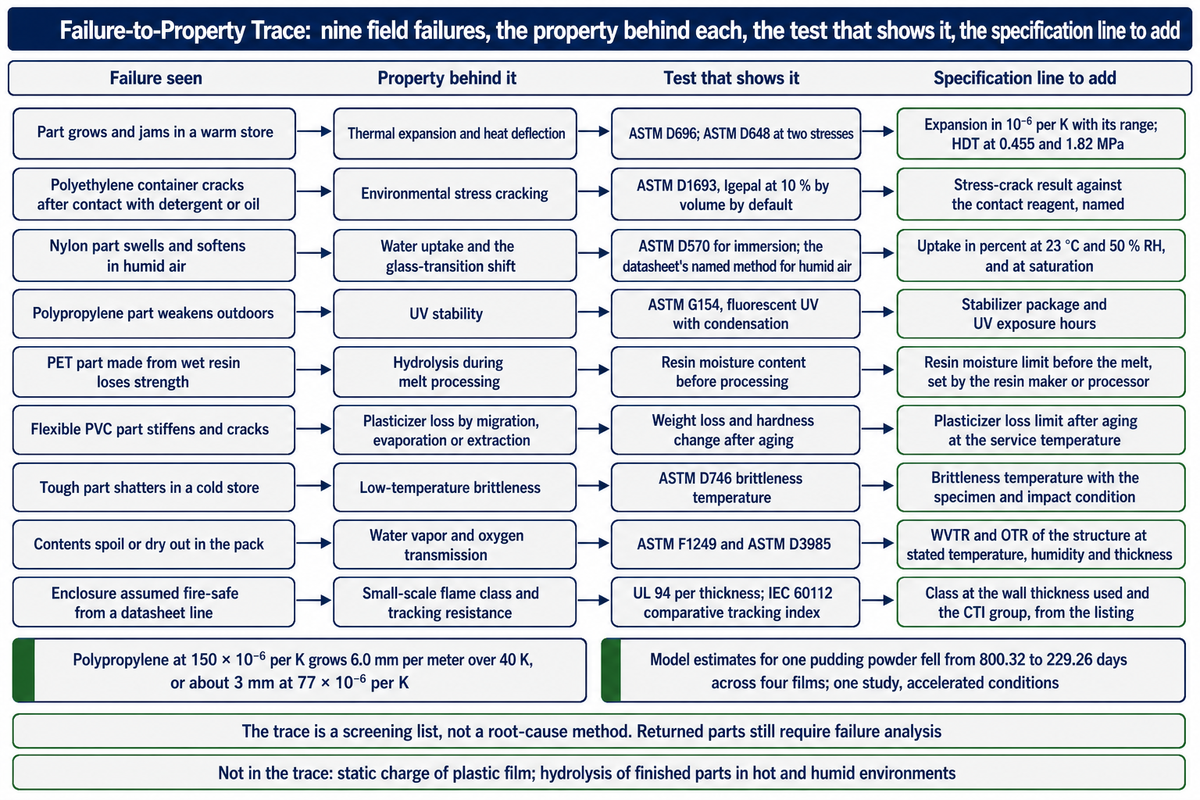
Many field failures in plastic parts trace to one property that the acceptance test never measured: heat and expansion, water, sunlight, a reagent, cold or a barrier that was assumed. The trace below matches nine failures to the property and test that would have shown it, and to the text that should be added to the specification.
The Failure-to-Property Trace
The Failure-to-Property Trace pairs each field failure with the property behind it and the test that would have shown it.
| Failure seen | Property behind it | Test that shows it | Specification line to add | Limitations |
|---|---|---|---|---|
| Part grows and jams in a warm store | Thermal expansion and heat deflection | ASTM D696; ASTM D648 at two stresses | Expansion in 10⁻⁶ per K with its range; HDT at 0.455 and 1.82 MPa | Polypropylene at 150 × 10⁻⁶ per K grows 6.0 mm per meter over 40 K, or about 3 mm at 77 × 10⁻⁶ per K; D648 data are not for design |
| Polyethylene container cracks after contact with detergent or oil | Environmental stress cracking | ASTM D1693, Igepal at 10 % by volume by default | Stress-crack result against the contact reagent, named | A ranking test, not a design allowable; amorphous resins are more susceptible |
| Nylon part swells and softens in humid air | Water uptake and the glass-transition shift | ASTM D570 for immersion; the datasheet’s named method for humid air | Uptake in percent at 23 °C and 50 % RH, and at saturation | Nylon 6 takes up 2.5–3 % at 50 % RH and about 9 % saturated; glass transition falls from about 60 to about -20 °C |
| Polypropylene part weakens outdoors | UV stability | ASTM G154, fluorescent UV with condensation | Stabilizer package and UV exposure hours | Unstabilized polypropylene can lose up to 70 % of tensile strength in days of intense UV, on one study’s claim; a laboratory proxy is not years of weather |
| PET part made from wet resin loses strength | Hydrolysis during melt processing | Resin moisture content before processing | Resin moisture limit before the melt, set by the resin maker or processor | One lab study measured 0.25 % in virgin and 0.49 % in recycled resin as received; it cites 0.02 % as a literature target with the basis unstated, and its drying time is not a plant specification |
| Flexible PVC part stiffens and cracks | Plasticizer loss by migration, evaporation or extraction | Weight loss and hardness change after aging | Plasticizer loss limit after aging at the service temperature | About 90 % of plasticizers go into flexible PVC; the source gives the direction, not a hardness number |
| Tough part shatters in a cold store | Low-temperature brittleness | ASTM D746 brittleness temperature | Brittleness temperature with the specimen and impact condition | The temperature at which 50 % of specimens fail; not the lowest suitable service temperature |
| Contents spoil or dry out in the pack | Water vapor and oxygen transmission | ASTM F1249 and ASTM D3985 | WVTR and OTR of the structure at stated temperature, humidity and thickness | Model estimates for one pudding powder fell from 800.32 to 229.26 days across four films; one study, accelerated conditions |
| Enclosure assumed fire-safe from a datasheet line | Small-scale flame class and tracking resistance | UL 94 per thickness; IEC 60112 comparative tracking index | Class at the wall thickness used and the CTI group, from the listing | UL 94 does not evaluate flame spread, smoke or heat release |
Basis: ASTM D1693-21, ASTM D746 (edition 07 page read; current edition not checked), Discover Polymers 2025, npj Materials Degradation 2019 and Foods 2025, plus sources cited in sections above. The pudding-powder shelf lives are model estimates, not measured storage.
The trace is a screening list, not a root-cause method. Returned parts still require failure analysis and the table only indicates the missing line to start with. Two failure modes are missing as no sources read for this manual provide a checkable figure: static charge of plastic film and hydrolysis of finished parts due to exposure in hot and humid environments. A buyer of PET strapping can use row five directly as resin moisture before extrusion isn’t something a finished product datasheet would likely provide and would therefore have to be requested.
One study estimated the shelf life of a cocoa-based pudding powder from film WVTR and found 800.32 days in PET, aluminum foil and LDPE against 229.26 days in metallized BOPP, a 3.5-fold spread in modeled shelf life for one product under accelerated storage, driven by film WVTR.
The Property Request Line: What to Print Beside Every Datasheet Number
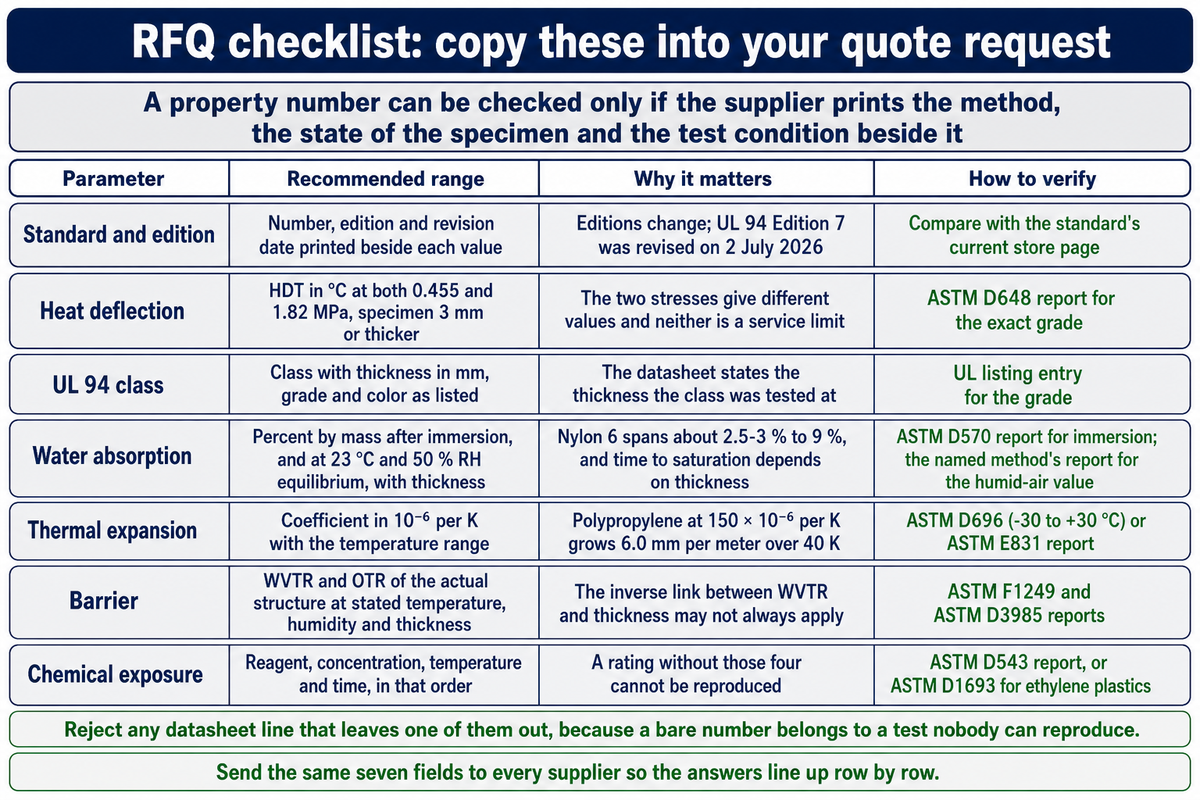
A property number can be checked only if the supplier prints the method, the state of the specimen and the test condition beside it. Copy the fields below into a request for quotation and reject any datasheet line that leaves one of them out, because a bare number belongs to a test nobody can reproduce.
RFQ checklist — copy these into your quote request:
| Parameter | Recommended range | Why it matters | How to verify |
|---|---|---|---|
| Standard and edition | Number, edition and revision date printed beside each value | Editions change; UL 94 Edition 7 was revised on 2 July 2026 | Compare with the standard’s current store page |
| Heat deflection | HDT in °C at both 0.455 and 1.82 MPa, specimen 3 mm or thicker | The two stresses give different values and neither is a service limit | ASTM D648 report for the exact grade |
| UL 94 class | Class with thickness in mm, grade and color as listed | The datasheet states the thickness the class was tested at | UL listing entry for the grade |
| Water absorption | Percent by mass after immersion, and at 23 °C and 50 % RH equilibrium, with thickness | Nylon 6 spans about 2.5–3 % to 9 %, and time to saturation depends on thickness | ASTM D570 report for immersion; the named method’s report for the humid-air value |
| Thermal expansion | Coefficient in 10⁻⁶ per K with the temperature range | Polypropylene at 150 × 10⁻⁶ per K grows 6.0 mm per meter over 40 K | ASTM D696 (−30 to +30 °C) or ASTM E831 report |
| Barrier | WVTR and OTR of the actual structure at stated temperature, humidity and thickness | The inverse link between WVTR and thickness may not always apply | ASTM F1249 and ASTM D3985 reports |
| Chemical exposure | Reagent, concentration, temperature and time, in that order | A rating without those four cannot be reproduced | ASTM D543 report, or ASTM D1693 for ethylene plastics |
Send the same seven fields to every supplier so the answers line up row by row. The 8-point test data comparability checker then scores whether the returned numbers can be compared at all.
Frequently Asked Questions
What are the 7 properties of materials with examples?
One common split has seven groups: physical, mechanical, thermal, electrical, chemical, optical and barrier, with separate named tests standing behind the reported values of these groups in a datasheet.
One common split has seven groups: physical (density under ASTM D792), mechanical (flexural modulus under ASTM D790), thermal (heat deflection under ASTM D648), electrical (volume resistivity under ASTM D257), chemical (stress cracking under ASTM D1693), optical (haze under ASTM D1003) and barrier (WVTR under ASTM F1249). Any list of seven is a grouping choice, not a standard count, and this guide sorts datasheet numbers into eight families instead, adding flammability and folding chemical resistance and stress cracking into environmental exposure.
What are the 5 properties of plastic?
Density, heat resistance, stiffness, electrical insulation and chemical resistance are five properties a buyer commonly checks first, and a value means little until its test standard and conditions are printed beside it.
Density, heat resistance, stiffness, electrical insulation and chemical resistance are five properties a buyer commonly checks first. Polypropylene sits at about 0.90 to 0.91 g/cm³, polycarbonate reads about 140 °C at 0.46 MPa and 125 to 130 °C at 1.8 MPa on heat deflection, and insulating plastics run about 10¹² to 10¹⁶ ohm-cm in volume resistivity. Each figure belongs to a named test, so print the standard beside the number.
What does UL 94 V-0 mean on a plastic datasheet?
In a small-scale vertical-burn test carried out on specimens of a stated thickness, V-0 is the strictest of the V-0, V-1 and V-2 classes listed in UL 94.
V-0 is the strictest of the V-0, V-1 and V-2 classes in UL 94: five specimens each get two 10 s flame applications, each may burn no more than 10 s after each application, the ten applications total no more than 50 s, and no dripping particle ignites the cotton indicator below. It is a small-scale test on specimens of a stated thickness, so it does not approve a finished product.
Does a higher melting point mean better heat resistance?
No, a melting point marks where a crystalline plastic turns liquid, and a loaded part deflects far below it, so the two temperatures answer different questions and are read separately.
No, a melting point marks where a crystalline plastic turns liquid, and a loaded part deflects far below it: nylon 6 melts near 220 °C and PET near 250 °C, yet they read about 55 to 60 °C and 65 to 80 °C at 1.8 MPa, depending on grade and source.
What is the difference between HDT and Vicat softening temperature?
HDT reports where a loaded bar deflects, and Vicat reports where a needle penetrates, so the two values answer different questions and stay separate in a datasheet.
Under ASTM D648, HDT is the temperature at which a bar loaded to 0.455 or 1.82 MPa deflects 0.25 mm, while Vicat softening (ASTM D1525) is the temperature at which a specified needle penetration occurs under a set load. The two tests ask different questions, so a value from one does not convert into the other.
Is biodegradable plastic the same as compostable plastic?
No, biodegradable names a process that must be tied to a standard, a timeframe and an environment, while compostable names a tested result in a defined facility.
No, biodegradable names a process that must be tied to a standard, a timeframe and an environment, while compostable names a tested result in a defined facility. According to BPI and a Michigan State University packaging guide, a plastic certified to ASTM D6400 for industrial composting shows about 90 percent disintegration through a 2 mm sieve within about 12 weeks and about 90 percent carbon conversion to CO2 within about 180 days, at roughly 58 °C. Home composting runs at 20 to 30 °C on longer clocks, and most industrially compostable materials, PLA among them, fail the home test. The FTC Green Guides treat an unqualified degradable claim as deceptive unless the item decomposes within one year after customary disposal, so the basis for a printed claim has to be documented before the claim is made.
Do all plastics absorb water?
Not equally, because uptake, measured on a specimen of stated thickness and conditioning, ranges from very little in polypropylene and polyethylene to about 9 percent in saturated nylon 6.
Not equally, and the amount varies widely. Polypropylene and polyethylene are hydrophobic enough to be good water vapor barriers, while nylon 6 gains about 2.5 to 3 percent of its mass at 23 °C and 50 percent relative humidity and about 9 percent when saturated. ASTM D570 measures the gain on immersion, and time to saturation depends strongly on specimen thickness, so a result needs its thickness and conditioning state printed beside it.
About This Property Guide
This guide is organized by exposure (heat, electricity and fire, chemicals and weather, light and barrier, end of life) because a datasheet number is read against the condition the part will meet. Tensile testing, mechanical data comparison and resin classification live on the two pages linked in the mechanical and thermal sections, so they are covered here only in outline. UD Packaging supplies PET strapping and stretch film; the standards’ scope statements come from the ASTM, UL, ISO and IEC pages, and the numbers come from university, agency, trade and encyclopedia tables and single studies, some reproducing supplier datasheets, so treat them as typical grade values and confirm them against the supplier’s datasheet for the exact grade.
Request a plastic material review →
References & Sources
- ASTM D1693-21, environmental stress-cracking of ethylene plastics, ASTM International
- ASTM D1003-21, haze and luminous transmittance of transparent plastics, ASTM International
- ASTM F1249-25, water vapor transmission rate through plastic film, ASTM International
- ASTM E831-25, linear thermal expansion of solid materials by thermomechanical analysis, ASTM International
- ASTM D257-14(2021)e1, DC resistance or conductance of insulating materials, ASTM International
- ASTM D149-25, dielectric breakdown voltage and dielectric strength of solid electrical insulating materials, ASTM International
- ASTM D648-18, deflection temperature of plastics under flexural load, ASTM International
- ISO 180:2023 preview, plastics, determination of Izod impact strength, International Organization for Standardization, preview hosted by iTeh
- ASTM D792-20, density and specific gravity of plastics by displacement, ASTM International
- Microbial and enzymatic degradation of synthetic plastics, Table 1, Frontiers in Microbiology, 2020
- Polypropylene, Wikipedia
- Recent progress of biodegradable polymer package materials, Table 2, Nanomaterials, 2024
- Polymers: Experiment 5, University of Illinois, Department of Materials Science and Engineering
- Polyvinyl chloride, Wikipedia
- Polytetrafluoroethylene, Wikipedia
- Sambale, Stanko, Emde and Stommel, water uptake and dimensional change of polyamide 6, Polymers, 2021, via NIH PMC
- Heat deflection temperature versus dynamic mechanical analysis, Part 1, Plastics Technology, 2019
- Deflection temperature reference, MatWeb
- PLA blends overview, Table 1, thermomechanical properties of engineering polymers, Polymers, 2024, via NIH PMC
- Relative thermal index (UL 746B) definition, UL Prospector
- Thermal aging tests for plastics, UL Solutions
- Thermal expansion, Wikipedia
- Thermal expansion and contraction of plastic piping, bulletin UB-20, Plastic Pipe and Fittings Association
- ANSI/UL 94, tests for flammability of plastic materials, Edition 7, UL Standards and Engagement
- Understanding UL 94 rating certifications and limitations, UL Code Authorities
- Combustion and fire tests for plastics, UL Solutions
- UL94 standard operating procedures, University of Texas Fire Research Group
- Volume resistivity of plastics, SpecialChem
- Fundamentals of ESD, Part 1, an introduction to ESD, ESD Association
- Comparative tracking index (CTI), IEC 60112, UL Solutions
- ASTM D543-21, resistance of plastics to chemical reagents, ASTM International
- Plasticiser loss from plastic or rubber products through diffusion and evaporation, npj Materials Degradation, 2019
- Janse, environmental stress cracking in plastic failure analysis, ASM Advanced Materials and Processes, 2004, hosted by the Madison Group
- Polypropylene ultraviolet degradation study, Scientific Reports, 2025, via NIH PMC
- Polypropylene geotextile ultraviolet ageing, Materials, 2021, via NIH PMC
- ASTM G154-23, operating fluorescent ultraviolet lamp apparatus for exposure of nonmetallic materials, ASTM International
- PLA barrier properties review, Table 1, Polymers, 2022, via NIH PMC
- Turksever and Koc, sustainable alternatives in multilayer packaging: storage stability of pudding powder, Foods, 2025, via NIH PMC
- Vapor transmission rates in barrier flexible packaging, Packaging World, 2024
- Polycarbonate, Wikipedia
- Aluminium, Wikipedia
- Steel, Wikipedia
- Soda-lime glass, Wikipedia
- List of thermal conductivities, Wikipedia
- Young’s modulus, Wikipedia
- 16 CFR Part 260, Guides for the Use of Environmental Marketing Claims, US Federal Trade Commission, via eCFR
- Green Guides, US Federal Trade Commission
- Setting the record straight: what certified compostable really means, Biodegradable Products Institute
- Compostable packaging: a US packaging producer’s guide to the new rules and the science beneath them, Michigan State University, author’s views
- ASTM D6400-26, labeling of plastics designed to be aerobically composted in municipal or industrial facilities, ASTM International
- Disintegration of commercial biodegradable plastic products under simulated industrial composting conditions, Scientific Reports, 2025, via NIH PMC
- ASTM D746, brittleness temperature of plastics and elastomers by impact, ASTM International
- Beyond processing methods: the impact of the drying technique on PET performance, Discover Polymers, 2025