

By XCX · Updated September 2026
machine direction vs transverse direction plastic film refers to two perpendicular axes, not two grades. MD follows the web through production and winding; TD, also called cross direction (CD), runs across the web. Film structure and processing may orient polymer chains unevenly, so tensile strength, modulus, elongation, tear and shrinkage can differ by axis.
Short answer
Mark MD and TD before cutting a specimen, then read every property as a direction-specific pair. Never call one direction “stronger” until the property, method, thickness, conditioning, sampling position, replicate spread and failure path are visible.
MD — along the webProduction travel, unwind or longitudinal direction. An MD specimen has its long test axis aligned with that path.
TD — across the webDirection at 90° to MD, from one web edge toward the other. CD is a common synonym, but confirm each report’s convention.
Machine Direction vs Transverse Direction: the 30-second definition
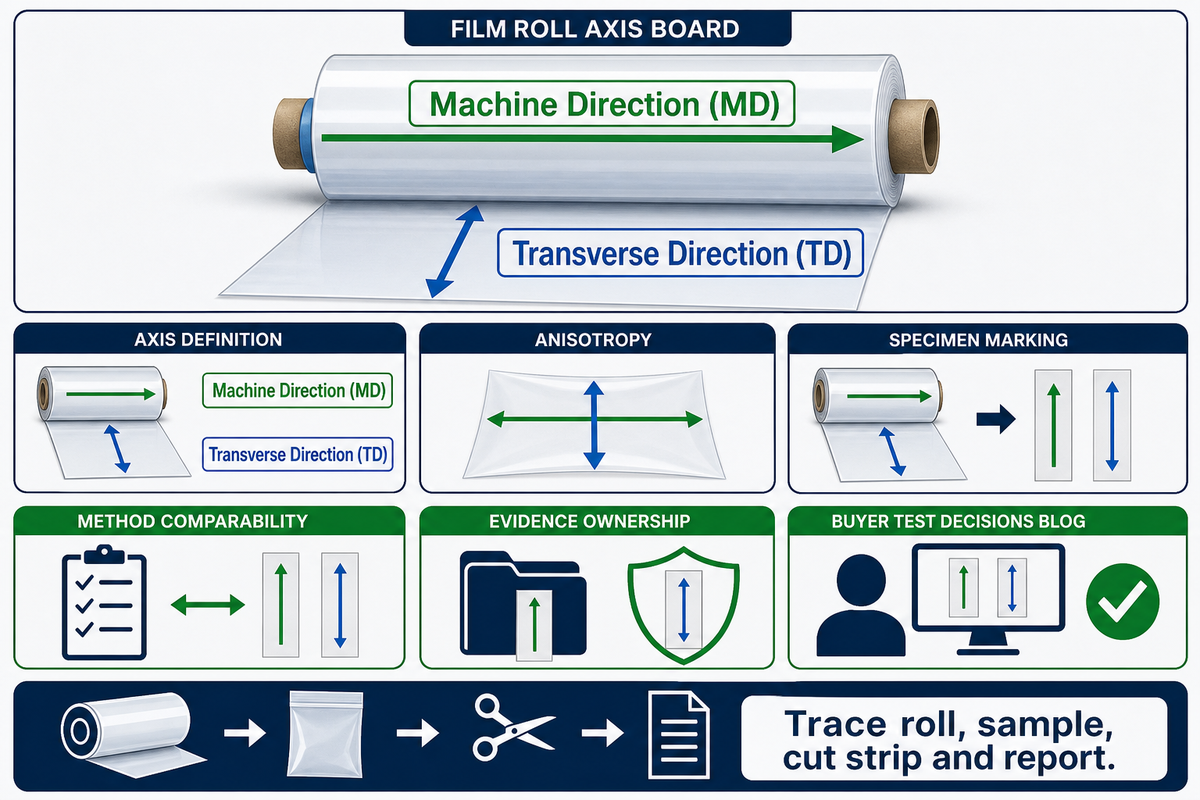
Imagine a roll of film as it exits an unwinder. The path represented by that film as it leaves the unwinder is the machine direction (MD) of that film. TD is a line drawn straight across the roll width, and both axis marks should stay attached to the roll, sample, cut strip and report through one traceable label system.
1. Trace
Find the production or unwind path.
Find the production or unwind path.
2. Mark
Draw MD and TD arrows before separation.
Draw MD and TD arrows before separation.
3. Carry
Copy the axis onto every specimen ID.
Copy the axis onto every specimen ID.
4. Report
Keep direction beside every value.
Keep direction beside every value.
When a film sample is separated from its roll, it may not reveal its original MD or TD reliably. To determine TD, curl, tear feel and visual appearance cannot replace the film’s roll-path provenance. In those cases, the film industry should record the direction as unknown instead of assigning a guessed direction. A reviewer shouldn’t speculate about film directionality and should instead request a traceable replacement. The plastic-film testing framework should be used when direction is only one part of a larger film test plan.
Why plastic film behaves differently in MD and TD
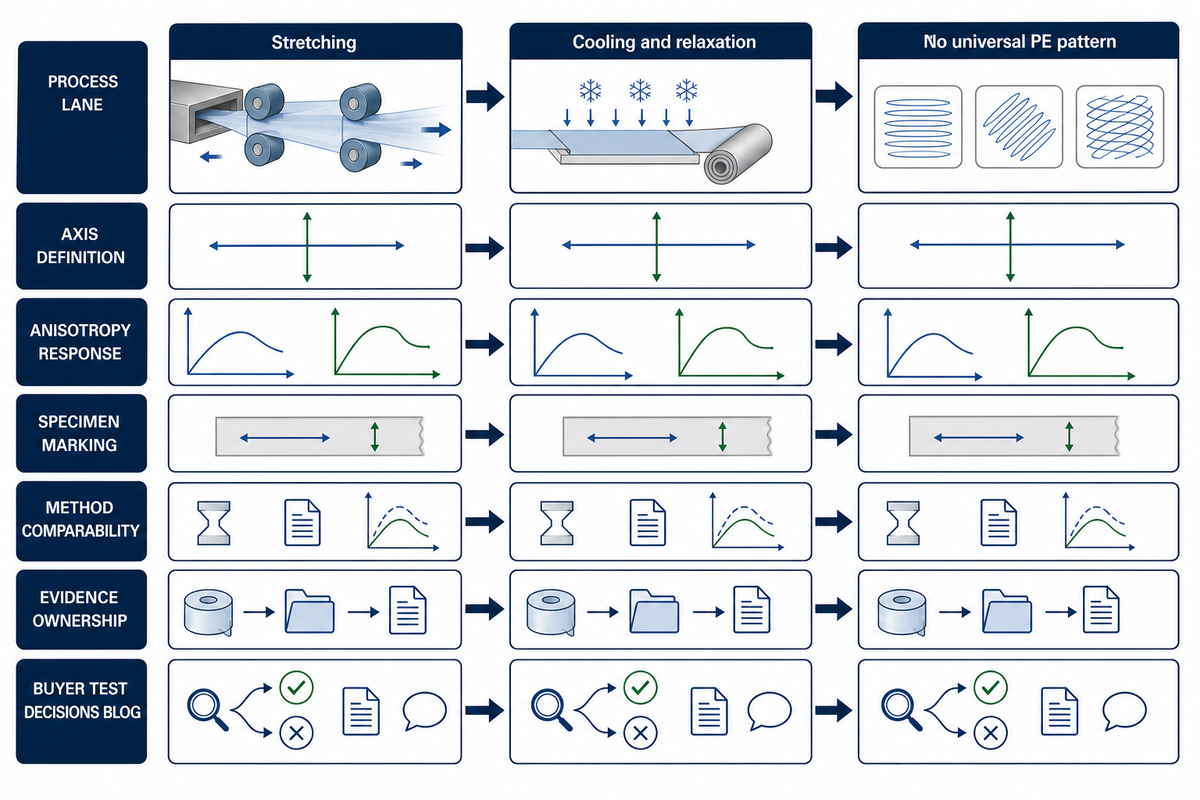
There are many variables that can affect the anisotropic nature of a film; for example, cooling, relaxation and drawing in different directions. Processing film in a particular way may leave it with properties that differ based on which principal direction is considered.
During extrusion, the orientation process depends on how the film is stretched, cooled and relaxed. That interaction can link machine direction orientation to crystallinity in some polymer films, but it doesn’t establish a universal pattern for PE films, multilayer structures, MDO film, shrink films or other biaxial orientation routes. Reported variability must stay tied to the tested material, including thickness (for example, the cited LLDPE study includes a 30 μm film) and to the property measured in the plane of the film.
Useful prior, not a prediction
Peer-reviewed blown-film research reports systematic differences among selected HDPE, LDPE and LLDPE tear patterns. Resin family, branching and morphology can therefore guide questions, but they can’t predict an exact commercial film result without product- and process-specific measurements.
This distinction protects against two possibilities. First, it’s tempting to think that every polyethylene film has the same MD/TD pattern. Second, it’s tempting to ignore material information in polyethylene films and assume that the MD and TD represent a random axis system. In general, expectations should use resin and construction as a prior, then let the stated test and specimen evidence decide.
| Field | Question to ask | Risk if missing |
|---|---|---|
| Resin | Which polymer family, grade or blend? | A qualitative prior is mistaken for a product value |
| Structure | Mono-layer, coextruded, laminated or reinforced? | Different load paths are compared as one material |
| Gauge | What measured thickness belongs to the specimen? | Thickness-driven differences are assigned to direction |
| Process | Blown, cast, mono-oriented or biaxially oriented? | Orientation history is hidden |
| Sampling | Which roll, length station and cross-web position? | Unlike populations receive the same label |
| Method | Which standard, edition and setup? | Method effects become product claims |
| Conditioning | What temperature, humidity and duration applied? | State differences remain invisible |
| Failure mode | Did it break, yield, slip, split or tear obliquely? | Unlike events are averaged together |
Use a Direction-to-Property Matrix instead of a stronger-weaker label
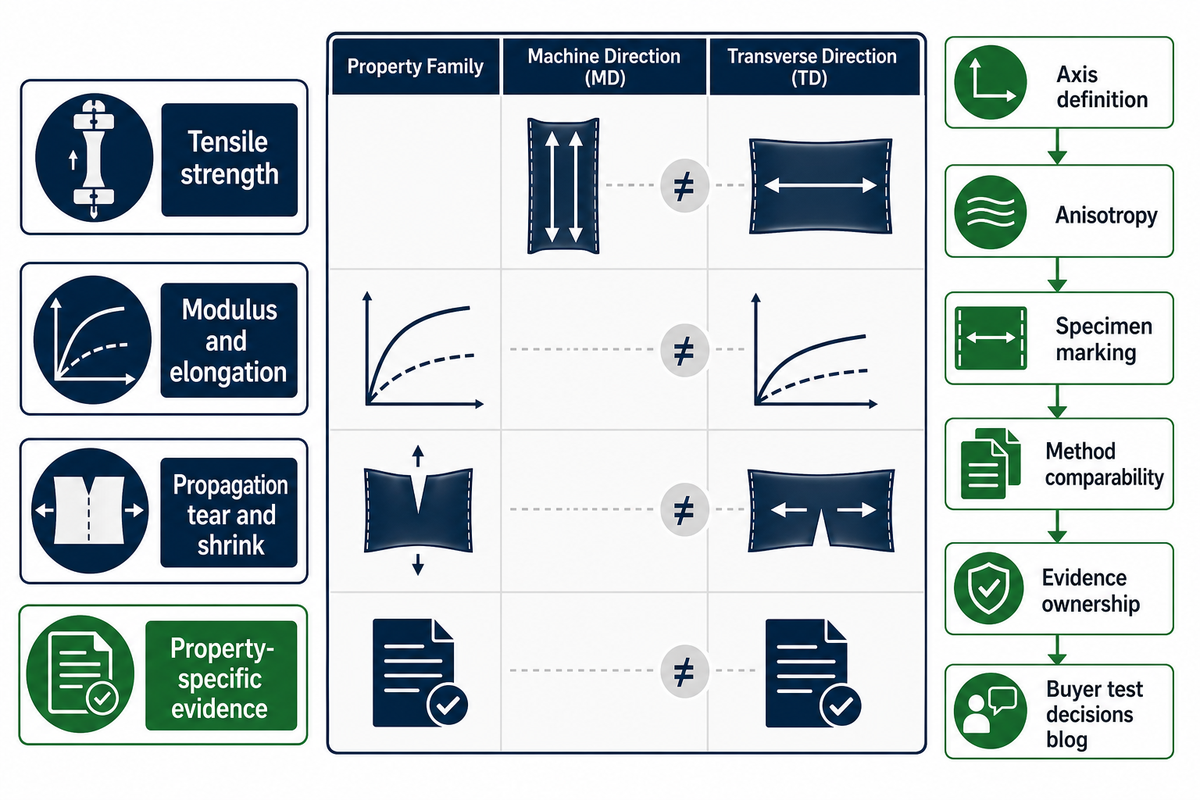
“In what direction is greater?” is incomplete because strength depends on the property being compared. Shrinkage and modulus are measures of different film responses in a given direction and don’t necessarily reflect the same mode of behavior. Mechanical properties are response measures, not one interchangeable mode of failure; tensile strength, elongation and tear resistance may rank differently by axis.
| Material/property type | What it can answer | What it cannot prove | Next evidence |
|---|---|---|---|
| MD/TD tensile strength | Directional peak stress under the named tensile setup | Tear, puncture or pallet stability | Method, specimen and raw trace |
| MD/TD modulus | Directional stiffness within the defined calculation region | Strength at break or permanent-set behavior | Strain-measurement route and calculation basis |
| MD/TD elongation | Directional extension under the named test | Toughness or usable stretch in a packaging machine | Break validity and gauge basis |
| MD/TD propagation tear | Resistance to growth of an initiated tear under that method | Tensile strength or puncture resistance | Applicability, thickness, spread and tear path |
| MD/TD shrink | Directional dimensional response at stated conditions | Ambient dimensional stability under every use | Temperature, time and restraint condition |
| MD/TD puncture-related result | Only what the named specimen and loading geometry measure | A universal directional puncture ranking | Fixture, probe, speed and failure observation |
| Coefficient or ratio | A compact view of one paired property | Whether either value meets the use requirement | Both original values and acceptance context |
| Single-axis result | That axis under the stated setup | The untested axis | Justification or second-direction test |
| “Balanced film” claim | A supplier’s intended positioning | Equality across all properties and conditions | Actual paired data |
Study-specific counterexample
In one peer-reviewed LLDPE study, blown-film sample 2045G reported propagation tear of 127 mN/µm in MD and 411 mN/µm in TD; sample 9085 reported 41 and 219 mN/µm. These figures aren’t purchasing limits. They show why a tensile-based “stronger direction” label can’t be transferred automatically to tear behavior.
How to identify MD and TD on a film roll and cut specimens
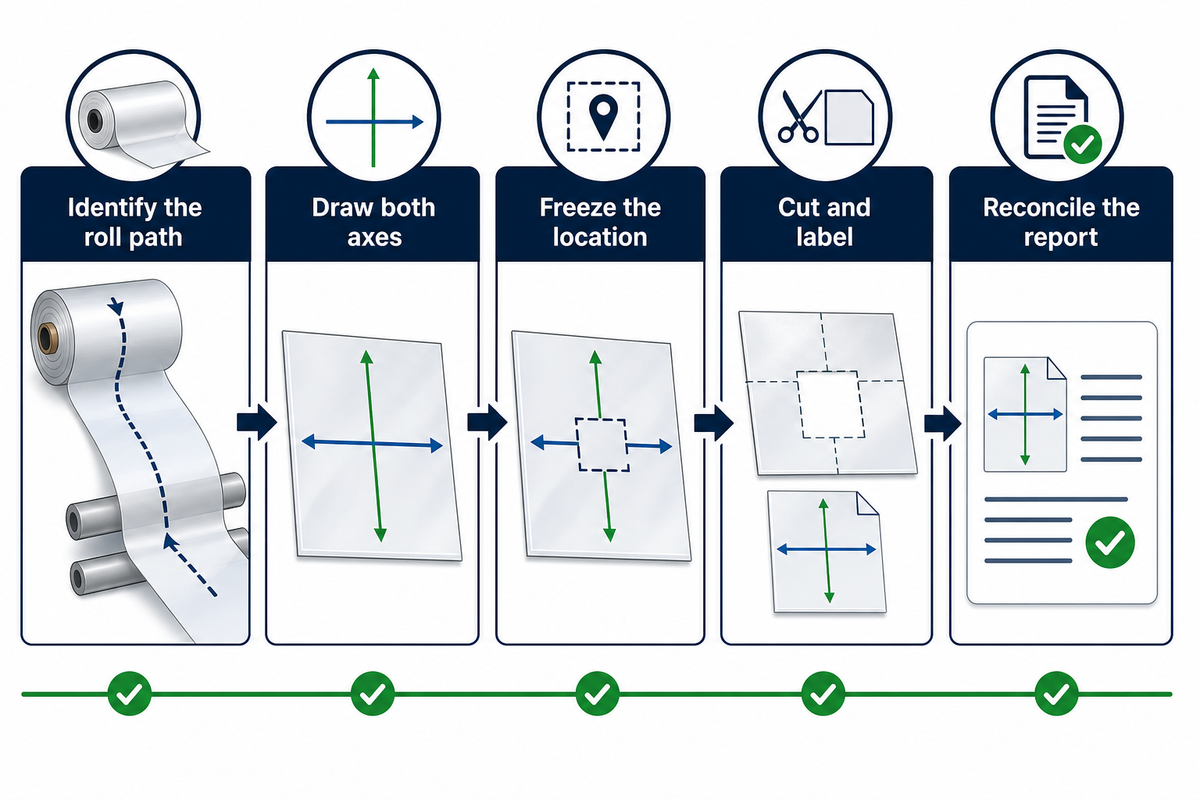
Control of direction is critical throughout the entire process and particularly at the beginning when the web is still in roll form. Determine the path of the web, illustrate arrows for direction on a retained roll, and assign a unique identifier to the illustration. Carry the identifier onto each strip to preserve its marked direction. For the cross-direction, provide traceability metadata that records the strip position as left, center, right or a measured coordinate.
- Identify the roll path. Use the production, converting or unwind record, not tear feel.
- Draw both axes. Put an MD arrow along the path and a TD arrow at 90°.
- Freeze the location. Record roll ID, length station and cross-web position before cutting.
- Cut and label. State which specimen axis is aligned with MD or TD and preserve a sketch.
- Reconcile the report. Confirm that every result row points back to the specimen ID and orientation.
Stop condition
If a detached sample has no trustworthy roll-path record, don’t relabel it from appearance. Treat orientation as unknown, retain that uncertainty and obtain a traceable replacement for direction-specific comparison.
Read MD/TD test reports without making false comparisons
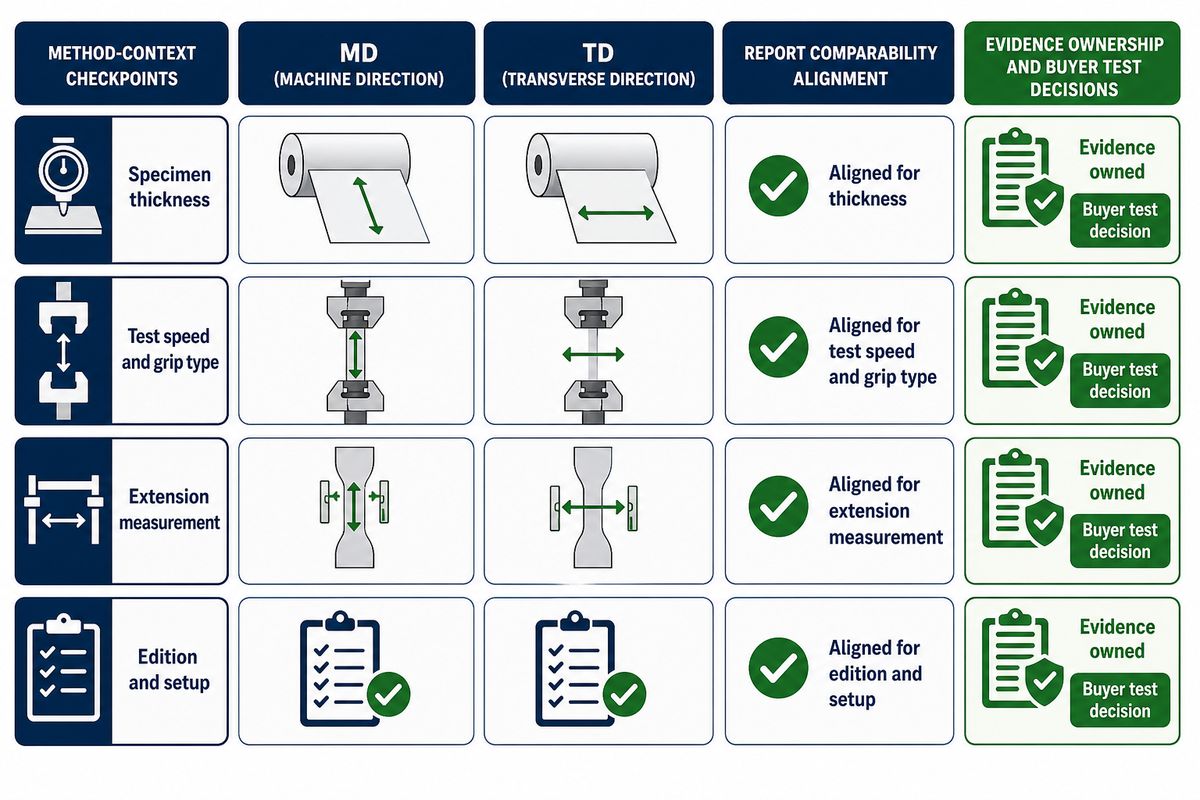
Two columns labelled MD and TD are not automatically comparable across suppliers or laboratories. ASTM’s public D882-26 significance text states that tensile properties can vary with specimen thickness, specimen preparation, test speed, grip type and extension measurement. ISO 527-3:2018 covers films and sheets below 1 mm within the ISO 527 framework; naming either standard without an edition and setup leaves important context unresolved.
Aligned
Material population, direction, thickness, method, conditions, property definition, units and data-quality fields match.
Conditional
A difference is visible and its influence can be evaluated or bounded for the stated decision.
Unusable
A critical field is missing, so the apparent directional difference has no traceable basis.
Tear reports need an extra applicability check. ASTM D1922-23 states that reproducibility may be uncertain, warns that highly extensible or highly oriented materials may lead to variable or misleading values, and states that the relationship between tear strength and film thickness may not be linear. The same public page states reproducibility may be within ±5% of the mean for some films, but potentially no better than ±50% for others. When creating an RFQ, do not state the tear-report percentages as product specification values. Instead, use them to request replicate data and confirm method suitability.
Oblique tear is evidence, not noise
If the tear path turns away from the nominal axis, record it. ASTM D1922-23 explicitly addresses oblique directional tearing. A report that hides the path can make two nominally identical MD or TD results look more comparable than they are.
| Public source | Bounded numeric cue | Safe use |
|---|---|---|
| ASTM D882-26 | Public scope below 1.0 mm; nominal film note at or below 0.25 mm | Scope screen only |
| ISO 527-3:2018 | Film and sheet below 1 mm | Scope screen only |
| ASTM D1922-23 | Nominal film at or below 0.25 mm; tear rate 7.6–46 m/min; public reproducibility caution from about ±5% to ±50% | Applicability and uncertainty warning |
| LLDPE tear study | Film thicknesses of 30 μm, 28 μm and 28 μm; MD retention example 77% versus 47% | Study-specific contrast only |
| 2025 MDO/PCR study | 5% and 30% PCR study formulations; about 410 MPa MD and 450 MPa TD at 30% PCR; reprocessed-film modulus about 77% of the study’s virgin reference | Research context, not a buying limit |
The numbers represented in this document are designated to specific methods and/or systems. They assist a reviewer in assessing order of magnitude, relevance and uncertainty; they aren’t to be interpreted as a lower or upper specification limit. Preserve the context in which a number is cited when it’s referred to in a Request for Quote (RFQ) or during an internal review.
Use the 5-Lock Direction Report Check
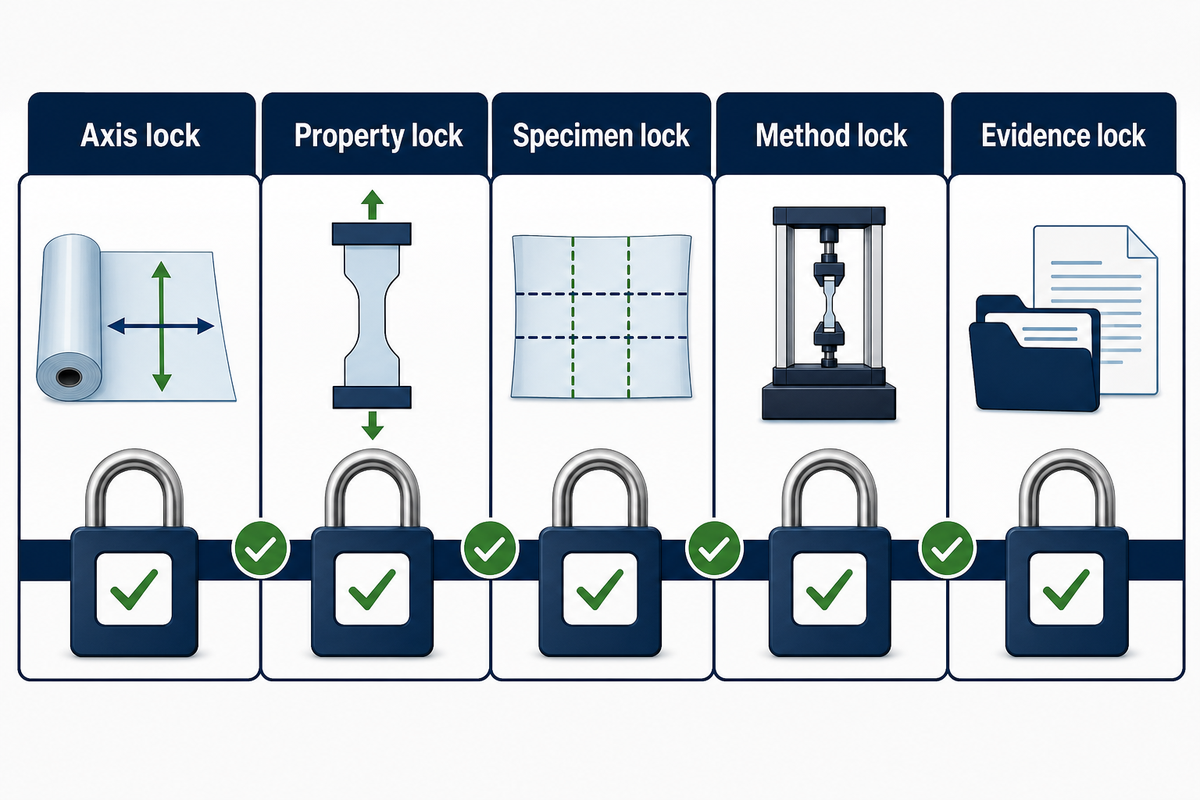
The 5-Lock Direction Report Check is an editorial framework from UD Packaging for evaluating MD/TD tables. It is not a Standard or procedure published by ASTM, ISO, or NIST. It can compare an MD/TD table with a separately defined acceptance limit, but it doesn’t create that limit. It evaluates a two-column table without letting its clean appearance outrun the evidence.
- Axis lock: roll path, MD/TD convention and specimen orientation are traceable.
- Property lock: the result name, calculation basis and units are explicit.
- Specimen lock: material, lot, structure, thickness and condition are identified.
- Method lock: method, edition, setup and applicability are visible.
- Evidence lock: sampling position, specimen count, individual values or spread, exclusions and failure path are retained.
| Outcome | Evidence state | Buyer action |
|---|---|---|
| Complete | All five locks are present and aligned for the intended decision | Apply the governing acceptance rule |
| Conditional | A known difference has a documented bridge or limitation | State the qualification beside the conclusion |
| Blocked | A lock is missing, contradictory or outside method applicability | Request the field, replace the sample or retest |
Build an MD/TD test request worksheet
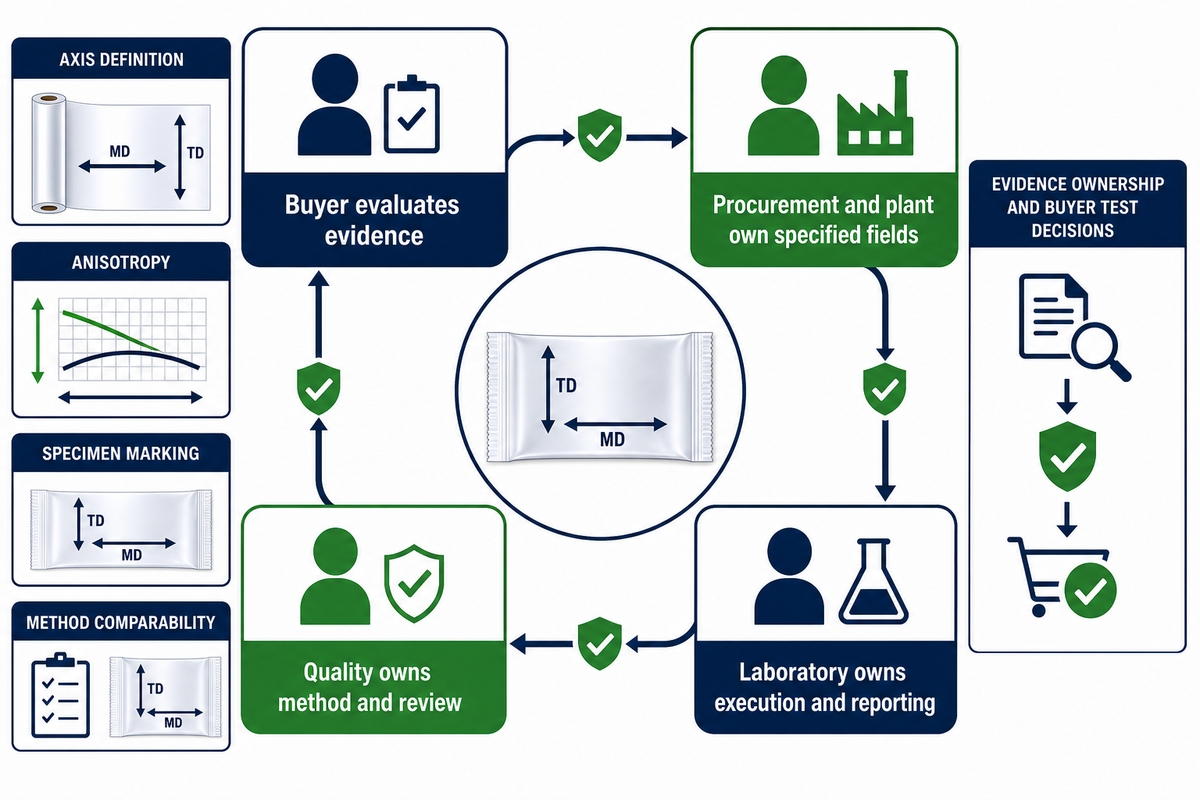
It’s desirable that ownership of evidence be established prior to the physical transfer of a sample. In the context of this document, ownership of evidence means that the prospective buyer evaluates the evidence while procurement, the converter or plant, quality and the laboratory each own specified fields. Evidence may include product, process or test data, while quality owns the method and review and the laboratory owns execution and reporting.
Why role assignment matters
A laboratory can’t repair a missing roll-path record after specimens arrive, procurement can’t infer a valid test method from a price quote, and QA can’t apply an acceptance limit whose evidence basis is unknown. Assigning fields before handoff prevents each team from assuming another team owns the missing context.
| Required field | Example entry format | Owner |
|---|---|---|
| Request and decision | RFQ comparison / incoming check / investigation | Procurement + QA |
| Material identity | Supplier, grade, structure, lot and roll | Procurement |
| Roll-path evidence | MD arrow, TD arrow and retained sketch | Converter / plant |
| Sampling location | Length station plus left/center/right or coordinate | Converter / plant |
| Requested property | Tensile strength, modulus, elongation, tear or shrink | QA |
| Method identity | Standard, edition and permitted deviation | QA + laboratory |
| Method applicability | Material/form within scope; known limitation stated | Laboratory |
| Specimen record | Thickness, geometry, direction, preparation and ID | Laboratory |
| Conditioning | Applicable temperature, humidity and duration | QA + laboratory |
| Data package | Individual values, count, average, spread and exclusions | Laboratory |
| Failure observation | Break, slip, split, oblique tear or other path | Laboratory |
| Acceptance use | Comparison only or named pass/fail rule | QA + decision owner |
Don’t use an educated guess to fill in an unknown; record the field as not supplied and request it. “Not supplied” is useful because it identifies missing data and the next request. A complete worksheet shows the observation made in the lab and separates the person who made the observation from the person who authorized the release of the material for production.
Directional results that should delay approval
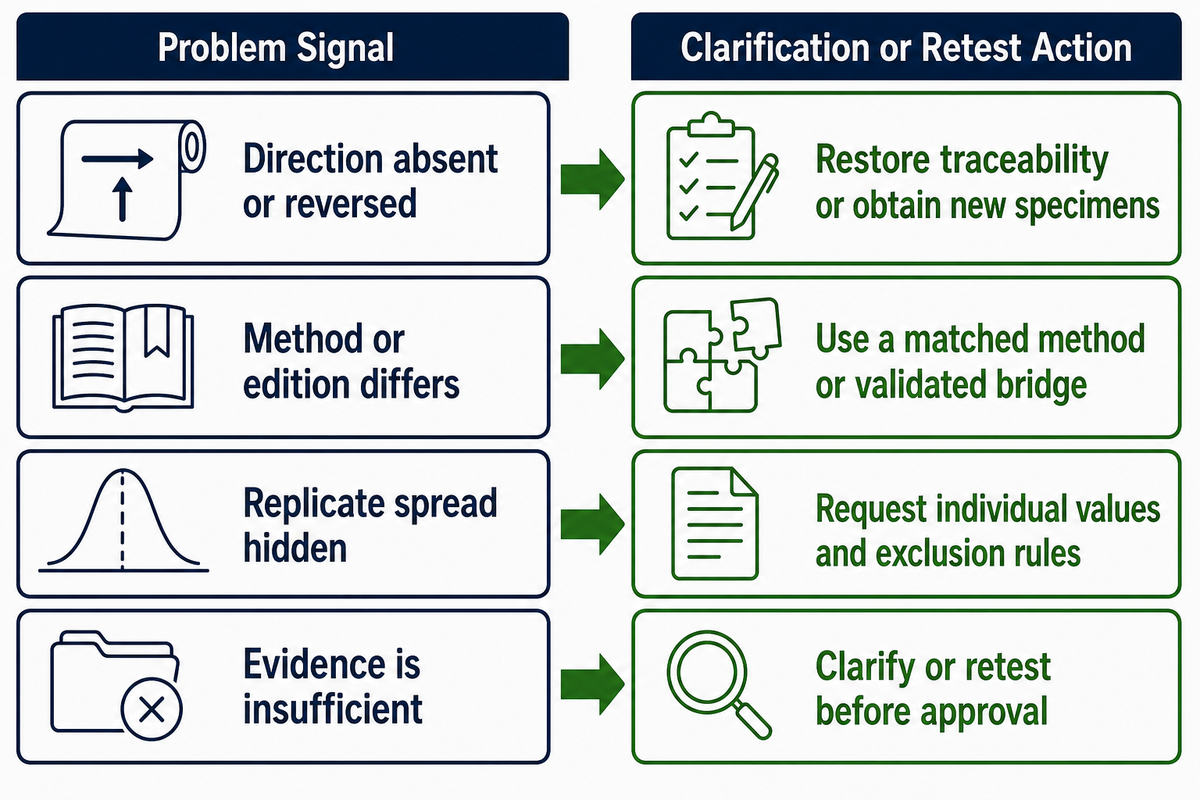
Tentative or delayed results don’t automatically indicate film failure. This indicates that the evidence is insufficient to support a conclusive material decision. A test result reporting a material out of specification must distinguish positive evidence of nonconformance from a report that cannot prove comparability.
| Signal | Why it blocks the evidence | Clarification or retest trigger |
|---|---|---|
| Direction absent or reversed | Values cannot be tied to the web axes | Restore traceability or obtain new specimens |
| Only one axis reported | The untested direction remains unknown | Ask for the omitted axis or documented justification |
| Method or edition differs | Setup effects can masquerade as film effects | Use a matched method or validated bridge |
| Thickness basis differs | Stress or tear interpretation may shift | Compare same-thickness specimens or qualify the limit |
| Replicate spread hidden | An average conceals stability and outliers | Request individual values and exclusion rules |
| Oblique tear ignored | The nominal axis may not describe the failure path | Record path and review method applicability |
| Tensile used as tear proof | The properties answer different questions | Route the concern to the named tear method |
| Sampling position unknown | Material populations cannot be reconciled | Recover the sample map or repeat traceably |
| Acceptance owner absent | A result has no authorized decision path | Name the contract or quality decision owner |
Route the next test question to the right evidence
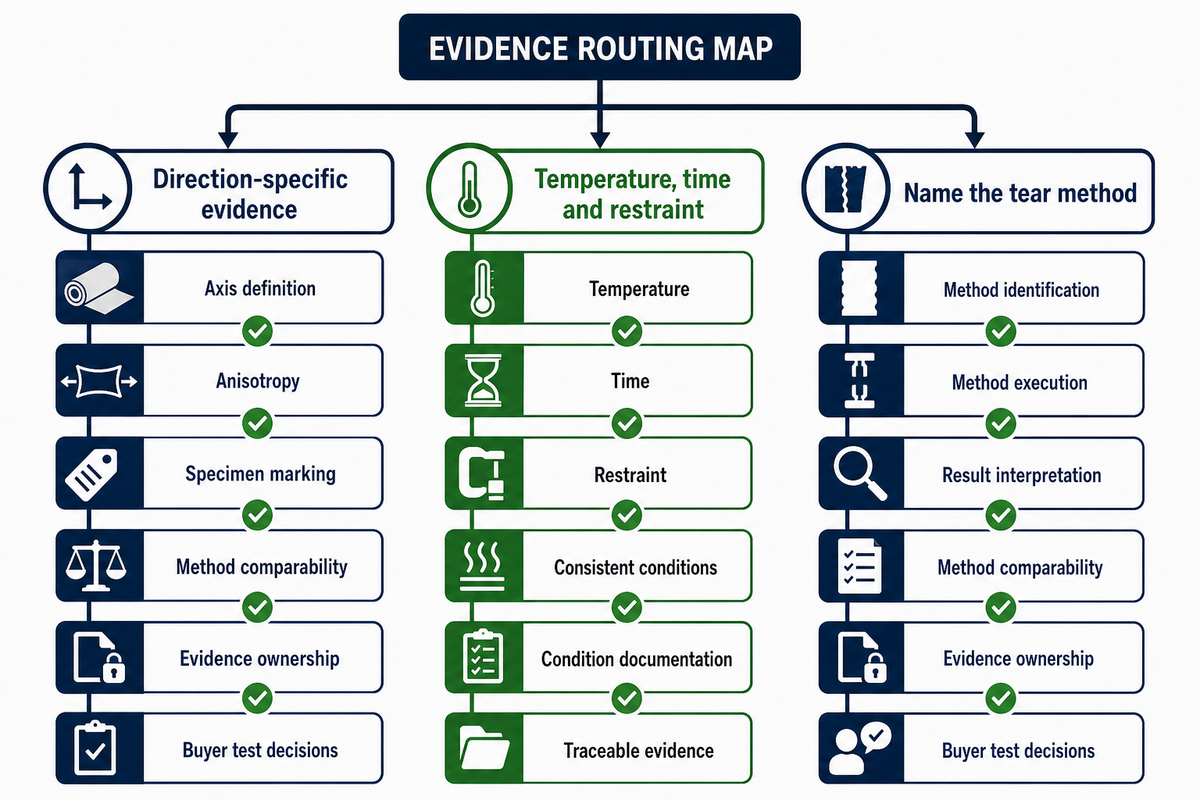
As a general rule, all MD/TD analyses should be performed with the most relevant direction-specific evidence available. If a shrink limit is required, specify its temperature, time and restraint conditions instead of a generic tighter tolerance. Test plans should reflect the customer’s intent and name the tear method, thickness, repeatability and path observations needed for acceptance. Adequate communication between customer and supplier can narrow broad uncertainty without defaulting to a request for full testing.
Portable conclusion
MD and TD are specimen metadata. They tell you where the test axis came from; they do not tell you whether the film is suitable until the property, method, specimen and decision context are locked.
UD Packaging is an integrated industrial packaging supplier offering PET strapping, industrial stretch film, supporting consumables and strapping equipment. For film-related questions, provide the film structure, roll identification, intended use, observed failure concern and any evidence already available. The description of the test/evaluation method and the terms and conditions of the film purchase will govern the acceptance of the film.
Need to turn an MD/TD question into a usable test request?
Review the plastic-film testing path, then share the material, axis marks, property, method and decision you need to support.
Frequently asked questions
What is the difference between MD and TD tensile strength?
MD tensile strength comes from a specimen whose long test axis follows the film’s machine direction. TD tensile strength comes from a specimen aligned across the web. Both use the same property name, but they describe different orientations. Compare them only when material, thickness, conditioning, method, geometry, speed, strain measurement, result definition and units are aligned. If one report omits the specimen direction or uses a different setup, treat the comparison as conditional rather than converting the values or assigning the difference to the film.
What is the transverse direction of a film?
Transverse direction runs across the web at right angles to machine direction. On a roll, MD follows the unwind path while TD runs from one edge toward the other. Mark both before separating the sample, and carry those marks onto every specimen label and report row so the orientation remains traceable after cutting.
Is cross direction the same as transverse direction?
Often yes. Cross direction, CD, and transverse direction, TD, commonly describe the across-web axis perpendicular to MD. Some documents use CMD or another convention, so preserve the issuer’s definitions and resolve ambiguity before cutting specimens or comparing data. Put the chosen convention in the request and report rather than relying on an abbreviation alone.
What does biaxially oriented mean?
Biaxially oriented film has been stretched in two in-plane directions under a defined process, either sequentially or simultaneously. It doesn’t guarantee identical MD and TD properties. Draw ratio, temperature, resin, layer structure and relaxation can still create directional differences, and the term doesn’t identify a test method or acceptance limit. Ask for the actual paired property data, the test conditions and the specimen map. A film can be described correctly as biaxially oriented while still being intentionally unbalanced for a particular converting or packaging function.
Is machine direction always stronger than transverse direction?
No. The ranking changes with the property, structure, processing history and test conditions. State the property before using the word “stronger.”
How do I identify machine direction when a sample is no longer on the roll?
Use a production record, retained sample map or reliable supplier marking that connects the piece to the web path. Don’t infer MD from curl, tear feel or appearance alone. If provenance can’t be restored, label the orientation unknown and obtain a traceable sample for direction-specific testing. Keep the untraceable piece only as an investigation sample, not as approval evidence.
Conclusion
Always keep each film property attached to its axis and its evidence. Mark the film path, preserve specimen locations, compare each property separately, assess method applicability, and retain replicate and failure data. If a field is missing, request that information before turning the comparison into a conclusion. Always consider all the evidence and information before making a determination.
References & sources
- ASTM D882-26 official public scope and significance page
- ISO 527-3:2018 official catalog record
- ASTM D1922-23 official public scope and significance page
- Peer-reviewed LLDPE tear and orientation study
- Peer-reviewed HDPE, LLDPE and LDPE blown-film anisotropy study
- NIST metrological traceability guidance