
Updated November 2026
PBT is a polyester for molded parts that require dimensional stability, electrical insulation and resistance to many common chemicals. It’s a good choice for connectors, appliance parts and keycaps for computer keyboards. But finding a grade of PBT isn’t enough to ensure performance: Glass fibers, fire retardants and other additions alter the mix.
A connector housing can face heat and humidity in service, but the resin has a different moisture problem in the molding machine. This guide breaks down each condition, shows the property table of a real grade, and discusses how density drives the cost.
PBT selection starts with the part
Match the grade to the service environment, then establish the molding process. A melting point, a glass-fiber percentage or a low price per kilogram answers only one part of that decision.
What is PBT plastic?
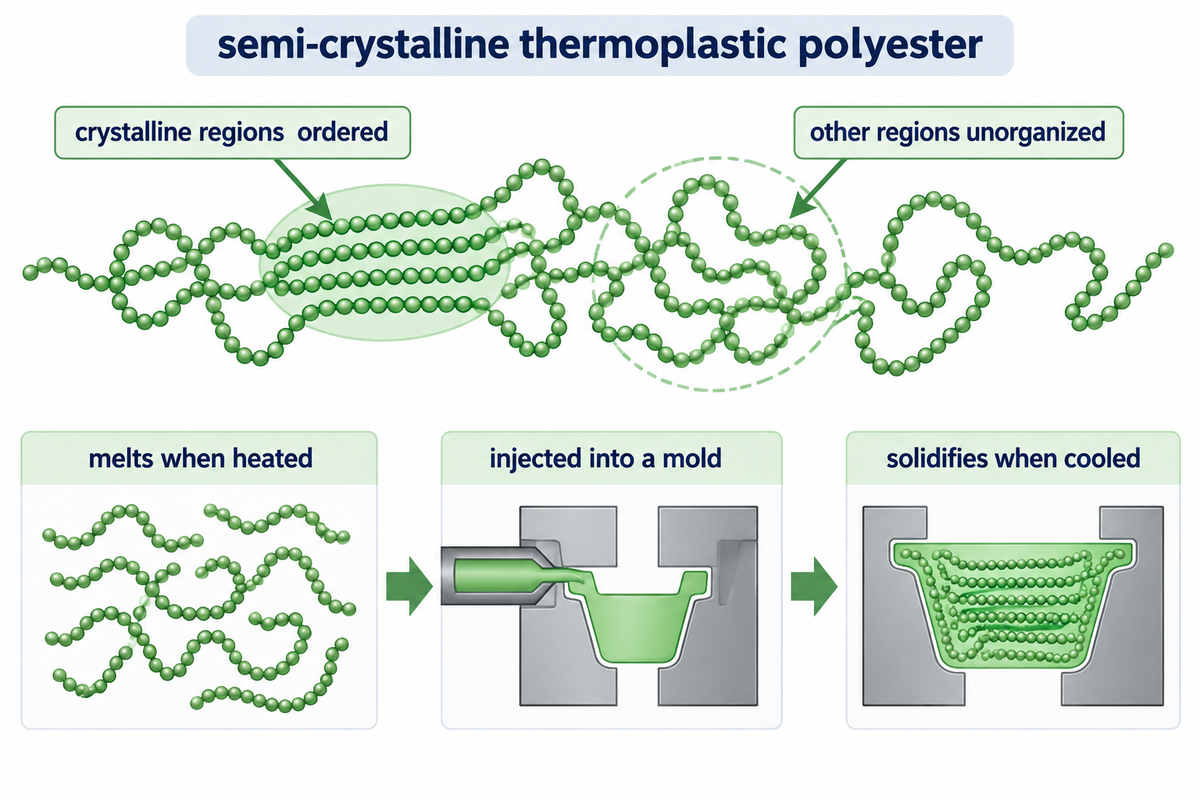
Polybutylene terephthalate (PBT) is a semi-crystalline thermoplastic polyester. A distinct molecular arrangement is present with crystalline regions ordered, and other regions unorganized. It melts when heated and then solidifies when cooled, allowing it to be injected into a mold to create complex engineering parts.
Imagine the crystallinity as an organized section of a larger arrangement of polymer chains. The proportion and organization of those crystalline regions influence stiffness, dimensional stability and heat stability. Cooling conditions then become integral to the finished product’s performance, in conjunction with the resin formulation.
How is PBT made?
PBT is prepared by reacting a terephthalate feedstock with 1,4-butanediol to produce polyester chains. Commercial processes may involve using terephthalic acid or dimethyl terephthalate. Compounding includes the addition of glass fibers, impact modifiers or flame retardants to produce grades suitable for specific molding and service conditions.
PET belongs to the same polyester family but uses ethylene glycol as a building block. Examples of that related polymer are PET bottles and polyester fibers. The family tie doesn’t mean PET and PBT can be swapped in the same mold.
In fact, even the ISO thermoplastic polyester designation standard differentiates the materials by properties, additives and intended processing.
To replace the material, take the current compound designation and part drawing. The general plastic materials guide provides a quick comparison of PBT with the general family of thermoplastics to help eliminate some options.
PBT material properties: what the numbers mean
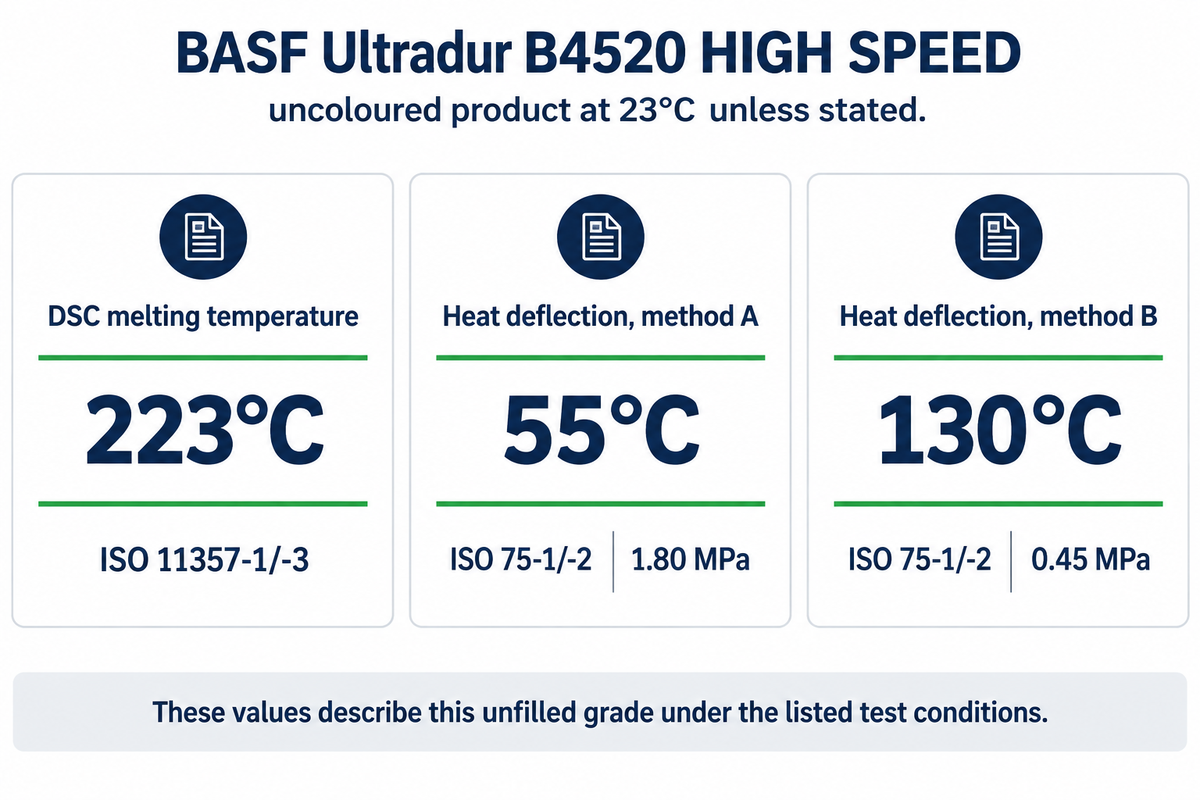
BASF lists a 223°C melting temperature for Ultradur B4520 HIGH SPEED, but its heat-deflection values are 55°C and 130°C under different loads. Those numbers are from different tests. PBT specifications become useful when the grade, specimen conditions and test method stay attached to every value.
| Property | BASF typical value | Test basis | How to use it |
|---|---|---|---|
| Density | 1.30 g/cm³ | ISO 1183 | Convert cavity volume to nominal part mass. |
| Tensile modulus | 2,200 MPa | ISO 527-1/-2 | Screen stiffness before considering geometry. |
| Yield stress | 53 MPa | ISO 527-1/-2; 50 mm/min | Compare yield under the same test conditions. |
| Yield strain | 3.5% | ISO 527-1/-2; 50 mm/min | Check how much deformation occurs at yield. |
| Water absorption | 0.5% | Equilibrium in water at 23°C | Distinguish immersion from ambient humidity. |
| Moisture absorption | 0.25% | Equilibrium at 23°C / 50% relative humidity | Keep conditioning consistent in comparisons. |
| DSC melting temperature | 223°C | ISO 11357-1/-3 | Identify the melting transition. |
| Heat deflection, method A | 55°C | ISO 75-1/-2; 1.80 MPa | Retain the load when quoting the result. |
| Heat deflection, method B | 130°C | ISO 75-1/-2; 0.45 MPa | Use the same load when comparing candidates. |
| Unnotched Charpy impact | 190 kJ/m² | ISO 179/1eU; 23°C | Interpret alongside specimen geometry. |
| Notched Charpy impact | 4 kJ/m² | ISO 179/1eA; 23°C | Investigate stress concentrations in the part. |
Values are published in BASF’s September 2026 B4520 HIGH SPEED product data sheet. These values describe this unfilled grade under the listed test conditions.
The heat-deflection difference comes from the applied stress. ISO 75-2 defines method A at 1.80 MPa and method B at 0.45 MPa. This is because applying a lower load means a higher temperature has to be used in order for the deflection to reach the required extent.
Another switch occurs over long-term heat exposure. The results described in ISO 75-1’s public scope are not meant to estimate the actual end-use performance or endurance. And the glass transition temperature describes another transition once more; it should not be used as an alternative to a loaded-deflection or aging requirement.
Distinguish the melting point from the heat-deflection temperature and how the material behaves after aging. For a constantly loaded housing, compare the retained stiffness or strength after the corresponding aging treatment. For a snap fit, give the notched-impact response and assembly strain more weight than just the unnotched result.
PBT uses in molded parts and everyday products
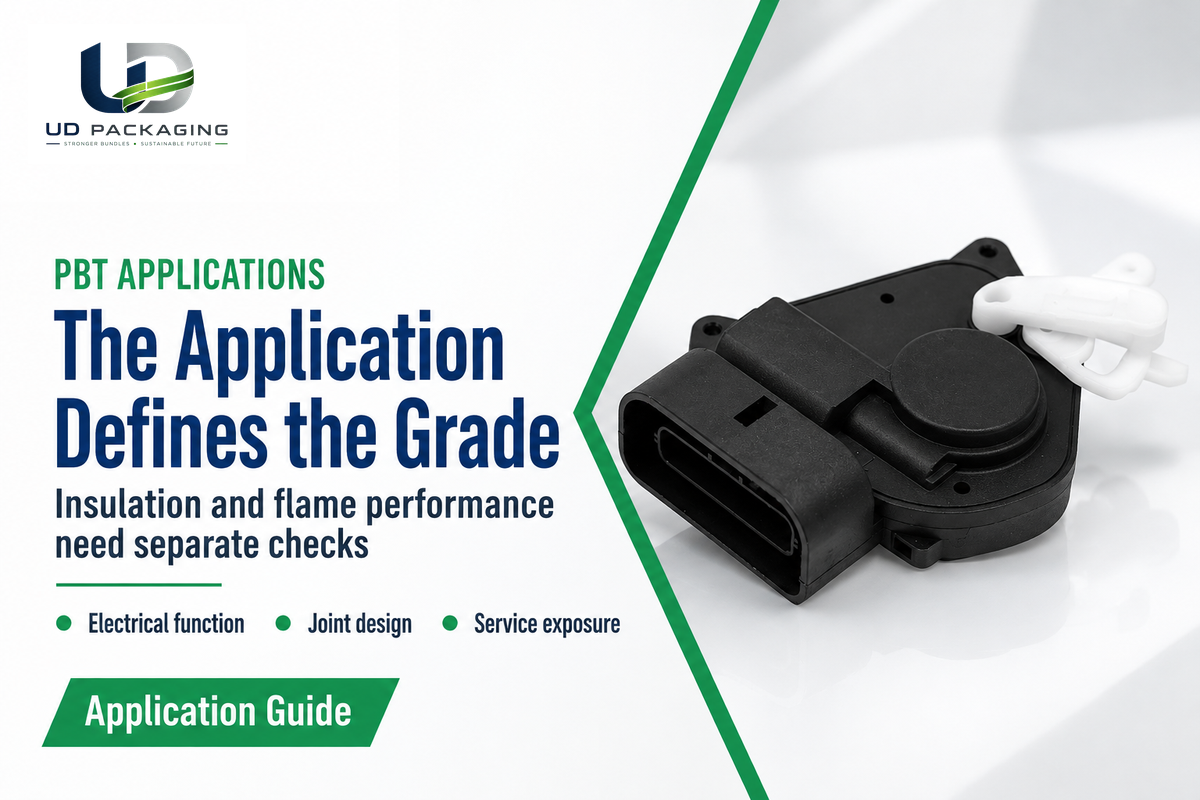
PBT is also used in many electrical connector, electronic housing, automotive and appliance parts as the flow and dimensional stability of PBT lend themselves to detailed shapes. Standard articles of everyday use include some keyboard key caps. Again, each application stresses the compound in a different way; the list of uses is a guide to grade choice.
What is PBT material used for?
PBT is a common choice for electrical contact housings, protective housings, and small molded parts that require dimensional stability over time. Technical injection molding grades are available that are more rigid, and there are also specialty formulations for impact protection, flame-retardancy, or hot-moisture environments. Electrical insulation and flame-retardancy are independent properties, and your grade choice should account for both.
A useful example is the Sogefi automotive actuator described in a 2021 Plastics Technology report. Its two mating housing components used different Pocan PBT formulations: one transmitted the welding laser and the other absorbed it. Heat developed at the joint where the components met. The material choice therefore had to address the joining process as well as dimensional stability and hot, humid service. Buying two parts made from any available black PBT would miss that distinction. For a similar assembly, specify which half transmits the laser, which half absorbs it, and how the completed seam will be evaluated.
A keyboard keycap has different requirements: withstanding repeated loading, fitting the switch stem and providing the desired surface finish. Applying the grade of an under-hood connector in the automotive industry directly into the world of keyboard keys ignores the best-fit conditions that drove the decision.
PBT grades: unfilled, glass-filled and modified
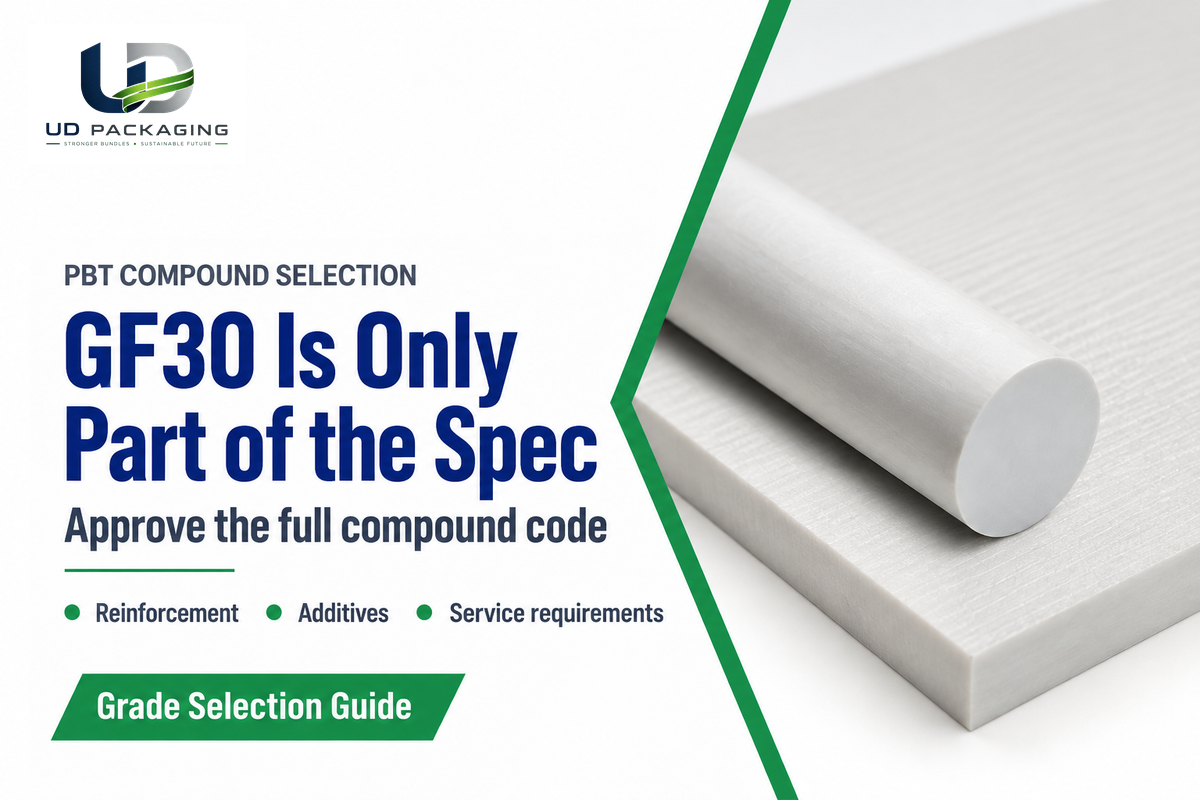
Unfilled PBT and glass filled PBT and modified compounds provide various levels of flow, stiffness, impact performance and resistance to the environment. Glass fibers increase stiffness but also may make orientation and, consequently, properties more critical. Some additive systems improve one property such as flame behavior or resistance to hydrolysis without simultaneously improving all properties.
| Grade description | Typical selection goal | Decisive check |
|---|---|---|
| Unfilled molding grade | General technical parts | Flow, toughness and dimensional requirements |
| High-flow unfilled grade | Thin sections or long flow paths | Fill behavior and the resulting weld-line positions |
| Glass-fiber-reinforced grade | Parts needing greater stiffness | Fiber direction, shrinkage and load direction |
| Hydrolysis-resistant grade | Hot, humid service | Aging conditions and retained part properties |
| Flame-retardant grade | Electrical components with a fire specification | Rating at the intended thickness and formulation |
| Impact-modified grade | Parts exposed to impact or assembly strain | Impact behavior alongside stiffness |
| Laser-transmitting grade | The transmitting half of a laser-welded joint | Transmission at the welding wavelength |
| Laser-absorbing grade | The absorbing half of the same joint | Compatibility with the transmitting component |
| Chemically recycled grade | Parts with a recycled-material requirement | Feedstock route and grade-level performance |
Formulation groups derived from Asahi Kasei PBT overview, BASF grade descriptions, the reported Pocan joining application, Toray recycled-resin overview.
BASF’s B4300 G6 HR combines 30% glass fibers with increased hydrolysis resistance. Its published density is 1.51 g/cm³. Both features matter: reinforcement changes how the part carries load, while the hydrolysis-resistant formulation addresses a particular degradation route. The higher density also changes the mass of a fixed-volume part.
Indicate the entire grade code upon approval of the material change. “GF30” indicates the ratio of glass-fiber and doesn’t specify the rest of the formulation. A high-performance label should also specify a definite service requirement. For purchase by flame performance, note the appropriate thickness and rating for that specific formulation rather than simply accepting a generic flame-retardant label.
PBT disadvantages: hydrolysis, notches and warpage
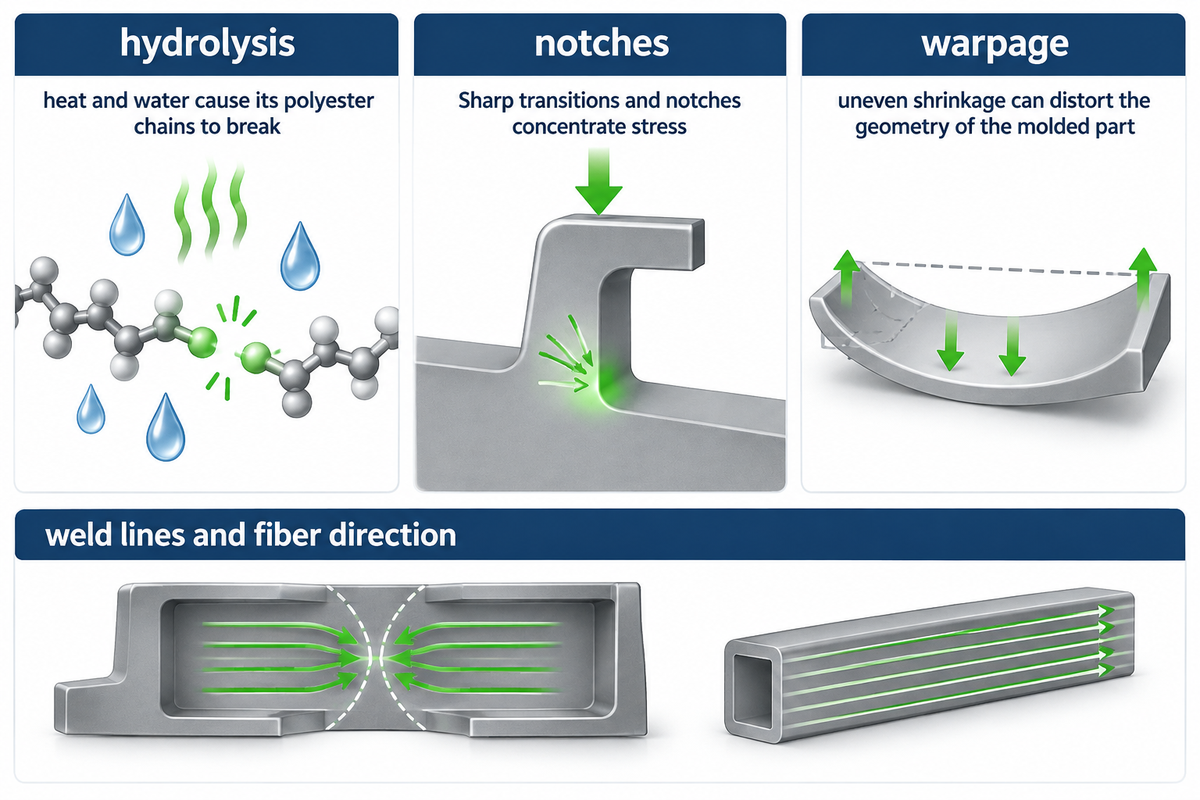
PBT limitations include hydrolysis during the part’s service in hot, humid conditions or during badly done wet processing. Stress concentration points. Molding distortion.
A stiff test bar can perform well while a thin latch or a joint in the actual part fails. Also fiber-reinforced grades require attention to weld lines and fiber direction.
What are the disadvantages of PBT?
PBT’s mechanical performance can be reduced when heat and water cause its polyester chains to break. Sharp transitions and notches concentrate stress, and uneven shrinkage can distort the geometry of the molded part. Glass-filled compounds exhibit a directional response, so strength in the flow direction may not characterize the material across a weld line or another local feature.
Loyer and colleagues’ 2021 hydrolysis study linked embrittlement with chain scission and changes in crystallinity. Water uptake and chemical damage answer different questions. A low absorption figure describes how much water enters under a specified test; it doesn’t cancel the reactions that can occur when temperature and time become severe.
Weld lines introduce another failure route. In Baradi and colleagues’ study of short-glass-fiber PBT, fiber orientation dominated weakness at frontal weld lines even with complete matrix healing and no V-notch. Place a high-load attachment across that region and a neat material ranking becomes a poor guide to the assembled part.
A 2012 Eng-Tips discussion illustrates how process changes can complicate diagnosis. An operator reported brittle PBT clips despite a stated drying routine. Later, the operator reported that lowering the mold temperature from 60°C to 40°C reduced rejects from 9.6% to 0.8%; an additional mold-open delay then appeared to remove the remaining failures. Those were observations from one mold, with no controlled trial or reported sample size. The useful lesson is to record the changes separately. Moisture, cooling, crystallization and removal stress can affect the same symptom.
For a snap-fit replacement, inspect radii, the weld-line location and assembly deflection before ordering a stiffer compound. Increasing a sharp root radius can be part of the solution. The distinction between stiffness and ductility in plastic parts matters when the feature must flex into place.
PBT vs PET and nylon: where each fits
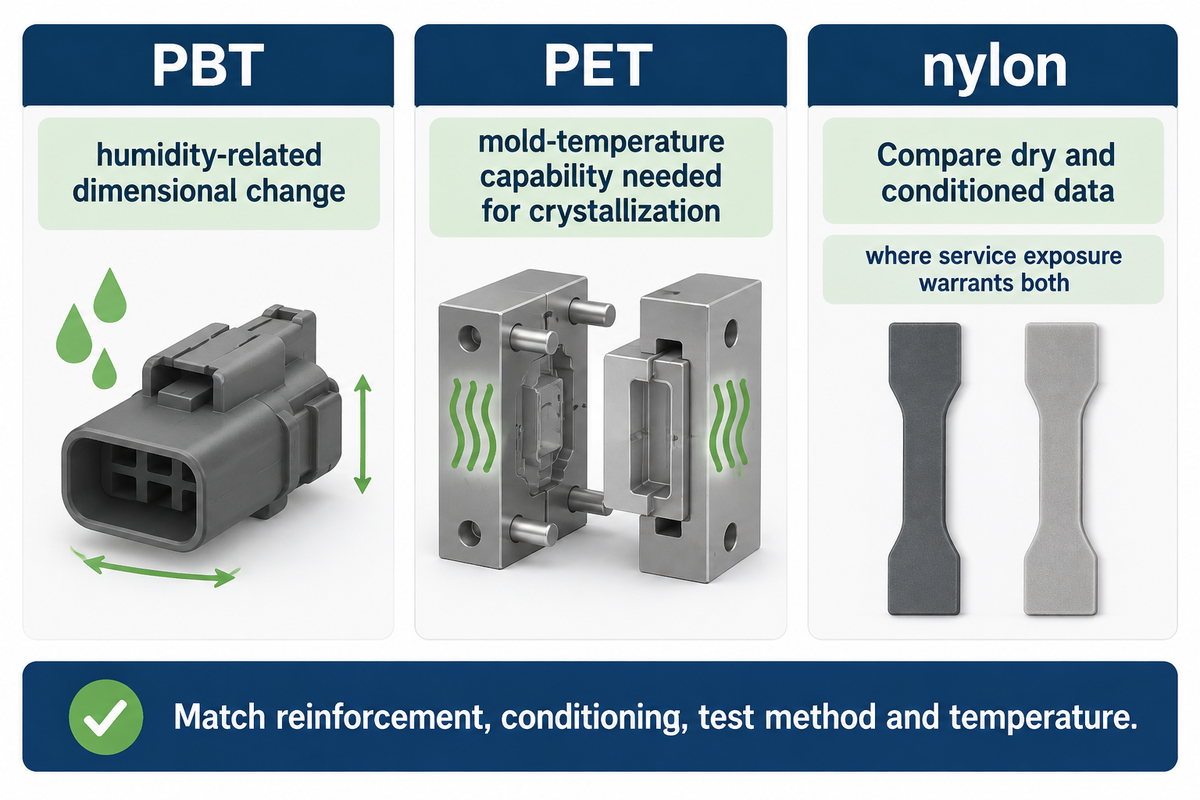
PBT is sometimes rated for dimensional stability and ease of flow, where PET and nylon give their own combinations of mechanical and thermal properties. Use comparable levels of reinforcement and pre-conditioning, then check the manufacturing process.
Crystallization is the key process difference between PBT and PET. Some PET compounds may require tighter mold-temperature control to achieve the desired crystallinity. A resin that seems inexpensive on a purchase sheet can experience a switch of fortunes if the available mold process means the part isn’t crystalline enough.
For nylon material selection, moisture conditioning belongs in the specification. Compare dry and conditioned data where service exposure warrants both. Avoid ranking a dry unfilled nylon specimen against glass-filled PBT, or treating a more flexible conditioned material as automatically defective when the part needs deformation capacity.
For an electrical connector, shortlist PBT when humidity-related dimensional change is a central concern. Asahi Kasei identifies low water absorption as a reason for its dimensional stability. Its material overview also points to reinforced PA66 for demanding strength and heat applications. Treat those as screening directions: compare the exact compounds at the intended humidity and temperature before choosing between them. For PET, include the mold-temperature capability needed for crystallization in that comparison.
Filler shape matters too. A 2026 PA66/PBT study used glass beads in injection-molded, annealed specimens. Its comparison helps explain how fillers and test methods influence elastic properties, but glass beads aren’t short glass fibers. Equal filler percentages don’t create identical local structures.
Before comparing data
Match reinforcement, conditioning, test method and temperature.
Before approving the part
Check load direction, weld lines, dimensions and the intended service exposure.
Where visible transparency drives the design, review an optical material such as polycarbonate as a separate candidate rather than choosing PBT from a mechanical-property comparison.
PBT injection molding: drying before melting
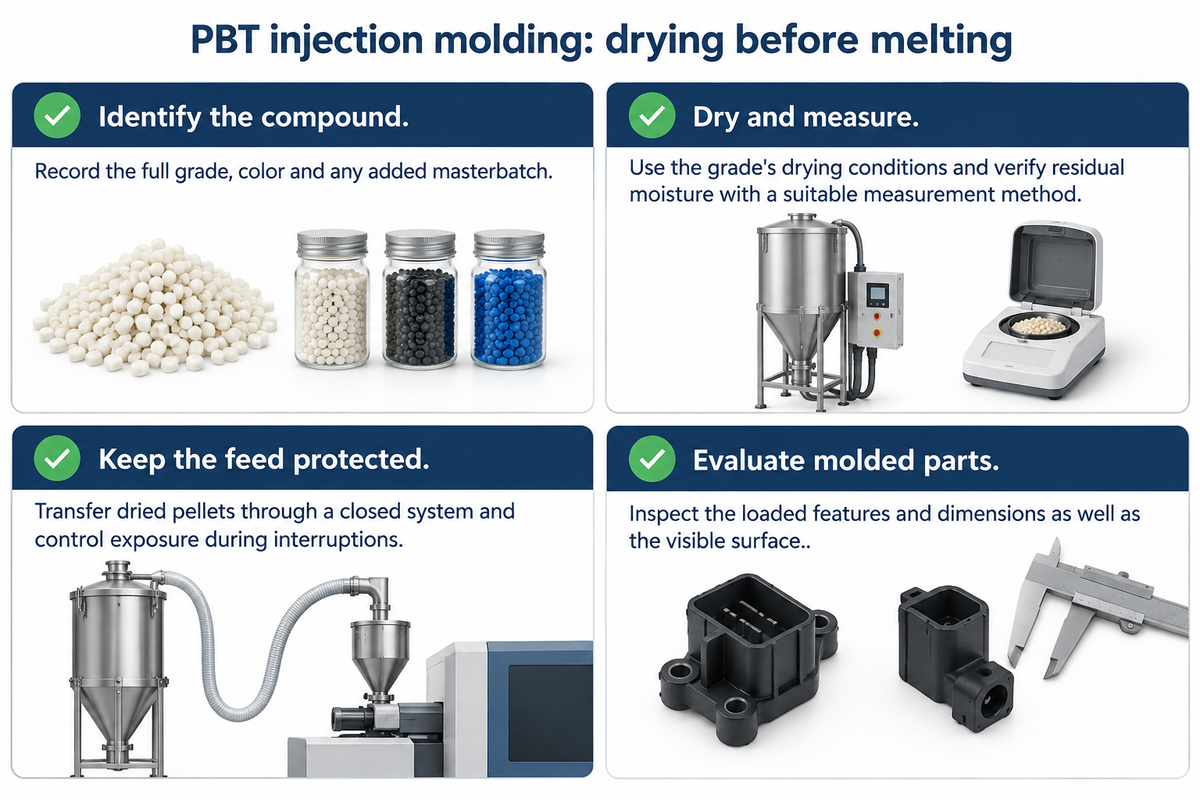
PBT pellets should meet the selected grade’s moisture requirement before melting. BASF’s B4300 G6 HR guide specifies moisture below 0.04%, with drying guidance of 80–120°C for 4 h. Those are grade-specific starting conditions. Verify the result at the material, because a dryer setting alone doesn’t measure residual moisture.
“If PBT or PET is heated above the melting point in the presence of excess moisture, the polymer chains break.”
The problem is straightforward: low water absorption in a solid component and moisture sensitivity in a hot melt take place under distinct circumstances. The water absorption test can be used to characterize uptake, whereas the processing moisture limit safeguards the resin during molding. Use the processing moisture limit to release a dried batch to production.
For B4300 G6 HR, BASF provides a melt-temperature window of 250-275°C and a mold-temperature window of 60-100°C. A different formulation may require a different window. Establish the processing parameters from the compound supplier’s current guide, then record the fill, cooling and part outcomes.
- Identify the compound. Record the full grade, color and any added masterbatch.
- Dry and measure. Use the grade’s drying conditions and verify residual moisture with a suitable measurement method.
- Keep the feed protected. Transfer dried pellets through a closed system and control exposure during interruptions.
- Evaluate molded parts. Inspect the loaded features and dimensions as well as the visible surface.
Long residence times or excessive melt temperatures can lead to additional degradation. When an injection molding machine is down, the shutdown and restart procedure prescribed by the compound supplier should be followed. A good-looking surface must not substitute for inspecting the latch, seam or other service-loaded feature.
PBT resin price and cost per finished part
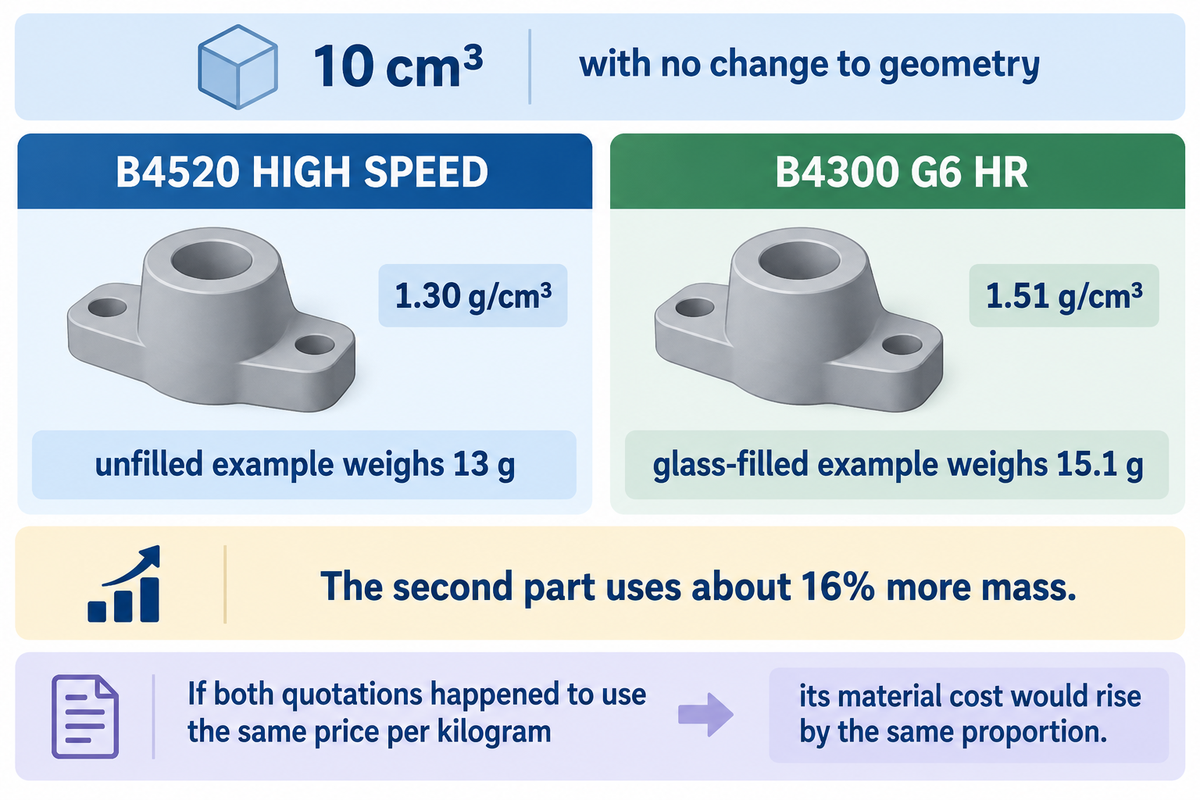
Compare PBT resin quotations for the same grade, reinforcement, order quantity and delivery terms. Keep the comparison within one regional market: IMARC’s price index put PBT at 2.38 USD/kg in Northeast Asia, 3.24 USD/kg in North America and 3.81 USD/kg in Europe in September 2026. Material cost per part is heavily dependent on the part mass: Using material price per kilogram only can be confusing to the buyer if two part candidates have different densities.
Finished-part processing and tooling costs must also be included in the comparison.
Assume two candidate parts each occupy 10 cm³, with no change to geometry. Using the two BASF densities discussed here, the unfilled example weighs 13 g and the glass-filled example weighs 15.1 g. The second part uses about 16% more mass. If both quotations happened to use the same price per kilogram, its material cost would rise by the same proportion. Write the calculation as mass in kilograms multiplied by the actual quoted price per kilogram. If the two quotes were different then calculate both separately.
A published injection-molding cost model accounts for equipment, tooling, labor, and material costs. When comparing a production run, divide the pertinent production costs by the number of accepted parts, and consistently account for runner material or rejects. A shorter cycle time or fewer rejected parts may change the purchase decision, even with a higher resin quote.
Choosing PBT for the actual service environment
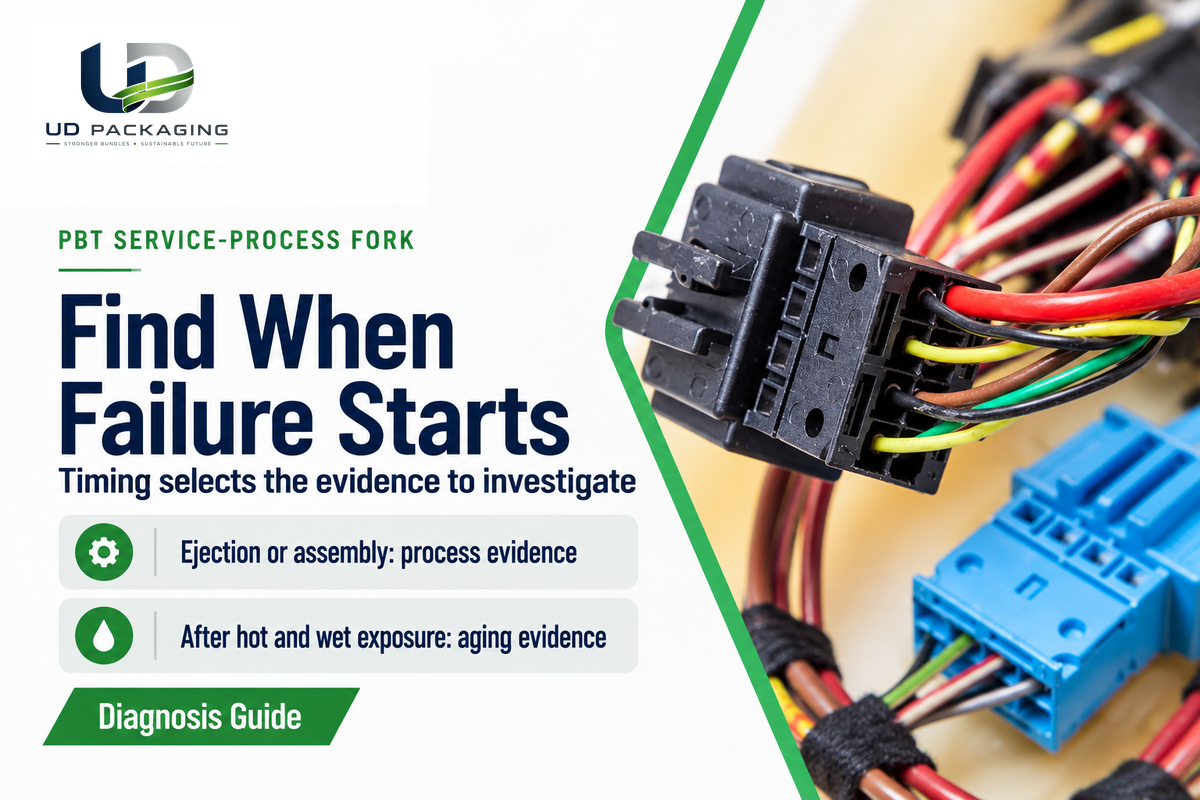
Select PBT by aligning what the service will do and the mechanical requirements against an entire grade, then verify the mold can produce the desired part. Separate those two investigations with the PBT Service-Process Fork. Service problem: check the material and part.
Processing problem: check the production evidence.
The first question is when the failure occurs. If parts fail on ejection or assembly, look at pellet moisture, melt residence time, cooling, weld line and local strains. If parts pass assembly and fail after hot and wet exposure, look at aging environment and retained properties of the compound.
For the latch of a connector, evaluate the retention before and after aging. For a welded housing, compare seam performance and dimensional fit at the same exposure.
A substitution is ready for approval when the candidate, on a known process window, satisfies the actual drawing and exposure needs. Secure whatever application specific approvals apply to the chosen formulation and final use. Retain the grade code in the purchase specification so that a subsequent replacement doesn’t silently change the compound.
Use UD Packaging’s plastic property reference to organize the comparison, then take the full grade requirements into the material discussion. Begin with the property that controls failure in your part rather than the longest list of advantages.
Frequently asked questions
Is PBT the same as polyester?
PBT is one type of polyester.
Polyester is the name of the family of polymers, and polybutylene terephthalate is the name of a specific member. This makes the entire name of the polymer useful if a drawing or purchase order otherwise would give “polyester” only. PET is a polyester with a different glycol segment.
A description that says “polyester” alone omits the resin identity, reinforcement and additive information required to compare engineering grades or authorize material substitution.
Why is PBT used for keycaps?
PBT is used in some keycaps because it lends itself to molded shapes that require dimensional stability and a durable surface under repeated handling.
In conclusion, the final feel is also influenced by the mold texture, wall thickness and manufacturing process. Check the stem fit and the finished keycap construction when comparing products; the resin label alone doesn’t determine sound, texture or the quality of the legends. For a set, the key profile and switch compatibility should also be included in the buying specifications.
Is PBT better than ABS?
PBT may be the better choice for some dimensional stability, chemical resistance or heat resistance requirements, but it isn’t always better than ABS.
Compare the desired grade and finished product. For keycaps consider the surface finish and construction as well as the polymer. For technical housings, consider impact, moulding needs and aesthetics rather than applying keyboard preferences to a technical housing product.
A candidate has to meet the housing drawing and service exposure as well as its aesthetic needs.
Is PBT transparent?
Standard PBT is not typically a choice for transparent parts.
Special laser-transmitting grades are a joining material at a specific wavelength. This description doesn’t imply the final material is see-through and transparent – choose optical materials based on the light transmission and look.
Can PBT be recycled?
PBT can be recycled via suitable industrial recycling processes and recycled grades are available.
Toray says its Ecouse TORAYCON is chemically recycled PBT with physical qualities comparable to virgin material. That claim describes one product, not recycled PBT in general. Collection, contamination, reinforcement and the recycling path affect what can be recovered and how it can be used.
A PBT moulded product won’t necessarily be accepted by a local domestic recycling scheme. For a new product, state the recycled compound and what performance is needed; don’t just rely on the polymer mark.
References & Sources
- ISO 20028-1:2019: thermoplastic polyester designation
- ISO 75-1:2020: general heat-deflection test method and scope
- ISO 75-2:2013: test methods and applied stresses
- Loyer et al., 2021: PBT hydrolysis and embrittlement
- Baradi et al., 2019: frontal weld lines in reinforced PBT
- PA66/PBT glass-bead composite elastic-property study, 2026
- Minguella-Canela et al., 2018: manufacturing cost model, section 2.3
- Michael Sepe: PBT and PET polyester performance
- Plastics Technology: hydrolysis-resistant, laser-transmitting PBT application