
Published September 2026
A plastic materials guide is easiest to use when it starts from three questions: how a resin responds to heat, how ordered its molecules are, and which service tier it sits in. As a guide to plastic material selection, it sorts the different types of plastic materials on those three axes, decodes resin codes 1 to 7, shows how to narrow an unknown plastic by density and adds the 2026 rules that now attach to packaging resins.
A plastic materials guide starts from three axes: heat response (thermoplastic, thermoset, elastomer), molecular order (amorphous or semi-crystalline) and service tier (commodity, engineering, high-performance). Density narrows an unknown resin; a resin code names the family, not the grade or recyclability.
Quick Specs
| Sorting axes | 3 (heat response, molecular order, service tier) |
| Resin identification codes | 7 codes, listed under ASTM D7611/D7611M-26 |
| Float check | Water at 1.00 g/cm³; PP and PE float at 0.89–0.97 g/cm³, PET sinks at 1.38–1.40 g/cm³ |
| Packaging rule date | 12 August 2026, when EU Regulation 2025/40 applies |
Plastic Materials Defined: Polymer, Resin, Compound and Part
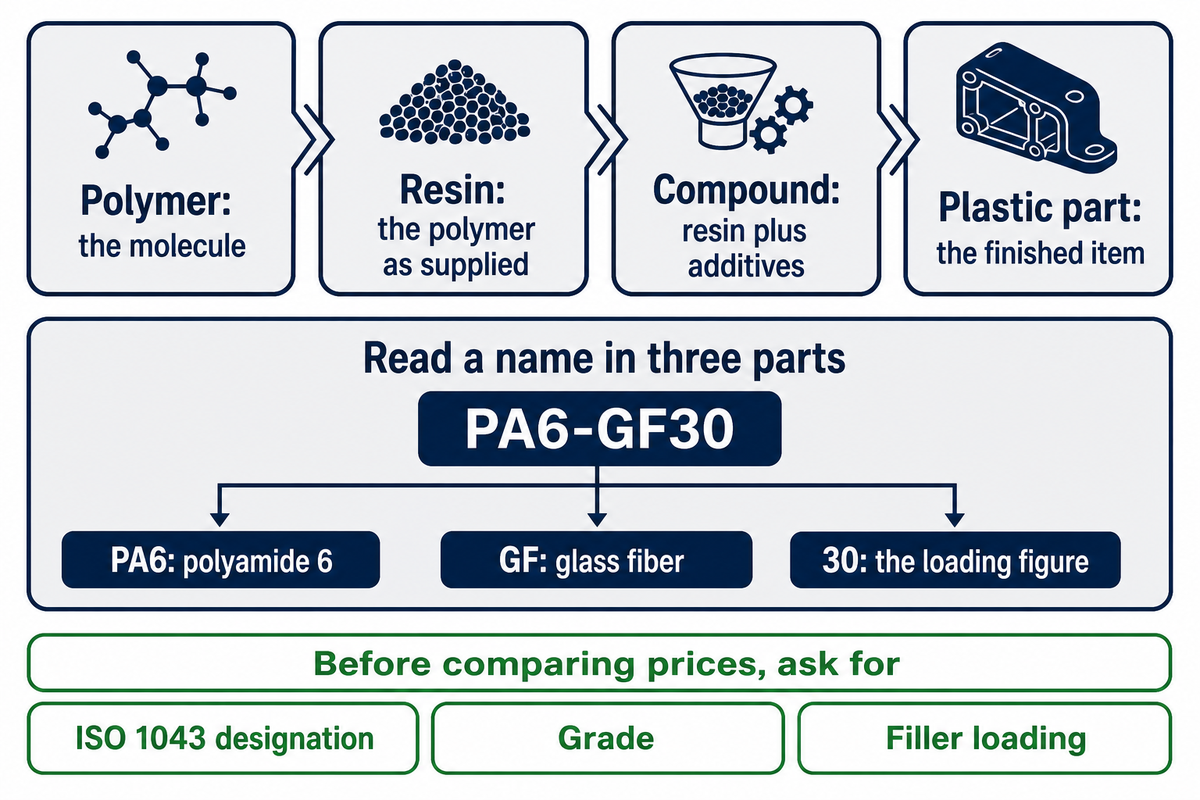
Plastics are a synthetic material built from polymers, usually blended with additives, that can be shaped under heat and pressure. Four words separate what a buyer names from what a factory runs: a polymer is the molecule, a resin is the polymer as supplied, a compound is resin plus additives, and a plastic part is the finished item.
Scale explains why the words matter. OECD figures put output of synthetic plastic at 460 million tonnes in 2019 and plastic waste at 353 million tonnes, with packaging making up about 40 percent of that waste. At that volume, a vague material name is expensive: two quotes for "polypropylene" can describe different plastic materials, fillers and grades.
ISO 1043-1 gives each type of plastic material a capital-letter abbreviation, with supplementary symbols after a hyphen, such as PE-LLD for linear low-density polyethylene, PS-HI for high-impact polystyrene and PVC-P for plasticized PVC (ISO 1043-1:2011 preview). Parts 2 to 4 of the series cover fillers and reinforcement, plasticizers and flame retardants.
Read a name in three parts. In PA6-GF30, PA6 is polyamide 6, GF is glass fiber, and 30 is the loading figure. ISO 1043-2 defines GF as the symbol for glass in the form of fiber, but the public pages do not define the number, so treat 30 as a supplier convention and ask for the loading in mass percent on the datasheet.
When a quote arrives with only a family name, ask for the ISO 1043 designation, the grade and the filler loading before comparing prices. Without those three, a price gap between two quotes cannot be traced to the plastic type, the filler or the grade.
Only 9% of the 353 million tonnes of plastic waste the OECD counted for 2019 was recycled. Quotes that name only a family such as PP or PA give a recycler and a buyer no way to identify which grade, filler or additive entered that stream.
Axis One: How Thermoplastic and Thermoset Materials Respond to Heat
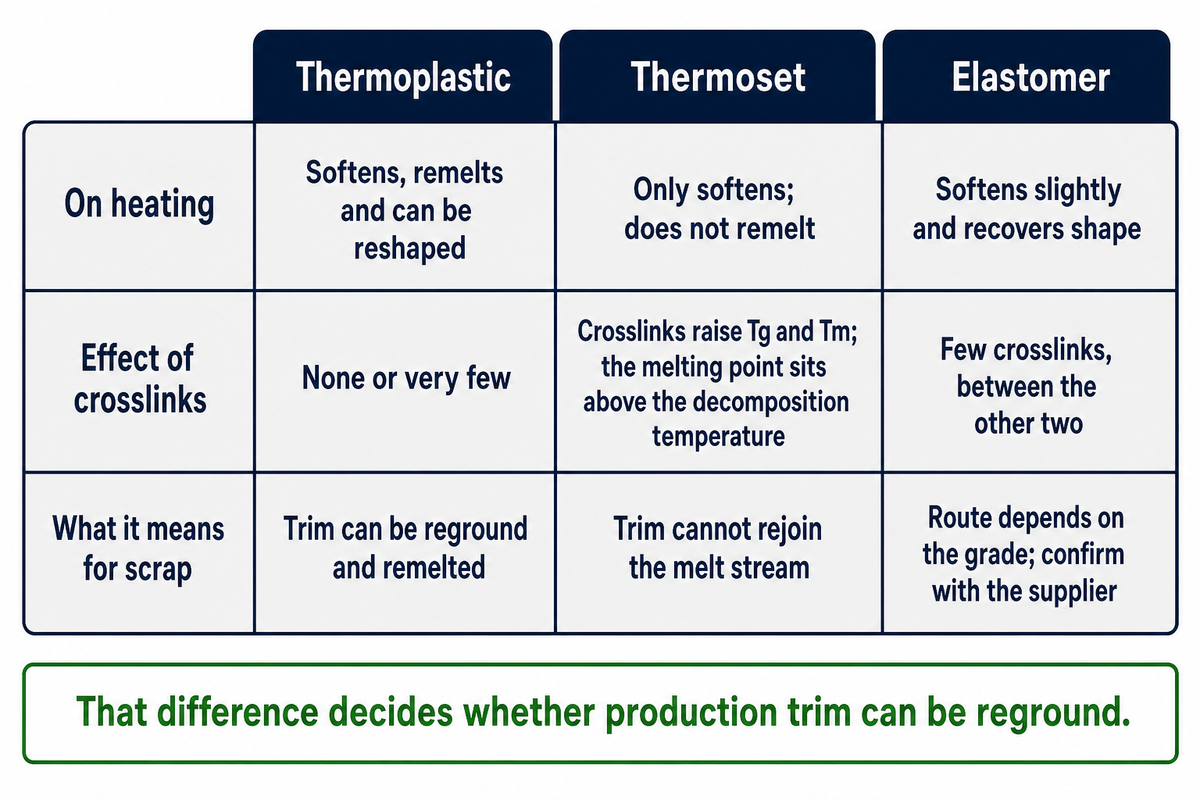
Heat response sorts every plastic into one of three groups: thermoplastics soften and can be remelted, thermoset materials crosslink during curing and only soften afterwards, and elastomers hold a few crosslinks and sit between the two. Heat response decides whether trim can be reground, whether parts can be welded and which end-of-life route exists.
| Group | On heating | Effect of crosslinks | What it means for scrap | Limitations / Not suitable for |
|---|---|---|---|---|
| Thermoplastic | Softens, remelts and can be reshaped | None or very few | Trim can be reground and remelted | Load-bearing limits sit below Tg or Tm, so stiffness falls before the resin melts |
| Thermoset | Only softens; does not remelt | Crosslinks raise Tg and Tm; the melting point sits above the decomposition temperature | Trim cannot rejoin the melt stream | Not suitable where rigid plastics must be reshaped or welded after curing |
| Elastomer | Softens slightly and recovers shape | Few crosslinks, between the other two | Route depends on the grade; confirm with the supplier | Sits between both behaviors, so neither remelt nor rigid-network assumptions hold without a grade check |
Source: BYU-Idaho open textbook and its thermal-changes chapter.
What Is the Difference Between Thermoplastic and Thermoset Plastics?
Thermoplastic plastics soften when heated and harden again on cooling, so they can be remelted and reshaped many times. Thermoset plastics form a crosslinked network during curing. They only soften on the application of heat, so they can’t be reshaped. That difference decides whether production trim can be reground.
Thermoplastic
- Remelts and reshapes on heating
- Softens as it nears Tg or Tm
- Trim can go back into the melt stream
Thermoset
- Crosslinks form during curing
- Heat softens it but does not remelt it
- Melting point sits above its decomposition temperature
If a plant returns trim to the melt, it can’t use a crosslinked material without creating a disposal route, and that route has to be named on the purchase order before the first sample is shipped.
Among the properties of plastics, thermal aging has its own measure. From BYU-Idaho’s textbook, the UL temperature index (UL 746B) is the temperature at which a sample loses 50 % of a mechanical property after 10,000 hours in circulating air. That yardstick is separate from Tg and Tm, so remelting behavior alone does not say how long a resin lasts in a warm store.
Axis Two: Molecular Order, Glass Transition and Melting Point
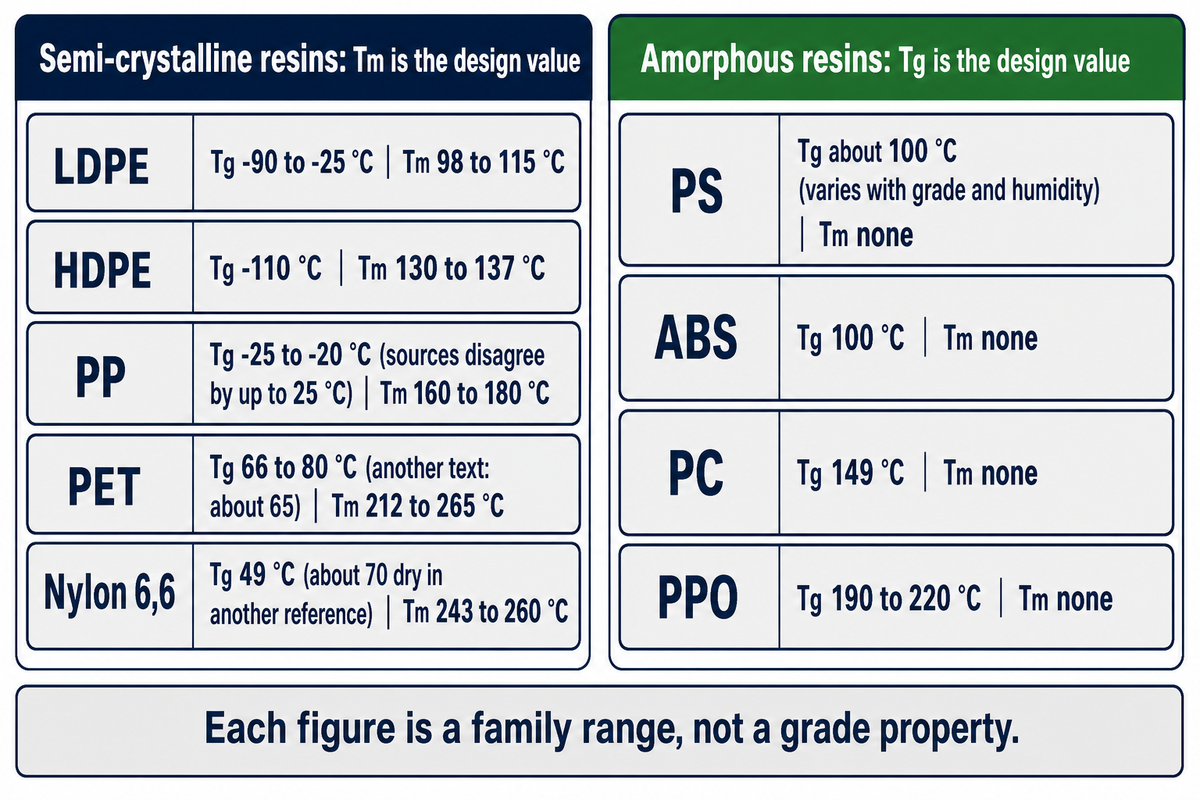
Plastics are split into amorphous resins and semi-crystalline resins by molecular order. Amorphous resins soften across the range of the glass transition temperature (Tg), while semi-crystalline resins retain their shape until they reach the melting temperature (Tm). These physical properties define temperature resistance differently: Tg is the design value of amorphous plastic, and Tm is the design value of semi-crystalline plastic.
| Resin | Molecular order | Tg (°C) | Tm (°C) | Design number | Limitations / Not suitable for |
|---|---|---|---|---|---|
| Low-density polyethylene (LDPE) | Semi-crystalline | −90 to −25 | 98 to 115 | Tm | Not suitable above its 98 °C melting onset |
| High-density polyethylene (HDPE) | Semi-crystalline | −110 | 130 to 137 | Tm | Not suitable above about 130 °C |
| Polypropylene (PP) | Semi-crystalline | −25 to −20 (sources disagree by up to 25 °C) | 160 to 180 | Tm | Not suitable above 160 °C; do not quote a Tg without its source |
| Polyethylene terephthalate (PET) | Semi-crystalline | 66 to 80 (another text: about 65) | 212 to 265 | Tm, and Tg for warm exposure | Softens from its 66 to 80 °C Tg, well before it melts |
| Nylon 6,6 | Semi-crystalline | 49 (about 70 dry in another reference) | 243 to 260 | Tm, and Tg for stiffness | Stiffness starts to fall near its Tg, and sources place that between 49 and about 70 °C |
| Polystyrene (PS) | Amorphous | about 100 (varies with grade and humidity) | none | Tg | Not suitable near 100 °C; Tg falls about 4 to 5 °C in humid air |
| Acrylonitrile butadiene styrene (ABS) | Amorphous | 100 | none | Tg | Not suitable near 100 °C |
| Polycarbonate (PC) | Amorphous | 149 | none | Tg | Not suitable near 149 °C |
| Polyphenylene oxide (PPO) | Amorphous | 190 to 220 | none | Tg | Not suitable near 190 °C |
The textbook also prints Tm values for the amorphous resins ABS, PC and PPO. Because amorphous resins have no sharp melting point, this table leaves those cells blank. Each figure is a family range, not a grade property.
Tg isn’t even a fixed constant inside one resin. Polystyrene shows the spread: a 2022 Membranes study notes that the common figure of about 100 °C depends on molecular weight and tacticity, and it measured a fall of roughly 4 to 5 °C between dry and humid conditions. Cross-checking the textbook against Wikipedia’s glass transition table found gaps of up to 25 °C for PP (atactic and isotactic grades differ) and 21 °C for nylon 6,6, so a Tg in any family table is a range for the family.
Choosing the number matters in practice. For a 60 °C exposure, PET has roughly 5 to 20 °C of margin below its Tg, which the textbook lists as 66 to 80 °C and a second open-university text puts near 65 °C. PP sits far below its 160 °C melting range. Ask which of Tg or Tm a supplier’s limit for operating temperatures refers to before that limit goes on a purchase order.
Nylon 6,6 melts at 243 to 260 °C, but its Tg is 49 °C in the textbook table and about 70 °C for dry nylon 6,6 in a second reference. Reading the melting point alone would rate the resin for far hotter service than its mechanical properties support.
Axis Three: Commodity, Engineering and High-Performance Tiers
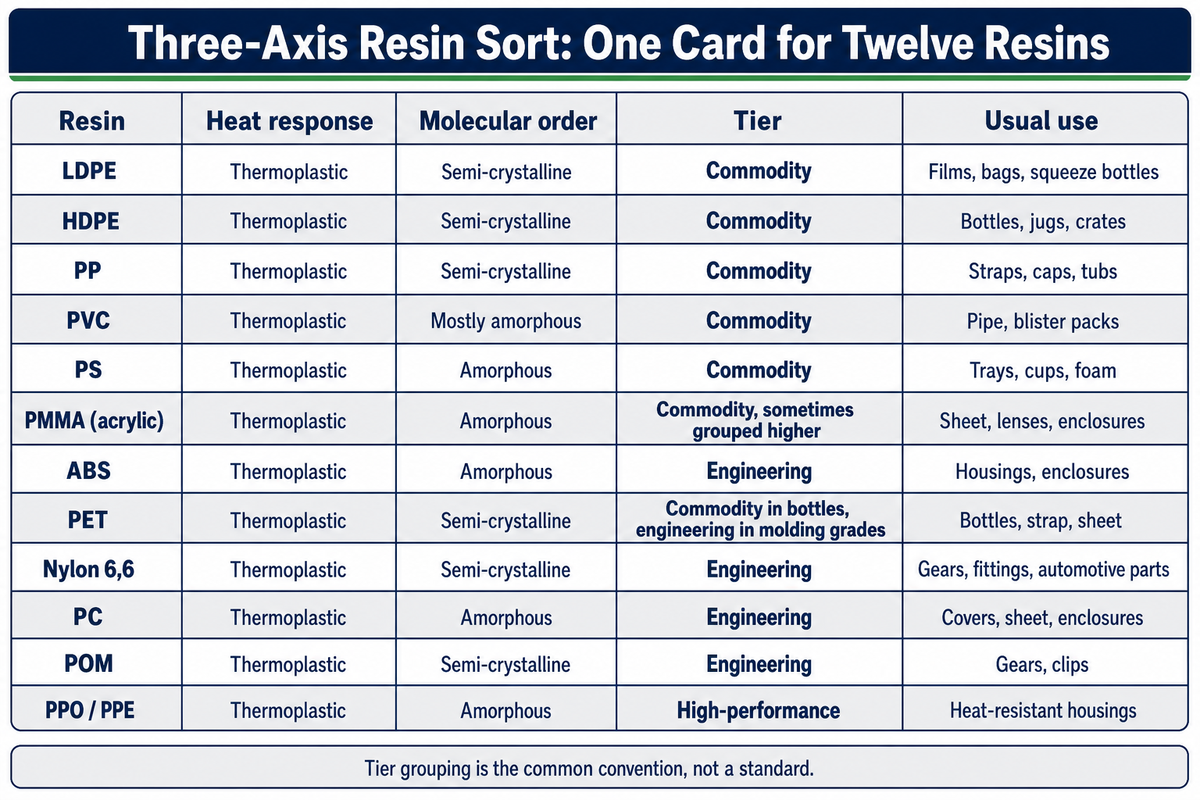
Service tier ranks resins by what they hold under load and heat: commodity resins such as PE, PP, PVC and PS carry most packaging and consumer goods, engineering plastic grades such as nylon, PC, POM and PET add stiffness, mechanical strength and heat resistance, and high-performance materials add one or more exceptional properties, usually at a premium price.
BYU-Idaho’s textbook ties the top tier to aromatic backbones and names PPS, PPE, PEEK, polysulfones and thermoplastic polyimides as examples of these specialized materials. Tier boundaries vary between sources, so the card below uses the common grouping and marks the resins where it splits.
Three-Axis Resin Sort: One Card for Twelve Resins
The Three-Axis Resin Sort places each resin by heat response, molecular order and service tier, so one row answers three selection questions.
| Resin | Heat response | Molecular order | Tier | Usual use | Limitations / Not suitable for |
|---|---|---|---|---|---|
| LDPE | Thermoplastic | Semi-crystalline | Commodity | Films, bags, squeeze bottles | Melts from 98 °C |
| HDPE | Thermoplastic | Semi-crystalline | Commodity | Bottles, jugs, crates | Melts from 130 °C |
| PP | Thermoplastic | Semi-crystalline | Commodity | Straps, caps, tubs | Melts from 160 °C; loses tension quickly as a strap |
| PVC | Thermoplastic | Mostly amorphous | Commodity | Pipe, blister packs | Rigid and plasticized (PVC-P) grades behave differently; name the grade |
| PS | Thermoplastic | Amorphous | Commodity | Trays, cups, foam | Tg about 100 °C |
| PMMA (acrylic) | Thermoplastic | Amorphous | Commodity, sometimes grouped higher | Sheet, lenses, enclosures | Check the grade Tg with the supplier; sources disagree |
| ABS | Thermoplastic | Amorphous | Engineering | Housings, enclosures | Tg 100 °C |
| PET | Thermoplastic | Semi-crystalline | Commodity in bottles, engineering in molding grades | Bottles, strap, sheet | Tg 66 to 80 °C |
| Nylon 6,6 | Thermoplastic | Semi-crystalline | Engineering | Gears, fittings, automotive parts | Tg 49 °C moves with moisture |
| PC | Thermoplastic | Amorphous | Engineering | Covers, sheet, enclosures | Tg 149 °C |
| POM | Thermoplastic | Semi-crystalline | Engineering | Gears, clips | Tg has no L1 source here; ask the supplier |
| PPO / PPE | Thermoplastic | Amorphous | High-performance | Heat-resistant housings | Tg 190 to 220 °C; premium price |
Order and temperatures follow the BYU-Idaho Table 3.2; tier grouping is the common convention, not a standard.
Budget approval needs a written reason for paying more. Tie any move up a tier to one named requirement: operating conditions above the commodity resin’s Tg or Tm in the table above, a load held for long periods, or wear. Datasheets compare tiers on tensile strength, impact resistance and chemical resistance. Specialty grades list additional properties that include electrical properties, optical properties and barrier properties. These grades require individual tests, so what test governs the movement must be cited. Family-level property sections, listing what each property family needs tested, sit on the page on plastic material properties.
Polyphenylene oxide (PPO, also called polyphenylene ether, PPE, a resin the same textbook lists among high-performance thermoplastics) has a Tg of 190 to 220 °C in the textbook table, against about 100 °C for polystyrene. A move to the next tier can potentially double the temperature at which the glassy state ends, and the move is justified only if the service range is situated between those two values.
Resin Identification Codes 1 to 7: What the Number Says and What It Leaves Out
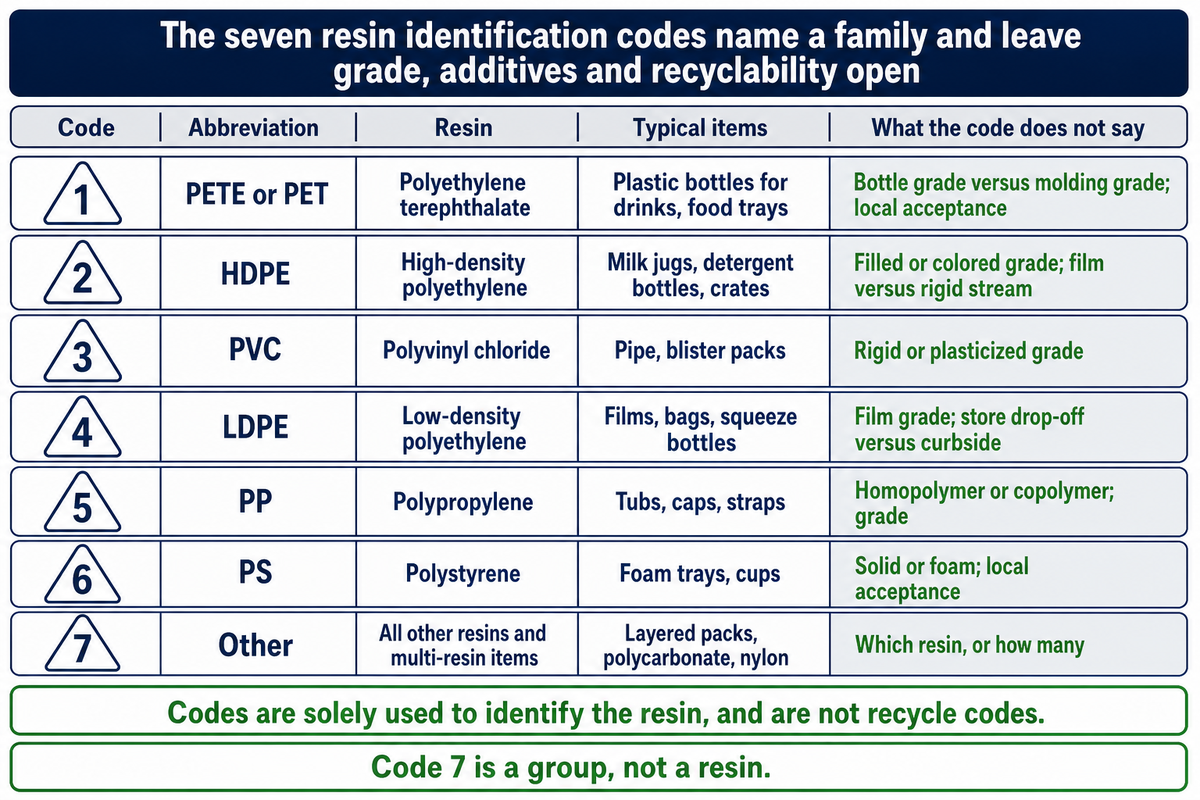
A resin identification code names the polymer family of a plastic article and nothing else. According to ASTM D7611/D7611M-26, codes are solely used to identify the resin, and are not recycle codes. Nor does the number rank quality, confirm a grade or promise that a local program will collect the item.
“But when it’s used on plastic, it’s no longer a recycling symbol. It’s now a resin identification code.”
| Code | Abbreviation | Resin | Typical items | What the code does not say |
|---|---|---|---|---|
| 1 | PETE or PET | Polyethylene terephthalate | Plastic bottles for drinks, food trays | Bottle grade versus molding grade; local acceptance |
| 2 | HDPE | High-density polyethylene | Milk jugs, detergent bottles, crates | Filled or colored grade; film versus rigid stream |
| 3 | PVC | Polyvinyl chloride | Pipe, blister packs | Rigid or plasticized grade |
| 4 | LDPE | Low-density polyethylene | Films, bags, squeeze bottles | Film grade; store drop-off versus curbside |
| 5 | PP | Polypropylene | Tubs, caps, straps | Homopolymer or copolymer; grade |
| 6 | PS | Polystyrene | Foam trays, cups | Solid or foam; local acceptance |
| 7 | Other | All other resins and multi-resin items | Layered packs, polycarbonate, nylon | Which resin, or how many |
Code list: ASTM 2013 release on the revised D7611. Typical items are examples, not part of the standard.
Code 7 is a group, not a resin. It holds all other resins and multi-resin items, so a 7 on a pack can be polycarbonate, nylon or a layered structure, and the number alone cannot tell a buyer which. Codes 1 to 6 name the common materials used in food packaging and consumer goods, while code 7 collects everything else.
The revision in 2013 changed the symbol. ASTM’s release says the system had used chasing arrows around the numeral and that D7611 now specifies a solid equilateral triangle, a change meant to separate the code from a recycling message. According to the FTC roundtable speaker, some manufacturers did not adopt the change, so both symbols remain in circulation.
Program rules, not the number, decide what a household can put in the bin. Greensboro, North Carolina accepts codes 1 to 7 but not plastic bags, which can be made from code 2 or 4, and it accepts code 6 but not Styrofoam, which often carries a small 6. EPA says the symbol doesn’t necessarily mean the item can be collected for recycling in your community, and an Oceana article cites a Consumer Brands Association survey in which 68 % of respondents thought any item with a code would be recyclable.
What Are Type 4 Plastics?
Type 4 plastics are low-density polyethylene, resin identification code 4 (LDPE). LDPE is soft and flexible and is one of the plastics used for films, bags and squeeze bottles, and linear low-density grades, the usual base for stretch film, are generally grouped with it. Code 4 names the polymer family only, so film grade and stretch level still need a datasheet.
Some communities, such as Greensboro, don’t collect plastic bags for curbside pick-up, so a code 4 mark on a pack doesn’t relate to curbside collection. Check the local program before a pack design promises a disposal route. The plastics industry uses the code to tell recyclers which polymer is in a bale, and not to guarantee that there’s a market for it.
The EPA reported the generation of over 35 million tons of plastics in 2018 with only 8.7% of them recycled, meaning the presence of a particular code on an item and the post-item fate are distinct pieces of data. Codes are used to identify resin; the 8.7% is the yield due to collection and sorting.
Identifying an Unknown Plastic: The Density-First Identification Route
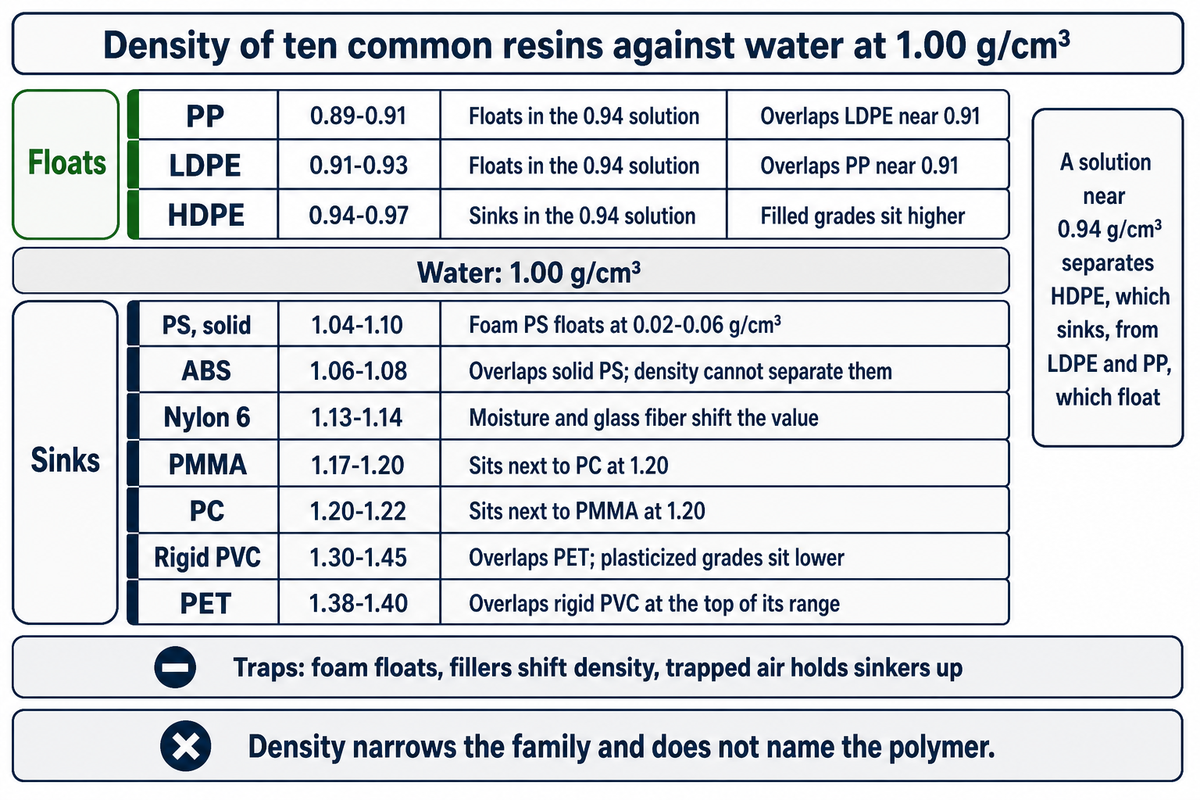
The Density-First Identification Route narrows an unknown plastic to a resin family by density before any lab test: read any marking, compare density with water at 1.00 g/cm³, test the split liquids, then stop at the first step that names a family. This is a screen, and confirming a polymer for a specification requires either spectroscopy or the supplier’s declaration.
- Read the marking: look for a resin code, an ISO abbreviation or a molded symbol, and note color, hardness and flexibility; a code names the family only
- Test density in water: PP and PE float at 0.89–0.97 g/cm³, and the other common resins in the table below sink
- Split the floaters: a solution near 0.94 g/cm³ separates HDPE, which sinks, from LDPE and PP, which float
- Note the traps: foam floats, fillers shift density, trapped air holds sinkers up, and a lid can be a different resin from the body
- Confirm before you specify: use spectroscopy or the supplier’s declaration; density alone never names the grade
The following table presents typical density ranges of a solid plastic sample from teaching sources. Real parts move away from these values when fillers, plasticizers or air are present.
| Resin | Typical density (g/cm³) | In water | Next check | Limitations / Not suitable for |
|---|---|---|---|---|
| PP | 0.89–0.91 | Floats | Floats in the 0.94 solution | Overlaps LDPE near 0.91 |
| LDPE | 0.91–0.93 | Floats | Floats in the 0.94 solution | Overlaps PP near 0.91 |
| HDPE | 0.94–0.97 | Floats | Sinks in the 0.94 solution | Filled grades sit higher |
| PS, solid | 1.04–1.10 | Sinks | Check the marking | Foam PS floats at 0.02–0.06 g/cm³ |
| ABS | 1.06–1.08 | Sinks | Check the marking | Overlaps solid PS; density cannot separate them |
| Nylon 6 | 1.13–1.14 | Sinks | Check the marking | Moisture and glass fiber shift the value |
| PMMA | 1.17–1.20 | Sinks | Check the marking | Sits next to PC at 1.20 |
| PC | 1.20–1.22 | Sinks | Check the marking | Sits next to PMMA at 1.20 |
| Rigid PVC | 1.30–1.45 | Sinks | Check the marking | Overlaps PET; plasticized grades sit lower |
| PET | 1.38–1.40 | Sinks | Check the marking | Overlaps rigid PVC at the top of its range |
Ranges: Royal Society of Chemistry density method, cross-checked against the Hudson River Park density table.
Suppose a clear-lidded tub arrives unmarked. Its body floats in water and floats in a 0.94 g/cm³ solution, so it’s LDPE or PP. Its lid sinks, so it’s one of the denser resins, and the pack is at least two resins. Each needs its own line on a quote.
Posters on an engineering forum explain the same thing more clearly: a burn test only identifies a particular family, but often the grade becomes very difficult to identify, as a single family like ABS has thousands of different formulations with additives, and a supplier who’s unwilling to disclose the composition of a part is a valid reason to consider other options.
Density narrows the family and does not name the polymer. In a 2018 validation of ATR FT-IR on marine plastic, ethanol float and sink tests were added to sort HDPE from LDPE where the spectra were ambiguous, and even then some polyethylene samples could not be assigned without a further step. Heating and burn tests are outside this route: fumes vary with the additives in the grade, so those tests belong in a ventilated laboratory or with a testing supplier, not at a desk.
Contrary to float-test folklore, water alone splits only two groups of unfilled solid resins: PP and PE float at 0.89 to 0.97 g/cm³, and every other resin in the table sinks. ABS at 1.06 to 1.08 g/cm³ and solid PS at 1.04 to 1.10 g/cm³ overlap, so a sinking result never separates those two.
Grades, Additives and the Mechanical Properties They Change
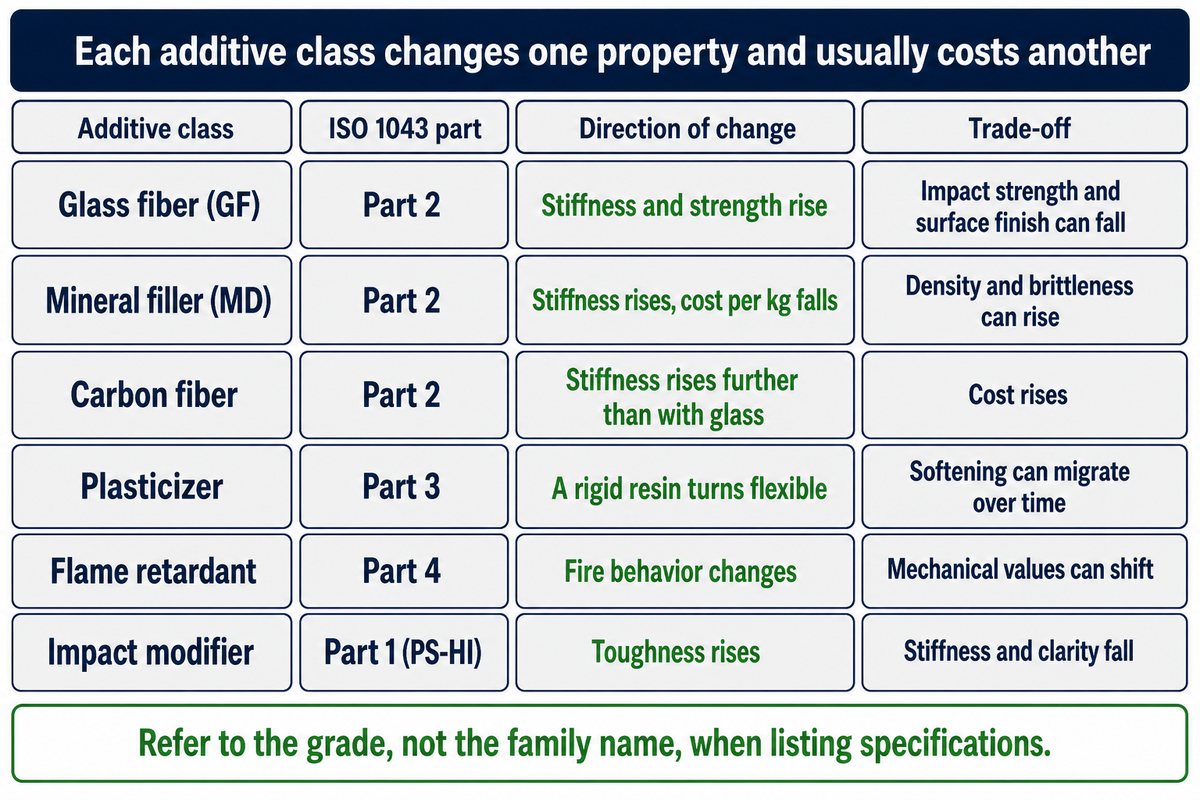
Grades exist because additives move properties: fillers and glass fiber raise stiffness and dimensional stability, plasticizers soften a rigid resin, and flame retardants change fire behavior, each usually at a cost in another property. Two datasheets for one resin family therefore differ by grade, and ISO 1043 parts 2 to 4 give the letters that name each additive class.
| Additive class | ISO 1043 part | Direction of change | Trade-off | Limitations / Not suitable for |
|---|---|---|---|---|
| Glass fiber (GF) | Part 2 | Stiffness and strength rise | Impact strength and surface finish can fall | The loading number after GF is a supplier convention |
| Mineral filler (MD) | Part 2 | Stiffness rises, cost per kg falls | Density and brittleness can rise | Loading must be stated in mass percent |
| Carbon fiber | Part 2 | Stiffness rises further than with glass | Cost rises | Confirm the grade name and the loading in mass percent |
| Plasticizer | Part 3 | A rigid resin turns flexible | Softening can migrate over time | PVC-P and rigid PVC are different materials |
| Flame retardant | Part 4 | Fire behavior changes | Mechanical values can shift | Only amounts above 1 % by mass need identifying |
| Impact modifier | Part 1 (PS-HI) | Toughness rises | Stiffness and clarity fall | High-impact grades are named separately from general-purpose |
Letters and parts: ISO 1043-1 preview and ISO 1043-2 preview.
What Are the Different Grades of Plastic Materials?
Grades of a plastic material are versions of one polymer family with different molecular weight, additives or reinforcement, sold under supplier names. Grades may be unfilled, glass-filled, flame-retardant or impact-modified, and each version has its own datasheet values. It’s important to refer to the grade, not the family name, when listing specifications.
Grades expand the materials one family can include, and they also expand the ways two quotes can vary. Practitioners on an engineering forum report that suppliers sometimes change additives or fillers for production or cost reasons, so a datasheet’s important mechanical properties and physical properties can move between lots. For each supplier, ask for the grade name, the additive package, the filler loading in mass percent and the lot certificate; a supplier who can’t provide these doesn’t allow you to compare property values.
From Resin to Format: Films, Straps, Bottles, Trays and Crates
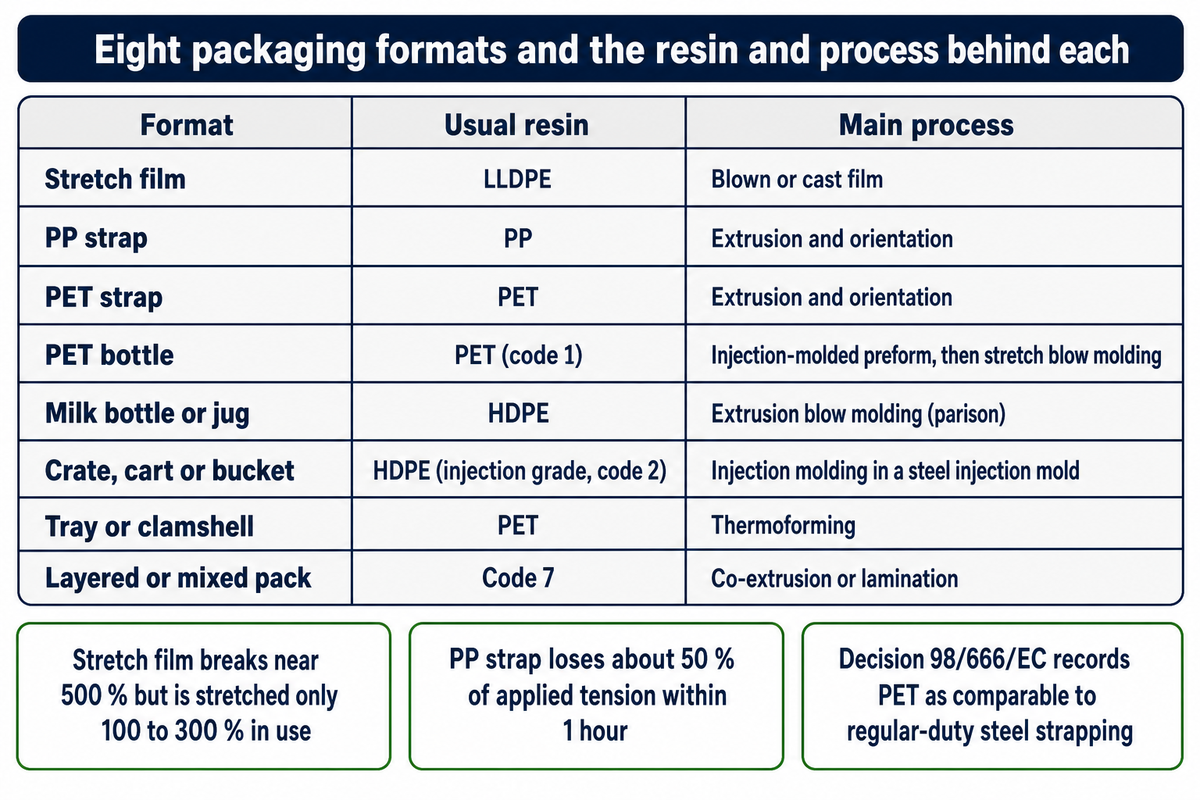
Each packaging format pairs with a resin family and a process: stretch film uses polyethylene, straps use PP or PET, bottles use PET or HDPE, trays use PET, and crates use HDPE. This association holds because each process requires a specific melt behavior and final stiffness for a specific application, so the selection of plastic follows the process.
| Format | Usual resin | Main process | Why the pairing holds | Limitations / Not suitable for |
|---|---|---|---|---|
| Stretch film | LLDPE | Blown or cast film | Both routes make plastic films: blown film is slower and clings better, cast film is quicker and more consistent | Breaks near 500 % but is stretched only 100 to 300 % in use |
| PP strap | PP | Extrusion and orientation | Higher elongation at break | Loses about 50 % of applied tension within 1 hour; unsuited to rigid loads |
| PET strap | PET | Extrusion and orientation | Retains tension on rigid loads; Decision 98/666/EC records PET as comparable to regular-duty steel strapping | The regulator record dates from 1998; confirm with current grade data |
| PET bottle | PET (code 1) | Injection-molded preform, then stretch blow molding | Two machine steps give clarity and strength in plastic bottles | Preform and bottle grades differ |
| Milk bottle or jug | HDPE | Extrusion blow molding (parison) | Hollow goods are HDPE’s largest use | Filled or colored grades change recycling routes |
| Crate, cart or bucket | HDPE (injection grade, code 2) | Injection molding in a steel injection mold | APR files carts, crates and buckets under injection-grade code 2 HDPE, one of the rigid plastics | Mixed bulky rigid bales also hold PP and LDPE |
| Tray or clamshell | PET | Thermoforming | Sheet forms under vacuum over a mold, common in food packaging | PS and PP trays go to other bales |
| Layered or mixed pack | Code 7 | Co-extrusion or lamination | Combines properties no single resin gives | APR treats code 7 as mixed plastic or other |
Sources: Association of Plastic Recyclers glossary, stretch wrap, strapping, PET and HDPE overviews, and Commission Decision 98/666/EC.
Strap and film follow different documents. ASTM D3950 covers nonmetallic strapping and joining methods, and ASTM D4649 covers stretch films for unitizing, reinforcing and palletizing in indoor environments such as warehouses, closed truck trailers, rail boxcars and transfer terminals. Film datasheets cannot take the place of strap test reports.
For product details, the sister site covers PET strapping and machine stretch film, and another publication describes PP and PET strap comparison in service. Film strength testing is described under plastic film tensile testing. Converters’ lines are typically set up for one resin family, so a resin change means requalifying the line and adds lead time.
Stretch film that breaks near 500 % is stretched only 100 to 300 % in use, so the break figure on a datasheet overstates working stretch by a factor of roughly 1.7 to 5. When comparing films, consider the stretch the machine will apply.
Regulation and Recycled-Content Rules Now Attached to Plastic Packaging
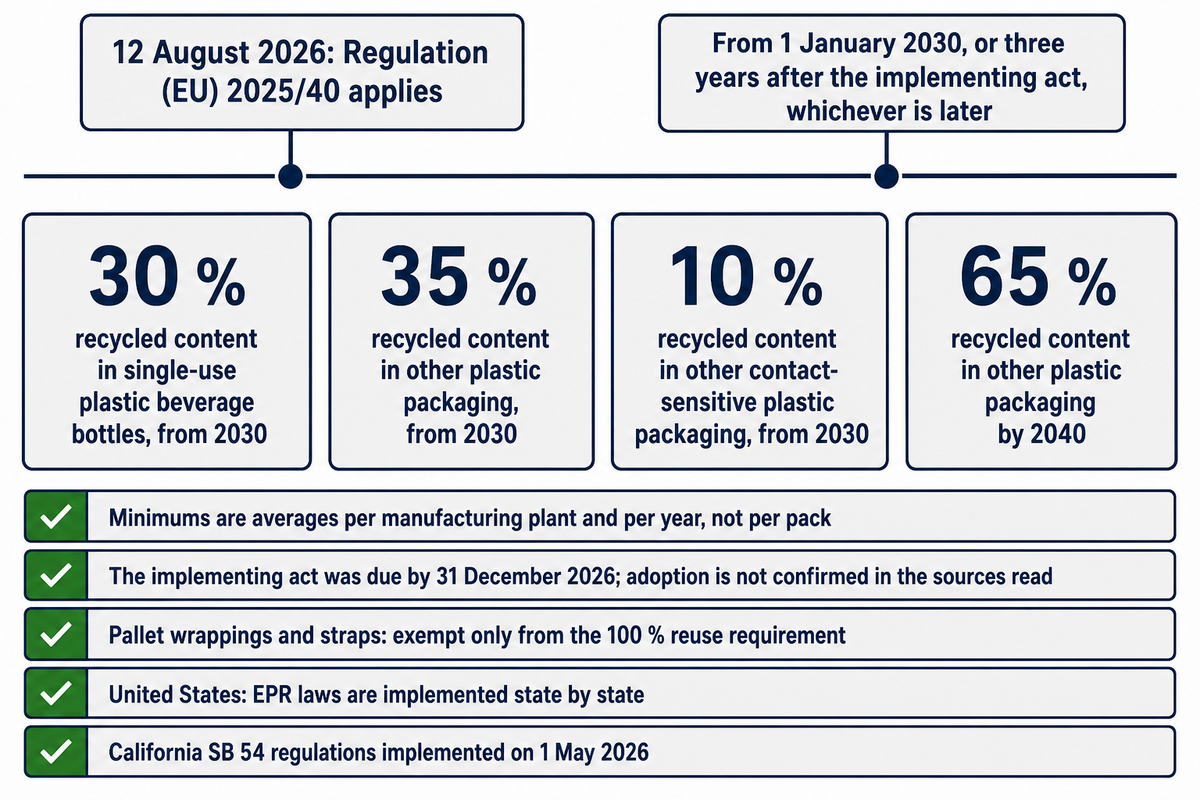
Regulation (EU) 2025/40 applies from 12 August 2026 and sets a minimum for the use of recycled material in plastic packaging starting in 2030 or thereafter. So resin choice now carries an evidence request to every supplier. For both EU and US state markets, three factors should be included in a shortlist for resin: evidence of mono-material design, evidence of a claimed level of recycled material, and a claim that can be supported.
30 %recycled content in single-use plastic beverage bottles, from 2030
35 %recycled content in other plastic packaging, from 2030
10 %recycled content in other contact-sensitive plastic packaging, from 2030
65 %recycled content in other plastic packaging by 2040
The dates require attention. Article 7(1) establishes minimum requirements from 1 January 2030, or three years after the Commission’s implementing act, whichever comes later. That act was due by 31 December 2026, and the sources read for this guide do not confirm its adoption. Application dates are provided in the Regulation text and in the Commission’s packaging waste page, which states that Directive 94/62/EC is generally repealed on the same date.
Exemptions aren’t as broad as they seem. Under the Commission’s delegated decision on pallet wrappings and straps, certain operators are exempt only from the 100 % reuse requirement for those formats in Article 29(2) and (3); the Regulation itself still applies.
In the United States, the implementation of Extended Producer Responsibility (EPR) laws is occurring on a state-by-state basis. According to CalRecycle, the SB 54 regulations in California were implemented on 1 May 2026, and the Circular Action Alliance submitted its plan on 15 June 2026. For 2026, before finalizing a shortlist, request from each resin supplier its evidence on recycled content and status on mono-materials, as a recycled grade may have a longer lead time than a virgin material.
As background only, the OECD’s plastics topic page projects a 70 % rise in plastics production, use and waste by 2040 compared with 2020 without further action, a market context for the plastics industry and not a forecast for any single resin.
Recycled-content minimums in Article 7(1) are averages per manufacturing plant and per year, not per pack, and they start on 1 January 2030 or three years after the implementing act, whichever is later. For 2040, the value for other plastic packaging rises to 65 %, so a resin supplier’s 2026 recycled-content evidence is the first file to request.
The Six-Question Resin Screen: A Plastic Material Selection Sequence Before Any Datasheet Comparison
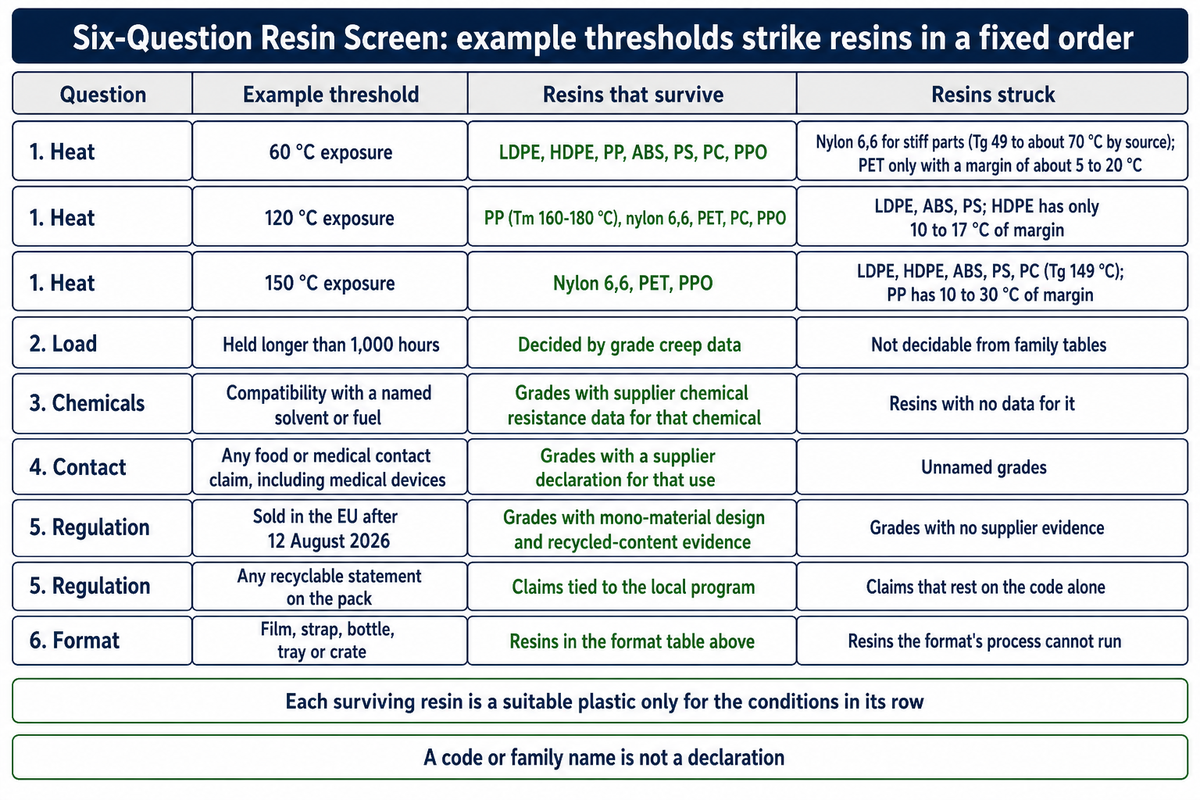
The Six-Question Resin Screen is a material selection process. This involves providing an answer to six questions in the order given that are: heat, load, chemicals, food or medical contact, regulation, and format. By answering each question, we’re able to eliminate resins, thus creating a final selection with a written rationale prior to ordering a sample.
| Question | Example threshold | Resins that survive | Resins struck | Limitations / Not suitable for |
|---|---|---|---|---|
| 1. Heat | 60 °C exposure | LDPE, HDPE, PP, ABS, PS, PC, PPO | Nylon 6,6 for stiff parts (Tg 49 to about 70 °C by source); PET only with a margin of about 5 to 20 °C | Tg moves with moisture and grade |
| 1. Heat | 120 °C exposure | PP (Tm 160–180 °C), nylon 6,6, PET, PC, PPO | LDPE, ABS, PS; HDPE has only 10 to 17 °C of margin | Long-term aging needs an index temperature |
| 1. Heat | 150 °C exposure | Nylon 6,6, PET, PPO | LDPE, HDPE, ABS, PS, PC (Tg 149 °C); PP has 10 to 30 °C of margin | Continuous ratings sit below Tg and Tm |
| 2. Load | Held longer than 1,000 hours | Decided by grade creep data | Not decidable from family tables | Family tables stop here |
| 3. Chemicals | Compatibility with a named solvent or fuel | Grades with supplier chemical resistance data for that chemical | Resins with no data for it | Additives and stress change resistance |
| 4. Contact | Any food or medical contact claim, including medical devices | Grades with a supplier declaration for that use | Unnamed grades | A resin code or family name is not a declaration |
| 5. Regulation | Sold in the EU after 12 August 2026 | Grades with mono-material design and recycled-content evidence | Grades with no supplier evidence | Recycled-content minimums start 1 January 2030 or later |
| 5. Regulation | Any recyclable statement on the pack | Claims tied to the local program | Claims that rest on the code alone | The code is not a recycling promise (ASTM, EPA, FTC) |
| 6. Format | Film, strap, bottle, tray or crate | Resins in the format table above | Resins the format’s process cannot run | A line set for one resin family needs requalifying |
Constraints are considered to be threshold values for a first shortlist. Temperature margins are defined in relation to the Tg and Tm values in BYU-Idaho Table 3.2.
Plastics selection at this stage is a screening step, not a rating. There typically isn’t a best, but rather a most appropriate material for the conditions of a given application. Each surviving resin is a suitable plastic only for the conditions in its row. Selecting a plastic material in this way keeps the right plastic material on the list and takes all others off with a stated reason.
Before perusing datasheets, please apply the eight checks for comparing plastic test data to make the numbers comparable, and collect some supplier data with the packaging evidence checklist.
Key takeaway
A resin shortlist is defensible when temperature, load, chemicals, contact, regulation and format each strike at least one resin with a written reason, and identification stops at a family until a supplier declares the grade.
Situations Where a General Plastics Guide Stops Being Enough
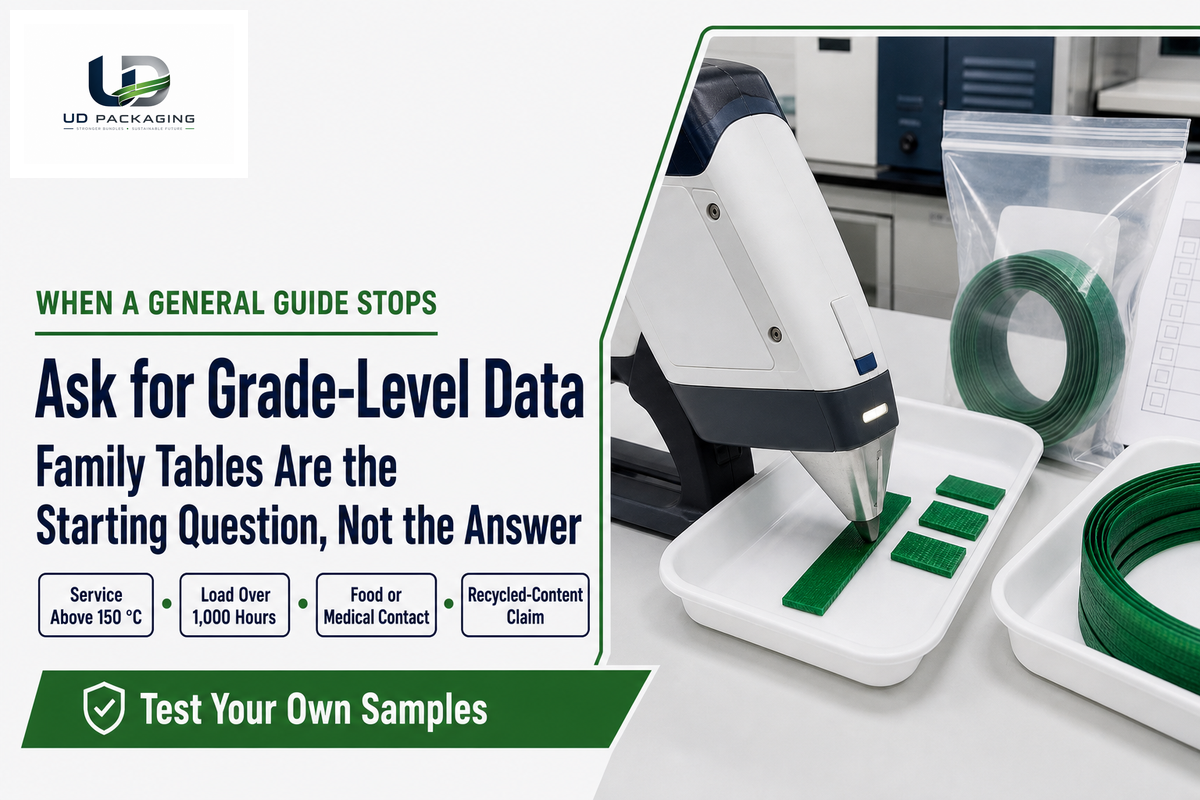
A general plastics guide stops being enough when a decision rests on grade-level data: continuous service above 150 °C, a load held longer than 1,000 hours, a food or medical contact claim, a recycled-content claim, or a safety-factor design. In those cases, family tables are the starting question, not the answer.
- Continuous service above 150 °C: ask for the grade’s UL temperature index (UL 746B) or for heat-deflection data.
- Load held longer than 1,000 hours: ask for creep data for the grade at the service temperature.
- Food or medical contact claim: ask for the supplier’s declaration for the exact grade, not the family name.
- Recycled-content claim: ask for recycled-content evidence for each lot.
- Safety-factor design: test your own samples; published family values aren’t design allowables.
Chemical exposure, environmental stress cracking, UV and weathering, flammability, food contact and electrical properties are all outside a family-level sort and require specific data. A statement such as “excellent environmental stress crack resistance” names a test and a grade, not a family, so ask what test and what grade. For the property-by-property side that this guide does not repeat, use the test data comparability checker, a screening tool designed for this task.
Frequently Asked Questions
What are the 7 main types of plastic?
Resin identification codes 1 to 7 give the seven main types of plastic: PET, HDPE, PVC, LDPE, PP, PS and a seventh group called other, which holds every resin outside the named families.
Resin identification codes 1 to 7 give the seven main types: PET, HDPE, PVC, LDPE, PP, PS and a group called other. Codes 1 to 6 each name one resin family, while code 7 holds everything else, including polycarbonate, nylon and layered packs. That list sorts by polymer family, not by quality, grade or recyclability, so two items with the same code can behave very differently. The types of plastic materials available on a datasheet are grades inside these families, not extra codes.
How do I tell what type of plastic I have?
Start with any resin marking on the part, then compare its density with water at 1.00 g/cm³, because PP and PE float and most other common resins sink.
Start with any marking, then compare density with water at 1.00 g/cm³: PP and PE float at 0.89 to 0.97 g/cm³, and most other common resins sink. Solutions near 0.94 g/cm³ separate HDPE from LDPE and PP. Density narrows the family only, so ask the supplier for a declaration or use spectroscopy before naming a grade in a specification.
How do polypropylene and polyethylene differ?
Polypropylene melts higher, at 160 to 180 °C, than polyethylene, which melts at 98 to 137 °C depending on density, and the two resins float in water with density ranges that touch at the top of the PP band.
Polypropylene melts higher, at 160 to 180 °C, than polyethylene, which melts at 98 to 115 °C for low-density and 130 to 137 °C for high-density grades in the BYU-Idaho table. Both float in water, PP at 0.89 to 0.91 g/cm³ and PE at 0.91 to 0.97 g/cm³, so density alone separates them except near the 0.91 edge, where the ranges meet.
Does a higher resin code number mean a better plastic?
No, the code order is a list of resin families and not a quality ranking, and the last group is a catch-all that includes polycarbonate, nylon and layered packs.
No. Codes name the different types of plastic in list order, and code 7 is a catch-all group.
Is a biodegradable plastic a different family of material?
Biodegradable describes how a plastic behaves at end of life, not which polymer family it belongs to, so a biodegradable claim and a resin code answer two separate questions about the same pack.
Biodegradable describes how a plastic behaves at end of life, not which polymer family it belongs to. The resin code answers the family question, and any resin outside codes 1 to 6 sits in the catch-all group 7, so a 7 on a pack cannot tell you whether a material is biodegradable. EPA states that compostable plastics are not meant for recycling. Resin code, disposal route and biodegradable claim are therefore three separate facts, and the claim should be checked against the local disposal route before it goes on a pack.
Which plastics do industrial films and straps use?
Stretch film is most commonly linear low-density polyethylene, and straps use PP or PET, so film and strap grades sit in the polyethylene, polypropylene and polyester families.
Stretch film is most commonly linear low-density polyethylene, and straps use PP or PET. Commission Decision 98/666/EC recorded PET strapping as comparable to regular-duty steel strapping and PP as a less satisfactory substitute in heavy applications.
Why This Guide Uses Three Axes
The Three-Axis Resin Sort organizes this guide because that sort answers the questions buyers ask: will the resin soften, will it survive a hot store, and is a premium tier justified. UD Packaging supplies PET strapping and stretch film, and the resin data here comes from the standards, university and agency sources listed below.
Request a packaging material review →
References & Sources
- OECD Global Plastics Outlook, Organisation for Economic Co-operation and Development
- ISO 1043-1:2011 preview, basic polymers and their special characteristics, International Organization for Standardization
- ISO 1043-2:2011 preview, fillers and reinforcing materials, International Organization for Standardization
- Plastics Materials open textbook, thermoplastics and thermosets, Brigham Young University-Idaho
- Plastics Materials open textbook, thermal changes and Table 3.2, Brigham Young University-Idaho
- Plastics Materials open textbook, high-performance thermoplastics, Brigham Young University-Idaho
- Effect of Polystyrene Synthesis Method on Water Sorption and Glass Transition, Membranes, 2022
- ASTM D7611/D7611M-26, coding plastic manufactured articles for resin identification, ASTM International
- ASTM plastics committee releases major revisions to the resin identification code standard, ASTM International
- Talking Trash at the FTC: Recyclable Claims and the Green Guides, U.S. Federal Trade Commission
- How do I recycle common recyclables?, U.S. Environmental Protection Agency
- Ever wonder about waste, City of Greensboro, North Carolina
- Recycling myth of the month: numbered symbols do not mean you can recycle me, Oceana
- Identifying polymers by density, Royal Society of Chemistry
- Plastic density table, Hudson River Park and Monterey Bay Aquarium Foundation
- Validation of ATR FT-IR to identify polymers of plastic marine debris, Marine Pollution Bulletin, 2018
- Plastics recycling glossary, Association of Plastic Recyclers
- ASTM D3950, nonmetallic strapping and joining methods, ASTM International
- ASTM D4649, selection and use of stretch wrap film, ASTM International
- Commission Decision 98/666/EC, EUR-Lex
- Regulation (EU) 2025/40 on packaging and packaging waste, EUR-Lex
- Packaging waste, European Commission
- Commission Delegated Decision on pallet wrappings and straps, European Commission
- Packaging extended producer responsibility, CalRecycle
- Plastics topic page, Organisation for Economic Co-operation and Development
- Stretch wrap, Wikipedia
- Strapping, Wikipedia
- Polyethylene terephthalate, Wikipedia
- High-density polyethylene, Wikipedia