
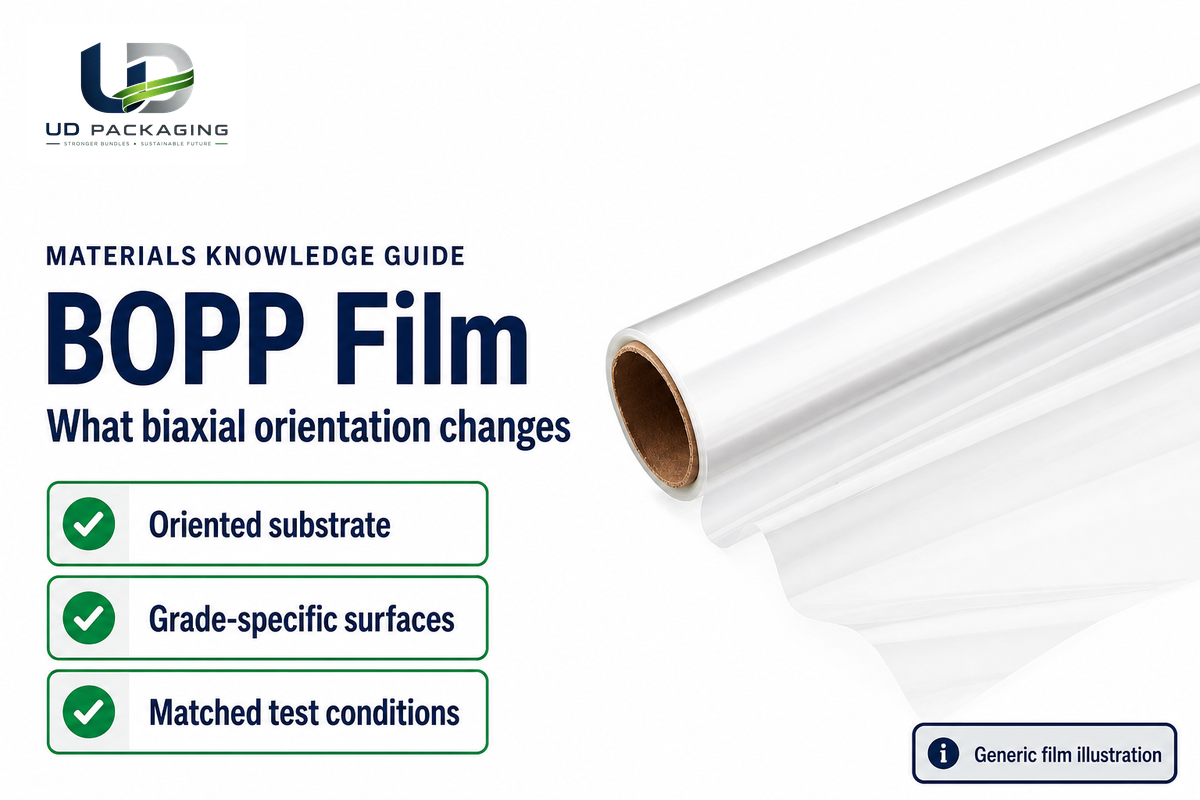
Biaxially oriented polypropylene is PP film stretched in two directions. Orientation impacts stiffness, strength and heat response. Surface layers and coatings influence sealing, printing and barrier properties. The film name isn’t a specification.
Updated October 2026
- A heat-sealable BOPP grade and a non-sealable CPP grade both exist.
- Water-vapor transmission and oxygen transmission answer different packaging questions.
- High tensile strength can’t predict resistance to a growing tear.
- Clear, white and matte films serve different optical purposes.
Quick specs
Resin: polypropylene. Process: stretching in two directions. Construction: grade-specific skins, coatings or metallization. Examples discussed below: 18 µm metallized film and 40 µm or 50 µm transparent multilayer film. Those examples don’t define the full BOPP thickness range.
BOPP Film: Resin, Orientation and Structure
Biaxially-oriented polypropylene film is a type of PP film stretched along and across the production web. Resin identifies the polymer family; orientation describes the process. A finished grade may add sealing surfaces or coatings or metals. Those additions change its practical role without changing the underlying BOPP name.
Two-direction stretching is defined by Arkis and colleagues in their 2015 study of pearlescent multilayer film. The study describes one of the biaxially oriented polypropylene film constituents as isotactic polypropylene. Begin with polypropylene properties and consider what the finished grade adds.
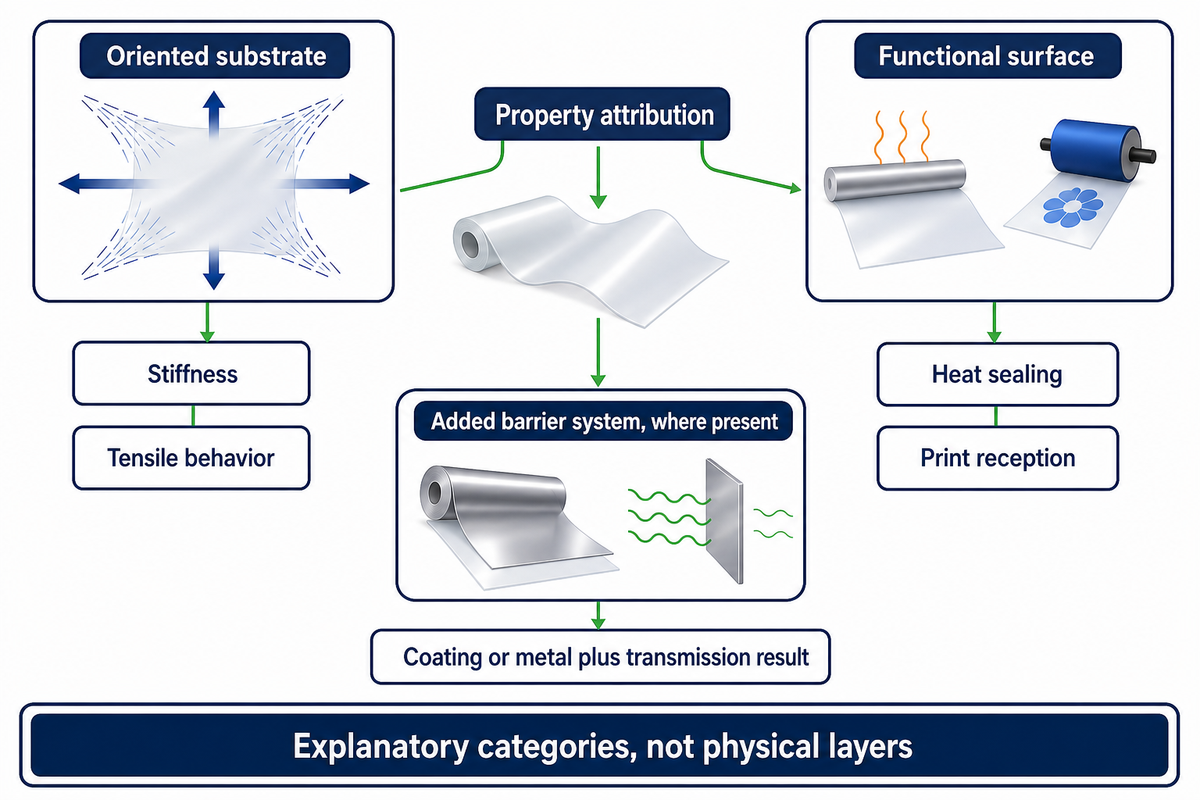
3-Layer Property Attribution Map
This map sorts a film’s properties into three levels of explanation: an oriented substrate, a functional surface, and a barrier system.
The levels are descriptive categories, not a claim that every film has three physical layers. Use the matrix to identify the evidence behind a description.
| Property | Attribution level | Evidence to inspect | Inference to avoid |
|---|---|---|---|
| Polymer identity | Substrate | Resin and construction description | Every layer is identical PP |
| Stiffness | Substrate and structure | Directional modulus | A stiffness value predicts tearing |
| Tensile behavior | Oriented substrate | Direction and failure mode | Both directions behave equally |
| Heat shrinkage | Orientation and heat setting | Exposure-specific dimensional change | Resin melting point is a processing limit |
| Heat sealing | Functional surface | Sealable face and seal response | Every BOPP face seals |
| Print reception | Functional surface | Treatment and ink-system results | Surface treatment proves barrier |
| Water-vapor barrier | Whole structure | Conditioned transmission result | Moisture performance predicts oxygen performance |
| Oxygen barrier | Added barrier system, where present | Coating or metal plus transmission result | A coated grade describes bare PP |
| Opacity | Substrate formulation and structure | Pigment, voids and optical measurements | White film is defective clear film |
A specification saying “BOPP plastic” leaves these choices unresolved. Identify the grade and faces before assigning a packaging function.
Advantages and limitations
BOPP film offers a stiff oriented substrate with surfaces designed for a specific task. Key advantages of using BOPP depend on the construction; i.e. different sealing, visibility and barrier requirements call for different grades. To evaluate the benefits of BOPP for a packaging solution, match the construction to the job.
BOPP Manufacturing Process: Stretching and Heat Setting
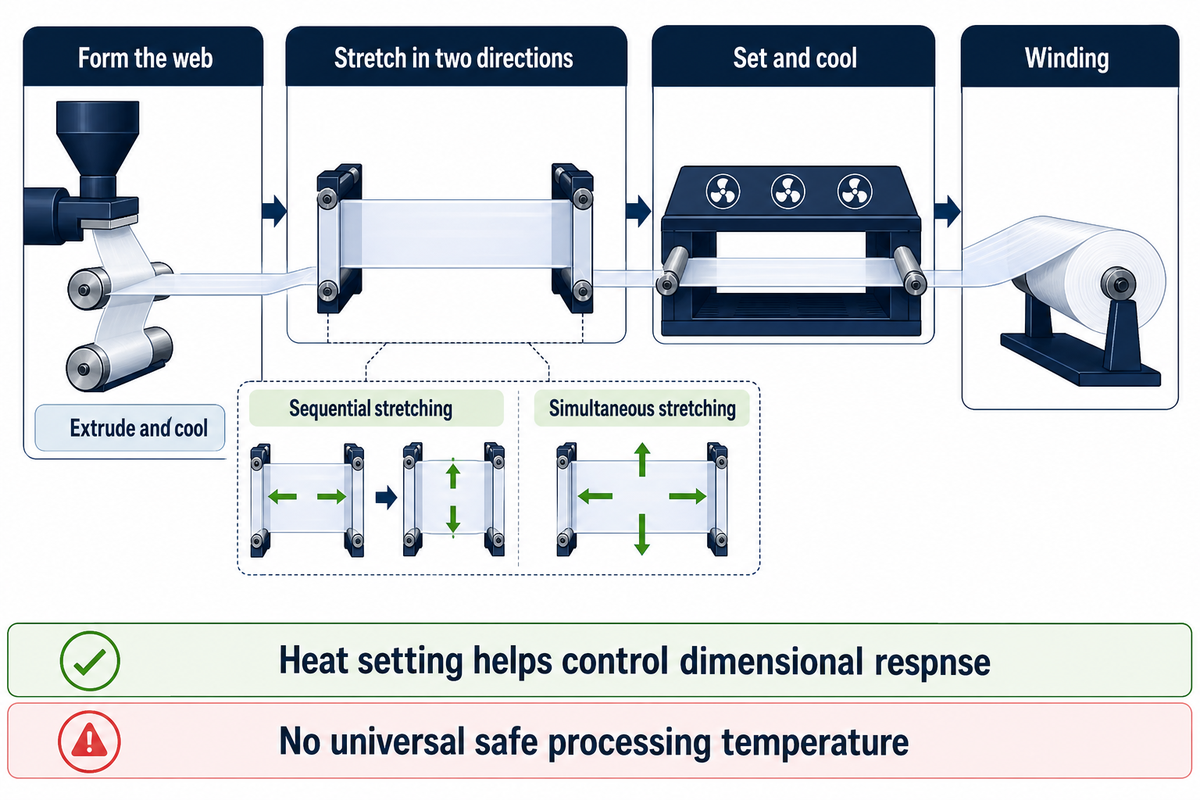
The BOPP manufacturing process forms a polypropylene web, stretches it in two directions, and controls the history of its heating before winding. Equipment is configured to perform stretching in either a sequential or a simultaneous mode. Heating during heat setting helps with dimensional control of the film. The temperature limit for later processing comes from that grade’s shrinkage data at the intended exposure time and direction.
How is BOPP film made?
BOPP plastic film manufacturing starts with the extrusion of a starting sheet. Stretching alters the arrangement of polymer chains and reduces sheet thickness. Brückner’s technology-center brochure outlines both stretching routes and lists preheating, stretching, annealing and cooling steps. Capabilities of the equipment outline available routes not a formulation for every grade.
- Form the web. Extrude and cool the starting film structure.
- Stretch the film. Apply the selected sequential or simultaneous orientation process.
- Set and cool. Control the thermal stages before subsequent handling and winding.
Stretching polypropylene is also capable of creating voids around dispersed particles. In the introductory chapter of the Arkis study this relationship with orientation and pearlescent structure is described. Thus, for a clear film and a cavitated film which both happen to be biaxially stretched, a different interpretation would be required.
How are stated stretch ratios related to measured properties of BOPP films, for example? Without understanding the thermal sequence and formulation of the film, relating stretch ratios to shrinkage performance in a dryer wouldn’t be possible. Keep the recipe for the film separate from its dimensional performance.
What Orientation Changes in Strength and Heat Response
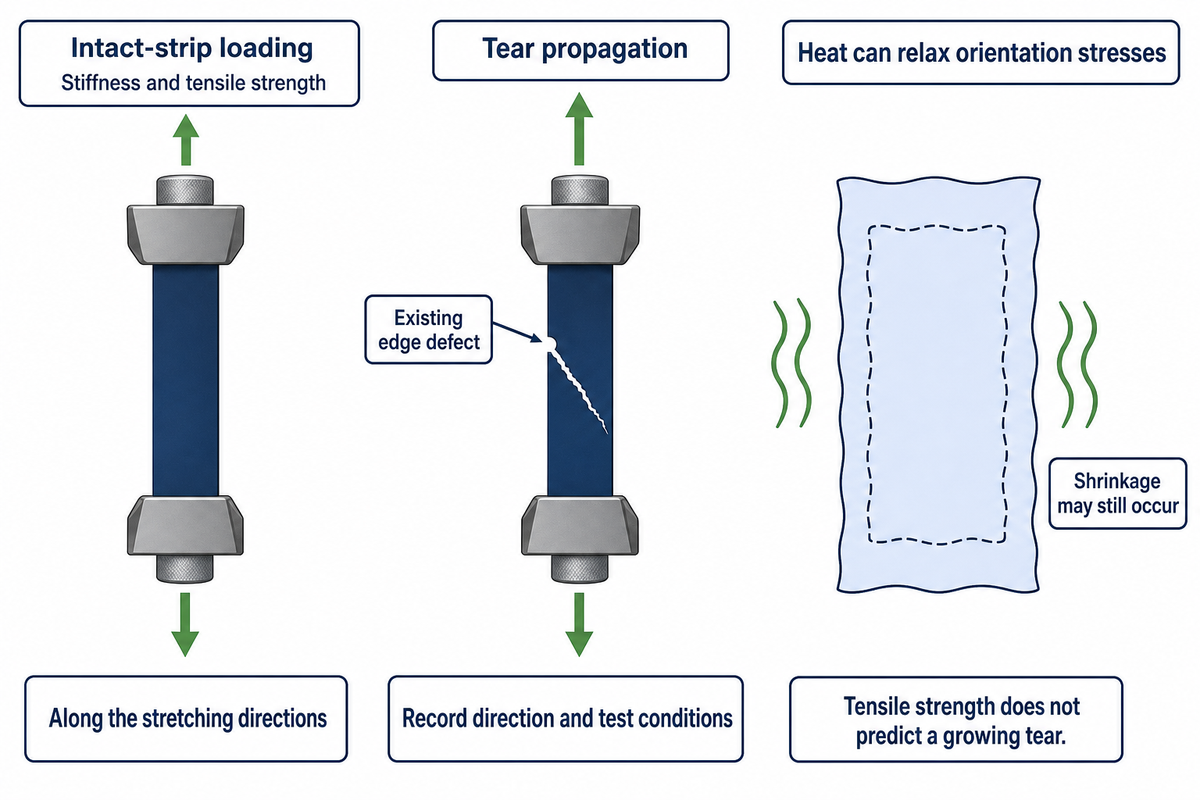
Orientation alters the way that film carries a load and typically increases stiffness and tensile strength in the direction of stretching. Tear propagation is a different failure mechanism. Heat can also relax a film’s orientation stresses, so a specimen that’s strong at room temperature may still shrink during processing. Grade-specific measurements are required for each question.
ASTM D882-26a covers thin film and plastic sheeting below 1.0 mm. Its public guidance identifies specimen geometry and test conditions as comparative controls, and makes a finer distinction. It also makes a sharper distinction:
“Materials that fail by tearing give anomalous data which cannot be compared with those from normal failure.”
The direction question is handled by a separate guide for machine direction and transverse direction in plastic film. A direction label is to be placed next to the measurement result and not in a footnote detached from it.
Hypothetical scenario: If a stronger web still splits, a BOPP film’s high tensile result may lead the converter to consider replacing the web. During a planned trial to evaluate the effect of the new web, an engineer notices splits initiating near a damaged slit edge. Purchasing wants to reject the tensile test report, and production wants to increase web tension to stabilize tracking. Neither response establishes the cause of splitting. A more useful comparison is to distinguish intact strip loading from crack growth at a defect. It also checks if the reports used the same direction and test conditions. Edge splitting may have occurred during the test, but its cause remains to be established. Recording the failure mode, an edge inspection, or either measurement may help explain the root cause of the problem. No improvement percentage follows from a tensile test alone, and increasing web tension may load the edge further.
Engineering note: A nominal thickness is incomplete without its agreed tolerance. For D882 comparisons, record measured thickness and specimen dimensions; don’t invent a universal BOPP tolerance from the standard’s 1.0 mm scope boundary.
BOPP Barrier Properties: Moisture Is Not Oxygen
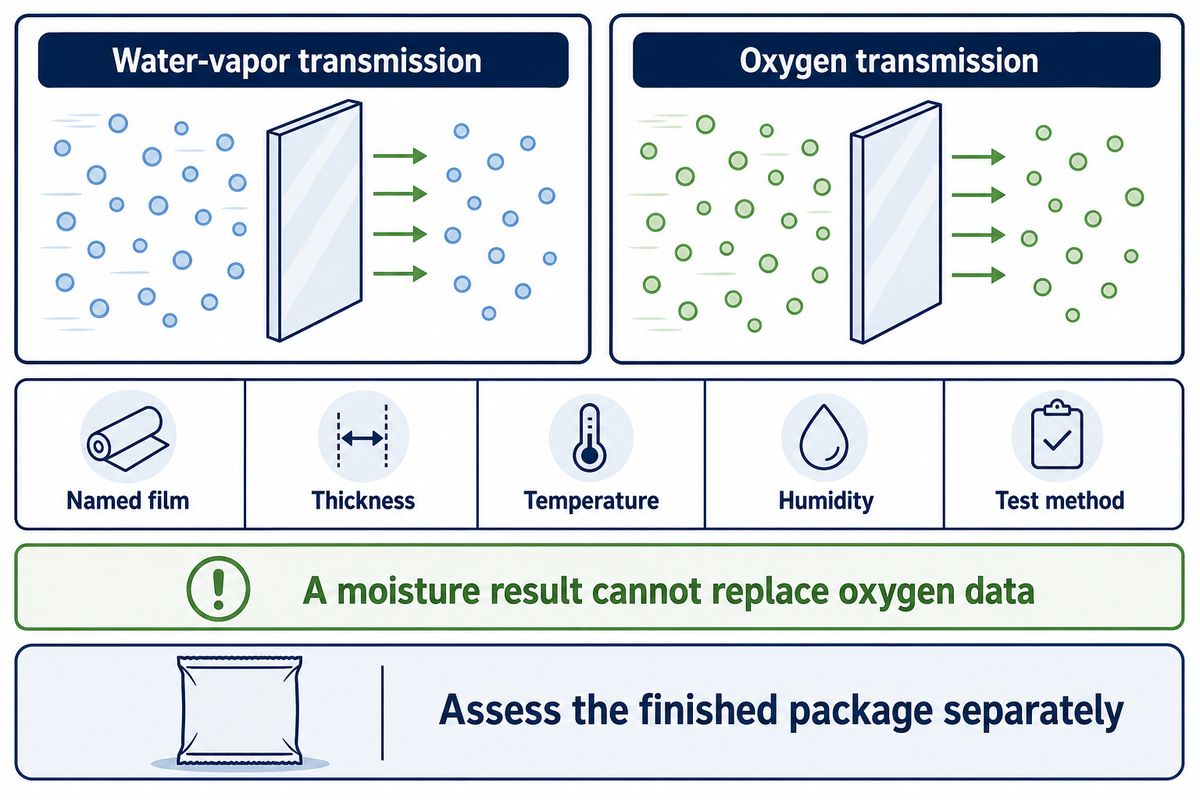
BOPP barrier properties have to be split into water vapor and oxygen transmission. Moisture resistance can suit one product, and oxygen protection remains inadequate for another. Coatings or metallization change the structure being measured, and, therefore, a barrier result belongs to a film of named type at stated thickness, temperature and relative humidity.
ASTM F1249-25 refers to water vapor transmission, and ASTM D3985-24 refers to oxygen transmission. For product packaging, neither number in isolation indicates the level of protection offered by a sealed package.
| Named film | Nominal thickness | Reported property | Conditions and method |
|---|---|---|---|
| Jindal Bicor MB344US, transparent multilayer OPP | 40 µm and 50 µm grades | WVTR: 4 g/m²/24 h for each | 38°C, 90% RH; ITM 46 |
| Toray PWX5, metallized BOPP | 18 µm | WVTR: 0.09 g/m²/day | 38°C, 90% RH; ASTM F1249 |
| Toray PWX5, metallized BOPP | 18 µm | OTR: 0.78 cc/m²/day | 23°C, 0% RH; ASTM D3985 |
These represent typical values, and not acceptance limits, of the manufacturers. The films differ in their thickness, construction and water-vapor test method. Dividing their numbers wouldn’t isolate the effect of orientation or metal. Jindal’s film also has a sealant function, and its data are not a measurement on a bare resin.
Comparisons need to consider history. ASTM F392/F392M-23 describes flex conditioning, followed by gas or water-vapor tests, to characterize barrier changes. Where the package flexes in use, ask for transmission results after Condition D or E, the levels the practice typically uses for barrier effects; flat-film results omit flex history.
PWX5’s 0.78 cc/m²/day oxygen result applies at 23°C and 0% relative humidity. An oxygen sensitive food packaging decision requires an assessment of a finished package and an oxygen result under relevant conditions. A low water-vapor number cannot replace the missing oxygen result.
Clear, White and Matte BOPP: Optical Tradeoffs
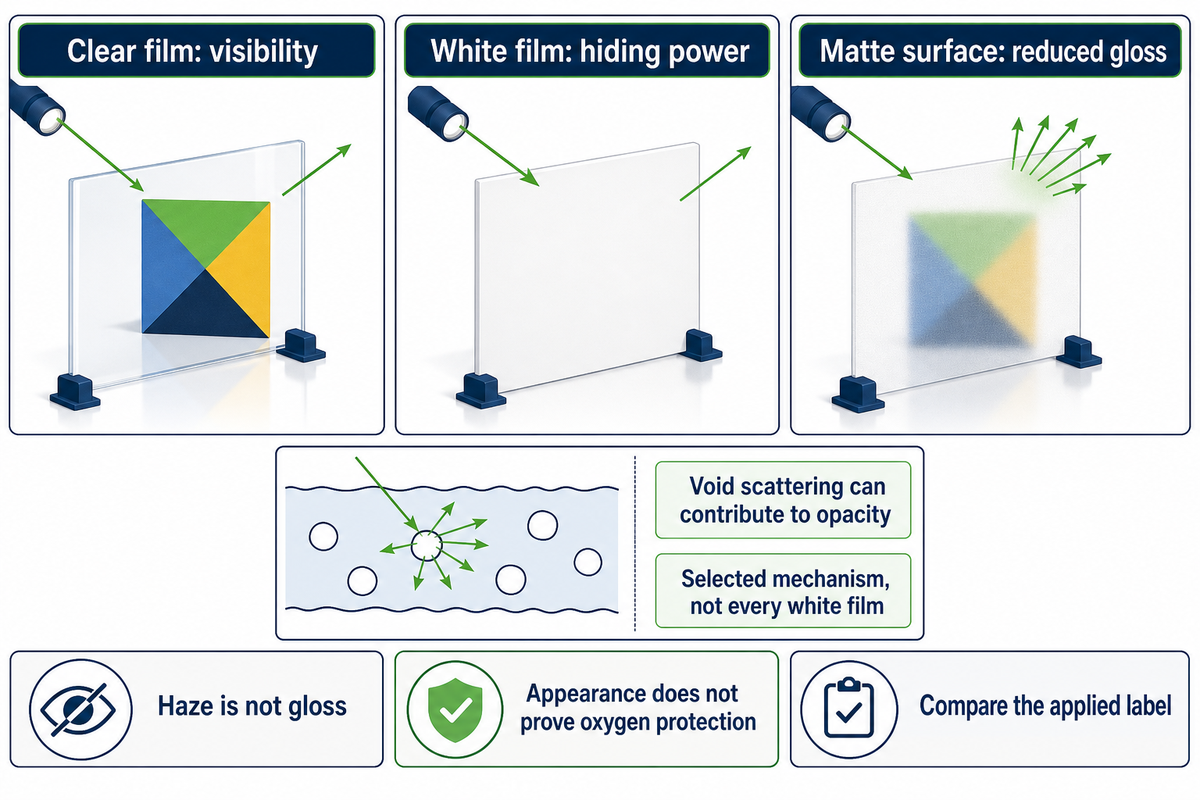
Clear BOPP films favor visibility; hiding power is favored by white BOPP and a glossy appearance is reduced by matte surfaces. Clarity and haze are different than gloss. Change in appearance can be by intent, hence the intended wrapper or label determines which result is considered useful.
ASTM D1003-21 describes haze and luminous transmittance for transparent, planar specimens. Keep haze results from the hazemeter and spectrophotometry procedures apart: hazemeter values are normally slightly higher and less variable. Haze is a separate result from gloss and from oxygen protection; above 30% haze the method treats the material as diffusing and points to Practice E2387.
In the study conducted by Arkis and others on pearlescent films, internal air spaces contributed to opacity through light scattering; the removal of pores by heat pressing changed transparency and reduced film thickness from 30 µm to about 23 µm. The study doesn’t isolate a percentage improvement in transparency due only to the removal of internal pores.
We need to consider surface preparations separately. A 2020 study in Coatings reported changes in the surface chemistry and roughness after corona treatment. Those changes suggest a surface treatment mechanism, but don’t supply an ink-adhesion guarantee or an oxygen-barrier value.
To evaluate a clear BOPP label, look at the label on its intended product. Some adhesives and inks may alter the appearance of the label. If the objection is “the clearer sample must be better,” consider whether the requirement is actually visibility or background hiding.
BOPP vs CPP: Match the Film to Its Role
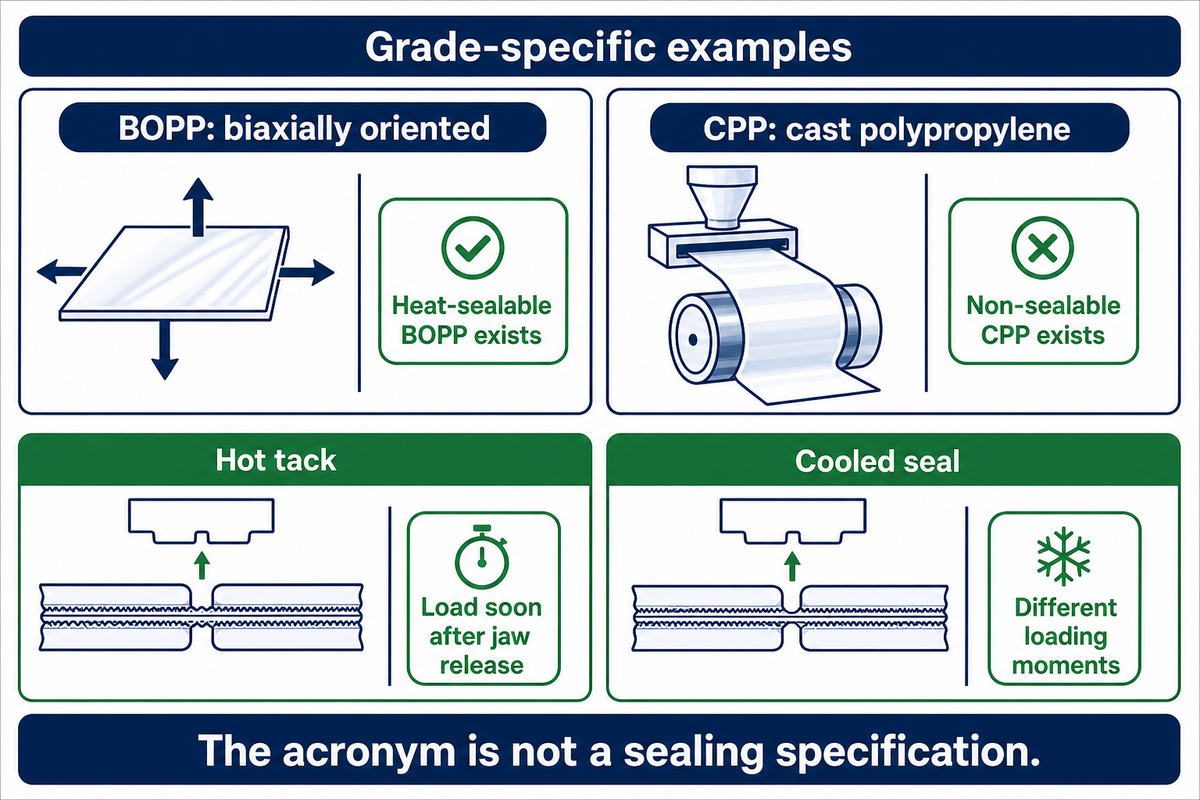
BOPP and CPP indicate different means of film processing in the polypropylene family. BOPP is biaxially oriented and CPP is cast (polypropylene film). Packaging applications depend on the actual grade and sealing surfaces. Neither abbreviation alone defines which film seals, which side is printable, or which structure gives the required protection.
What is the difference between PP and BOPP?
PP names the polymer, and the acronym cannot determine the film grade. Biaxially oriented polypropylene film names the processed film. Polyplex lists heat sealable BOPP grades BTHOS and BTHOW. Non-sealable metallized CPP film is listed in the product range TNMMIC. In this scenario, product descriptions don’t follow an acronym-based sealing rule.
Key applications of BOPP film include labels and flexible wrappers. The Arkis paper describes how BOPP film is widely used in packaging. When BOPP film is used as a laminate layer, determine its role and the surface to which it’s bonded; the polymer name can’t provide the answer.
A 2005 OPP/CPP study’s public abstract states that CPP surfaces can be sealed face to face. A 2012 BOPP study’s abstract states that an 18 µm film can be sealed on both sides. These research structures are specific to the studies, and the findings are not universal settings.
Hypothetical scenario: A cooled seal passes, a hot seal opens. A food and beverage packer looks at a new sealable film after a laboratory sample holds once cooled. On the intended form-fill line, product weight would load the seam shortly after the jaws release. The laboratory result answers only part of that question. An engineer would look at hot tack at the relevant loading delay along with the cooled seal result, and consider the temperature and dwell time window. Purchasing might look at the seal initiation temperature, but that single point doesn’t describe the behavior of the seam before cooling. The next significant evidence might be a hot tack response related to the line timing, and not a general BOPP vs CPP comparison.
In ASTM F1921/F1921M-12(2023), hot seals are addressed prior to ambient cooling. Its instrumented methods differentiate loading and timing conditions. Make that differentiation when assessing sealing claims.
Before Using BOPP: Compare Like-for-Like Film Data
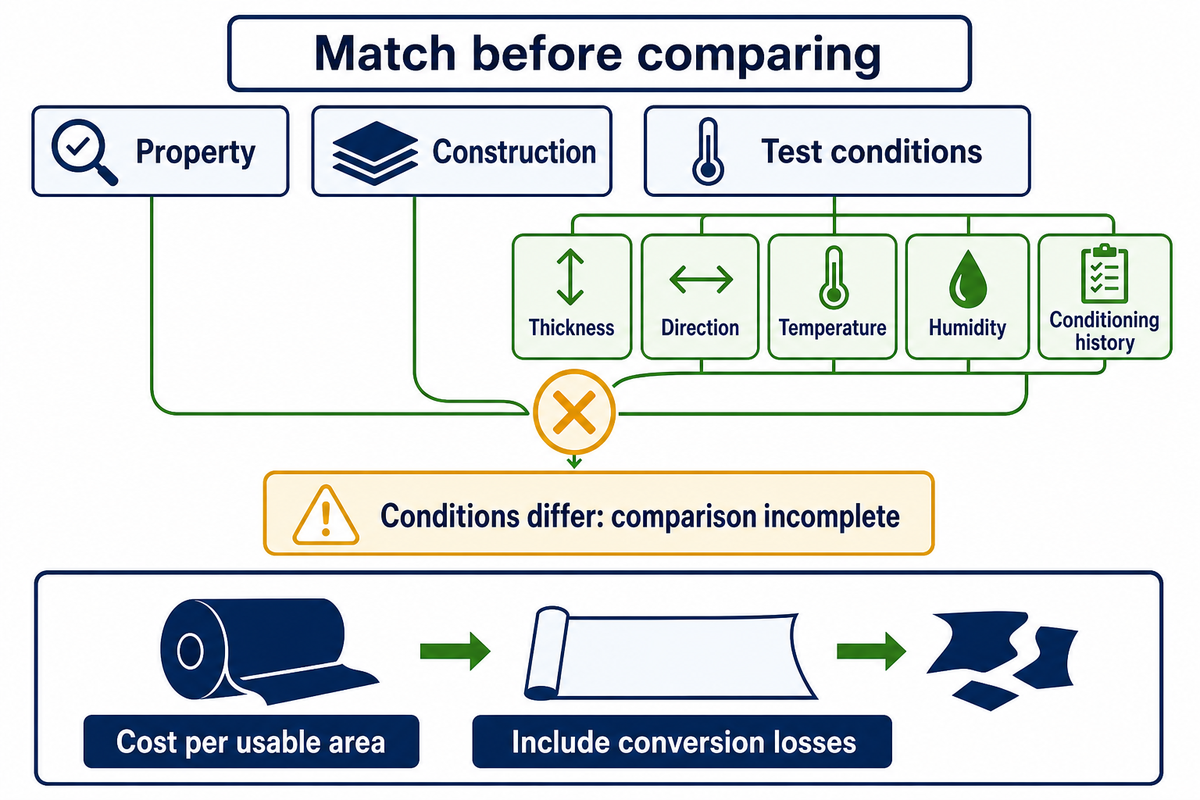
Prior to using BOPP, compare results only for the same property, construction and test conditions. The meaning of a value can be altered by factors such as humidity, conditioning history, temperature, thickness and direction. The price of the film also needs conversion into usable area, because rejected film is of no value.
Matched-Condition Film Comparison Sheet
This page pairs each property of common plastic films, and identifies the missing condition that could invalidate a comparison.
| Compare | Match or record | If missing | Decision limit |
|---|---|---|---|
| Thickness | µm, variation and construction | Request measured values | Equal thickness does not mean equal structure |
| Stiffness | Modulus, direction, specimen dimensions | Align test setup | No tear-resistance prediction |
| Tensile failure | Method, speed, direction, failure mode | Separate unlike failures | No universal web-tension setting |
| Shrinkage | Temperature, time and direction | Obtain exposure-specific results | Room-temperature strength is insufficient |
| Water-vapor transmission | g/m²/day, temperature, humidity, method | Keep results separate | No automatic thickness normalization |
| Oxygen transmission | cc/m²/day, temperature, humidity, method | Obtain oxygen data | WVTR cannot substitute |
| Flex durability | Conditioning plus post-flex transmission | Evaluate handled material | Flat-film results omit flex history |
| Optics | Haze or transmittance and procedure | Name the optical requirement | Haze is not gloss |
| Seal response | Faces, temperature, pressure, dwell | Compare the sealing window | Initiation alone cannot approve a line |
| Hot tack | Loading delay and test procedure | Match early seam loading | Cooled strength is a different result |
| Material cost | Usable m² and conversion losses | Calculate cost per usable area | Price per kilogram omits yield |
F1249’s public note mentions that the inverse relationship of water-vapor transmission rate to film thickness and its direct relationship to water-vapor partial pressure difference may not always hold. Rescaling unmatched figures can create a false sense of precision. The plastic film test methods overview offers insights into the relevant measurements.
Hypothetical scenario: More expensive material costs less per usable area. Assume film A costs $240 per roll and provides 4,000 m² before a hypothetical 5% conversion loss. Assume film B costs $250 per roll and provides the same 4,000 m² before a hypothetical 1% conversion loss. Usable area equals gross area multiplied by the retained fraction. Assuming those conversions, film A provides 3,800 m² and costs about $0.0632/m²; film B provides 3,960 m² and costs about $0.0631/m². The calculated difference is small, but film B, which costs more per roll, is less expensive per unit area. Those assumptions are artificial for illustrative purposes. A true comparison should include loss and downtime as well as disposal costs. Engineering should still evaluate functional equivalence.
Common mistakes and their consequences
Copying a supplier’s normal or typical value into an acceptance limit removes the distinction between a normal or typical example and an agreed specification. Consequently, a shipment can appear to fail a promise that was never made. Compare the requirement with the supplier’s stated test basis prior to making the value contractual.
Approving a structure by its best isolated property is erroneous. An optically clear film may fulfill the appearance requirement, but may leave protection against the introduction of oxygen unresolved. A strong cooled seal may leave early seam loading unresolved. There’s a mismatch between a passing material report and the requirement the package is intended to fulfill.
Ultimately, a lab report can lose meaning with a spreadsheet comparison. Dropping humidity, direction or flex history fields leaves neat numbers representing different experiments. Keep related field data when sharing or sorting data. In cases where conditions differ, mark the comparison as incomplete and define the next measurement. A blank data field is more meaningful than a calculated ranking where justification for the assumption is lacking.
What Is Changing in BOPP Packaging and Recycling
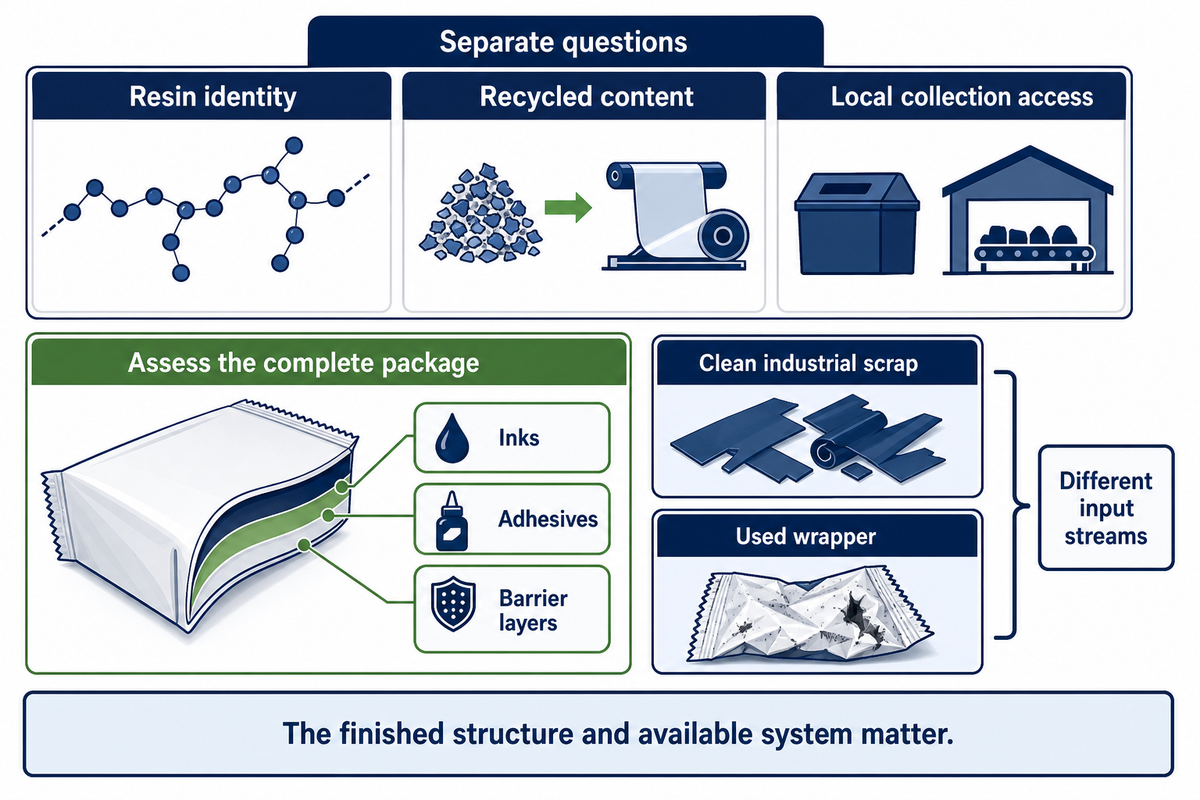
BOPP packaging’s progress includes new structures designed for recycling, as well as grades and structures with recycled content, as long as the package functions aren’t compromised. The questions of resin identity, recycled content and local collection access are separate questions, and progress in one doesn’t mean the same for the others. As such, not every package can be safely recycled in the same way.
On June 9, 2026, Packaging Strategies reported the announcement of PureCycle and Innovia of white cavitated films containing greater than 40% post-consumer recycled content. The report described the companies’ trials, not an independent assessment of all BOPP grades, or a UD Packaging development.
Can bopp film be recycled?
BOPP can use appropriate polypropylene recycling paths, but the final structure and available system determine success. CEFLEX’s recycling guidance covers commercial mechanical recycling of flexible PE and PP in Europe and notes the need for more infrastructure. Clean industrial scrap and a used wrapper are different input streams.
CEFLEX’s design guidelines cover collection, sorting and recycling; for a product revision in 2026, assess the full package (including inks, adhesives, and barrier layers) against the intended recycling pathway. Don’t replace the package assessment with the PP resin code or the percentage of recycled content.
Key takeaway
BOPP describes a processing history. Choose a finished structure by the job each layer must do, then compare measurements under conditions that matter to that job.
Frequently Asked Questions
Will biaxially oriented polypropylene shrink?
Yes. Heat can shrink BOPP even after heat setting.
Heating allows orientation stresses to relax. Heat setting helps control that response but does not remove it. Compare grade-specific shrinkage with exposure time and direction, then relate those conditions to the intended process. Melting temperature alone can’t establish dimensional stability during a shorter exposure at a lower temperature.
Can BOPP film be printed, laminated, or metallized?
Yes, on grades whose intended face is prepared for the ink, adhesive or metal-deposition step.
Identify the intended face before selecting an ink, adhesive or metal-deposition process. A surface treatment changes how that face interacts with other materials; a sealable skin has a different job. BOPP film is also used in metallized structures, as the PWX5 example shows. Films of equal nominal thickness may therefore need different converting conditions. Pair a treatment description with evidence for the proposed ink or adhesive system, rather than treating it as a universal bonding guarantee.
What quality parameters are tested in finished BOPP film?
Start with thickness, tensile, shrinkage, optics and barrier, then add seal and hot tack tests where seams carry load.
For plastic film used in packaging, relevant records include thickness variation, directional tensile behavior, shrinkage, optical properties and transmission rates. Add seal behavior and hot tack where a seam carries load before cooling. Keep the method and conditioning beside each result. Film testing describes the specimen; seams, closures and handling introduce further questions for the finished package. For BOPP bags, identify the film construction and the surfaces being joined. Polypropylene bags described only by resin still leave the conversion process and seal structure unresolved, so request those details before choosing the relevant test.
Is biaxially oriented polypropylene biodegradable?
No. Conventional polypropylene is among the plastics classed as non-biodegradable, so conventional BOPP supports neither a biodegradable nor a compostable claim.
Its polypropylene identity shouldn’t be turned into either claim. Recycling, biodegradation and composting describe different end-of-life routes, each requiring its own evidence.
What is the difference between clear and white BOPP labels?
Clear labels favor visibility; white labels provide a background.
A white film may obtain opacity from pigment or a voided structure. The applied label also includes adhesive and ink, and its appearance depends on the container behind it. Compare finished labels on the intended surface.
As a starting point, consult the plastic materials library for behavior of related polymers. Keep the film construction and its intended function together when reading the next datasheet.
The three scenarios are hypothetical. Grade data describe the specified conditions and specimens; assess the finished packaging separately. The technical basis is summaries of published standards and literature and identified grade data of manufacturers.
References & Sources
- Arkis et al., pearlescent multilayer BOPP characterization, Chemistry & Chemical Technology, 2015.
- ASTM D882-26a, ASTM International, public scope and significance.
- ASTM F1249-25, ASTM International, water-vapor transmission.
- ASTM D3985-24, ASTM International, oxygen transmission.
- ASTM F392/F392M-23, ASTM International, flex conditioning.
- ASTM D1003-21, ASTM International, haze and luminous transmittance.
- Corona-treated BOPP surface study, Coatings, 2020.
- OPP/CPP heat-sealing study, Wiley, 2005; public abstract.
- BOPP heat-sealing study, SAGE, 2012; public abstract.
- ASTM F1921/F1921M-12(2023), ASTM International, hot tack.
- PureCycle and Innovia recycled-content film announcement, Packaging Strategies, June 2026.
- Flexible packaging recyclability, CEFLEX.
- Designing for a Circular Economy, CEFLEX.