
Polycarbonate is an amorphous engineering thermoplastic chosen when a part needs a useful balance of impact tolerance, transparency, dimensional capability and heat resistance. Resin name alone isn’t a design specification. Things like grade, additives, color, thickness, processing history, test methods, and service exposure can all affect the outcome.
This guide focuses on the properties of polycarbonate that affect material approval and failure investigation. Polycarbonate’s versatility is useful, but using polycarbonate well requires more than repeating a family-level property list.
Start with the failure you must prevent. Then match the exact polycarbonate grade, specimen, method and condition to that decision. A trade name, data sheet value, or classification can’t replace validation of a finished polycarbonate part.
At a glance
- The properties of polycarbonate belong to a grade and test condition and not to the polymer name alone.
- Notch geometry, residual stress, temperature, and chemical exposure can interact.
- Compare acrylic, PETG, glass and ABS against the failure mode, not a generic winner claim.
- Approval evidence must match the producer, grade, color, thickness, process and end use.
What Is Polycarbonate?
Polycarbonate is a family of thermoplastics containing carbonate groups in the polymer chain. Commercial grades can be transparent, opaque, reinforced or modified for a particular process or requirement. The family name tells the starting chemistry. It doesn’t give a complete formulation or processing history or service performance.
Its amorphous structure allows many unfilled grades to be optically clear. Common applications of clear polycarbonate sheet include lenses, lighting parts, machine guards, and glazing. Transparency still depends on colorants, fillers, surface texture, thickness, weathering, and the way it’s processed. These factors can affect optical clarity, haze, and light transmission.
The applications of polycarbonate also include some eyeglass lenses and housings for electronic components. Manufacturers make polycarbonate grades for different requirements.
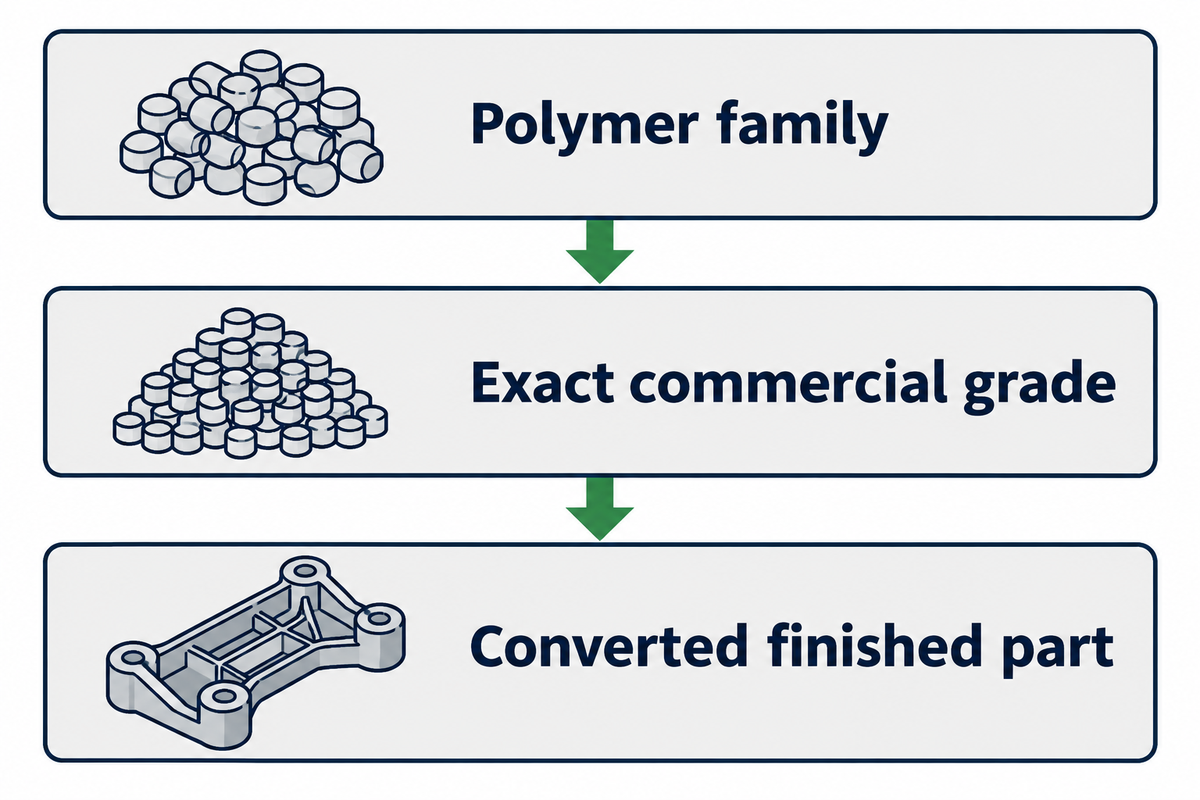
The practical chain is:
polycarbonate family → supplier grade and formulation → processed part → service result
A specification that stops at “PC” leaves open the flow range, ultraviolet package, flame-retardant system, release package, reinforcement, color and regulatory scope. Even a well-known brand such as Lexan or Makrolon covers many grades. Use the exact supplier designation when you want to compare data or approve a substitute.
There are several grades, not three main types that cover every application. “Standard polycarbonate” is therefore too vague for a drawing. Strength and stiffness, flow, optics and approval scope must be stated separately.
For a broader view of polymer families, see UD Packaging’s plastic materials selection index. The cited test results and formulations come from the producers and researchers named in this guide.
Which Polycarbonate Properties Actually Matter in Service?
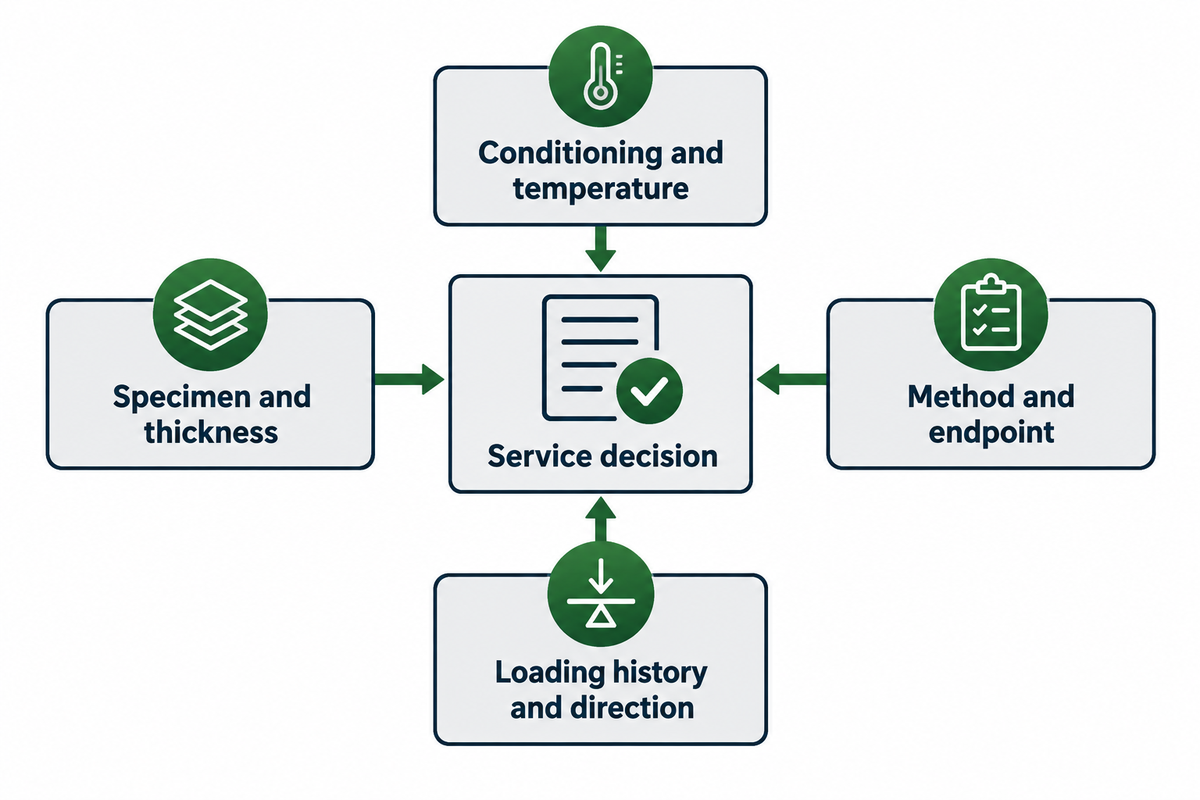
In service, factors such as impact resistance, strength, stiffness, creep, optical clarity, thermal response, and weathering behavior can all matter. Measure each property on a comparable grade and specimen, using a procedure appropriate for the decision. Keep notch, thickness, direction, temperature, conditioning and loading history of specimens attached to every measurement.
Service-Condition Evidence Map
| Decision | Useful screening evidence | Context that must travel with it | What it cannot prove |
|---|---|---|---|
| Impact event | Notched or unnotched impact result | Method, notch, thickness, temperature and conditioning | Finished-part survival in a different geometry |
| Heat under load | Heat-deflection or creep data | Stress, duration, temperature, specimen and direction | A universal continuous-use limit |
| Transparent part | Transmission, haze and yellowness | Thickness, method, spectrum and aging condition | Outdoor retention without relevant weathering data |
| Chemical contact | Compatibility or stress-cracking test | Chemical, concentration, stress, time and temperature | Compatibility with every cleaner, adhesive or assembly load |
| Electrical function | Resistivity or dielectric result | Method, thickness, humidity, temperature and frequency | Safety of a complete electrical assembly |
| Dimensional fit | Shrinkage, expansion or dimensional study | Direction, process, temperature, moisture and geometry | Assembly tolerance after every process change |
| Surface wear | Abrasion or coating test | Load, counterface, cycles, cleaner and coating system | Field scratch life under different contact |
| Fire response | Material flammability classification | Grade, color, thickness, conditioning and method | Finished-equipment or end-use acceptance |
Impact resistance is especially sensitive to context. A 2024 peer-reviewed Charpy study tested two polycarbonates under stated molding and test conditions. At a 0.1 mm notch-tip radius, it reported about 15 kJ/m² and brittle fracture. At 0.25 to 1.00 mm, it reported roughly 70–120 kJ/m² and ductile fracture. The two molecular-weight materials also showed different brittle-to-ductile transition radii.
Those values show condition sensitivity. They shouldn’t be used as design allowables for a different grade or part. A claim like “stronger than acrylic” has the same problem when the values come from unmatched specimens, thicknesses, or methods. Compare equivalent evidence, then test the actual feature where a crack may start.
Short tests do not answer every time scale
A quick impact or tensile test and a sustained-load test ask different questions. For a cover, bracket, or transparent panel that has to support a load for months, request creep or long-duration deformation evidence at the relevant stress and temperature.
The same holds for extrapolation of weathering test data. A NIST study of aromatic engineering thermoplastics showed that wavelength response varied by polymer, while humidity and temperature affected gloss loss and yellowing; these dependencies complicate the interpretation of accelerated exposure. This was a NIST consortium study funded by SABIC-HPP; two authors were SABIC-HPP employees and one was a consultant. Chamber hours shouldn’t be converted to outdoor exposure years.
UV radiation, visible light and moisture cycles don’t make one interchangeable exposure. A grade exposed to UV light behind glazing may see a different spectrum from a panel directly under ultraviolet rays. Prolonged exposure and ordinary exposure to sunlight must be tied to the test cycle.
The existing plastic property-evidence page discusses how different properties such as strength and stiffness provide different insights and answers. Refer to it for cases where several values are given on a data sheet and the service decision remains undecided.
How to Choose a Polycarbonate Grade
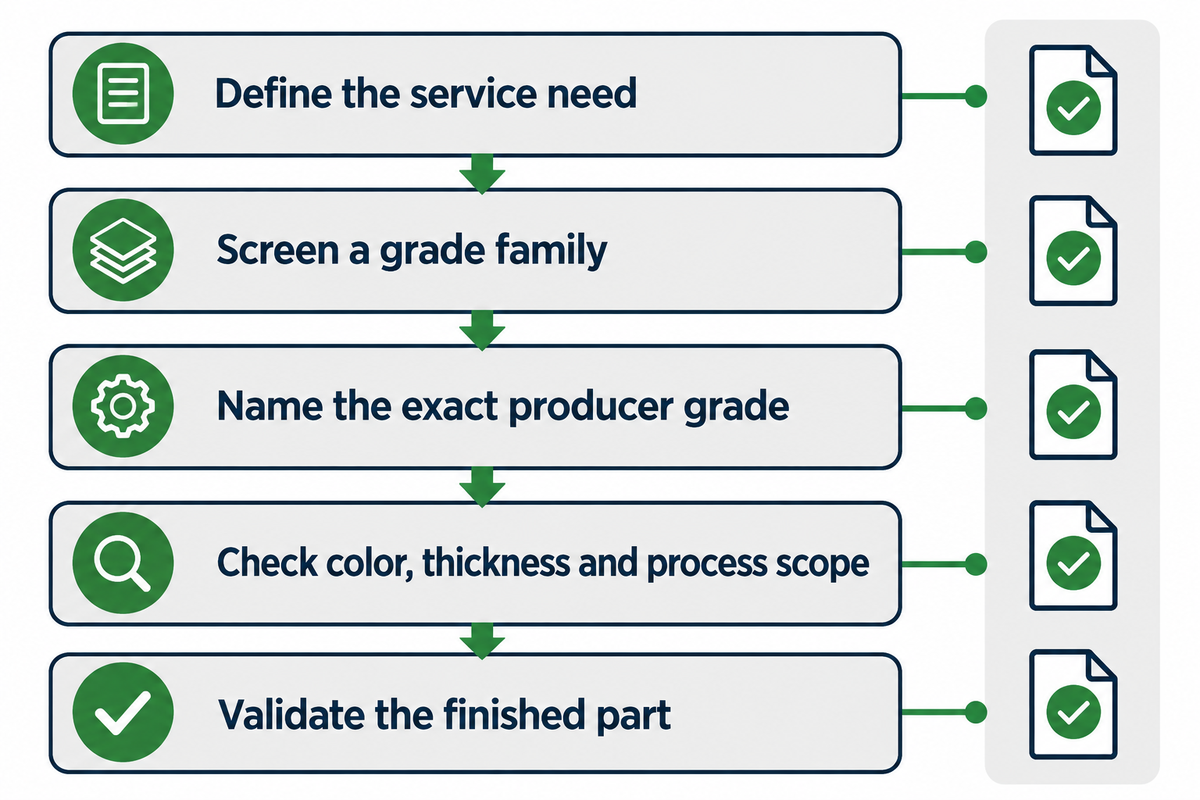
Lock in the non-negotiable service and processing requirements, the optical requirements and the regulatory requirements prior to comparing flow or additive designations. Commercial family names overlap, and one grade may combine ultraviolet stabilization, flame performance, release additives, and color. A written grade stack is a good starting point to define trade-offs and confirm them.
Polycarbonate Grade Evidence Stack
- Base resin and supplier grade: record the full producer designation and revision.
- Flow or molecular-weight range: State the process route and geometry it must fill or form.
- Modifier package: Identify ultraviolet, flame-retardant, impact, release, antistatic, etc. modifiers.
- Reinforcement, color and optics: Define filler level and tint. Haze, transmission and surface requirements.
- Part form: Keep ribs, radii, gates, joints, coatings, secondary operations and thickness.
- Exact approval scope: bind listings and declarations to grade, color, thickness, and end use.
- Trade-off to recheck: Name what may worsen when a feature is added.
General-purpose, ultraviolet-stabilized, flame-retardant, glass-filled, optical, medical, food-contact, and high-flow grade families address different service or processing constraints; they are not a universal taxonomy. A UV-stabilized flame-retardant transparent grade may fit in several families. Don’t assume that family labels transfer between companies.
Use general-purpose grades only when no special modifier is required and the exact performance still passes validation. Optical grades need stated transmission, haze, and appearance requirements. Flame-retardant grades need the relevant classification at the approved color and thickness. Glass-filled grades suit stiffness-led screening, while high-flow grades may enter when a thin or complex geometry drives filling.
Producer examples show why. Covestro’s Makrolon portfolio page lists 6265 X at an MVR of 19 cm³/10 min under 300°C/1.2 kg and a UL 94 V-0 classification at 1.5 mm. It lists 6555 at 10 cm³/10 min under the same flow condition and V-0 at 3.0 mm.
Flow can assist a thin part to fill, but a higher MVR value doesn’t mean better impact performance, chemical behavior, or long-term strength. Glass fiber can increase stiffness and decrease dimensional movement in one direction, but can alter surface appearance, shrinkage, anisotropy and notch response. A hard coating can improve scratch behavior, but introduces edge finish and coating adhesion questions.
The use of medical or food contact language must be prescribed and defined. A resin declaration doesn’t automatically cover colorants, recycled content, alternative routes of finishing, other articles, sterilization, or the final end item. Put the approval documentation on the worksheet before samples are ordered.
A UV package or special coating may give a defined form of UV protection. Do not assume the same retention when a different surface, color or thickness is exposed to UV.
Carry the selected grade into the drawing, Bill of Materials (BOM), and purchase order. “polycarbonate or equivalent” can reopen all decisions a worksheet closed. If alternates are allowed, define the evidence an alternate must match: process route, color, thickness, listing scope, optical requirement, test methods, and acceptance criteria for the finished part.
Sample approvals should indicate what remains to be proved. A naturally colored plaque can’t confirm the appearance of a tinted production part, or the filling behavior of its tool. A prototype machined from sheet can’t answer all the questions related to injection molding, such as stresses and the gate. Define what each sample proves and what it doesn’t.
How Processing Changes the Result
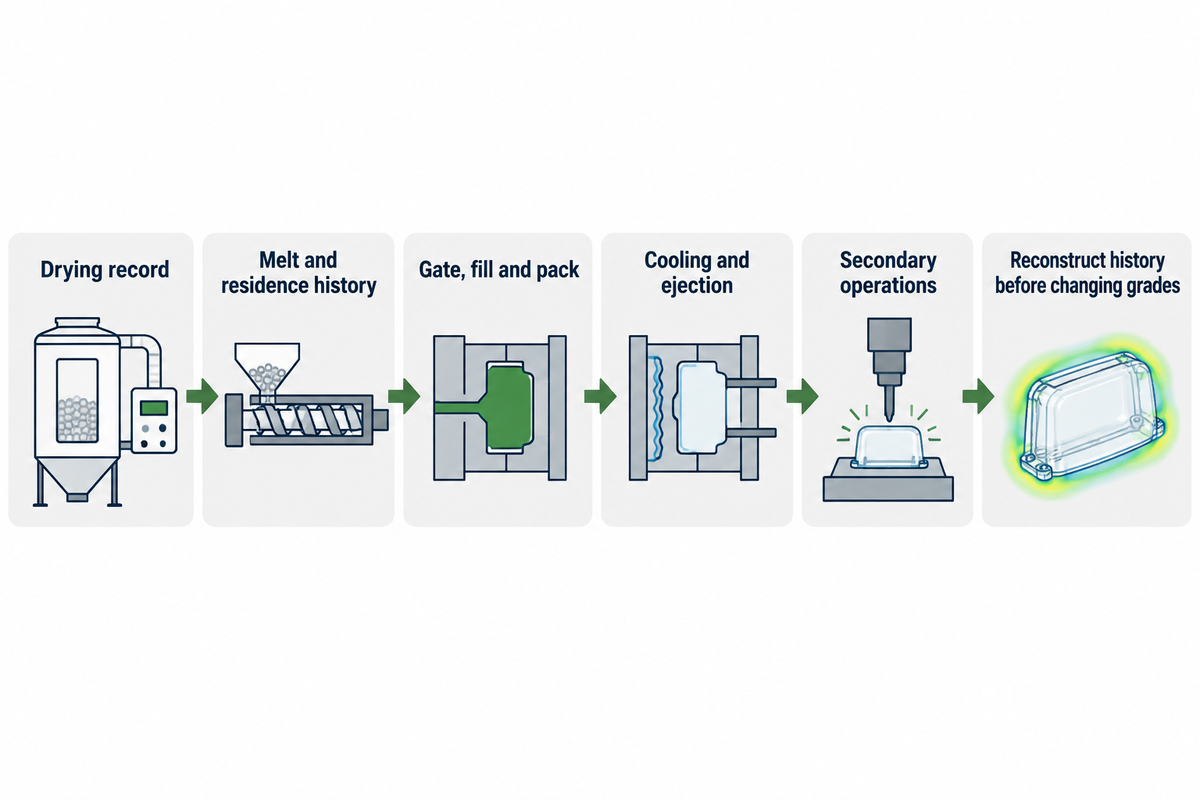
The history of how a part was manufactured (drying, melt, filling, cooling, and secondary operations) establishes the physical and residual stress conditions in a part prior to use. Therefore, two parts made from nominally similar resin can differ in dimensions, appearance, and behavior upon fracture. Understand this history before assessing the base polymer or changing grades.
Polycarbonate is moisture sensitive during processing, but drying schedules vary with the particular grade, equipment and conditions. Use the current manufacturer instructions for the particular grade, and record the setting of the dryer, the condition and behavior of the polymer hopper, the dew point, the temperature of the material, and any interruptions. A set temperature without evidence that the pellets reached the required condition is an incomplete record.
Numerous process variables impact a part’s final form, such as the design of the gate, the mold temperature, the melt temperature, shear, fill and pack behavior, and cooling. For an example, see the Plastics Technology article about mold temperature for polycarbonate. Along with the article and an actual machine record, use a grade-specific processing sheet to complete your analysis.
Recent thermal-history research shows longer annealing times, under the conditions tested, increased yield stress and decreased fracture strain of the polymer. Preserve thermal history when a part’s response changes.
Many post-molding operations (drilling, cutting, heat-forming, coating, painting, and cleaning) can result in residual stresses, surface flaws and changes in the part. A drilled clear polycarbonate sheet may fail at a poorly finished hole even when a flat data sheet specimen looks suitable.
Process-history packet
- Record the resin producer, full grade, lot, color and regrind level.
- Retain storage and drying records.
- Record the machine, melt and mold conditions.
- Retain fill, pack, cooling, ejection and tool-change records.
- Document machining, forming, joining, coating and cleaning steps.
- Preserve failed parts plus known-good controls from traceable runs.
Polycarbonate vs Other Materials: Shortlist Boundaries
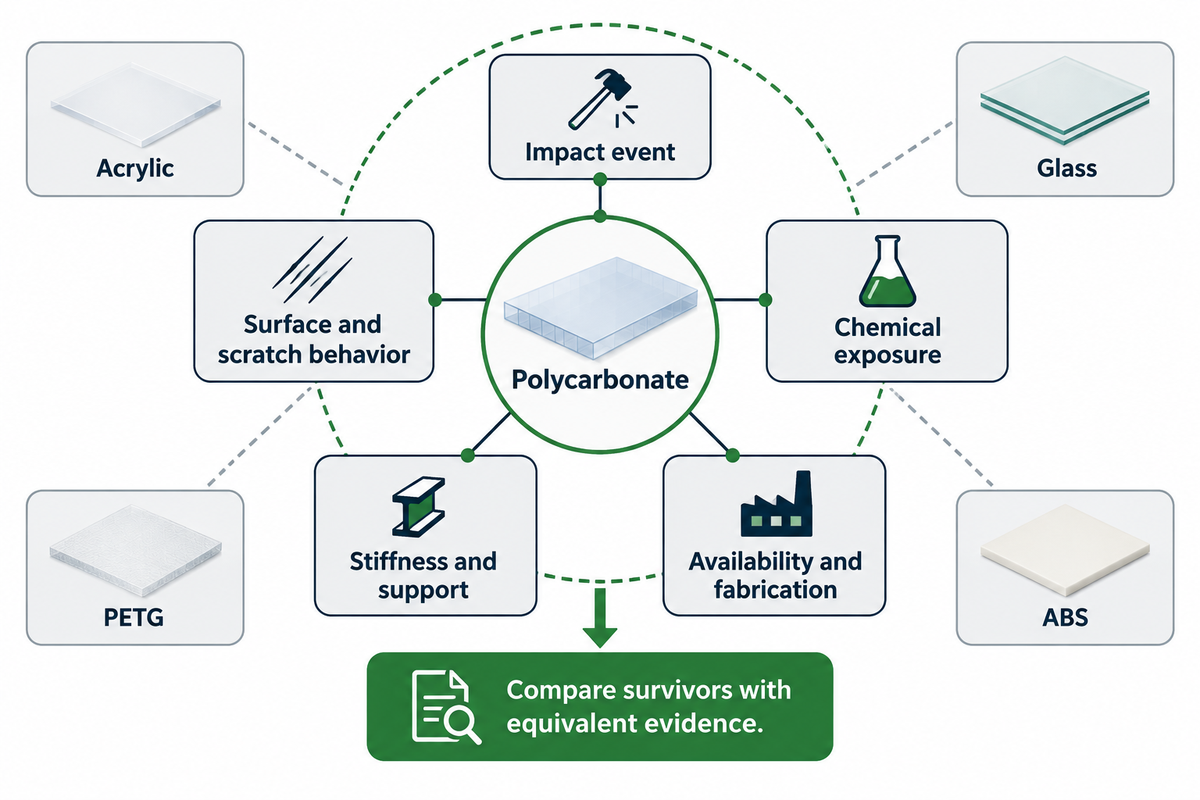
Polycarbonate vs acrylic, PETG, glass and ABS should set shortlist boundaries, while PVC, nylon or polyethylene enter only when other requirements dominate. Impact tolerance, surface behavior, chemistry, stiffness, price, and availability may all be hard screening constraints. Compare the remaining candidates on application fit with equivalent evidence. A 2025 cross-material abrasion study also shows why manufacturing route and test setup must remain visible when comparing plastics.
| Material | Reasons to shortlist | Reasons to reject or validate carefully |
|---|---|---|
| Polycarbonate | Impact-tolerant transparent or engineering parts; forming and molding options | Scratch, chemical and UV behavior depends on grade, stress and coating |
| Acrylic | Optical appearance and surface hardness in many sheet uses | Impact requirement, notch details and fabrication route |
| PETG | Forming and fabrication for selected transparent parts | Heat, chemical and long-duration load requirements |
| Glass | Hard surface, stiffness and long-term optical surface | Weight, edge condition, breakage mode and forming constraints |
| ABS | Cost, process and appearance for opaque housings | Transparency and grade-specific heat, flame and impact targets |
| PVC | Chemical and weathering options in selected rigid sheet applications | Impact, heat, fabrication and smoke or fire requirements by formulation |
| Nylon | Wear, fatigue and load-bearing molded parts in selected grades | Moisture conditioning, dimensions and lack of optical transparency |
| Polyethylene | Chemical resistance, low density and tough opaque parts | Stiffness, heat, bonding, creep and optical requirements |
Acrylic sheets may be a better screen for a display cover where scratch behavior and visual edge quality may be the dominant factors. Polycarbonate panels may be a better screen where accidental impact is the main concern. That doesn’t mean every polycarbonate is “virtually unbreakable,” nor does it validate an unmatched “30 times stronger than acrylic” or “250 times stronger” claim.
Glass and acrylic can both outperform a candidate polycarbonate construction on a requirement that matters more than impact. Standard glass may provide a harder optical surface, while safety glass has its own construction and breakage criteria. A plastic panel used for windows is not automatically a safety-glazing substitute.
For a greenhouse or roof, the decision process goes beyond base-resin impact strength. Consider the structure of the panels, span, support, fastening, thermal expansion, drainage, ultraviolet layer orientation, fire, hail or wind requirements, and how the panels are installed. A clear polycarbonate sheet and a multiwall roofing panel don’t have the same structural evidence.
High impact resistance may help with accidental breakage, but “excellent impact” isn’t a test result. Claims about shatter behavior or bullet resistance require a defined construction and applicable test, not a base-resin label.
A cross-material abrasion study can be useful only when specimen route and test setup remain visible. A 2025 study compared extruded and printed samples of several plastics, including PC, PMMA, PETG, and ABS. Manufacturing route and structure influenced abrasion results, and glass wasn’t included in the study.
Use a decision sequence: define the unacceptable failure, eliminate candidates that can’t meet a hard technical, price or availability constraint, compare matched evidence, and finally validate the constructed or molded part.
How to Investigate Common Polycarbonate Failure Modes
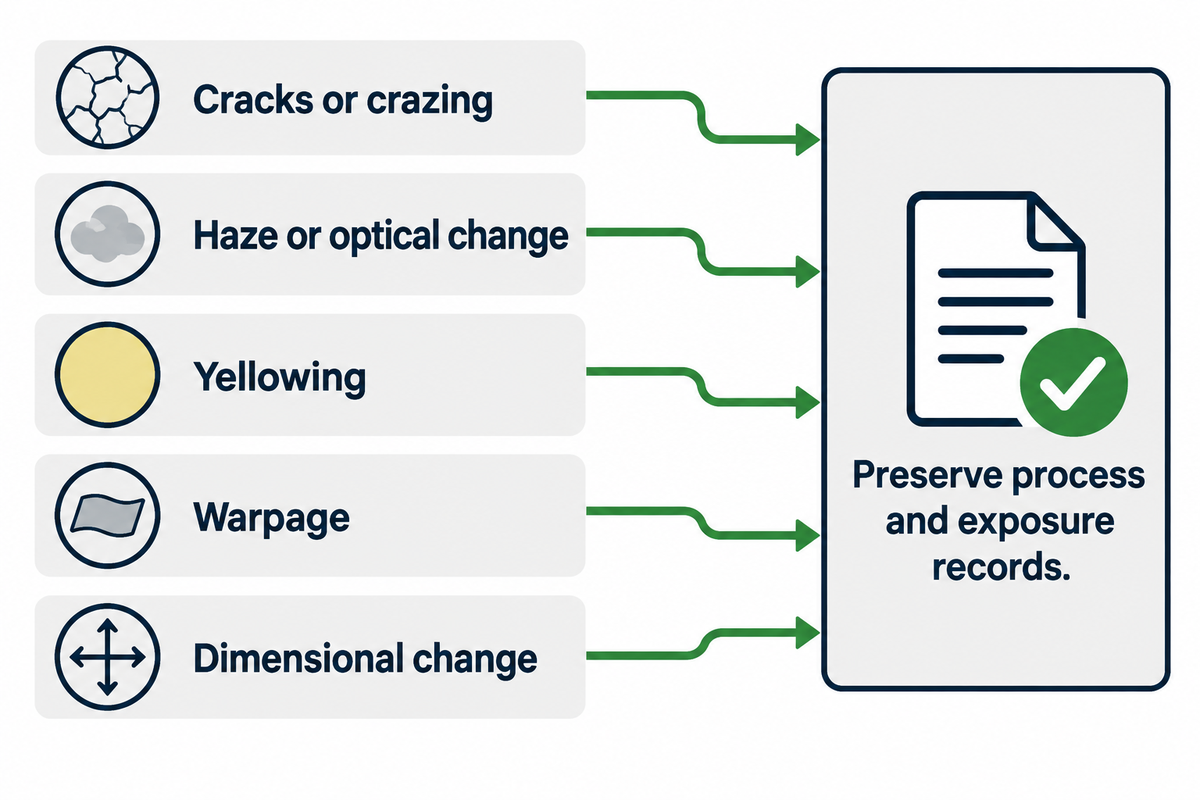
Maintain the failed part, along with a known good control, and a complete material and process history. Preserve competing hypotheses. Choose work that can confirm or reject each hypothesis. A crack, yellowing, warpage, or a scratch are observations. They aren’t the root cause of the failure. The controlled notch study illustrates why geometry and test conditions must remain attached to any fracture conclusion.
Symptom-to-Evidence Diagnostic Map
| Observation | Candidate mechanisms | Records and samples | Confirming or rejecting work |
|---|---|---|---|
| Cracks or crazing | Stress plus chemical exposure, notch, assembly load or degradation | Failed/control parts, cleaner and assembly history | Fractography, material ID and controlled stress/exposure reproduction |
| Yellowing | Ultraviolet or thermal degradation, contamination or wrong grade | Exposure location, lot, color and process records | Color comparison, spectroscopy and controlled aging |
| Warpage | Orientation, fill/pack/cooling imbalance or geometry | Machine/tool records and dimensional map | Process comparison and section/orientation review |
| Scratching | Surface contact, cleaning or coating mismatch | Coating, handling and cleaner history | Surface microscopy and controlled abrasion |
| Brittle break | Notch, aging, stress state, grade mismatch or process damage | Fracture surfaces, geometry, lot and service history | Fractography plus material and process comparison |
In the initial step, take a non-destructive photograph of the entire part, fracture origin, and mating parts. Record how the part was installed and the environment where the part is/was located. If you’re unsure what caused the failure, DO NOT clean the fracture surface. Bag residues and cleaners separately.
Next, review the approved records to verify the exact grade and lot. Infrared spectroscopy or other material-identification techniques may detect family mismatches, but these may not identify all additive packages. Traceability and other analyses may be required if a difference in additives is important.
Fractography can detect initiation sites and help discern ductile from brittle fracture. It requires a complete understanding of the load and exposure history, and the geometrical constraints of the part. The notch study cited earlier shows why a small local feature can affect the mode of fracture under otherwise controlled conditions.
For environmental stress cracking, reproduce the service condition including the chemical, its concentration, and the contact time and temperature. A stress-relieved coupon immersed in the chemical solutions addresses a different question. Thread-lockers, adhesives, machining fluids and cleaners can matter even if the part appeared acceptable immediately after contact.
In the end, state the confidence level. Identify which mechanisms were supported and which alternatives were ruled out. Also identify what evidence wasn’t available and if the conclusions can be extended beyond the tested lot.
Why Do Drying, Stress, Geometry and Exposure Interact?
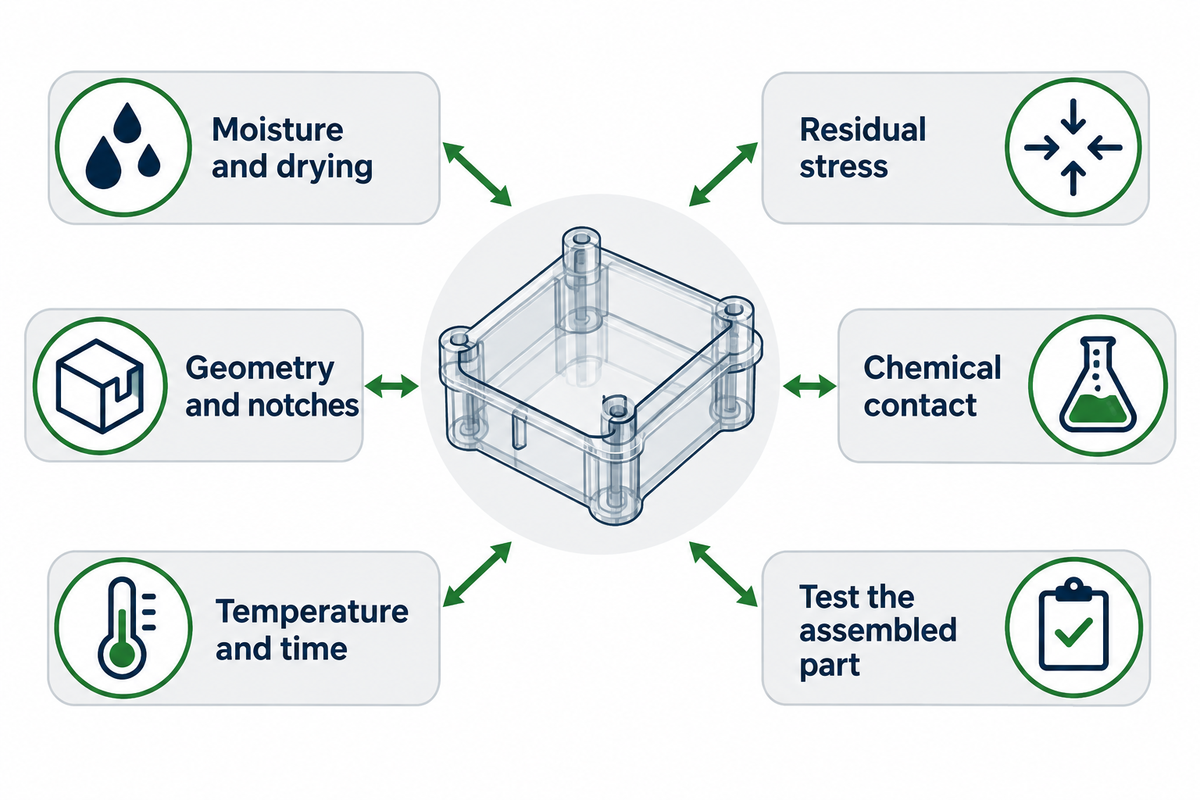
Processing produces the starting condition. The shape of the part controls where stress is concentrated. Chemical, ultraviolet and temperature exposure can also affect the material and initiate cracks. A grade-specific thermal-history study further shows that processing history can alter yield stress and fracture strain under its tested conditions.
Investigating the sequence of events is more effective than assigning a single cause to a department.
Residual stress is particularly important because it may be invisible before exposure. A cleaner that is acceptable for a low-stress coupon may then produce crazing in the assembled part.
Local stress concentrations are caused by changes in geometry. These can include sharp corners, drilled holes, tool marks, or even gate vestiges. The effects of an external stress, like a change in temperature, can alter a part’s stress state. Ultraviolet exposure can have long term effects on a part’s properties and color. Environmental conditions, along with the types of chemicals used, can affect a part’s long-term health.
Before testing, find out the exact grade of a part and preserve process controls and records. Map potential stress raisers. Know all the chemical exposures that can occur in the service life of a part, including maintenance. Vary the variable under study according to the test plan while keeping the other relevant variables as constant as possible. This controlled method supports conclusions about the stresses acting on a part and how they can be mitigated.
What Evidence Should You Request Before Approval?
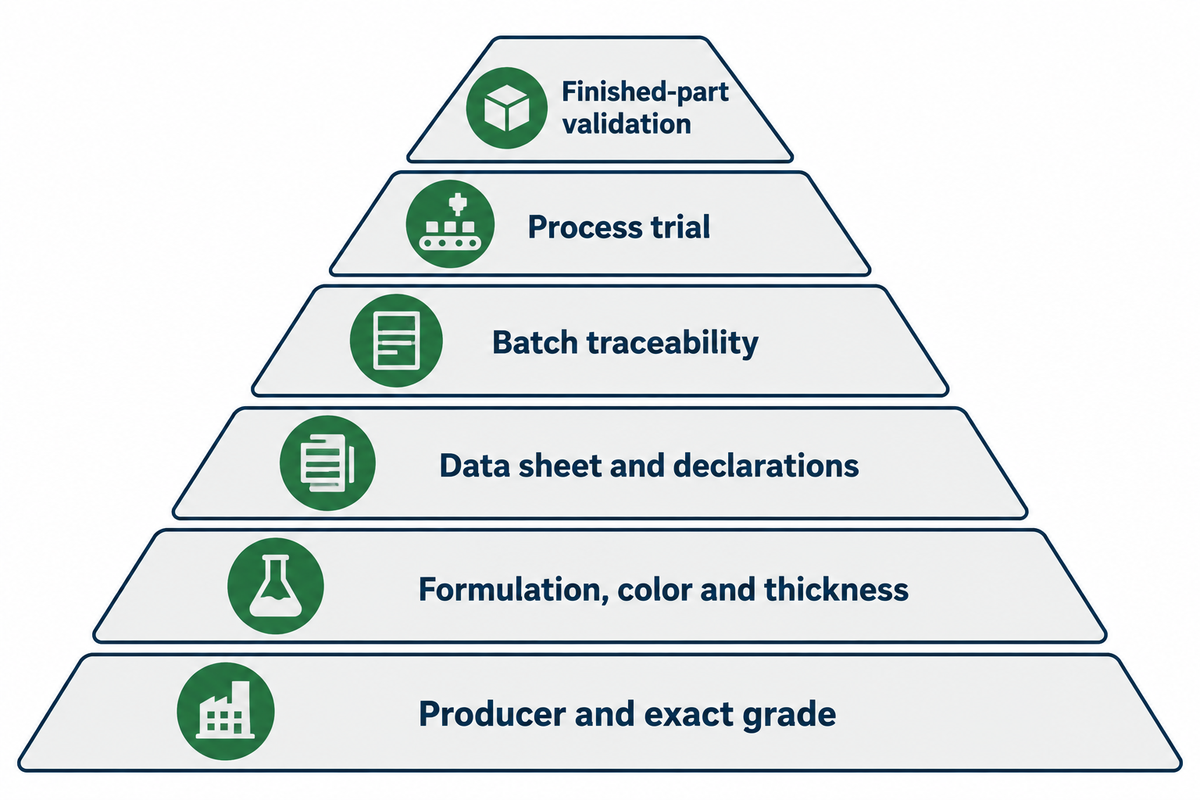
Request a technical data sheet, safety and regulatory declarations, listing records, a certificate of analysis or batch record, a process trial and finished-part validation; tie them to the exact producer, grade, formulation, color, thickness, process and end use. Screening data by itself doesn’t determine batch conformity or finished-part acceptance.
Supplier Approval Evidence Hierarchy
- Technical data sheet: typical screening values and stated test methods.
- Safety and regulatory declarations: material identification and claims tied to the intended market and application.
- Third-party listing or recognition: exact grade, color, thickness and condition.
- A certificate of analysis or batch record covers only the properties actually tested and reported.
- Sample and process trial: actual equipment, tool, drying and secondary operations.
- Finished-part validation: written service-specific acceptance criteria and traceability.
The official UL 94 Edition 7 scope states that final material acceptance depends on its use in complete equipment conforming to the applicable standards. It also warns against assuming that the measured material performance correlates with end-use performance. A V-0 value at a stated thickness is therefore not a blanket product approval.
Food-contact status is jurisdiction- and use-specific; FDA (USA) and European authorities do not issue equivalent, interchangeable conclusions. The FDA (USA) BPA webpage does not state a global conclusion. The European Commission’s current food-contact legislation index lists Regulation (EU) 2024/3190 and its 2026/250 correction, with particular attention to transitional provisions. Check the legal text and the actual article before making a market claim.
In the case of outdoor approval, provide the weathering methods, spectrum, cycles, temperature and humidity. The duration of exposure and the thickness of the specimens should also be provided. Then ask for impact, color and light transmission measured after that exposure rather than accepting a “UV resistant” label.
How are changes in the resin plant, formulation, additives and pigments, recycled content and the production site communicated for change control?
What risks were identified during qualification of the supplier and the supply chain? Identity and lot traceability may be required for every shipment, while dimensions, color or a pre-agreed material property may follow a defined sampling plan. A certificate should be checked against the purchase specification; collecting it alone does not prove that the reported tests cover the approved requirement.
What are the triggers that will initiate revalidation? A new color, thicker section, coating, tool, molding site, cleaner, assembly load or regulatory market may impact the evidence chain even if the supplier grade remains the same. Written triggers prevent approval for a similar material in a different application.
Where Polycarbonate Fits, and Where It Does Not
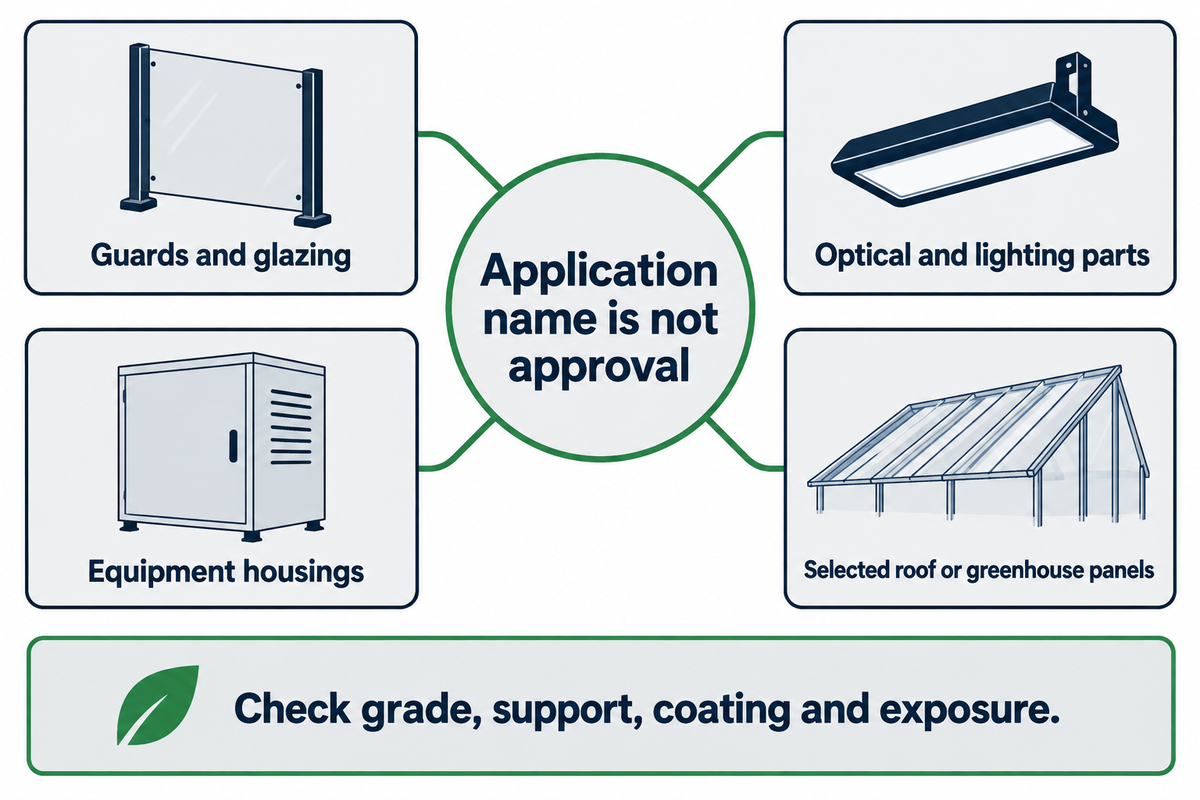
For transparent components, polycarbonate can be considered for impact-resistant engineered parts, molded optical components or housings. There are plenty of application examples, but actual part specification is determined by grade, thickness, coating, support, process, exposure and approvals. The current Makrolon portfolio illustrates the grade-level distinction: listed products differ in flow, flame classification, ultraviolet stabilization and available colors.
Applications for polycarbonate sheet and sheeting range from small covers to larger windows and barriers. Record finished dimensions, edge quality and hole details for custom cut polycarbonate sheets, and don’t assume “cut to size” includes the complete fabrication requirement.
Clear sheet sizes and cut-to-size options are supplier-specific. Ask the vendor about available sheet sizes, cutting tolerance, edge quality, hole quality, minimum order quantity and if working the sheet would alter the coating and/or impact the warranty.
Common application families include guards and glazing, optical and lighting components, equipment housings, healthcare-related components, reusable components, and selected greenhouse or roofing panels. Clear polycarbonate can accept natural light, while tinted polycarbonate can manage appearance or transmission. Each construction still needs its own structural, weathering, and fire evidence.
Sheet sizes and types of polycarbonate sheets affect support and fabrication choices, but size does not establish load capacity. Static electricity may also matter around sensitive assemblies; a static dissipative grade needs its own electrical and mechanical evidence.
Do not say a grade can withstand extreme temperatures merely because one thermal value looks high. Conditional evidence of strength, creep, dimensional stability and impact is required for the part expected to withstand temperatures at either extreme. “Withstand extreme” isn’t complete without time, temperature and load.
Another material deserves review when surface hardness, solvent resistance, stiffness, long-term optical surface, high-temperature retention or a lower-cost opaque housing dominates. Glass or acrylic may be the better answer for one window; PETG or ABS may be the better answer for another formed component. Material selection is conditional, not a loyalty test.
Recyclability depends on numerous factors such as formulation, coating, contamination, collection and available processing. A producer’s recycled-content initiative is evidence about that product route, not proof that all polycarbonate parts will be collected and recycled in the buyer’s market. Keep recycled content and end-of-life recovery as separate questions.
Frequently Asked Questions About Polycarbonate
What are the uses of polycarbonate?
Common application families
Polycarbonate is used for transparent guards and glazing, lighting and optical parts, electrical or equipment housings, healthcare components, reusable items and selected roof or greenhouse panels. Suitability depends on the exact grade, thickness, coating, process and exposure. Treat an application name alone as a shortlist signal, not as finished-part approval.
Which is better for windows, acrylic or polycarbonate?
Choose by service conditions
Polycarbonate is often shortlisted where impact tolerance matters; acrylic may be preferred for surface hardness, optical appearance or scratch behavior. Then check the shortlisted sheet against support spacing, thickness, fire requirements, cleaning chemicals, outdoor exposure and fabrication. Compare equivalent specimens and validate the installed panel instead of relying on a generic strength multiplier.
What are the downsides of polycarbonate?
Key limitations
Potential limitations include scratching, chemical sensitivity under stress, ultraviolet yellowing without a suitable grade, moisture-sensitive processing and residual stress. A coating or modified grade can change some trade-offs, but it also changes the exact evidence needed. Match each limitation to the real service condition before rejecting or approving the material.
Does polycarbonate turn yellow in the sun?
Weathering depends on grade
Yes, an unsuitable grade can yellow under ultraviolet exposure. Stabilized resin, cap layers or coatings may improve retention, but ask for grade-specific weathering data before predicting outdoor life.
What should you not use on polycarbonate?
Cleaners and chemicals need verification
Avoid abrasive tools on an uncoated optical surface unless its specification permits them. Don’t assume a cleaner, solvent, adhesive or thread-locking compound is safe because it causes no immediate visible damage. Some exposures become damaging when residual stress, assembly load, temperature and contact time combine. Check the exact producer compatibility guide, including chemical name, concentration, temperature and duration. Then test the assembled part with its real cleaning or bonding procedure and inspect after a relevant hold period. Don’t transfer a cleaner approval from another grade without checking the formulation.
What are the main types of polycarbonate?
Commercial grade families
Families include general-purpose, ultraviolet-stabilized, flame-retardant, reinforced, optical, medical or food-contact, and high-flow grades. Labels overlap, so the exact supplier grade and approval scope control.
What should a buyer request from a polycarbonate supplier?
Documents and trials to request
Request the exact grade data sheet, safety data, applicable regulatory declarations, third-party listing records, color and thickness scope, batch traceability, processing guidance, change-control terms and representative samples. State the intended process, part geometry and service exposure so the supplier can identify limitations. Then run a process trial and finished-part validation with written acceptance criteria. Keep approved document revisions with lot records. Evidence naming a different grade, formulation, production site, color, thickness or end use is acceptable only when its stated scope covers the proposed material and application.
Is polycarbonate costly?
Cost needs a current quote
The businessanalytiq price index put polycarbonate resin at US$3.29/kg in North America and US$2.07/kg in Northeast Asia in September 2026; grade, additives, color, thickness, product form, quantity, fabrication and certification scope then set the cost of sheet or a finished part. Compare total part and validation cost rather than a resin or sheet price alone.
Turn a Material Name into an Approval Plan
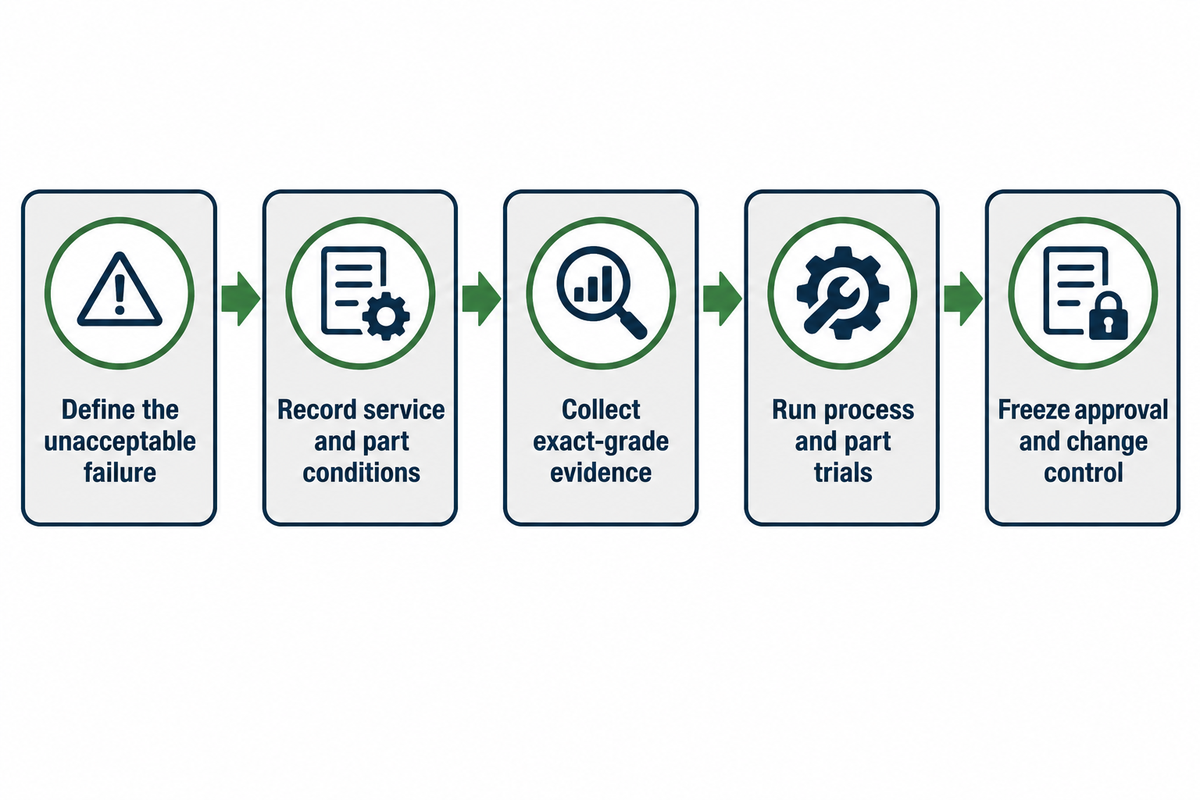
Begin with the service failure to prevent, and complete the grade-stack worksheet, retaining both methods and conditions with every property value. Preserve processing history, compare substitutes with matched evidence, and analyze symptoms without naming a cause too early. Before approval, require documents and trials that match the exact grade, color, thickness, process and end use.
Discuss a plastic material requirement
Send the resin or sheet supplier the intended application, part form, service conditions, current grade information and the failure or approval question to answer. Include an existing data sheet or test report if available to assist in focusing the discussion on evidence gaps.
How this guide was prepared
UD Packaging has developed this resource to assist readers to understand polycarbonate grades and service conditions and identify symptoms of failure. Numerical examples and standards boundaries are from the cited producers, academics, government and standards.
References & Sources
- The Effect of Notch and Molecular Weight on the Impact Fracture Behavior of Polycarbonate Polymers, 2024.
- Makrolon polycarbonate portfolio and named grade examples Covestro.
- UL 94, Edition 7, public scope and revision record UL Standards & Engagement.
- Accelerated Weathering Parameters for Some Aromatic Engineering Thermoplastics, Part 2 NIST; SABIC-HPP-funded NIST consortium study.
- Part One: The Importance of Mold Temperature When Processing Polycarbonate Plastics Technology.
- Thermal History-Dependent Deformation of Polycarbonate peer-reviewed open-access study.
- Cross-material abrasion study of extruded and printed polymers peer-reviewed open-access study, 2025.
- Food-contact materials legislation index European Commission.
- Bisphenol A use in food-contact applications US Food and Drug Administration.