
Polyvinyl chloride is a thermoplastic that becomes rigid pipe, pliable tubing or clear sheet, through changes in formulation and processing. The PVC polymer identifies the material family, and the individual PVC grades determine how a product bends and carries a load and how the product interacts with its environment.
Updated October 2026
Polyvinyl chloride is a plastic supplied in rigid and flexible grades. Additives change its behavior. Select the compound and product form for the required stiffness, exposure and conversion process.
Quick Specs
- Material family: thermoplastic vinyl polymer.
- Two basic forms: rigid and flexible.
- Supply chain: resin, compound, converted article.
- Selection basis: named grade, product geometry and service conditions.
- A harder formulation can perform better in a cold-flexibility test than a softer one; hardness alone is a poor ranking tool.
- Compound test specimens and finished parts answer different questions.
- Thickness and price per sheet must be converted to the same area before comparing a quote.
What is polyvinyl chloride?
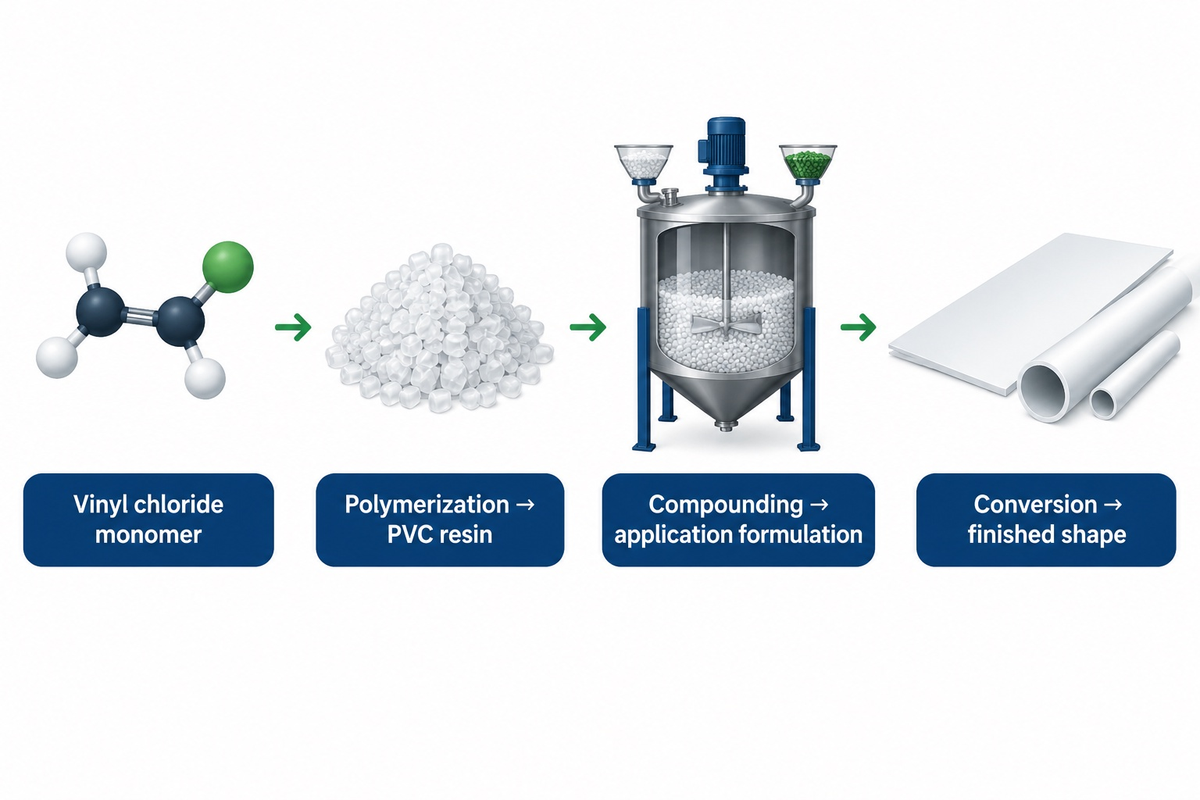
Polyvinyl chloride, abbreviated as PVC, is a synthetic plastic polymer produced by polymerization of vinyl chloride monomer. The PVC resin can then be compounded with additives and plasticizers that enable it to process and perform for a particular application. The finished articles can share the same polymer while having different stiffness, color and flexibility.
The chemical structure contains chlorine along a carbon-based chain; ethylene and chlorine are upstream production inputs. In the PVC production explanation by Teknor Apex, vinyl chloride is the monomer and polymerization produces the resin. These describe the various stages of production and aren’t interchangeable names for a product that’s ready to use.
What does a PVC resin supplier actually sell?
PVC resin feedstock is sold by PVC resin suppliers. Compound suppliers provide formulations for processing and application. Converted sheet suppliers, or processors, sell the finished articles. Choosing among these three sources starts with whether the buyer needs raw material for a line or a part-sized sheet for fabrication.
A fabricator machining a chemical-resistant panel may require finished sheet, while a converter running flexible tubing may require a pellet compound. The PVC plasticization academic review explains why PVC resin and a formulated PVC compound behave differently. For a general overview of resins, see the plastic materials guide.
Rigid and flexible PVC: what changes?
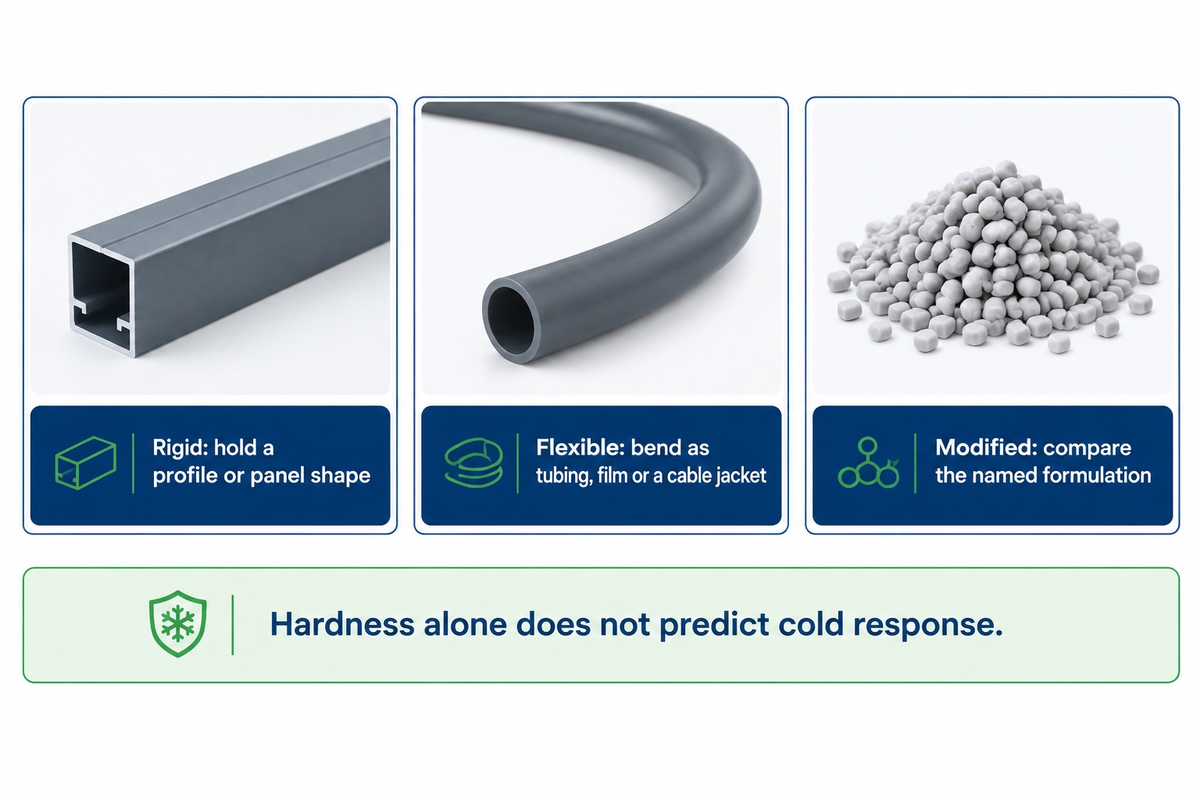
Rigid PVC exhibits relatively little plasticization, compared to conventional flexible PVC. Conventional flexible PVC uses plasticizers to allow chains to move more freely. The choice depends on the part’s function: standing up? Bending? Repeated flexing? Softness by touch does not describe elastic recovery, low temperature behavior or resistance to a particular fluid.
Unplasticized grades of PVC are commonly known as uPVC. In certain cases, plasticized PVC can have a rubber-like feel. Because it is thermoplastic, however, it is not vulcanized rubber. Flexible PVC applications include pliable sleeves. Self-supporting profiles impose a different set of requirements on the material. PVC film likewise needs a formulation that matches its required bend and shape retention.
| Choice | Typical function | Useful comparison |
|---|---|---|
| Rigid | Hold a pipe, profile or panel shape | Modulus, impact response and part geometry |
| Flexible | Bend as tubing, film or a cable jacket | Hardness, bend response and additive behavior |
| Modified or blended | Balance stiffness with a specific performance need | The named formulation’s actual test results |
A historical Plastics Technology report on PVC/POE alloys provides an interesting exception. In this case, a 94 Shore A alloy had a lower brittle point than a 70 Shore A alloy. Some semi-rigid formulations used the polymer alloy, without liquid plasticizer. This result applies to those experimental formulations. A hardness number alone cannot predict every flexible plastic’s cold response.
PVC additives: plasticizers, stabilizers and modifiers
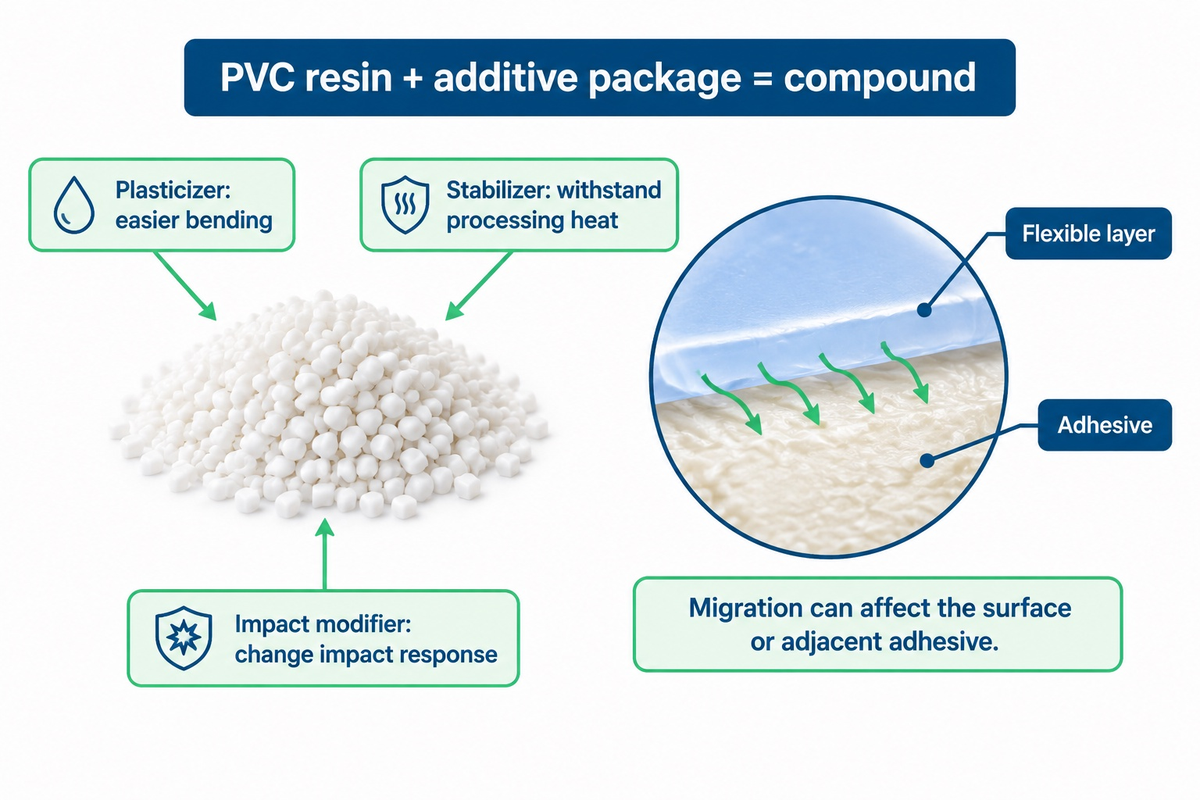
PVC additives affect chain mobility, processing stability, impact response and appearance. Plasticizers allow conventional flexible grades to bend more freely. A stabilizer helps the formulation to withstand processing temperatures. Modifiers, fillers, lubricants and pigments are added to PVC for other jobs. A formulation that allows a part to bend will most likely not be the same formulation that allows a part to maintain its shape.
How do PVC resin and a finished PVC compound differ?
PVC resin is the polymer ingredient. A finished PVC compound combines that resin with an additive package for a specific process and use. The compound can be supplied as a dry blend or pellets. A converter then creates the final geometry, such as a tube wall, sheet gauge or molded housing.
Teknor Apex describes compounding as a separate stage from PVC resin production. For example, a rigid part may be impact modified to be more impact-resistant. A processing aid, however, supports the movement of a resin during its conversion. Filler loading also changes the formulation represented by a density or mechanical result.
Not all plasticizers are phthalate chemicals. A phthalate-free description denotes an aspect of the additive selection, rather than the complete performance of the article. Czogała and colleagues’ review suggests that larger plasticizer molecules may help reduce the mobility of the plasticizing agent and increase processing difficulty.
Migration occurs at the interface. Plasticizer moving from a flexible layer can change the surface or affect an adjacent adhesive. The Chemical Company discusses migration in that product context. For a bonded sleeve, the compound and adhesive need to work together; replacing the adhesive while keeping an incompatible formulation can leave the original problem.
PVC properties: read the grade, not one generic number
Plaskolite’s Vintec I sheet has a published typical density of 1.42 g/cm³ and tensile modulus of 411,000 psi. Those values describe the rigid sheet grade. PVC is also chosen for corrosion resistance in an appropriate chemical service. A family description such as “good chemical resistance” is less specific: load, temperature, exposure and specimen geometry decide which of the physical and mechanical properties matters for the part.
| Property | Typical value | Published method |
|---|---|---|
| Density | 1.42 g/cm³ | ASTM D792 |
| Water absorption | 0.06% | ASTM D570 |
| Rockwell hardness | 115, R scale | ASTM D785 |
| Tensile modulus | 411,000 psi | ASTM D638 |
| Flexural modulus | 481,000 psi | ASTM D790 |
| Notched Izod impact | 1.0 ft-lb/in | ASTM D256 |
| Vicat softening point | 83°C / 181°F | ASTM D1525 |
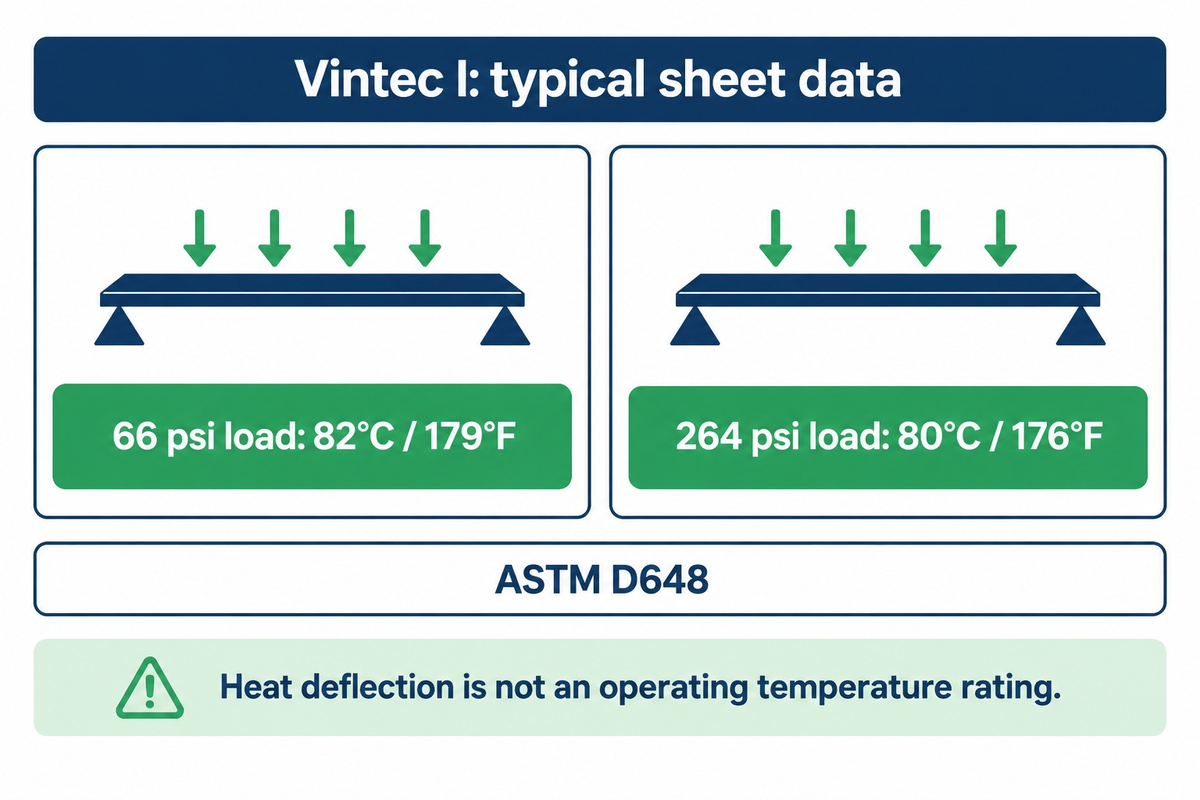
| Heat deflection, 66 psi load | 82°C / 179°F | ASTM D648 |
| Heat deflection, 264 psi load | 80°C / 176°F | ASTM D648 |
Source: Plaskolite Vintec I Typical Physical Properties. These are the manufacturer’s typical results for a given grade, and not guaranteed acceptance limits for every shipment. The two heat-deflection results show why a temperature value must retain its load condition. Neither heat deflection nor Vicat is a continuous operating temperature rating.
ASTM D1784-25 classifies rigid CPVC and PVC compounds via standard test specimens. Its public scope distinguishes those results from properties of a finished product:
“They are not directly applicable to finished products.”
Like other testing methods, tensile testing also has a specimen boundary. ASTM D638-22 describes specified preparation and test conditions; its scope prefers ASTM D882 for thin films below 1.0 mm. Comparisons between a molded dumbbell result and a thin-film result should preserve each test method.
Electrical properties are also assigned to a grade and method. The Vintec I table provides dielectric strength of 544 V/mil under ASTM D149, a dielectric constant of 3.9 at 60 Hz and a dissipation factor of 0.0096 at 60 Hz under ASTM D150. The voltage-per-thickness result describes the test specimen; cable insulation is a separate finished application.
Time adds another variable. A panel that feels stiff during a quick bend can slowly deflect under sustained load. ASTM D2990-17(2025) addresses creep and creep-rupture, including dimensional change under long-term loading. A short-term modulus helps compare initial stiffness; it does not set a loaded tray’s service life. The material test-data comparability checker helps keep those test conditions together.
PVC applications: match the material to the product
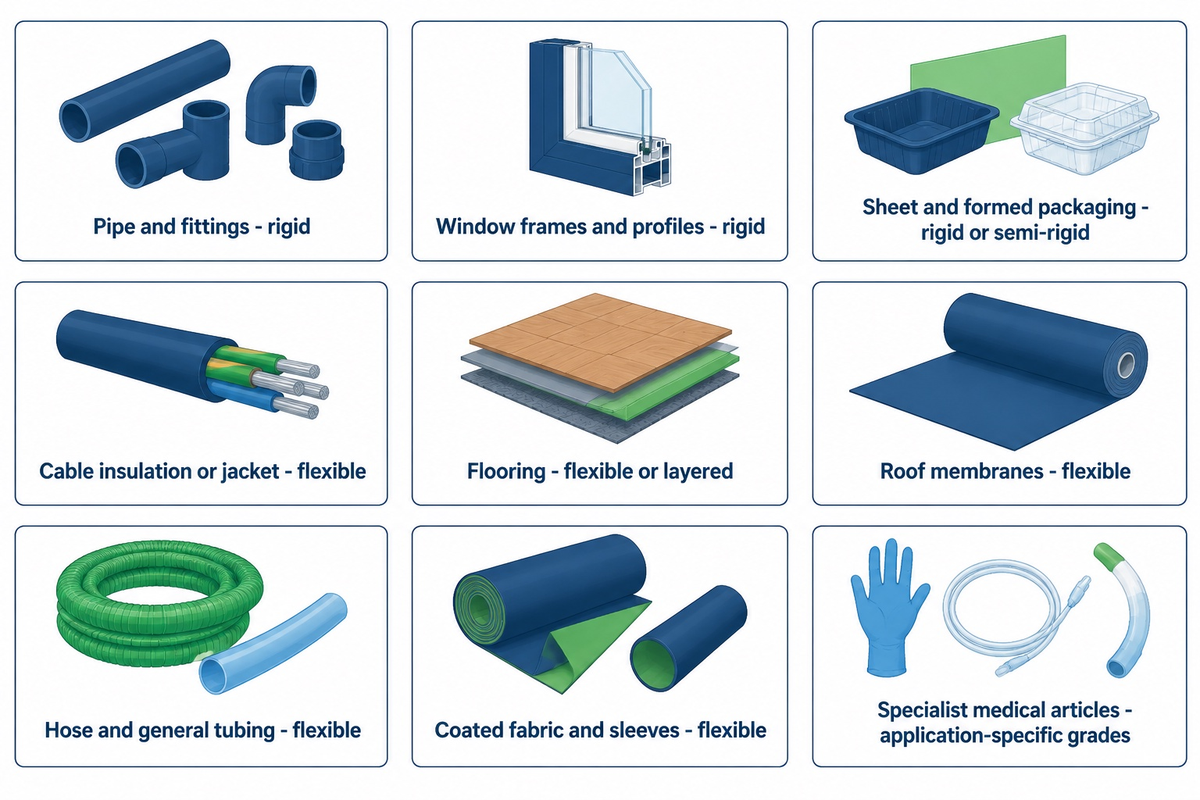
PVC applications split by the shape and movement the product requires. Rigid formulations suit pipes, profiles and self-supporting sheets; flexible formulations suit cable insulation, pliable film and tubing. During product design, other factors impact grade selection. These include impact resistance, exposure to weather, means of attachment and intended contact.
| Product family | Usual form | Decision that changes the grade |
|---|---|---|
| Pipe and fittings | Rigid | Fluid, pressure class and joint system |
| Window frames and profiles | Rigid | Weathering, impact and profile geometry |
| Sheet and formed packaging | Rigid or semi-rigid | Cavity shape, clarity and wall distribution |
| Cable insulation or jacket | Flexible | Bend response and insulating properties |
| Flooring | Flexible or layered | Wear layer, indentation and substrate |
| Roof membranes | Flexible | Outdoor exposure, seams and service conditions |
| Hose and general tubing | Flexible | Bend radius, fluid and connection |
| Coated fabric and sleeves | Flexible | Drape, abrasion and adjoining layers |
| Specialist medical articles | Application-specific flexible grades | The particular device and contact requirements |
Teknor Apex’s production and application overview connects the rigid/flexible distinction to product families. Blood bags and tubing are examples of special uses; neither the PVC designation nor a general sheet datasheet specifies a medical grade.
Should I use rigid or flexible PVC for a thermoformed packaging part?
Use rigid or semi-rigid PVC for a cavity that needs to retain its shape; use flexible PVC when the package needs to drape or bend. The formed wall is as important as the incoming sheet. Stretching redistributes material, so the thinnest corner and the loaded span are considered in the packaging decision.
Let’s look at a proposed clear cavity for a small fitting. A designer starts with a self-supporting wall so the fitting stays in place while the package is handled. Deepening the cavity stretches the corners farther, and the flange still has to meet its mating surface. Selecting a higher incoming gauge can add mass across the sheet but may leave the troublesome corner too thin. A better development sequence would compare the formed part, the remaining wall and the actual loaded package. The initial choice of forming grade is rigid; the trial then decides whether to change the geometry or gauge. This is a design example, not a reported customer example.
For a flexible coil sleeve, the priorities are reversed. A rigid sheet resists the bend; flexible material easily conforms to the shape of the coil. The outer layer of the sleeve (be it printed, bonded, etc.) becomes important. In a 2011 Eng-Tips PVC-to-polycarbonate assembly discussion, the cracks reported were in the polycarbonate component next to the PVC tubing.
PVC processing: from resin to sheet, film and tubing
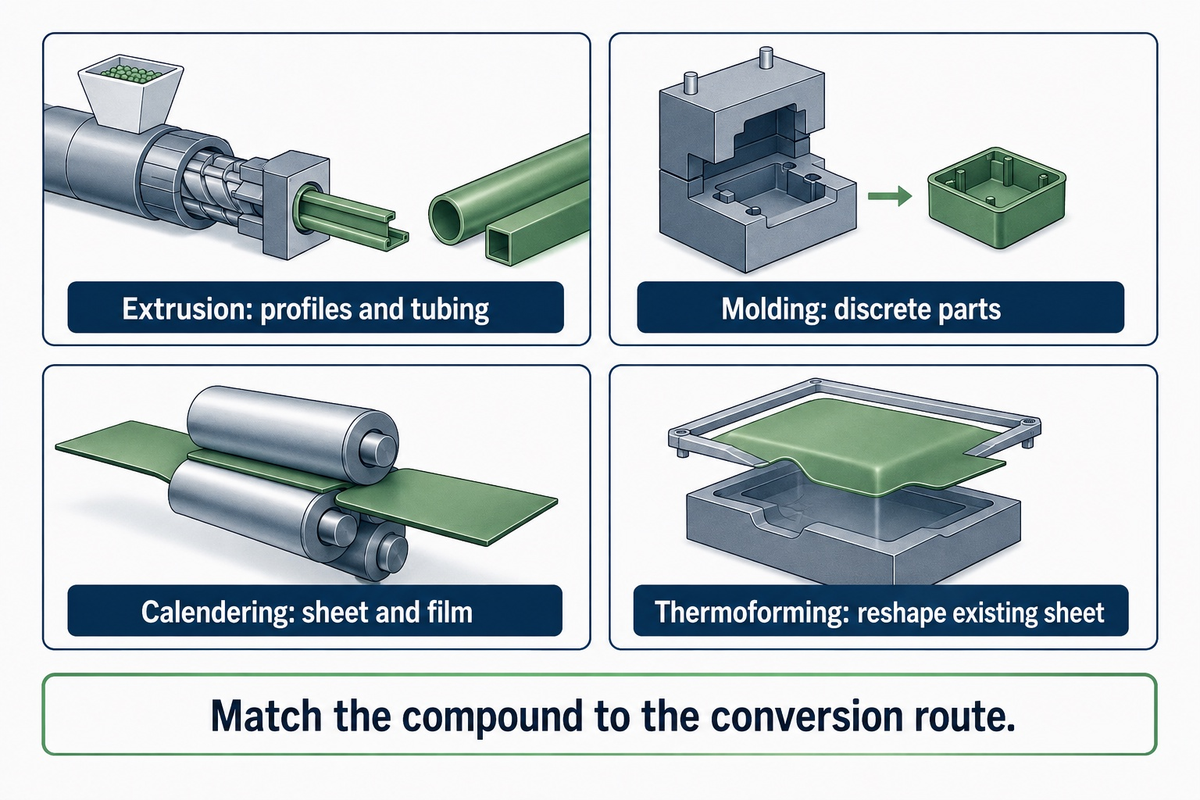
PVC processing turns a selected compound into its final cross-section or shape. Extrusion produces continuous forms (profiles and tubing); molding produces discrete parts, while calendering produces sheet and film (such as roll stock) in continuous form. Thermoforming takes an existing sheet of PVC and shapes it. The best input for conversion is a compound that’s formulated to be converted in a particular way, not a general purpose resin.
Think of the compound as the recipe and the conversion line as the shaping equipment. The production sequence described by Teknor Apex separates polymerization, compounding and the manufacturing of PVC products. Pellet handling and dry-blend handling also differ: the supplied form affects feeding and preparation before shaping.
A flexible-tubing compound and a rigid-sheet formulation require different processing behavior. Heat history matters because degradation of PVC changes the material during conversion; severe thermal decomposition can release hydrogen chloride. UK HSE guidance on chemicals in plastics processing distinguishes chemicals added to products and fumes generated during the process. Occupational health and safety controls that protect human health during processing belong to the conversion operation, along with the grade’s processing instructions.
Selecting rigid material is just the start for an outdoor window profile. The profile must also have a weather-suitable formulation and stable section at the line’s operating conditions. Pigment, stabilizer selection, and impact response are part of that job. Building and construction uses therefore require a product-specific choice among these building materials. A flexible jacket compound isn’t a substitute merely because both components are PVC particles or pellets. Consider an outdoor profile with an indoor trim piece of similar shape: the outdoor profile is subjected to sunlight, rain and temperature extremes. An outdoor profile with an exposed shape must be formulated to withstand the elements. The comparison starts with a weather-suitable grade, then the actual profile, including its joints and corners. No universal lifetime can follow from the polymer name.
PVC price and suppliers: compare finished-material quotes
Two small-sheet listings observed on October 28, 2026 put PVC at $22.50 for a 12 × 48 in sheet and $4.40 for a 12 × 12 in sheet, both nominally 1/8 in thick. Size normalization makes the price basis readable. The sellers and their grade descriptions remain separate.
| Seller and product | Listed price | Nominal area | Calculated price per area |
|---|---|---|---|
| eStreet Plastics, Type 1 gray, SKU 9400121248, 1/8 × 12 × 48 in | $22.50 each | 4 ft² | $5.625/ft² |
| US Plastic, item 45927, 1/8 × 12 × 12 in | $4.40 each | 1 ft² | $4.40/ft² |
Sources: eStreet’s exact Type 1 sheet listing and US Plastic’s item 45927. Neither example is identified as Vintec I, the grade used in the property table.
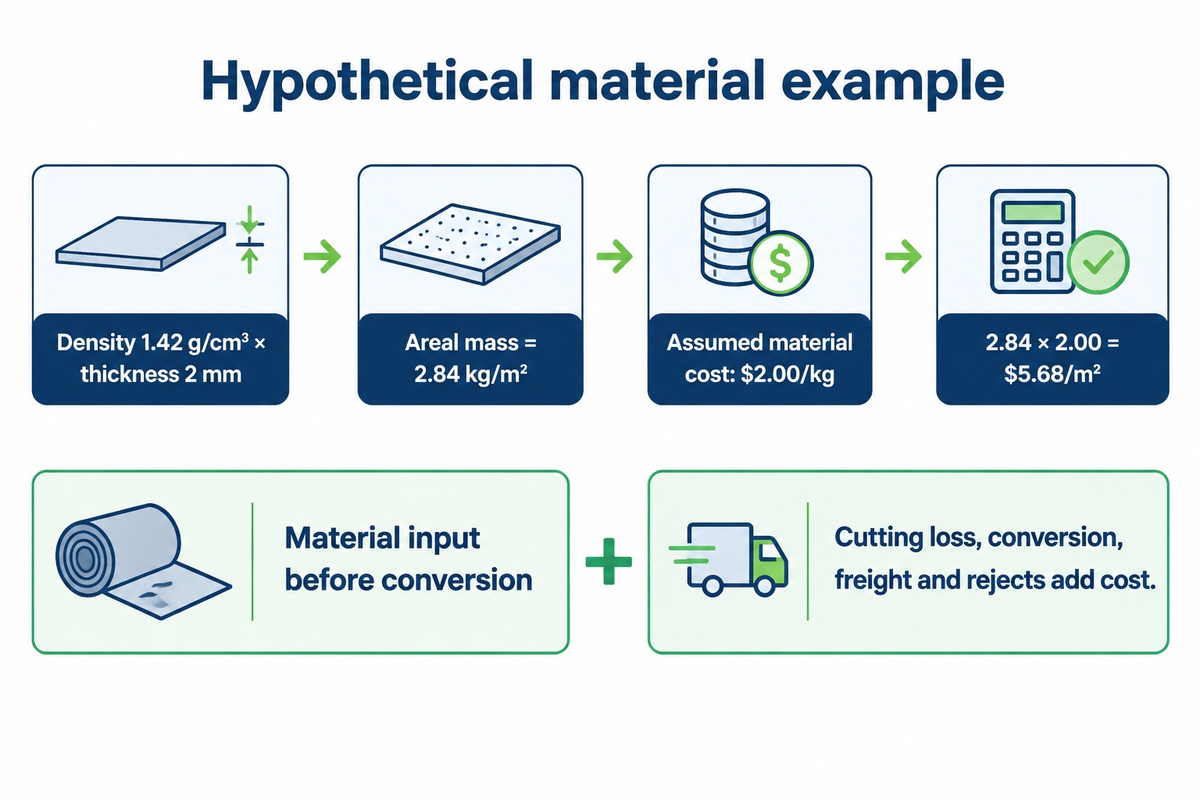
An example: a buyer comparing a sheet quote by weight to one by area may start with density and thickness. Using the typical density of Vintec I at 1.42 g/cm³, a hypothetical sheet of 2 mm thickness has an areal mass of 1.42 × 2 = 2.84 kg/m². At a hypothetical material price of $2.00/kg, the material cost would be 2.84 × 2.00 = $5.68/m². Cutting loss, conversion, freight and rejected pieces would increase the cost of an accepted part. The result would reflect the cost of the material before conversion.
Where can you buy polyvinyl chloride?
Buy PVC compounds from a compounder, sheet and rod from a plastics distributor, or finished films and parts from the appropriate converter. Teknor Apex and GEON are some examples of compound suppliers. Plaskolite is a sheet producer. PVC comes as resin, a ready-to-process compound or a fabricated product, depending on the supply stage.
GEON’s current PVC materials page separates rigid and flexible families. The compound range serves a different client need from a distributor cut sheet. UD Packaging’s plastic materials and packaging evaluation resources address how materials behave for packaging decisions.
Recycled PVC: sorting and formulation limits
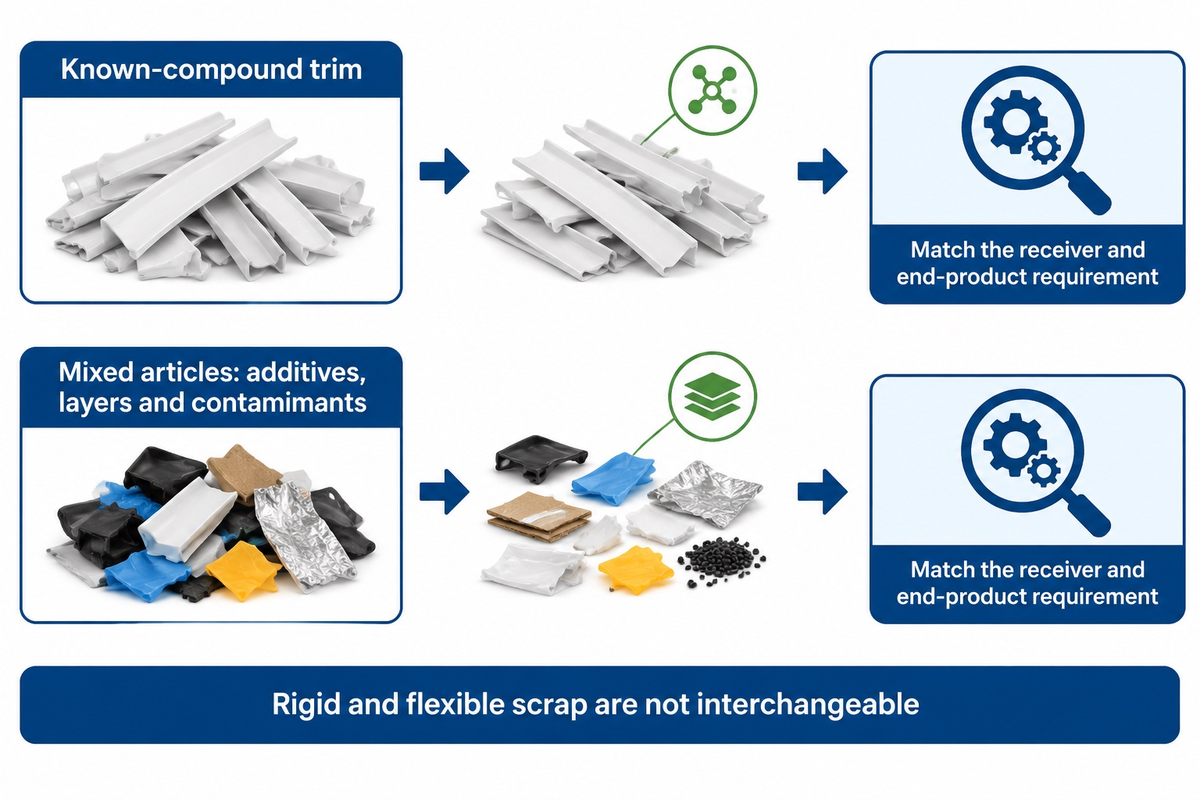
Recycled PVC works through identifiable product streams and formulations suited to the next article. Clean trim from one known compound is easier to characterize than a mixed plastic waste stream, containing different additives, layers and contaminants. Recycling of PVC therefore starts with separating the incoming material and matching it with a receiver and an end-product requirement.
ASTM D1784-25 allows recycled PVC within a compound framework subject to the requirements of the specific finished product standard. That differentiates a recycled input from a product meeting a specification. Rigid and flexible scrap should not be considered as a single interchangeable raw material.
The VinylPlus 2026 progress report describes the industry’s circularity work and reports on 2025 activity. The PVC industry program reports 765,972 tonnes of PVC waste recycled within the VinylPlus framework in 2025, 5.7% more than in 2024; the receiving recycler still determines whether an individual waste stream fits its process.
Legacy additives can make the separation problem harder. An example is the published application WO2026150030A1, which names D&G Recycling GmbH and describes a lead-removal approach for PVC recyclates. The application is still pending. Mixing unidentified PVC waste into a known clean trim stream can remove the formulation consistency that gave the trim its usability.
Specify PVC for the actual job
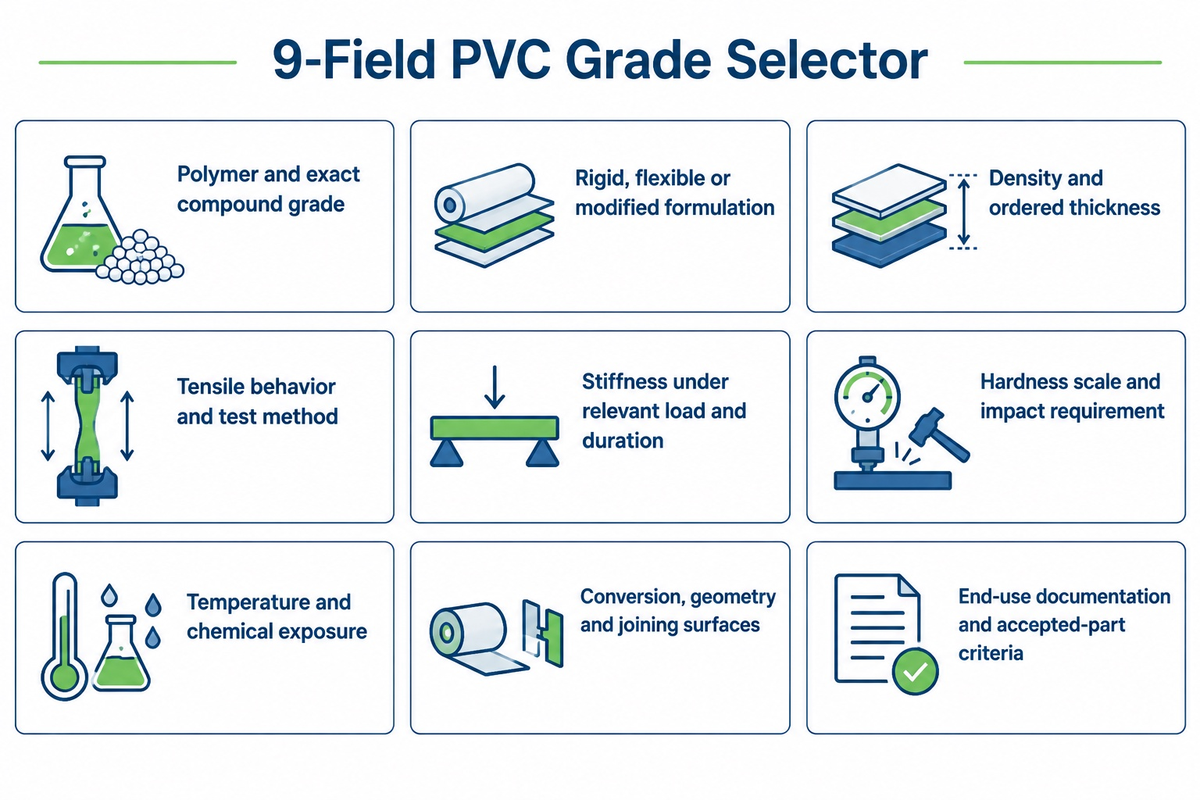
An appropriate PVC specification names the grade and finished form, and links the properties to the part’s function. The 9-Field PVC Grade Selector shortens that to a quick handoff between engineering, quality and purchasing. It lists a density value with its test basis and a choice of material with the exposure and conversion it must endure.
9-Field PVC Grade Selector
The 9-Field PVC Grade Selector connects the compound’s measured properties to its geometry, exposure and intended application.
- Polymer and exact compound grade.
- Rigid, flexible or modified formulation.
- Density and ordered thickness.
- Tensile behavior and test method.
- Stiffness under the relevant load and duration.
- Hardness scale and impact requirement.
- Temperature and chemical exposure.
- Conversion process, geometry and joining surfaces.
- End-use documentation and accepted-part criteria.
Engineering can start from D638 specimen and test conditions; quality can retain the specimen record with the acceptance result. Purchasing can request the same grade, thickness, dimensions, finish, quantity and delivery basis from each bidder. In a packaging project, before evaluating converted product quotes, review the material and packaging requirements.
Frequently asked questions
Is polyvinyl chloride plastic?
Yes. Polyvinyl chloride is a thermoplastic.
Manufacturers compound PVC resin with ingredients that control processing and performance. A finished product can be rigid or flexible even though its polymer belongs to the same family. A rigid pipe, a pliable cable jacket and a sheet therefore share the PVC name while serving different mechanical jobs. The selected grade and product geometry determine the useful behavior.
What products are made of PVC?
PVC is used for pipes, window profiles, cable insulation, flooring, roofing membranes, tubing and some packaging films or sheets.
Rigid formulations provide shape retention; flexible formulations allow bending or drape. Specialist bags and tubing also use application-specific compounds. The product example identifies a possible material family, while the grade, additives, conversion route and intended contact select the actual formulation. A general rigid sheet and a specialist tube are different PVC plastic products.
Is PVC safe for drinking water?
Yes, PVC can be used in drinking-water systems when the specific product is certified and suitable for that service.
Under NSF/ANSI/CAN 61, NSF reviews the formulation of PVC pipe and fittings, tests products at least once a year from each production facility, and requires detected regulated contaminants to fall below U.S. EPA and Health Canada acceptable levels. The certification applies to listed products, rather than every article made of PVC. NSF’s product-listing guidance explains how the potable-water marking and listing identify the tested item. A generic sheet designation should not be used as a water-system approval.
Is PVC the same as vinyl?
Vinyl often means PVC in everyday product names.
Flooring, coated fabric and flexible sheet may be described as vinyl. For an order, “PVC” plus the grade and product form is more precise than the trade name alone.
What is chlorinated PVC?
Chlorinated polyvinyl chloride, or CPVC, is a separately specified PVC-derived material.
It undergoes additional chlorination and has its own formulations and product requirements. GEON lists CPVC separately from its ordinary rigid and flexible PVC families; the material names should remain distinct on an order.
Can polyvinyl chloride be recycled?
PVC can be recycled through suitable collection and processing routes, with the formulation and contamination level matched to the receiving process.
Known production trim and mixed discarded articles present different sorting problems. The useful purchasing question is which specific feedstock can enter the intended new product.
Have a PVC sheet or film report to compare? Bring the grade, dimensions, test method and packaging task to discuss the material requirements with UD Packaging.
From compound choice to packaging behavior
UD Packaging publishes material guides to help connect test results with packaging decisions.
References & Sources
- ASTM D1784-25, rigid PVC and CPVC compounds
- ASTM D638-22, tensile properties of plastics
- ASTM D2990-17(2025), creep and creep-rupture
- Czogała et al., Recent Attempts in the Design of Efficient PVC Plasticizers with Reduced Migration, Materials, 2021
- Plastics Technology, historical PVC/POE alloy development
- UK HSE, chemicals in plastics processing
- NSF, health effects monitoring of PVC pipe and fittings
- VinylPlus Progress Report 2026, reporting 2025
- WIPO publication WO2026150030A1, applicant D&G Recycling GmbH