A thermoplastic material is a polymer that becomes more mobile and moldable as it’s heated and then becomes solid as it cools. Many thermoplastics can be reheated and reshaped because the cycle does not create the same permanent cross-linked network found in a cured thermoset.
Just because a thermoplastic is reprocessable doesn’t mean it’s unchanged forever. There are many factors that can change the material, including temperature, residence time, the presence of oxygen and moisture, contamination, additives, shear, and cooling history. A sound selection should be based on the heat response, service load, history of processing, and comparison-ready evidence, rather than popularity of the name of the resin.
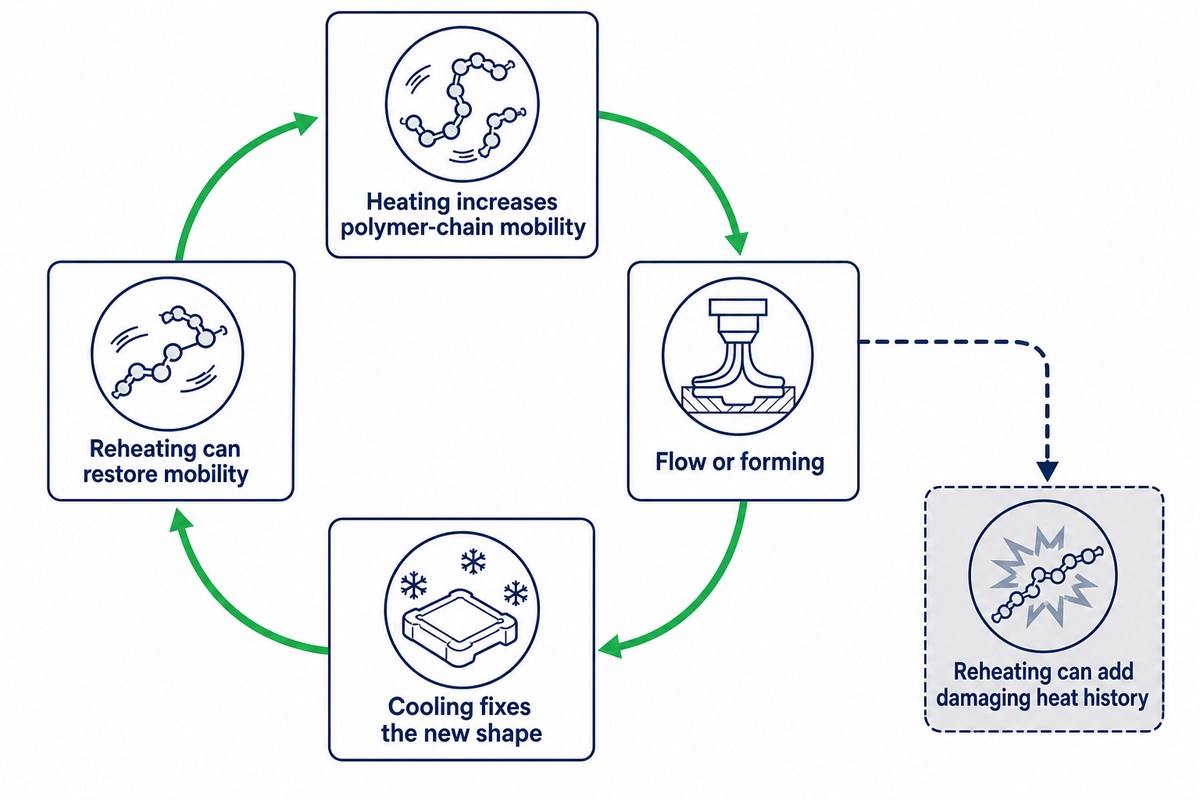
6-Stage Heat-History Map
The starting structure becomes mobile by the action of heat and chain mobility. It can then be shaped and/or oriented. It is fixed in that shape by the cooling process. It can then be reprocessed and checked for degradation.
What Is a Thermoplastic Material?
Heating a thermoplastic increases polymer-chain mobility, which permits flow or forming; cooling restricts that motion and fixes the new shape. With thermoplastics that have amorphous regions, behavior is changed with the glass-transition range. Semicrystalline thermoplastics have a melting range. Reheating can restore mobility, but it can also add damaging heat history.
“Thermoplastics can be transformed repeatedly by means of heating.”
There needs to be a limit on the term “repeatedly” because many changes can occur during processing, such as oxidation and chain scission. Oxidation, chain scission, hydrolysis, contamination, or additive loss may occur during processing. Cooling can change the crystallinity of the material and also leave residual stress and orientation. A molded part, strap or film of a thermoplastic has a process history and material condition, which can’t be determined by the family of resin it belongs to.
Key point: one controlled PET study dried material at 160 °C for 5 h below 0.3 atm, then used a 16 mm screw and 2 mm die. Its four passes each lasted 120 s, or 2 min, with zones at 250 °C, 260 °C, 270 °C, and 280 °C. Those conditions belong to the experiment, not a universal processing recipe.
Thermoplastic vs Thermoset and Elastomer
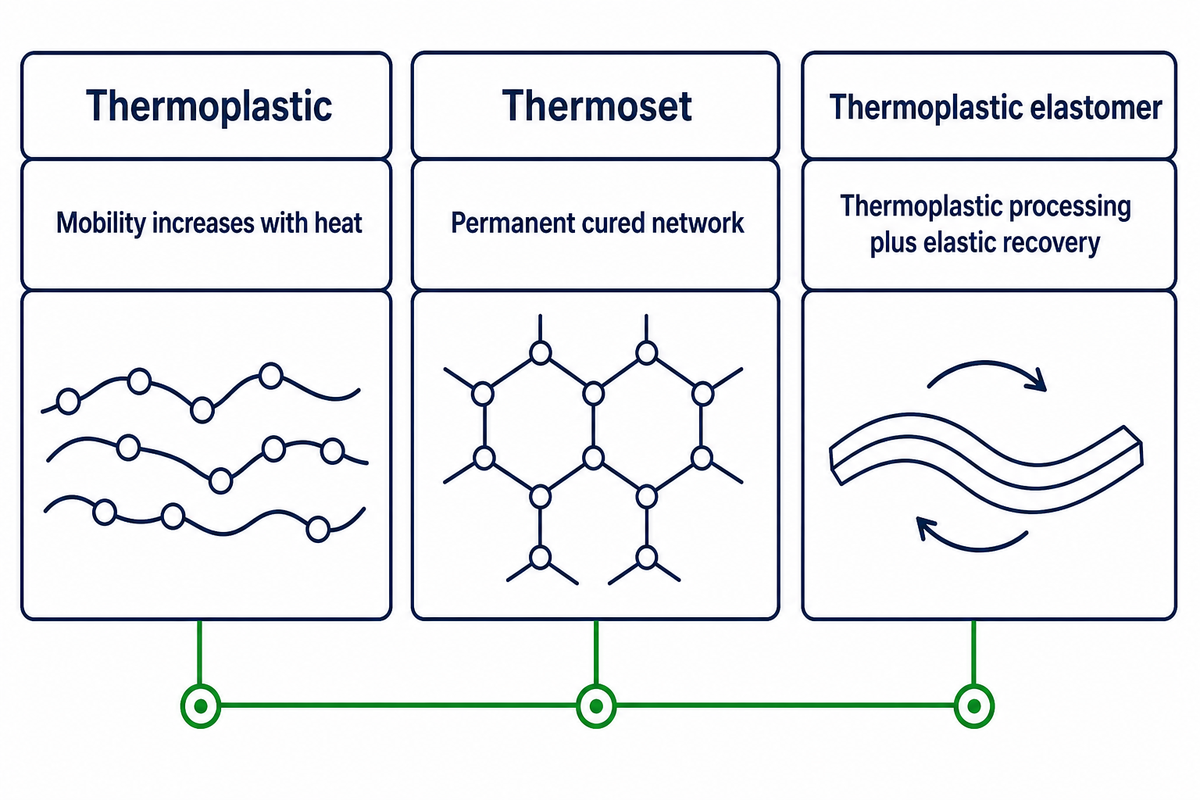
Thermoplastics soften and melt but don’t form a permanent network. Cured thermosets have a heavily cross-linked structure and don’t return to a moldable state. Elastomers are defined by flexibility and elastic recovery. Some elastomers are thermoplastics; cured rubbers may behave more like a thermoset, so the labels may overlap.
Category or family
Heat or structure cue
Use in a shortlist
Limitations / Not suitable for
Thermoplastic
Mobility increases with heat
Reheatable processing route
Does not promise unlimited cycles
Thermoset
Permanent cured network
Stable cured form
Does not remelt for reshaping
Thermoplastic elastomer
Thermoplastic processing plus elastic recovery
Flexible parts and seals
Family name does not define recovery at a stated temperature
PET
Moisture, orientation, and crystallinity matter
Film, sheet, bottle, fiber, or strap candidate
Unverified drying or heat history
PE
Density family and branching differ
Flexible film or rigid-product candidate
One PE grade cannot represent every film or molding grade
PP
Grade, orientation, and temperature shift behavior
PVC alone does not define additives or service limits
Polyamide
Moisture can shift mechanical properties
Load-bearing plastic parts
Dry data may not represent conditioned service
Polycarbonate
Impact resistance, stress, and chemicals interact
Clear or impact-oriented parts
Family reputation does not prove stress-crack resistance
Is every plastic a thermoplastic?
No. Plastic is an umbrella term and thermoplastics are one class within that. Thermosets are another class. Buyers who require the broader family taxonomy can use UD Packaging’s plastic materials resource; this guide is restricted to heat response, processing history and evidence for thermoplastic selection.
Build a Heat-Load-Evidence Screen
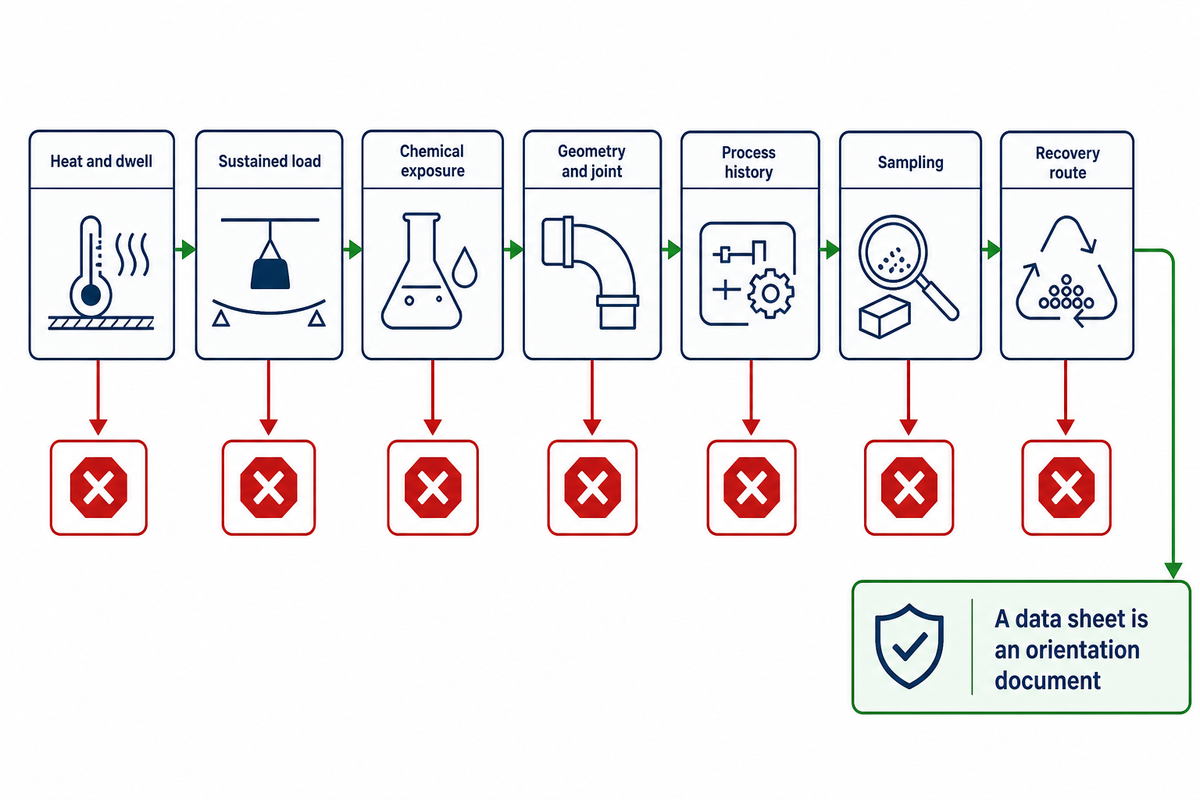
A Heat-Load-Evidence Screen starts with the failure that must be prevented, not the preferred resin. Screen temperature and time, sustained versus impact load, chemicals, weather, geometry, joints, processing route, and evidence quality. Reject a candidate that fails one service gate prior to evaluating price or convenience of the supplier.
Decision row
Minimum input
Evidence to request
Limitations / Not suitable for
Heat and dwell
Normal, peak, and dwell time
Grade-specific thermal basis
One short test cannot predict multi-year exposure
Sustained load
Stress, duration, and temperature
Creep or relaxation basis
Tensile break strength alone is insufficient
Impact and shock
Handling event and geometry
Relevant specimen and test condition
Room-temperature averages may miss cold impact
Puncture
Edge shape, contact area, and film state
Applied-film or product test
Resin data cannot represent a wrapped corner
Chemical exposure
Chemical, concentration, time, and stress
Grade-specific compatibility basis
Unstressed immersion may miss stress cracking
Moisture
Storage, drying, and service humidity
Conditioning and moisture record
Dry data may not represent humid service
UV and weather
Location, duration, and protection
Weathering basis for the grade
Color alone does not prove UV stability
Geometry and joint
Thickness, direction, closure, and contact points
Finished configuration result
Material coupons do not prove joint strength
Process history
Drying, heat, shear, orientation, and regrind
Lot and process record
Pellet data may not represent the finished form
Sampling
Plan, sample size, and accept/reject rule
Lot-acceptance record
One passing specimen is not a passing lot
Supply change
Grade, source, formulation, and notification rule
Change-control evidence
A prior lot cannot approve an undisclosed change
Recovery route
Collection, sorting, processor, and end market
Location-specific route evidence
Resin code alone does not prove recovery
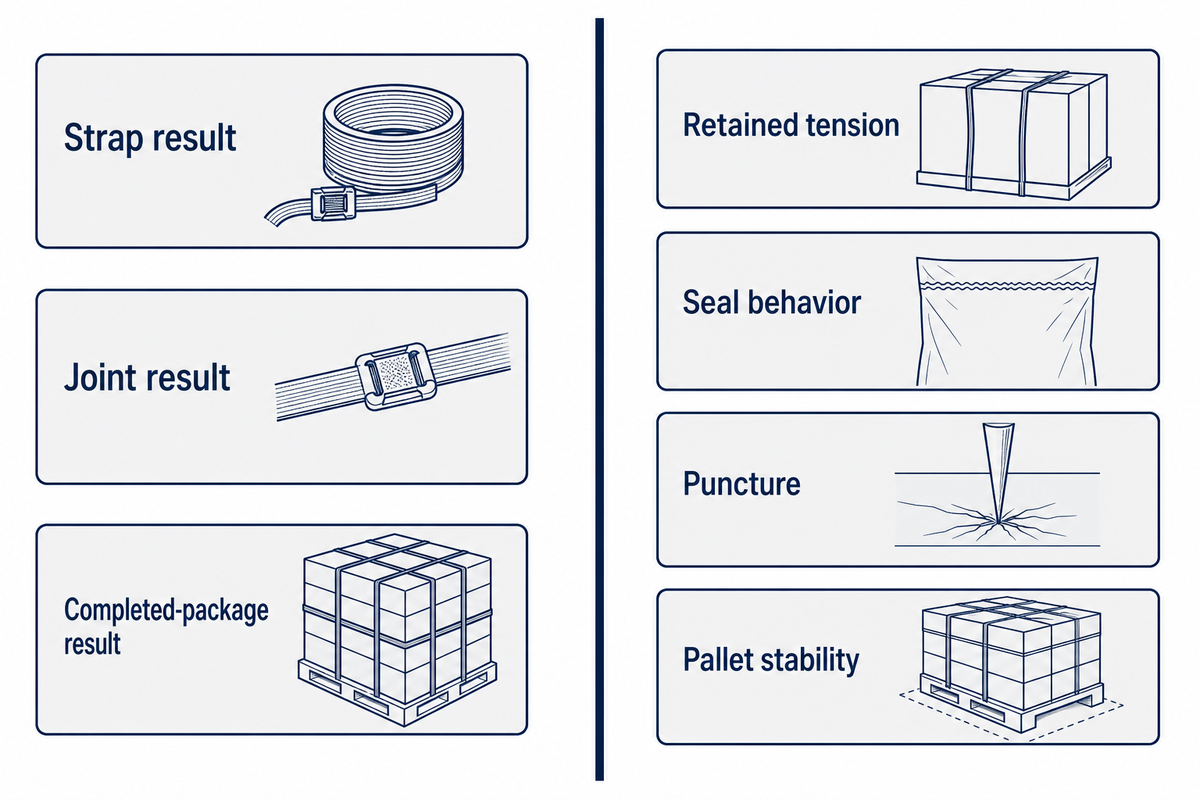
Selection scenario: A buyer sees a high tensile value for PET resin and treats it as proof that an oriented strap will retain load in storage and transport. Resin data omit the strap’s orientation; a strap result does not establish joint efficiency; and a joint result does not establish pallet stability after settling, impact, and environmental exposure. The challenge for the manufacturer is to supply product level evidence tied to strap orientation, joint method, package geometry, load duration and owner acceptance.
When not to approve a thermoplastic from a datasheet alone
Don’t approve a material when the grade is missing, test conditions are different, processing history is unknown, or the application is dependent on creep, joints, puncture, weather, or regulatory status that the sheet doesn’t consider. A data sheet is an orientation document. Approval requires a defined specimen, method, condition, sampling plan, acceptance rule, and finished-product validation.
Common Thermoplastic Families Without the Best-Resin Myth
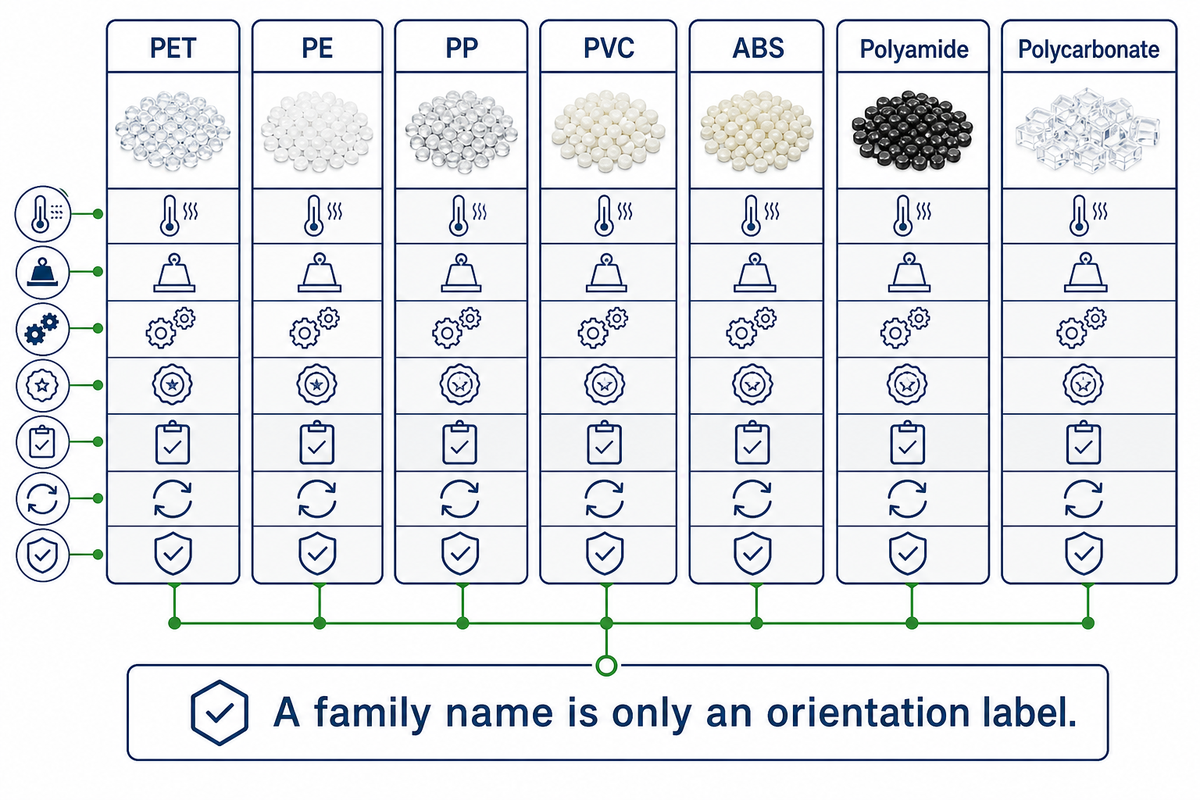
PET, PE, PP, PVC, ABS, polyamide and polycarbonate are commonly used, but a family name is only an orientation label. Exact grade, additives, form, thickness, moisture, aging, and test basis can modify behavior. A familiar name is an advantage for navigation, not proof that a high-performance claim fits the application.
ASTM D4976 makes the distinction unusually clear for polyethylene: groups, classes, and grades can identify commercial material, but that identification is not engineering design data. Buyers should treat every family description the same way. If a supplier cannot name the grade, form, formulation, and test basis, the candidate is not comparison-ready.
Key point: Family tables contain 9 separate rows because classification and evidence of purchase solve different problems. A family name narrows the search, while the approval record must still name grade, form, process history, sample basis, and service boundary.
Why Processing History Changes Material Behavior
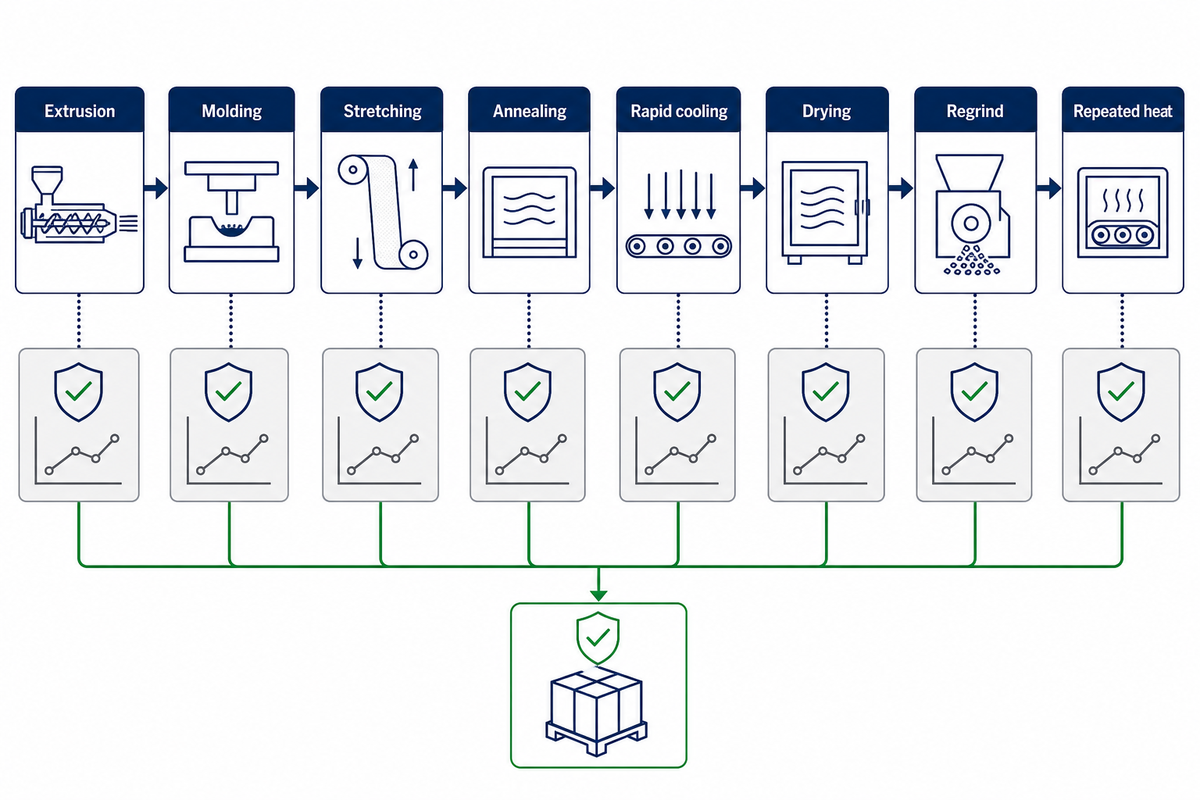
Extrusion, molding, stretching, annealing, rapid cooling, drying, regrind, and repeated heat can modify orientation, crystallinity, and residual stress. Moisture state and additive dispersion may affect behavior, along with molecular weight. Two products from the same resin family can therefore differ because process history becomes part of identity and may accelerate property decay.
Processing scenario: a converter compares a pellet supplier’s isotropic tensile result with an oriented finished strap. The numbers seem to describe one material, but the samples have different structure and direction. Stretching aligns chains, cooling freezes part of that alignment, and storage may allow physical aging in glassy regions. Further heat and shear may be introduced through regrind or an additional extrusion pass. In order to make a fair comparison, one needs to identify the resin grade, drying conditions, extrusion window, direction of orientation, cooling/annealing step, reprocessing route, finished thickness, test direction, and time between manufacturing and testing (i.e. the testing). Without this information, a difference in properties may not be assigned to the quality of the resin.
The PET experiment used a melt-flow test at 285 °C after 300 s with a 2.16 kg load, a 2 mm capillary, and an 8 mm length. Tensile testing used 2.0 mm strands, first at 1 mm/min and then 50 mm/min. Crystallinity rose from about 23.0% to 29.5%, while elongation fell from about 84% to 60%. The values are study-specific.
A separate 2023 study of four PET copolyesters reported composition-dependent physical aging below each material’s glass-transition temperature. Interestingly, this study showed that time after manufacture is another factor. Record manufacturing-to-test age when a glassy material’s comparison is sensitive enough that structural relaxation could matter.
Key point: four extrusion cycles aren’t a universal recycling limit. The same study’s literature review described other controlled systems that retained useful properties for more cycles. Feedstock quality, drying, contamination, residence time, and the required endpoint decide whether another loop remains acceptable.
Specify the Test Basis Before Comparing Data
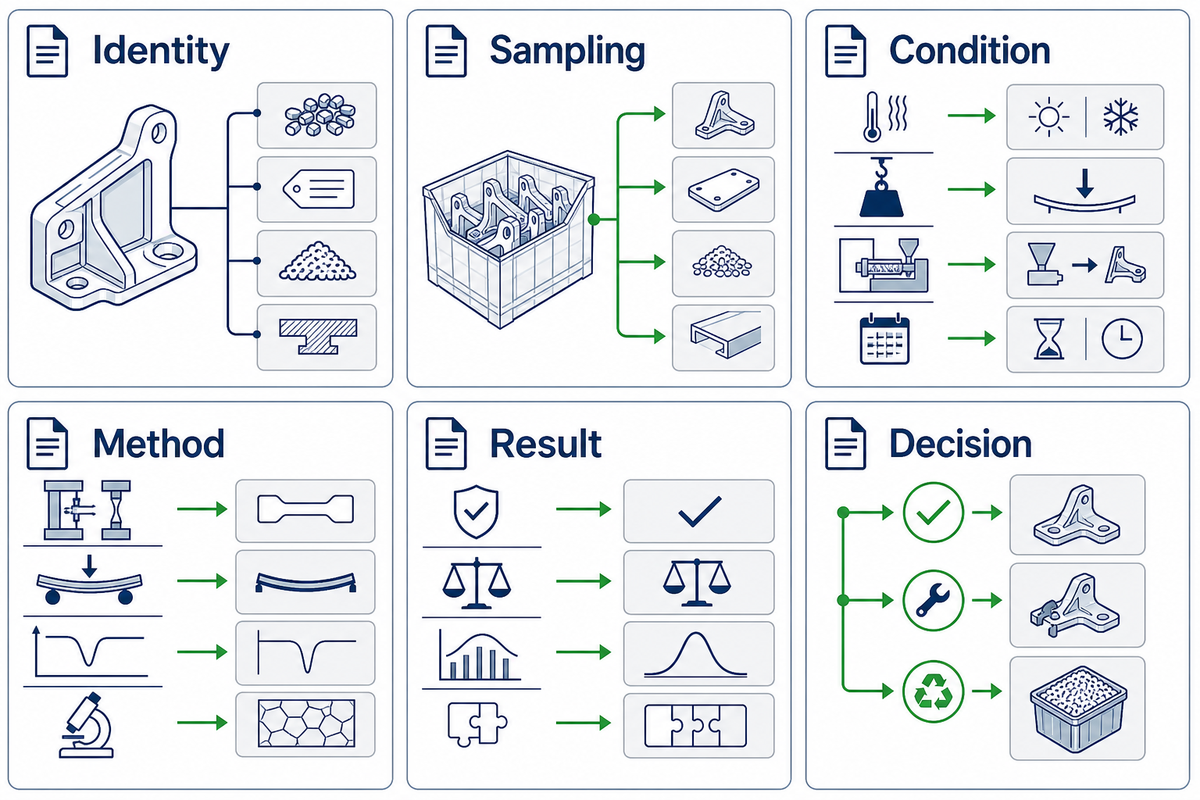
A property value becomes comparison-ready only when the record identifies what was tested, how it was conditioned, which method and edition applied, at what temperature and rate, in which direction, with which units, and from which lot. The title of a certificate or an average can’t reveal these.
Sampling: lot, sampling point, randomization, sample size, direction, geometry, and preparation.
Condition: manufacturing-to-test age, conditioning, temperature, and moisture state.
Method: standard, edition, methodology fit, equipment basis and rate of test.
Result: individual values, precision, statistic, units, exclusions, and uncertainty where used.
Decision: acceptance limit, accept/reject rule, owner, and change-notification trigger.
Method suitability matters as much as naming. ISO 1133-1:2022 measures melt flow under stated temperature and load, yet its public scope warns that the method may fail when rheological behavior changes too strongly. A high-quality report still needs the right method for the material.
Discipline is needed for thermal indicators as well. ASTM D648-18 states that heat-deflection-temperature data are not intended for design or prediction of elevated-temperature durability. A traceable HDT value can be used to correlate a defined test output; it cannot be used to provide duration at service conditions of load, stress, environment, or mode.
NIST separates sample results, lot disposition, and long-term control. A passing sample doesn’t mean a passing lot, and acceptance of a lot doesn’t ensure future acceptability. See related concepts in UD Packaging’s plastic testing resource and plastic tensile strength guide.
Company-claim boundary: UD Packaging states its products are subject to quality control and SGS product-quality testing, and the company uses GB/T 1040.1-2018 and GB/T 1040.3-2006 for its testing practices. Treat this as a company-provided statement, not laboratory accreditation, universal batch certification, method equivalence, or a performance guarantee.
Check Recyclability and Supplier Evidence Separately
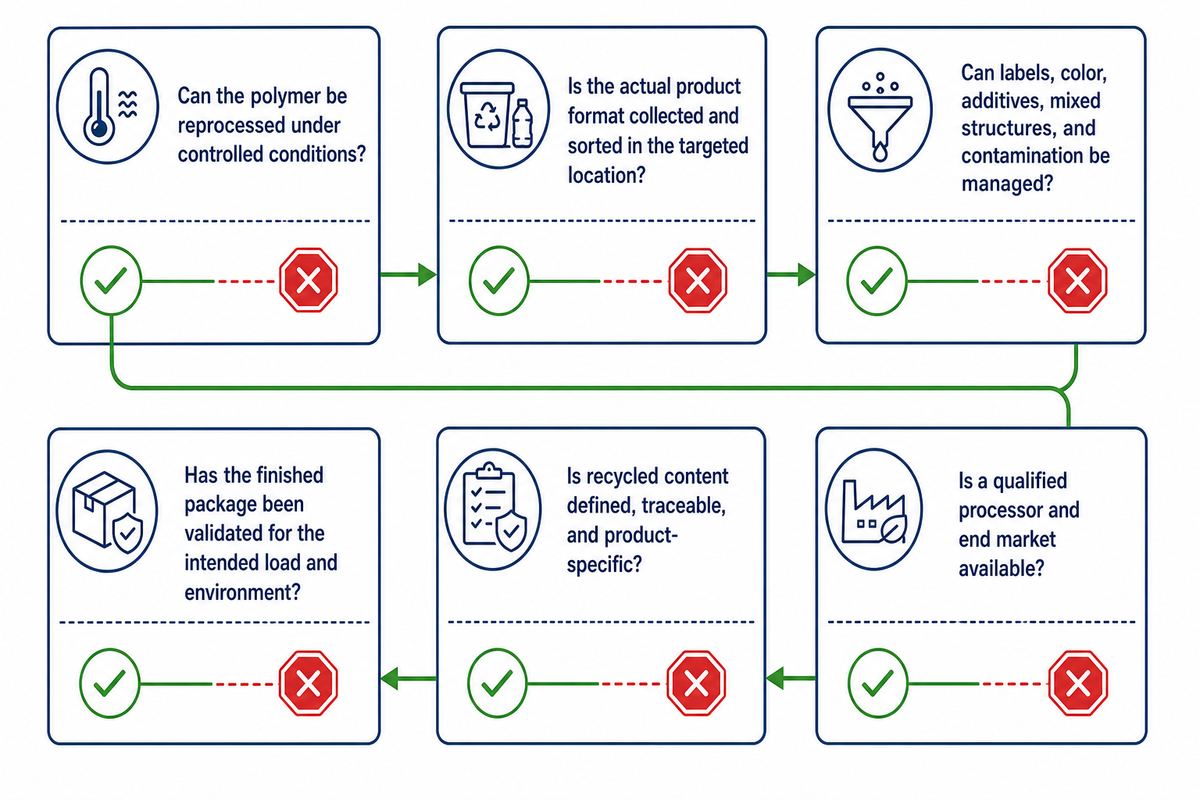
Thermoplastic remeltability is a material characteristic; practical recyclability is a systems-level outcome. Collection, product form, sorting, contamination, additives, degradation, process capability, and end markets all play a role. Recycled content percentage is a different claim. None of these prove that a finished package is fit for its intended use.
Recovery Route Check
Can the polymer be reprocessed under controlled conditions?
Is the actual product format collected and sorted in the targeted location?
Can labels, color, additives, mixed structures, and contamination be managed?
Is a qualified processor and end market available?
Is recycled content defined, traceable, and product-specific?
Has the finished package been validated for the intended load and environment?
The US EPA explains that a resin-number triangle identifies plastic type but does not mean a community program collects that item. Before adding an item to a recyclable list, check that a local program collects and sorts that product format; a pure resin label is no replacement for that check. The current trend toward recyclability claims makes this distinction more important, not less.
Recovery scenario: a procurement team adds a film to the “recyclable” list, based on a resin code they recognize. The waste contractor for the plant, in fact, accepts rigid containers, but not contaminated pallet wrap. The polymer can be remelted, yet the used format has no qualifying collection path in that location. If recycled content is claimed, the team needs to demonstrate the percentage of recycled content, as well as the product, is traceable. In many cases, material science provides data to assist with the first question in the chain, but not every route requirement.
Key point: EPA’s guidance separates a resin code from local collection, while a 2023 recycling review identifies cleaning and sorting as core steps for recycled-polymer quality. At least 2 independent decisions remain after identifying the polymer: route availability and finished-product fitness.
How Thermoplastic Selection Applies to Industrial Packaging
Material properties become a system result from interaction of multiple factors, including straps, film, seals, joints, load geometry, weather, storage time, equipment and the strength of the materials. Judge whether a durable package will control a defined load from tests on the applied strap, film and joints rather than from resin descriptions, especially when the product is susceptible to creep, puncture, or heat.
ASTM D3950 treats nonmetallic strapping properties, joining methods, and joint strength as separate requirements where applicable. ASTM D8314 assesses stretch film during and after application to a unit load or test structure and excludes isolated mechanical-property testing from the scope of this guide. Both boundaries refer to applied-system evidence, not catalog-number substitution.
UD Packaging identifies PET strapping as its flagship material and also supplies industrial stretch film, seals, and strapping equipment. Its stated industries include metals, solar, building materials, wood, paper, fibers, textiles, agriculture, food, electronics, and tobacco.
A buyer brief outlines the load and geometry, storage and transport route, temperature and weather, contact or chemical limits, joint or closure, equipment interface, test basis, sampling plan, acceptance owner, and change notification rule. For film-related examples, see UD Packaging’s plastic film testing overview and their description of elongation at break.
Key point: a strap result, a joint result, and a completed-package result answer 3 different questions. Procurement shouldn’t rely on one high tensile strength number to represent retained tension, seal behavior, puncture, pallet stability, or transport performance under the stated service conditions.
Decision Framework: Use the Heat-Load-Evidence Loop
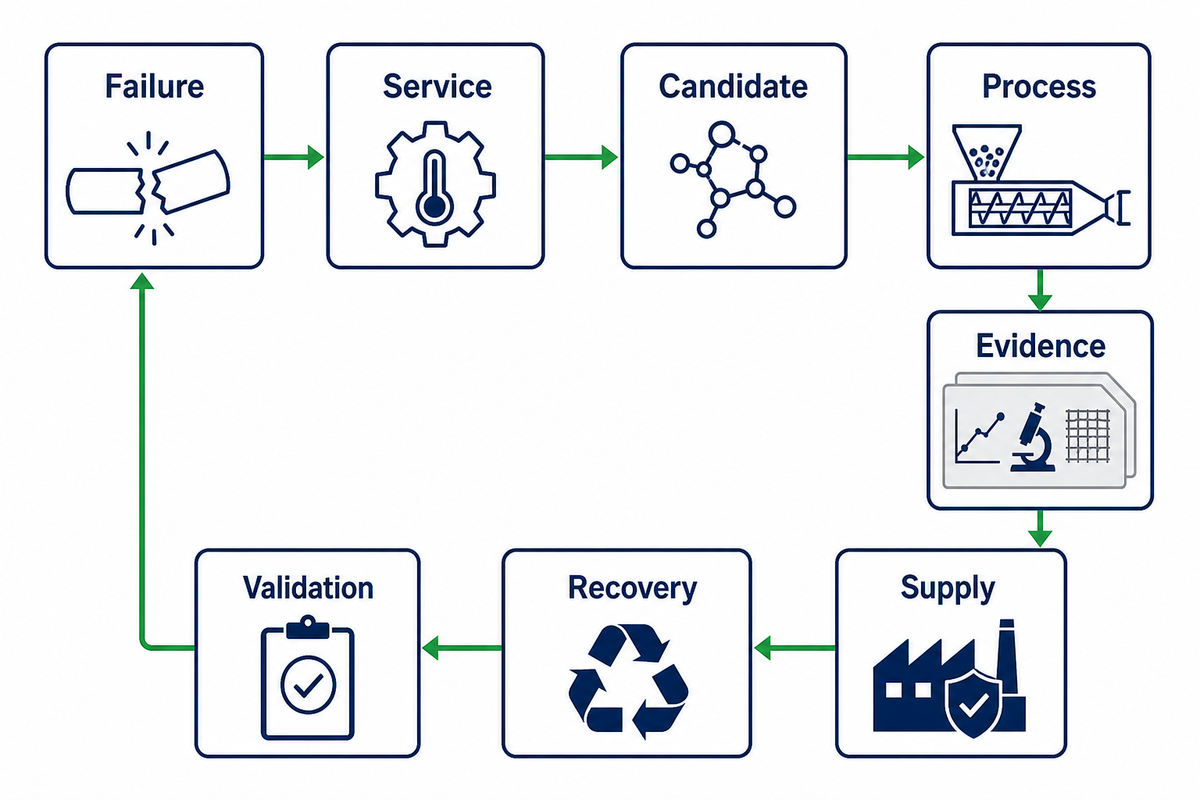
A defensible thermoplastic choice moves in a loop because service requirements, processing route, evidence, and supply controls constrain one another. In the presence of a late test result, formulation change, or process change which breaks an assumption, return to the earlier gate rather than forcing the original resin choice through approval.
Failure: define what must not happen and who owns acceptance.
Service: record time, temperature, load, environment, handling, and geometry.
Candidate: identify family, exact grade, form, and formulation.
Process: document drying, shaping, orientation, cooling, joining, prior heat history.
Supply: examine sampling, process control, change notification, continuity and support.
Recovery: verify collection and processing route separately from recycled content evidence.
Validation: verify finished package in intended use environment.
Use five honest output labels: reject; compare with evidence gaps; trial required; qualified for a defined condition; or change requires revalidation. Those labels represent uncertainty. They also help prevent an early shortlist from being confused with a technical acceptance list.
Standard currency belongs inside the loop. The live page for ISO 1133-1:2011 now identifies that edition as withdrawn and points to ISO 1133-1:2022. Confirm the lifecycle before relying on any method reference in a supplier report.
Turn Your Requirements Into a Material Evidence Brief
Compare suppliers only after you’ve combined the load, environment, process, test basis, and recovery questions.
Thermoplastics are polymers whose chains gain mobility when heated and become fixed again as the material cools. Many grades can therefore be reshaped or reprocessed. This doesn’t mean that all grades are similar at all temperature ranges, or can withstand endless thermo cycling. Structure, additives, moisture, contamination, residence time, and oxygen can change the result.
What are five examples of thermoplastics?
Examples include polyethylene, polypropylene, polyvinyl chloride, polyethylene terephthalate, and polycarbonate. ABS and many polyamides are also thermoplastics. Each of these describes families and not complete specs.
What is the difference between plastic and thermoplastic?
Plastic is the broad umbrella term for many polymeric materials. Thermoplastic is one such class. Thermoplastics generally exhibit reversible softening and hardening under heat. Thermosets are a different class, and once cross linked, won’t return to the melt. Some elastomers are thermoplastic, so the category names can overlap.
Is PVC a thermoplastic?
Conventional PVC is thermoplastic. Rigid PVC and plasticized flexible PVC can behave very differently because formulation, grade, additives, and processing route change stiffness, temperature response, and weathering. “PVC” answers the family question, but not necessarily the chemical, temperature or contact condition questions, nor the regulatory requirement.
What are the disadvantages of thermoplastics?
Possible limits include creep or stress relaxation under sustained load, softening at elevated temperature, dimensional change, stress cracking, UV or chemical sensitivity, and property loss after poor drying or excessive heat history. Severity varies by family, grade, formulation, geometry, processing, and service condition, so a generic disadvantage list should not replace grade-level screening.
Is thermoplastic safe?
Specific thermoplastic grades can be safe for defined uses: US FDA rules state that listed olefin polymers may be safely used in articles intended for contact with food, subject to the rule’s conditions, so safety is judged for the grade and use, not for “thermoplastic” as a whole. Analyze the exact polymer and additives, intended contact, temperature, fire and smoke behavior, migration or regulatory requirements, processing controls, and jurisdiction. A material suitable for an external industrial component may be unsuitable for food contact, high heat, or another exposure without product- and use-specific evidence.
Review note: The UD Packaging technical team reviewed this. Company descriptions and quality statements are first party information. Scientific and standard claims are material, method or application limited. Product suitability requires evidence for actual grade, lot, finished form, joint, equipment, load and service environment.
WHY WE WRITE THIS
About UD Packaging
UD Packaging is an integrated industry and trade enterprise focused on sustainable industrial packaging materials. Based in Jiangyin, Wuxi, Jiangsu Province, we develop and supply packaging solutions for customers who need dependable performance, practical sourcing, and clear technical guidance.
Our core range includes PET strapping, industrial stretch film, strapping seals, and manual, semi-automatic, and fully automatic strapping equipment. We use this blog to explain material properties, test logic, and packaging decisions in terms that procurement, operations, and quality teams can use.
OUR EXPERIENCE
More than a decade in plastic packaging materials, with PET strapping production and customer support across industrial applications.
OUR EXPERTISE
Material selection, tensile-property interpretation, packaging protection, and coordinated supply for medium and heavy-duty goods.