
By XCX · Updated October 2026
Types in the Plastic material series are good starting points, but a family name like PET, HDPE, or PP doesn’t specify a finished product. Completing a specification requires consideration for the type or grade, construction and additives, the service conditions, the equipment with which it’s to be used, the route of recovery, the behavior of the product, and evidence to demonstrate that the product meets the requirements of the specification.
Short answer
Plastic material types fall first into thermoplastics and thermosets, then into families and grades. For packaging, compare the finished construction against load duration, temperature, chemicals, handling, equipment, regulation, and recovery. A resin code identifies material; it doesn’t prove recyclability or fitness.
Key points
- ASTM D4000 states that a plastics classification system is not intended to select a material for a specific application.
- Long-duration loads need creep or creep-rupture evidence, such as ASTM D2990 testing, rather than a short tensile result.
- A multilayer film needs a construction record; naming only its base resin hides layers, coatings, orientation, and thickness.
- Bio-based origin, biodegradability, compostability, local collection, and application fitness are different claims.
7 familiar familiesUseful for orientation, not approval
Service-Condition Knockout SequenceReject mismatches before price review
5 evidence layersMake supplier offers comparable
Thermoplastics vs. Thermosets: The First Classification Split
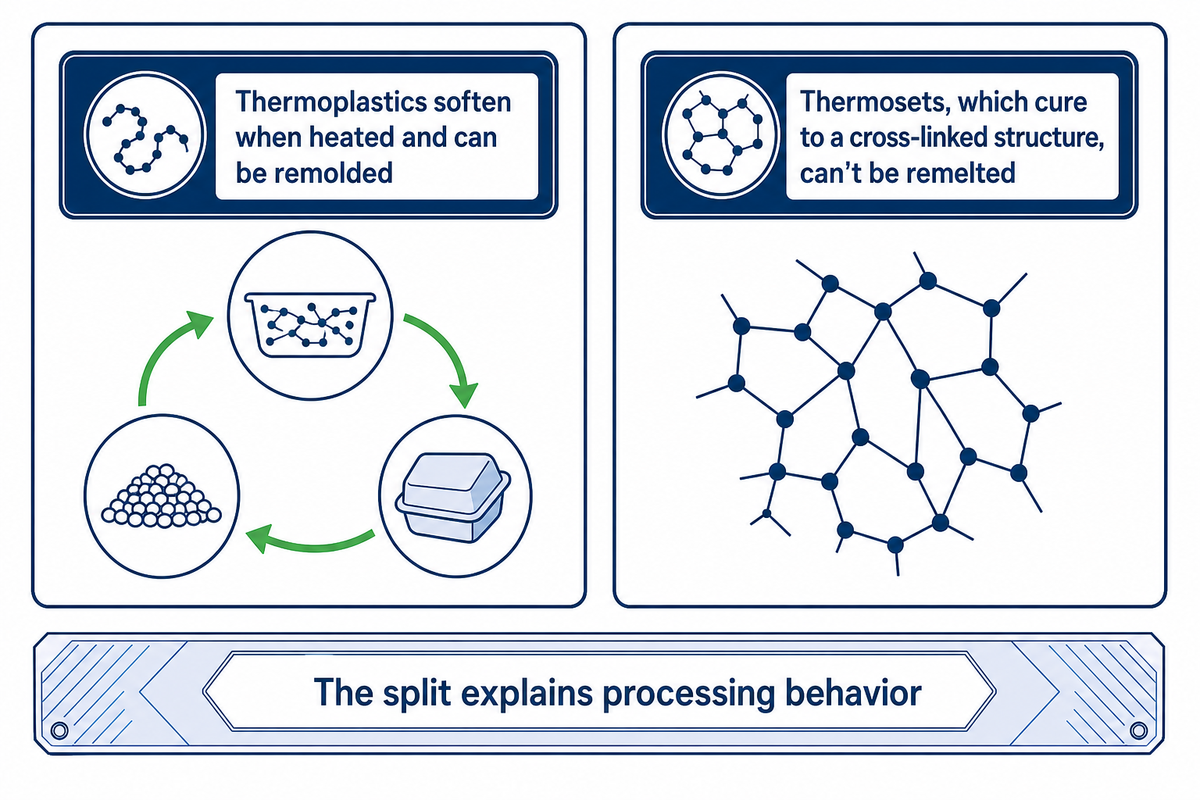
Thermoplastics soften when heated and can be remolded, whereas Thermosets, which cure to a cross-linked structure, can’t be remelted. The split explains processing behavior, but it does not reveal an exact grade, finished construction, permitted use, or service life.
Thermoplastics
- Chains can soften and flow when heated within a suitable process window
- Examples include PET, polyethylene, polypropylene, PVC, polystyrene, and polycarbonate
- Film, strapping, moulded parts, fibres, and rigid containers require different grades
- Local programs, not reprocessing potential, decide recycling acceptance
Thermosets
- Curing creates a permanent cross-linked network
- Examples include phenolic, melamine, and some formaldehyde-based systems
- Heat does not return the cured network to its original moldable state
- Recovery choices differ from those for remeltable thermoplastics
The British Plastics Federation thermoplastics overview describes this structural difference. It also shows why broad plastic types cannot replace an application specification. For example, a crystalline polymer may be changed with orientation and cooling history, and a nominally identical resin may be extruded to film, drawn to fiber, or molded to other forms.
Most familiar packaging resins are synthetic plastics built from monomers such as ethylene, propylene, or the precursors of polyethylene terephthalate and polyvinyl chloride. Cellulose-based materials show that polymer doesn’t automatically mean a petrochemical plastic. Plastic production route, feedstock, and chemistry are different from the thermal properties and the performance that the buyer must evaluate.
Procurement objection: Both candidates are thermoplastics. This by itself doesn’t make them interchangeable. The buyer must also have the polymer family, grade, additives, process route, geometry, and validation state. These factors explain why plastic products made from the same family can behave differently.
Seven Common Plastic Families Compared
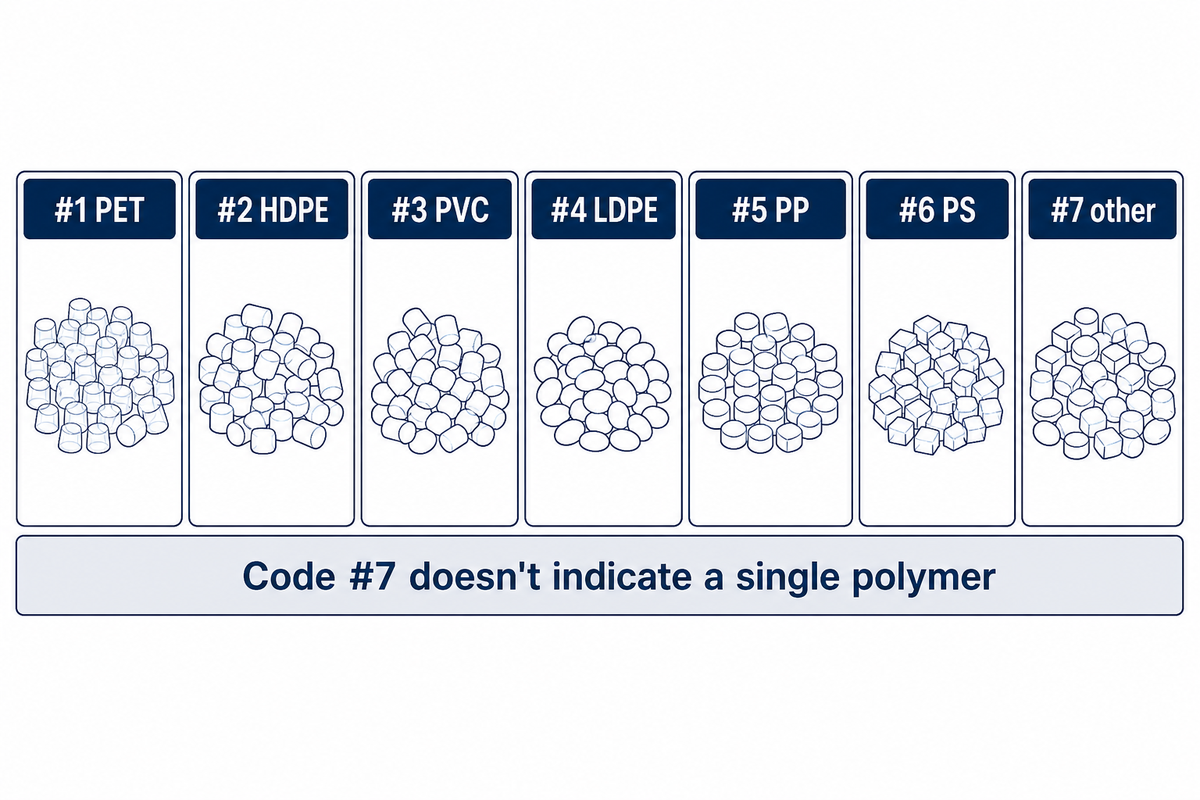
Seven familiar resin-code families are PET, HDPE, PVC, LDPE, PP, PS, and the mixed “other” category. They offer a practical orientation map. They don’t rank materials from best to worst, and the seventh code number groups unlike polymers rather than defining one consistent kind of plastic.
“This classification system is not intended for the selection of materials.”
| Material type / family | Typical packaging form | Directional trait | Common uses | Limitations / Not suitable for |
|---|---|---|---|---|
| PET / #1 | Beverage bottles, film, oriented strapping | Can be clear, stiff, and orientation-sensitive | Bottles, trays, fibres, industrial straps | Family name does not prove joint strength or weathering life |
| HDPE / #2 | Rigid containers, caps, crates | Higher density and stiffness than low-density PE grades | Detergent bottles, drums, closures | Environmental stress cracking remains grade- and condition-specific |
| PVC / #3 | Rigid or flexible sheet and profiles | Additives strongly influence flexibility and processing | Blister structures, plumbing pipes, building and construction products | Do not transfer a rigid-grade claim to a plasticized grade |
| LDPE / LLDPE / #4 | Flexible film and bags | Low density, flexible, and sealable in suitable grades | Stretch film, liners, shopping bags | Gauge, puncture, cling, and layer structure still need validation |
| PP / #5 | Film, woven tape, strapping, closures | Low density with grade-dependent stiffness and hinge behavior | Food containers, caps, fibres, straps | Cold-impact and sustained-load behavior require grade evidence |
| PS / #6 | Rigid or foamed items | Styrene-based grades span clear rigid parts and foam | Trays, protective inserts, disposable cutlery | The #6 label does not say whether a local program accepts the format |
| Other / #7 | Varies | A basket for unlike resins and constructions | Polycarbonate, multilayers, and other systems | Never infer one property set from the code alone |
| PC | Rigid engineering parts | An engineering plastic used where impact and clarity may matter | Protective equipment and durable components | Food-contact and bisphenol questions require product-specific evidence |
| PA / nylon | Barrier layers, fibres, components | Polyamide properties can shift with moisture | Films, ties, wear parts, medical devices | Dry-state data may not represent humid service |
| ABS | Rigid moulded housings | Acrylonitrile, butadiene, and styrene contribute different functions | Equipment housings and durable parts | Usually not a default flexible-packaging choice |
ASTM D4000 organizes plastic materials into families, groups, classes, and grades, and finally draws the above mentioned line. That line is more important than any other ranking. A broad table can help a team choose what to investigate; approval requires a grade data sheet, construction record, applicable declarations, and a trial or test plan.
Illustrative comparison scenario: A buyer gets one quotation each for rigid containers from high-density polyethylene and PP. According to the different types of plastic materials, neither family is superior based on name alone. The buyer first records the fill product, the rigid container’s geometry, the closure, the stacking period, the drop conditions, the temperature in degrees Celsius, the destination, and the recovery route. Each supplier provides the exact grade and finished-container evidence; the decision follows the matched service record, not a generic claim that one of these types of plastic materials is always tougher or easier to recycle.
What are the 7 different types of plastic?
The seven resin-code groups are #1 PET, #2 HDPE, #3 PVC, #4 LDPE, #5 PP, #6 PS, and #7 other. The lists allow the identification of broad resin families in different products, for example, in water bottles, detergent containers, film, food containers, and protective foam. Code #7 doesn’t indicate a single polymer. None of the seven codes proves a commercial grade, safe use, local recyclability, recycled content, or industrial-load performance.
What the Family Name Leaves Out: Form, Grade, Additives, and History
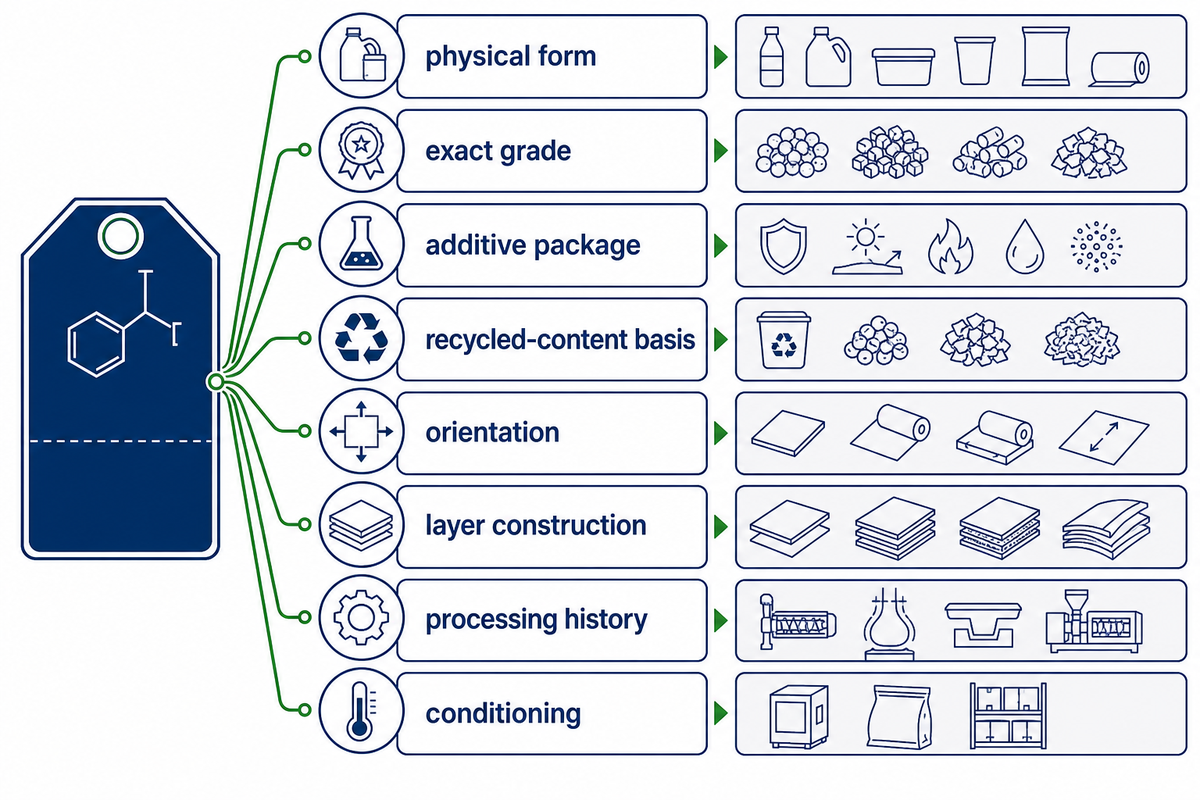
A family name omits variables that typically define performance: physical form, exact grade, molecular design, additive package, recycled-content basis, orientation, crystallinity, layer construction, processing history, and conditioning. ASTM D4000-23 separates plastic materials into families, groups, classes, and grades, while stating that the classification is not intended for material selection. Therefore, “PET,” “PE,” or “PP” defines a chemistry family not a complete industrial specification.
- Name the family: record the polymer or resin family and any blend.
- Describe the form: state film, sheet, fibre, strap, moulded part, foam, coating, or container.
- Lock the grade: retain the supplier designation, revision, additives, colour, and recycled-content basis.
- Map the construction: list each substrate, tie layer, coating, print layer, orientation, and nominal thickness.
- Preserve the history: record processing, conditioning, aging, lot, and any previous reuse or regrind step.
Consider a controlled hypothetical: two quotations both say “PE stretch film.” Offer A is a 3-layer, 23 µm construction; Offer B is a 5-layer, 17 µm construction. Those figures don’t prove which film performs better. They show why the comparison must include layer functions, resin grades, orientation, cling system, puncture response, containment test, equipment settings, and pallet trial.
Multi-layer identity is important outside film. Coatings, labels, sleeves, adhesives, closures, and pigments can affect separation and recovery, even when the main container uses a familiar polymer. A material passport has to capture both component layers and the final product that was tested.
What are different types of plastic grades?
Plastic grades are supplier-defined formulations within a polymer family. Grades may differ in molecular design, density, flow behavior, fillers, stabilizers, colourants, recycled content, food-contact scope, or target process such as film extrusion, blow moulding, or injection moulding. Compare the exact designation and revision; “HDPE grade” or “PP grade” alone still does not identify the supplied formulation.
Key takeaway
The Five-Layer Material Passport records family, form and construction, exact grade, declaration or authorization scope, and application validation. A family label fills only the first layer.
Choose by Service Conditions, Not Resin Name Alone
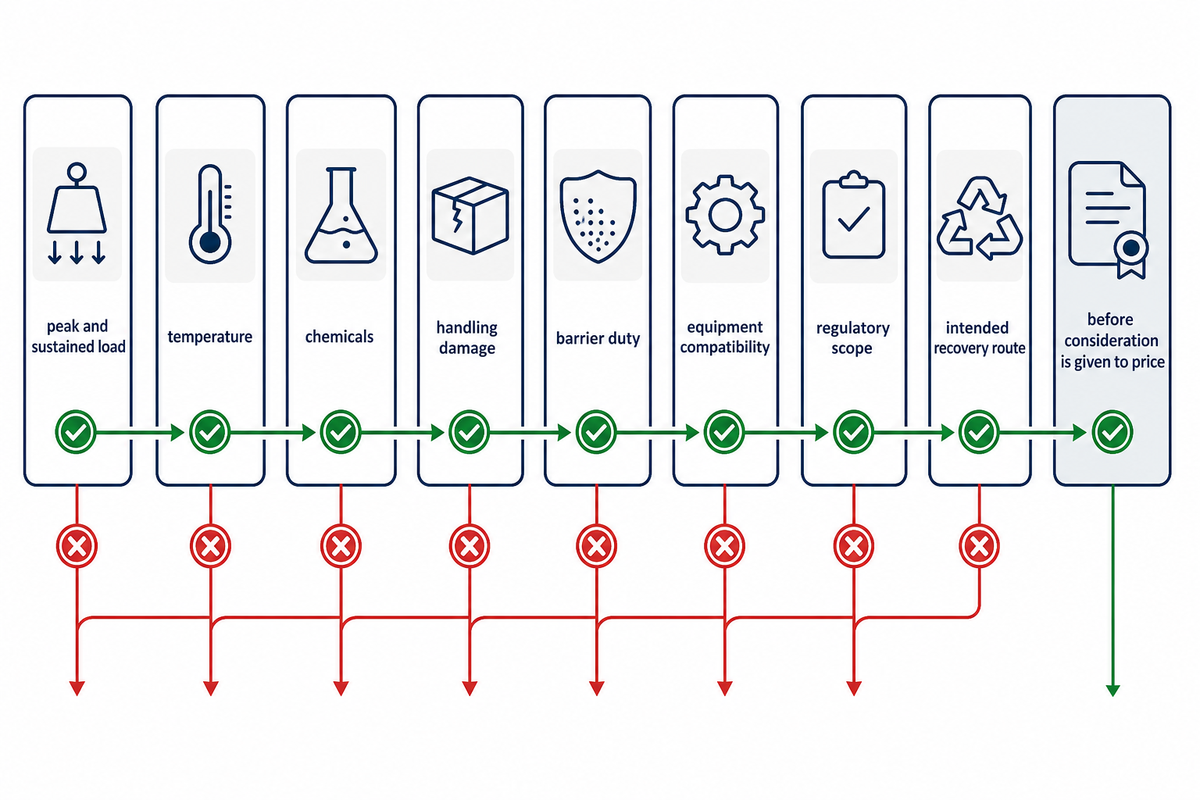
Material selection rejects candidates that don’t fall within the service envelope before consideration is given to price. The Service-Condition Knockout Sequence checks peak and sustained load, temperature, chemicals, handling damage, barrier duty, equipment compatibility, regulatory scope, and the intended recovery route. Evidence presented has to be tied directly to the grade and construction of the material.
| Gate | Question | Evidence | Reject trigger | Limitations / Not suitable for |
|---|---|---|---|---|
| Peak load | What maximum force and failure mode occur? | Defined tensile, joint, puncture, or impact test | Margin is absent at the required condition | A resin-family average cannot approve the package |
| Sustained load | How long must load be retained? | Creep or creep-rupture evidence | Short tensile data is the only proof | A 60 s pull does not simulate a 30 day hold |
| Temperature | What storage, transit, and process range applies? | Grade data and tests across the stated range | Softening, embrittlement, or seal loss enters the envelope | Room-temperature data is insufficient for thermal cycling |
| Chemistry | Which reagent, concentration, time, temperature, and stress? | Exposure test matched to service | Generic “chemical resistance” is the only claim | Immersion without load may not represent stressed service |
| Handling | Will edges, drops, abrasion, or puncture control failure? | Representative handling and package tests | The damage mode is outside the test plan | Tensile strength alone does not prove puncture resistance |
| Barrier | What must the construction retain or exclude? | Finished-film barrier test and seal validation | Only base-resin data is supplied | A coating or tie layer can control the result |
| Equipment | Can the line feed, tension, seal, cut, and control it? | Machine trial at production settings | Stable operation cannot be demonstrated | Laboratory coupons do not prove line compatibility |
| Regulatory use | What jurisdiction and conditions of use apply? | Scoped authorization or declaration | Evidence names a different substance, maker, or use | A generic “food grade” label is not enough |
| Recovery route | Who collects and processes the finished item? | Local acceptance plus design and traceability evidence | The route exists only in a broad marketing claim | A code symbol cannot guarantee collection |
What is the strongest type of plastic?
By tensile strength, one published properties table puts unfilled PA66 polyamide highest among standard plastics at about 80–90 MPa, followed by PA6 at about 70–85 MPa. Strength could mean maximum tensile strength, impact strength, puncture strength, joint strength, stiffness, or the ability to retain a load for a long time. Compare the exact grade and finished form under the temperature, time scale, geometry, and test method that match the application.
The time-scale boundary deserves special consideration. ASTM D882-26a (Film less than 1.0 mm) points out that tensile data may become irrelevant when the application operates on an entirely different force-time scale. ASTM D2990-17 (2025) addresses creep and creep rupture under long term load. The methods address different sets of concerns.
Chemistry needs the same discipline. ASTM D543-21 frames chemical evaluation through reagent, concentration, exposure time, temperature, stress, and service similarity. An illustrative screening brief might state 5% detergent solution, 40 °C, 72 h, and a defined applied stress. Those inputs define a test question; they are not a performance claim.
Illustrative load scenario. A pallet strap survives a 60 s pull at room temperature, while the shipment must remain unitized for 30 days through hot storage and repeated handling; the pull result answers a peak-load question. It doesn’t quantify tension loss after 720 h, joint behavior, edge damage, or the effect of the actual package. The approval plan therefore keeps the tensile report, adds time-dependent evidence, and runs a package trial using the selected strap, joint, tool settings, corner protection, pallet pattern, and route. Price review begins only after both candidates cleared the reject gates.
Example intake records, not recommended specifications
A strap brief might record 12 mm width, 0.70 mm thickness, a 350 kg unit load, 2.5 m load height, a −10 °C to 45 °C route, and a 30 day hold.
A stretch-film brief might record 500 mm roll width, 20 µm nominal gauge, 180% pre-stretch, 25 pallets/hour, conditioning at 23 °C and 50% RH for 24 h, plus the actual wrapper model.
A container brief might record an 8 kg top load, a 1.2 m drop, 15 min hot-fill exposure, and a 5 bar internal-pressure check. Replace every example with the application’s real envelope and governing method.
Plastic Packaging Forms: Film, Strapping, Containers, and Components
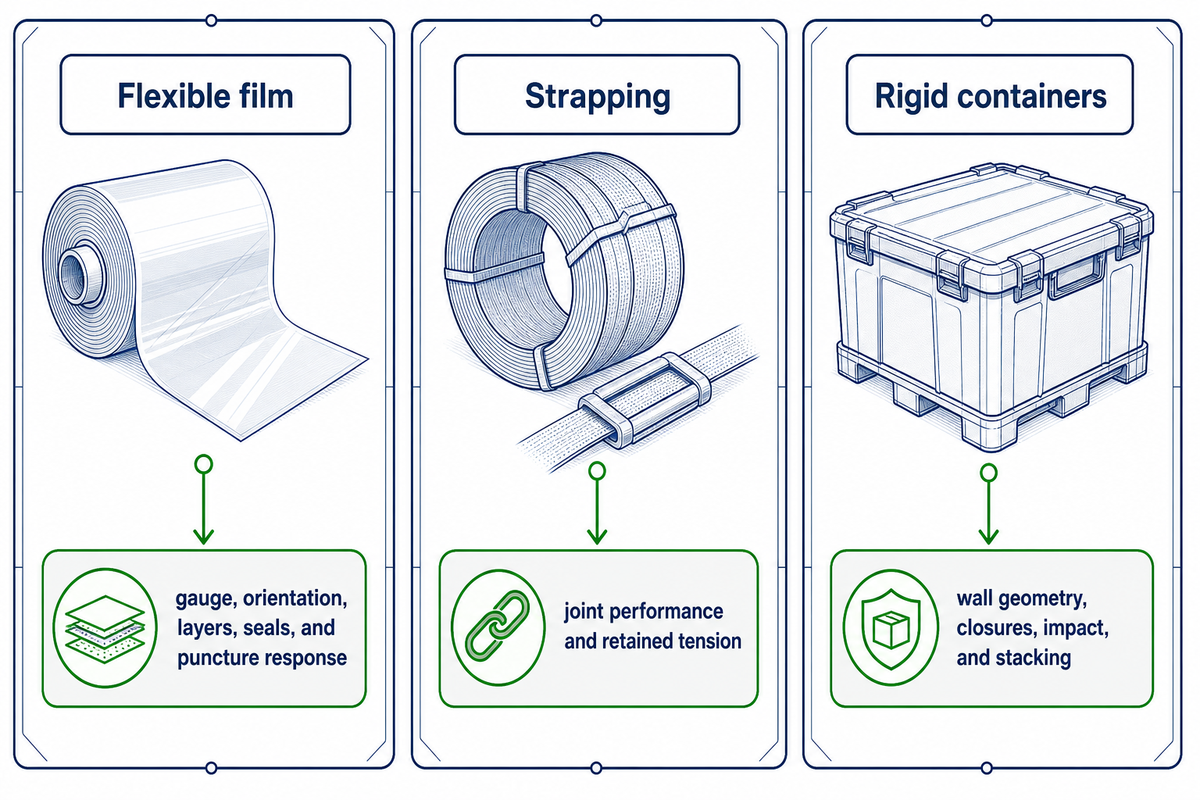
The form and content of the package influences failure and its load carrying capability. Flexible film is evaluated based on gauge, orientation, layers, seals, and puncture response. Strapping is evaluated based on joint performance and retained tension. Rigid containers are evaluated based on wall geometry, closures, impact, and stacking. Each form and content of the package needs evidence to show that it meets requirements.
| Finished form | Function to define | Construction fields | Validation boundary |
|---|---|---|---|
| Stretch film | Containment, puncture, cling, and load stability | LLDPE/LDPE grades, layers, gauge, orientation, additives | Film data plus production-wrapper and pallet trial |
| PET or PP strapping | Tension, elongation, retained load, and joint | Grade, draw ratio, width, thickness, surface, colour | Strap, seal or weld, tool, package, and transit system |
| Rigid container | Impact, stacking, closure, leak, and compatibility | Resin, grade, wall map, neck, closure, label system | Finished container with actual contents and distribution |
| Multilayer pouch | Barrier, seal, flex, print, and opening behavior | Each layer, tie layer, coating, ink, total gauge | Finished laminate, conversion process, seal, and aging |
| Closure or component | Fit, torque, fatigue, wear, and contact scope | Grade, mould, tolerances, colourants, assembly | Mated system at production tolerances |
A packaging engineer is able to use plastic packaging materials as a commercial handoff after requirements are defined. UD Packaging’s supplied company profile provides information about PET strapping, industrial stretch film, seals and strapping equipment. That first-party information doesn’t replace a grade data sheet, scoped certificate, or application trial.
Other forms of the package (e.g. plastic film) also need method discipline. The site’s guide to tensile testing of plastic film provides context for the test. ASTM D882 states that films, laminates and coatings are within its scope, but a coupon test does not prove pallet stability or integrity of seals and barriers.
Why Resin Codes Do Not Prove Recyclability or Load Fitness
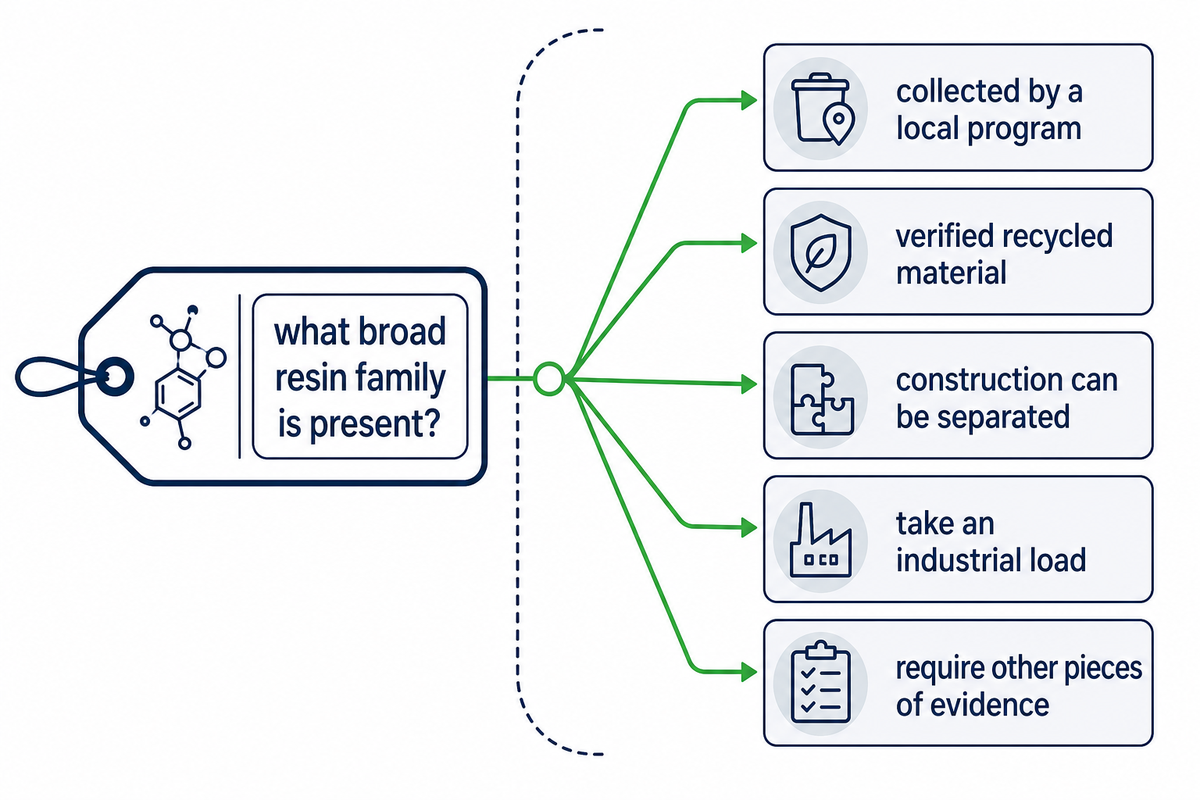
A resin identification code addresses the question, “what broad resin family is present?” It doesn’t answer whether the final format will be collected by a local program, whether the product contains verified recycled material, whether the construction can be separated, or whether it can take an industrial load. Those require other pieces of evidence.
| Decision | What can support it | What cannot prove it | Buyer action |
|---|---|---|---|
| Family identity | Resin code, material declaration, grade record | Appearance alone | Confirm construction and grade |
| Local acceptance | Collector or municipal program rules for the finished format | A #1 to #7 symbol | Check destination-specific instructions |
| Recycled content | Scoped certification, chain of custody, or physical traceability | The word “recyclable” | Request basis, percentage, scope, and lot record |
| Application fitness | Grade and finished-package validation | Resin family or code | Run the Service-Condition Knockout Sequence |
| Bio claim | Defined feedstock-origin evidence | Biodegradable or compostable wording | Separate origin from end-of-life behavior |
How do I identify different types of plastics?
Start with the supplier declaration, grade label, drawing, or resin identification code, then confirm physical form and construction. Visual inspection can help identify a family but can’t reliably identify every blend, additive package, coating, or multilayer construction. When identity affects safety, process settings, or acceptance, use documented material records or qualified analysis.
The public page for ASTM D7611/D7611M-26 states that a resin code identifies the family, but does not indicate recyclability. The US EPA recycling FAQ also states that accepted materials vary by community. Even a material that is technically easy to recycle may be rejected because of format, contamination, color, attachment, or lack of a local route.
Resin codes also do not answer every health and the environment question. Number 6 plastic identifies a polystyrene family and doesn’t estimate migration or microplastics, nor does it address exposure or risk for a given product. Plastic food containers, lunch boxes, and baby bottles require evidence based on product and use.
Bio-based, biodegradable, and compostable plastics need another separation. The European Commission policy framework explains that bio-based origin does not necessarily mean biodegradable or compostable. Compostable products normally need defined conditions and compatible collection and treatment; an item does not simply disintegrate into an accepted recovery route because of one label.
The Five-Layer Material Passport Buyers Should Request
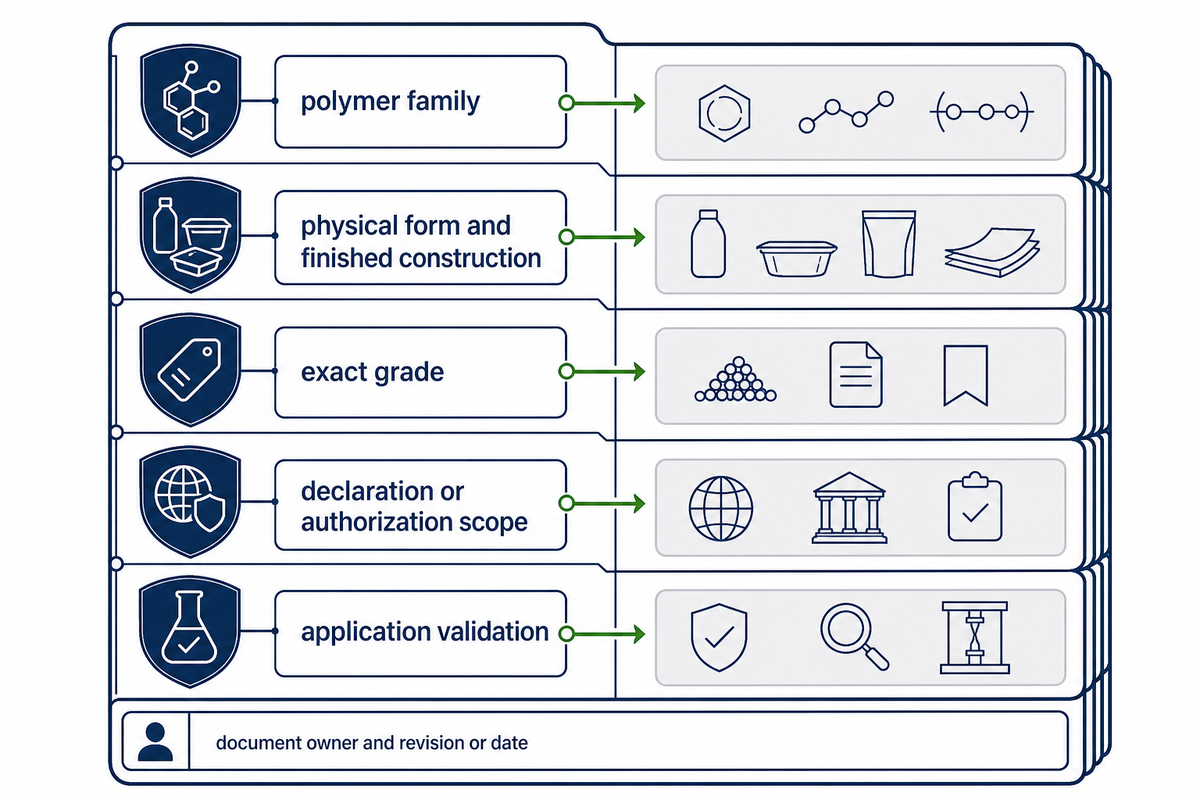
A five-layer material passport allows the quotation comparison of identity and evidence. It records the polymer family, physical form and finished construction, exact grade, declaration or authorization scope, and application validation. Each layer identifies a document owner and revision or date. Also lot identification and acceptance status are recorded.
| Layer | Minimum record | Typical evidence | Status question |
|---|---|---|---|
| 1. Family | Polymer, blend, and resin identification | Supplier declaration or technical record | Is the identity complete? |
| 2. Form and construction | Film, strap, part, layers, coatings, dimensions, orientation | Drawing, bill of materials, construction sheet | Does it match the finished item? |
| 3. Grade | Designation, additives, colour, recycled-content basis, revision | Technical data sheet and change record | Is the quoted grade the tested grade? |
| 4. Declaration | Claim, jurisdiction, substance or product scope, maker, use conditions | Scoped declaration, authorization, certificate | Does the document cover this supply chain? |
| 5. Validation | Method, edition, specimen, conditions, result, lot, package trial | Test report, CoA, incoming plan, trial record | Does the evidence match service? |
Testing records must retain sufficient information to allow comparison. UD Packaging’s plastic material testing resources, the guide to specimen and report details, and the comparison of ASTM D882 vs ISO 527-3 explain why method, specimen, conditioning, speed, and result definition must remain visible.
Food packaging needs a conditional regulatory field rather than a blanket label. FDA guidance on food-contact components ties status to substance identity, specifications, and conditions of use. For a Food Contact Notification, the effective authorization also attaches to the identified manufacturer, substance, and conditions of use. A certificate for another formulation or use condition cannot be silently transferred.
Evidence for the use of recycled content materials also needs limitations. The RecyClass traceability guidance addresses the origin and physical traceability through the value chain. That record is different from local recyclability, chemical recycling potential, reuse suitability, energy consumption, greenhouse gas emissions, or a general circular economy for plastics claim.
Supplier Approval Questions Before Production
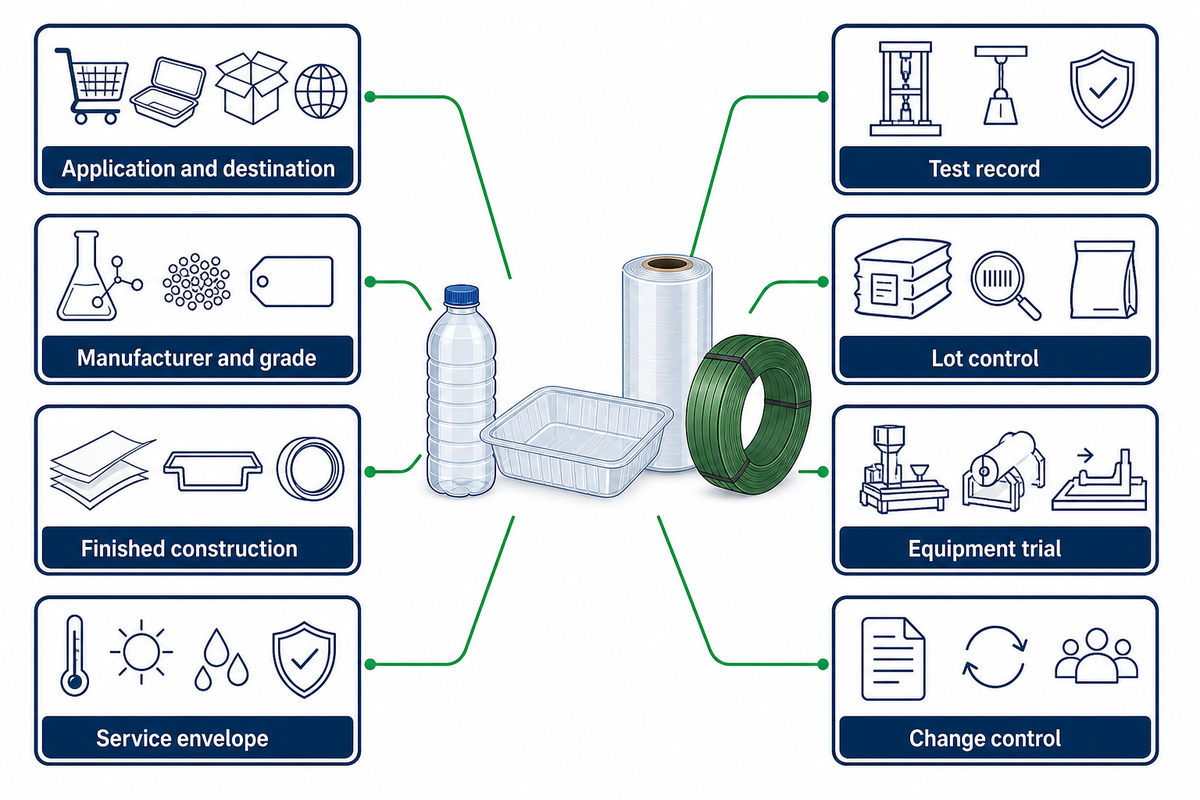
The scope of the approved supplier should bind the offered material to the actual product, the destination, equipment, test method, lot and change-control process. FDA guidance makes food-contact status conditional on substance identity, specifications, conditions of use and, in the FCN pathway, the identified manufacturer. The same scope questions should be posed to all bidders. Define what will be tested on the samples and what will be tested on production lots. The acceptance decision should be made based on what’s defined in a given document.
These fields should be included in an RFQ. The “recommended range” is the buyers’ tolerance or envelope rather than universal material value.
RFQ checklist: copy these into your quote request
| Parameter | Recommended range | Why it matters | How to verify |
|---|---|---|---|
| Application and destination | State product, route, jurisdiction, and duration | Defines service and regulatory scope | Signed specification review |
| Manufacturer and grade | Exact maker, formulation, grade, revision | Prevents substitution by family name | TDS and approved-source record |
| Finished construction | State layers, orientation, nominal dimensions, tolerances | Connects material to package form | Drawing and measured sample |
| Service envelope | Peak and sustained load, °C range, chemicals, handling | Defines reject gates | Grade data plus scoped test |
| Test record | Method, edition, specimen, conditions, replicates, result | Makes data comparable | Full report and raw-value access |
| Lot control | Define CoA fields and sampling frequency | Links approval to production | Lot ID and incoming record |
| Equipment trial | State line speed, tension, seal, cut, and acceptance | Tests production compatibility | Witnessed trial and signed result |
| Change control | Prior notice for grade, site, formula, tooling, or process changes | Protects the qualified state | Contract clause and requalification trigger |
A generic compliance pack can look complete while omitting key elements such as the actual manufacturer or components, intended use or test conditions. Approval should stop when a document covers a different construction or lot. The cost of an additional clarification is usually smaller than qualifying evidence that cannot be traced to the supplied product.
Illustrative approval scenario. A supplier offers a multilayer pouch for a food product and attaches a declaration for one resin component. A buyer doesn’t accept that file as authorization for the complete pouch. The RFQ seeks disclosure of all food-contact components, manufacturer or formulation identity, as applicable, layer and coating construction, intended food, and the duration and temperature of food contact, and the intended end use. The supplier also identifies the actual production site and change-notification process. The team approves the sample only after the evidence scope matches the offered construction and the finished pouch passes the defined seal, barrier, and handling checks.
When not to approve a material
Don’t approve when the quote names only a family, a certificate has no product or use scope, the test report hides conditions, the grade can change without notice, long-term duty is supported only by a short pull, or the recovery claim has no destination-specific route. Return the gap as a written supplier question.
What Is Changing in Plastic Packaging Material Selection
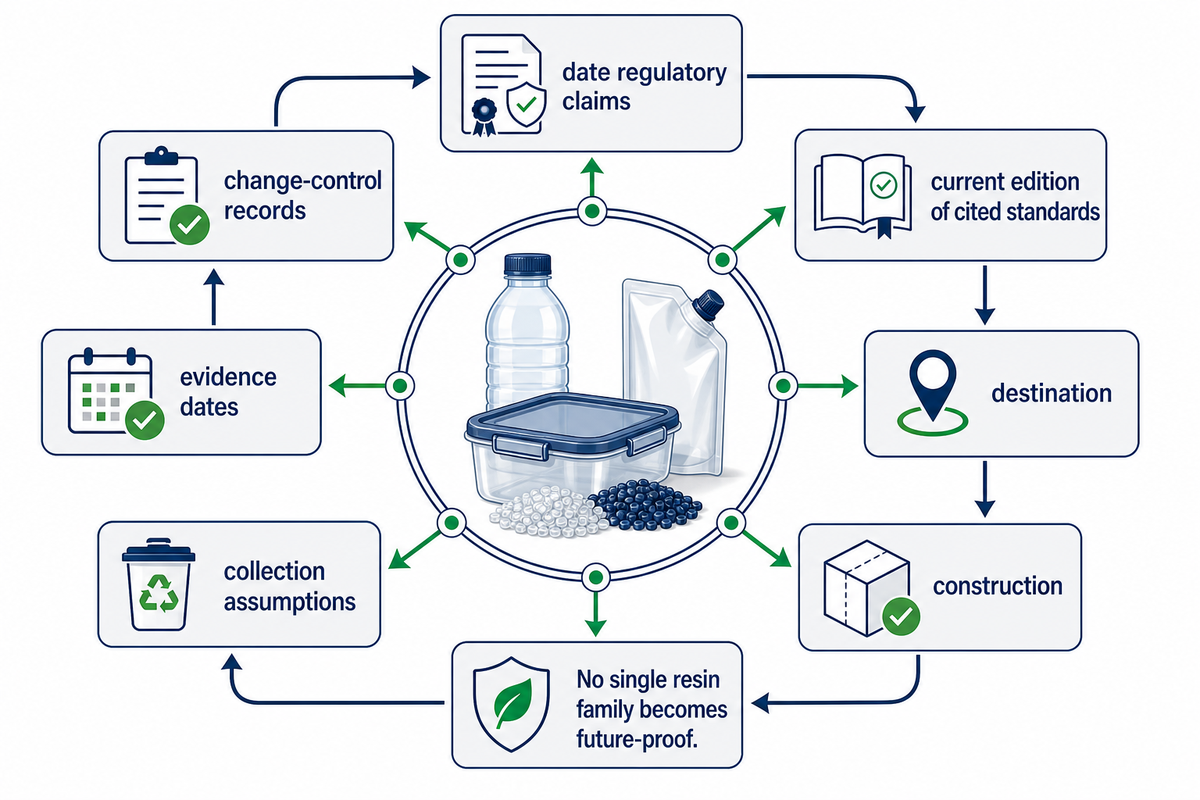
Evidence is starting to play a role in packaging selection to align design, recovery, and traceability. Buyers should date regulatory claims, confirm the current edition of cited standards, separate material origin from end-of-life behavior, and retain change-control records. No single resin family becomes future-proof because a policy or label changes.
As per the European Commission packaging-waste page, Regulation (EU) 2025/40 came into force on 11 February 2025 and will generally apply from 12 August 2026. It sets a target for packaging to be recyclable in an economically viable way by 2030. A buyer planning a 2026 supply agreement should therefore preserve destination, construction, collection assumptions, and evidence dates in the approval record.
Changes to designs can require modifications to the finished system rather than a simple substitution of materials. A mono-material structure can be in conflict with barrier or durability requirements, and a multi-layer structure can protect the contents but be difficult to recycle in an available system. Bio-based feedstock can reduce reliance on petroleum or natural gas without proving compostability. Compostable claims require collection, treatment, and conditions. Chemical recycling can increase options for some plastic waste streams, but the existence of a process doesn’t ensure local acceptance.
Standard status changes too. Date the standard edition in a specification and check it before renewal. A current revision can widen the scope or change the terminology, even though the supplier continues to cite the older document. This is especially important when brand literature names a test standard: the article should not call an older edition “current” without a live status check.
Frequently Asked Questions About Plastic Material Types
The answers below keep chemistry family, commercial grade, finished form, local recovery, and application proof separate.
What are the four main types of plastic?
Short answer
There is no universal set of four main plastic types; teaching schemes group plastics by resin code, chemical family, performance class, source, or end use. For packaging procurement, identify the chosen scheme before comparing materials.
Rubber-like elastomers and fibres can overlap with packaging components, but a family label still doesn’t define the grade or finished construction.
How many types of plastic are there?
Short answer
Seven, if you count resin identification codes, though the #7 group contains unlike materials. Chemistry adds many polymer families, and commercial suppliers create numerous grades through different monomers, molecular designs, fillers, additives, colours, and process targets.
The correct count depends on whether the question concerns chemistry, recycling labels, engineering classes, or purchasable grades.
What type of plastic cannot be remelted?
Short answer
Thermosetting plastics can’t be remelted and reshaped like thermoplastics after curing because cross-links lock the network. Reheating may damage or decompose the cured material instead. That behavior doesn’t by itself decide disposal or recovery; the exact thermoset, reinforcement, contamination, and available route still matter.
Melamine and phenolic systems are familiar examples, but use the product record rather than appearance to identify them.
Which plastics are recyclable and which are not?
Short answer
In the U.S., a 2020 Greenpeace survey of the country’s 367 material recovery facilities found that only PET #1 and HDPE #2 plastic bottles and jugs are being recycled with regularity. Acceptance depends on the resin, format, colour, size, contamination, labels, closures, collection system, and processor demand. Check the local program for the finished item; a recycling code identifies resin but doesn’t guarantee collection.
What plastic is typically used for stretch film?
Short answer
Industrial stretch film commonly uses linear low-density polyethylene, often with other polyethylene grades or additives in a multilayer construction. The family explains flexibility and process fit only at a broad level. Select the film by finished gauge, layer design, stretch behavior, puncture response, cling, containment force, wrapper settings, pallet geometry, and transport trial.
Plastic bags and stretch film may both use low-density polyethylene families, yet their grade, layer, seal, and load requirements differ.
What plastic material is commonly used for strapping?
Short answer
PET and PP are common plastic strapping families. Choose between exact products using load duration, elongation, retained tension, joint method, tool compatibility, package edges, storage temperature, weather exposure, and distribution validation rather than the family name alone.
Need a material brief that suppliers can answer?
Share the finished packaging form, load duration, environmental conditions, equipment, destination, and evidence already available. UD Packaging can discuss PET strapping, stretch film, supporting consumables, and equipment within that defined scope.
Transparency statement
This guide separates independent standards and public guidance from UD Packaging’s first-party company description. Broad family tendencies are screening information, not a substitute for the exact grade data sheet, licensed standard, regulatory determination, supplier approval, or finished-package validation.
References & Sources
- Polymer: Thermoplastics: British Plastics Federation
- ASTM D4000-23 Classification System: ASTM International
- ASTM D882-26a: ASTM International
- ASTM D2990-17 (2025): ASTM International
- ASTM D543-21: ASTM International
- ASTM D7611/D7611M-26: ASTM International
- Frequent Questions on Recycling: United States Environmental Protection Agency
- Bio-based, Biodegradable and Compostable Plastics: European Commission
- Determining the Regulatory Status of Food-Contact Components: US Food and Drug Administration
- Traceability of Recycled Plastics: RecyClass
- Packaging Waste and PPWR Timeline: European Commission