
By XCX · Updated September 2026
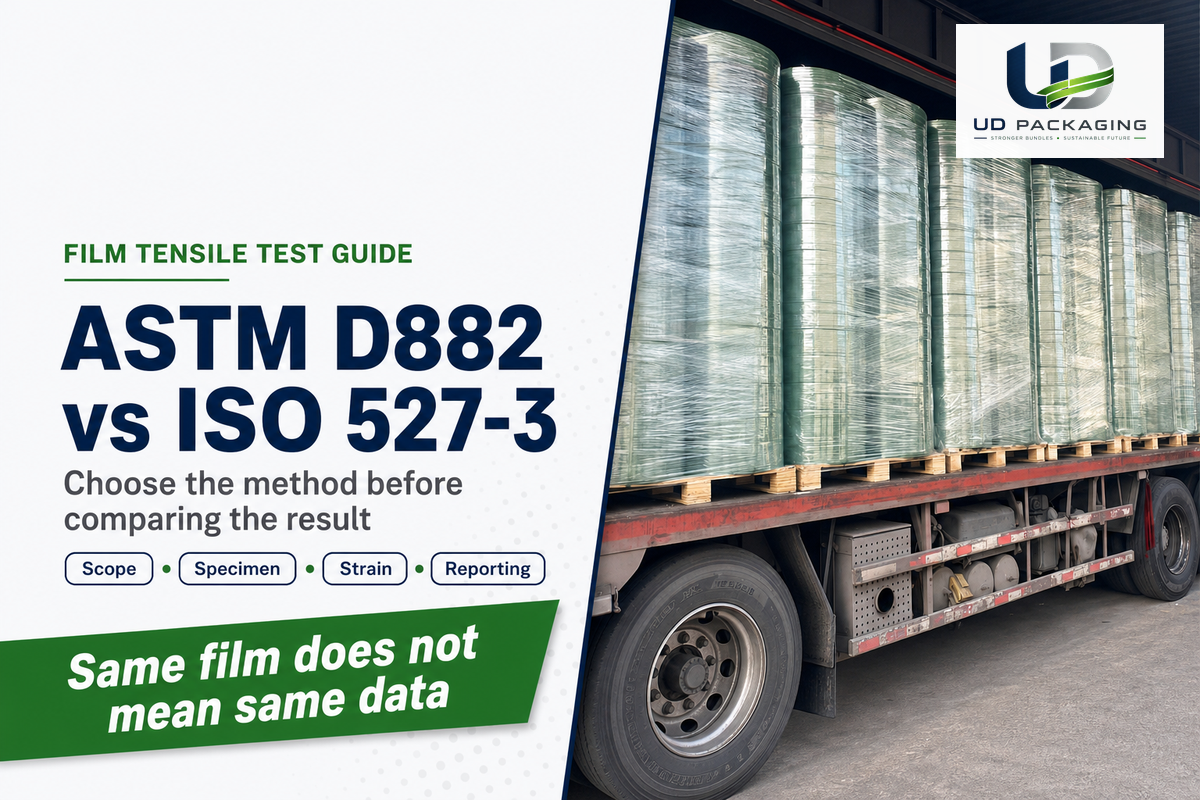
ASTM D882 vs ISO 527-3 is a comparison between two methods describing tensile testing of thin plastic film and sheet. Both methods incorporate selection of strain and definition of test procedure and calculations. There are also minor differences in reporting results. One important difference between the two methods is how they define strain measurement and how they choose the specimen to be tested. Select the method described by the customer, regulation, product specification or qualified laboratory and describe the edition and give the set up. Comparison of the results obtained helps evaluate suitability only when the governing requirement and setup match.
Short answer
Do not convert ASTM D882 results to ISO 527-3 with a universal factor. First confirm that both reports describe the same material population, thickness basis, specimen direction, conditioning, geometry, speed basis, strain measurement, property definition, and validity rules. If any of those fields differ, the numbers may still be useful, but they are not automatically equivalent.
1. Match the requirementContract, specification, market, or test program
2. Lock the methodEdition, specimen, speed, strain, and state
3. Compare the dataOnly after the setup fields are visible
ASTM D882 vs ISO 527-3: the short answer
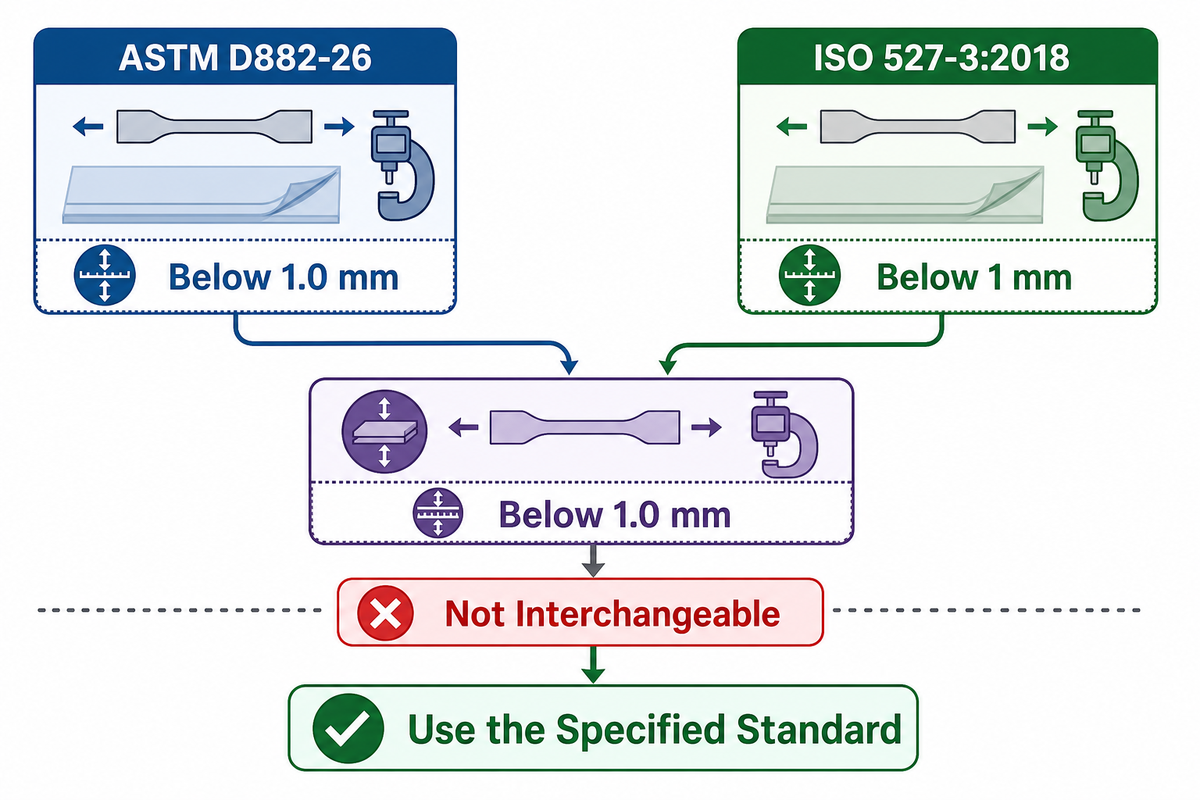
ASTM’s current public page lists ASTM D882-26 as active and describes tensile testing of plastic film and sheeting below 1.0 mm. The official ISO 527-3:2018 record also addresses film and sheet below 1 mm and shows that the 2018 edition was confirmed in 2024.
That shared thickness screen does not make the standards interchangeable. ASTM says D882 is technically similar to ISO 527-3, while the ISO record places Part 3 within the general principles of ISO 527-1 and states that it is not normally suitable for cellular materials or textile-fibre-reinforced plastics.
The practical rule
Use the specified standard, not the one that produces the more convenient number. If no method is specified, define the decision first: supplier qualification, incoming inspection, research comparison, process control, or failure investigation can require different evidence and reporting depth.
What both standards actually cover
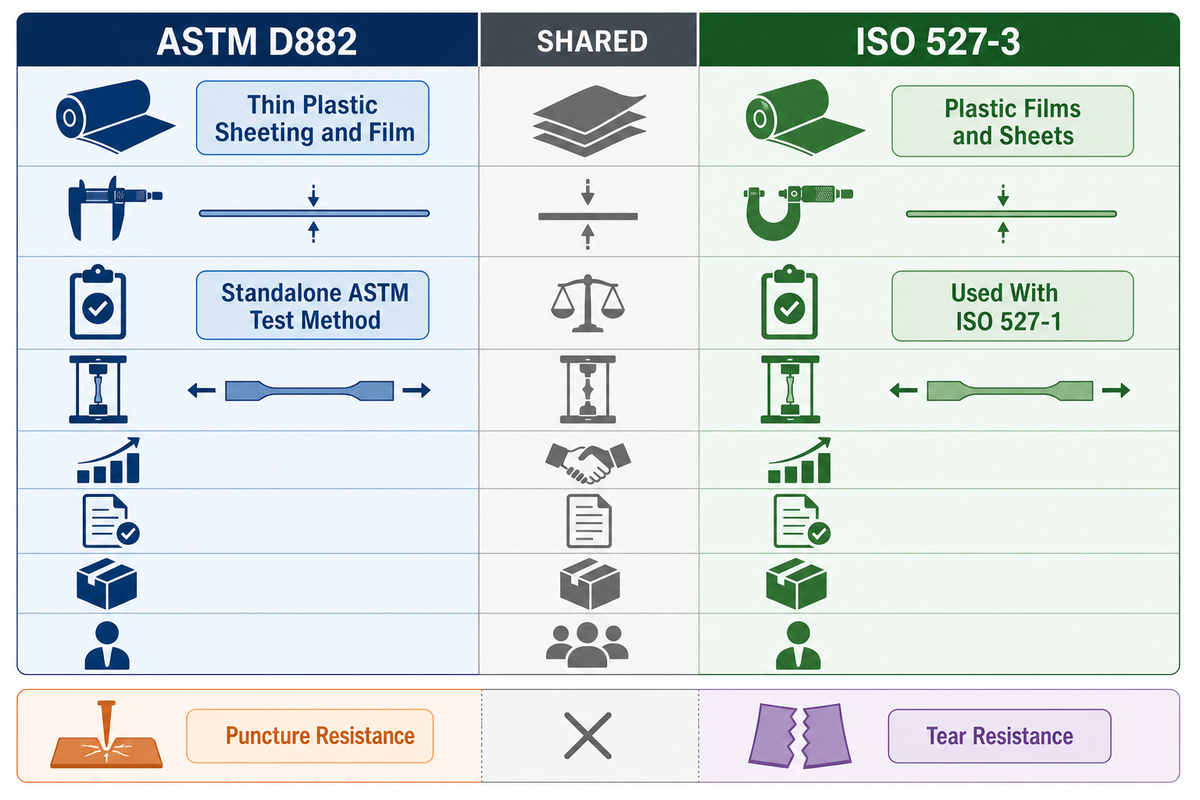
Both standards address tensile properties of plastic specimens in thin film and sheet forms. ASTM’s public scope gives the D882 boundary as less than 1.0 mm (0.04 in.) and notes a nominal 0.25 mm (0.010 in.) film definition, while the method itself covers thin sheeting and film within scope. The ASTM standard provides scope, apparatus, specimen, procedure, calculation, and reporting guidance for thin film. The thickness boundary for thin sheets is given in the public scope of the standard.
Depending on the requirement of the user and the interpreted scope of the standard, a report may include tensile strength, modulus, or elongation and may define the type of yield. The standard does not define the meaning of “puncture resistance” or “tear resistance”, and therefore interpretation of such terms is outside the scope of the standard.
| Question | ASTM D882-26 | ISO 527-3:2018 |
|---|---|---|
| Material form | Thin plastic sheeting and film | Plastic films and sheets |
| Public thickness cue | Below 1.0 mm | Below 1 mm |
| Standards framework | A standalone ASTM test method, subject to applicable material specifications | Part 3 conditions used with ISO 527-1 general principles |
| Public material limitation | ASTM describes broad plastics use within the stated thickness and machine capacity | ISO names cellular and textile-fibre-reinforced plastics as normally unsuitable |
This comparison table, or “selection screen,” provides no procedural guidance on the precise form or dimensions of the specimens, the speed of the test, or the calculation or reporting requirements of the test.
Where the test setups diverge
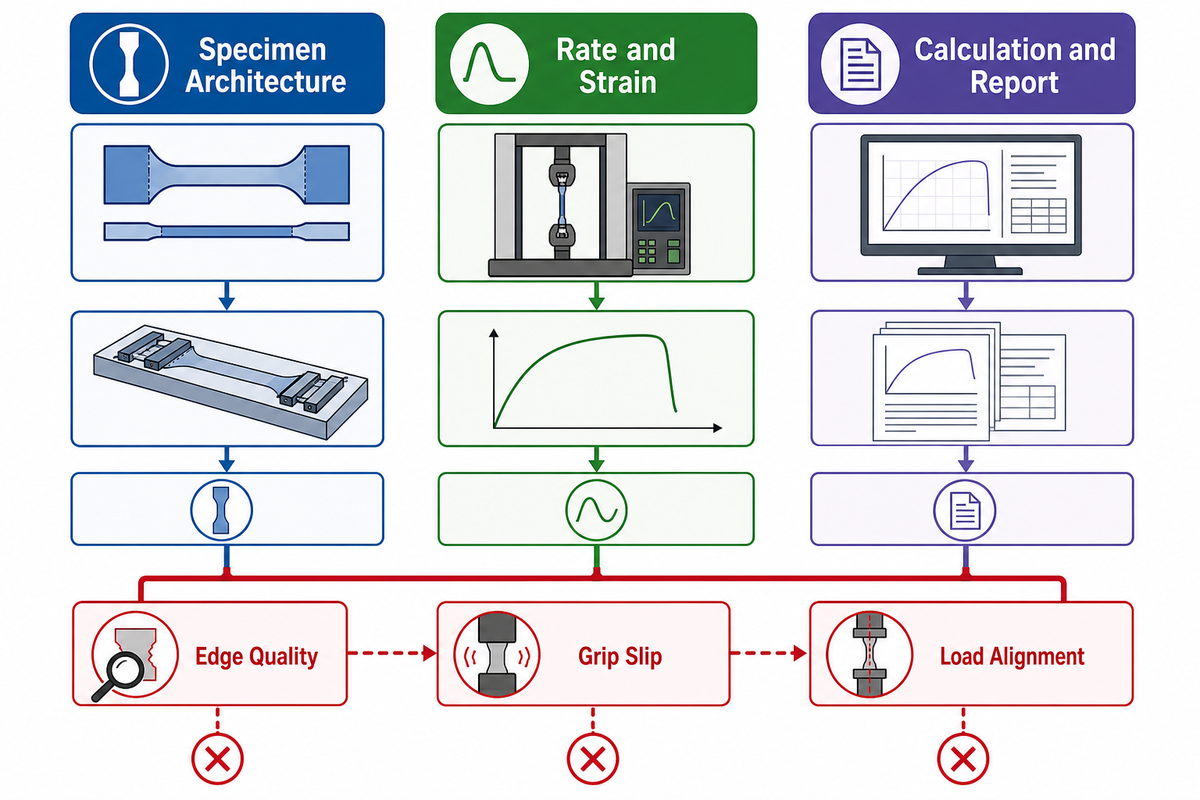
While the term “tensile test” creates the impression that the procedures of the two standards are similar, the official ISO 527-3 record places Part 3 within the ISO 527 framework, and there are a number of differences that affect the selection of the test specimen, test speed, test conditions, interpretation of test results, and the resulting report structure.
Specimen architecture
Record form, width, gauge or grip separation, thickness method, cutting direction, edge quality, and sampling location.
Rate and strain
Record the speed-selection basis and whether strain came from crosshead travel, grip separation, gauge marks, or an extensometer.
Calculation and report
Confirm the named property, original dimensions, units, exclusions, replicate count, and summary statistics.
Because thin film specimens are very delicate, the procedure is very operator dependent. The validity of the test is questionable if irregularities, such as a nick in the edge of the specimen, slip of the specimen in the grips, or non-axis-alignment of the load, are present.
It’s essential to analyze the requirements of the universal testing machine, load cells, grips, and testing software before sending film specimens for testing. This is especially true for thin film specimens, which can break or distort easily. Requests for testing should contain enough detail to allow a response to define the nature of the required testing. A specific example is the request to determine the tensile properties of a thin plastic film. This testing could encompass determination of tensile strength, elongation at break, or tensile modulus. It’s important for the lab performing the tests to understand the nature of the test to be performed.
Why the same film can produce different numbers
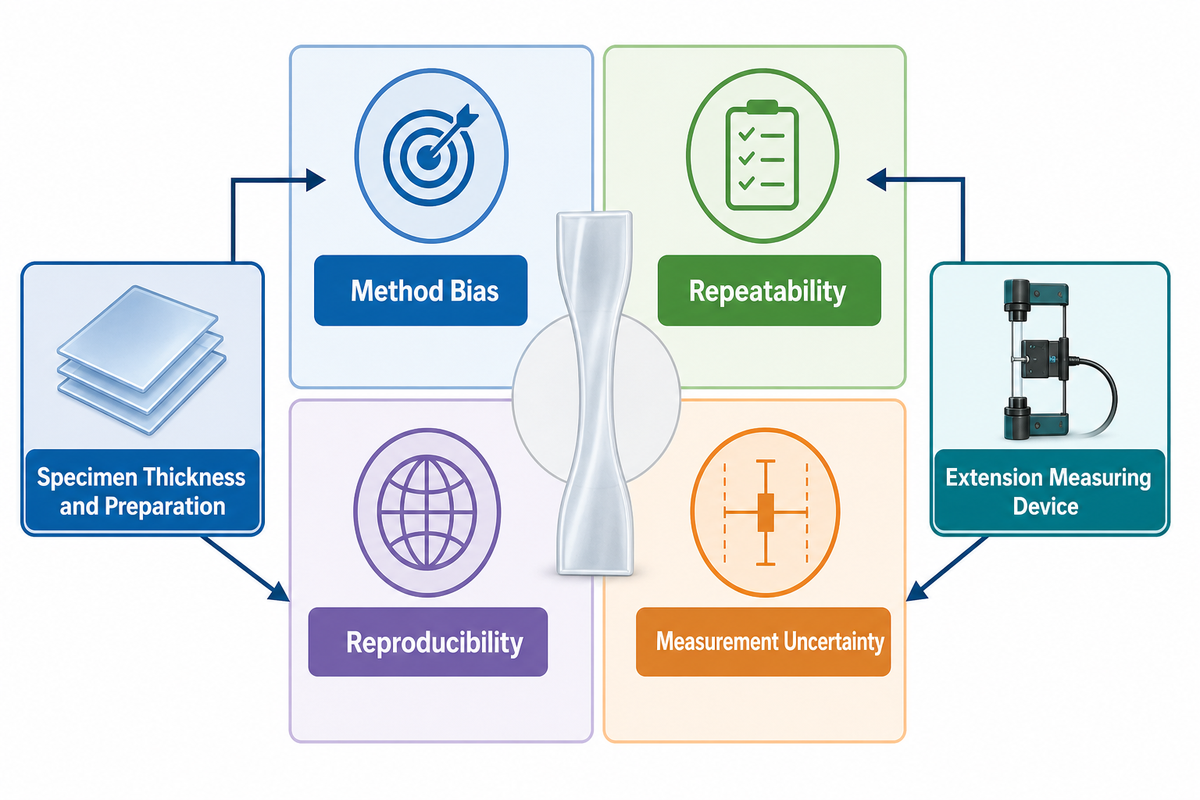
In the evaluation of film specimens, test methods and laboratories contribute a significant degree of uncertainty. Further, the film specimen may not be uniform. As stated in the ASTM publication on the significance of tensile properties of materials, specimen thickness and preparation affect the results of tensile tests.
Other factors that influence the results of tensile tests of plastic films include the type of machine and the type of extension measuring device. The resolution of the recording instruments and the training of the operator can also affect results.
Do not collapse four questions into one
- Method bias: do the prescribed setups produce systematically different results?
- Repeatability: does one laboratory obtain close results under the same conditions?
- Reproducibility: do laboratories agree when operators, equipment, or location change?
- Measurement uncertainty: how much doubt belongs to the reported value and process?
The distinction matters when reports disagree. A ten-page proceedings study in the International Geosynthetics Society library compared methods on selected PVC-P and flexible polypropylene geomembranes and found ASTM D882 and ISO 527-3 or its Brazilian equivalent comparatively close for those tested materials. For sample A, its table reports D882 versus NBR/ISO machine-direction tensile strength of 15.5 versus 15.2 kN/m and elongation of 471% versus 423%; the cross-machine figures were 13.7 versus 12.8 kN/m and 454% versus 402%.
Material-specific agreement is evidence against automatic disagreement, not evidence for a universal conversion.
Those examples show that the two assessments can indeed produce close results for specific samples. The paper reports 0.6 mm and 0.9 mm fPP samples and an estimated average error of about 4% for both D882 and ISO/NBR across its study. However, those details do not construct a conversion equation. The focus is on laboratory tests and specific geomembrane samples, not on packaging or other kinds of films and tensile properties.
ASTM D882 vs ISO 527-3 comparison matrix
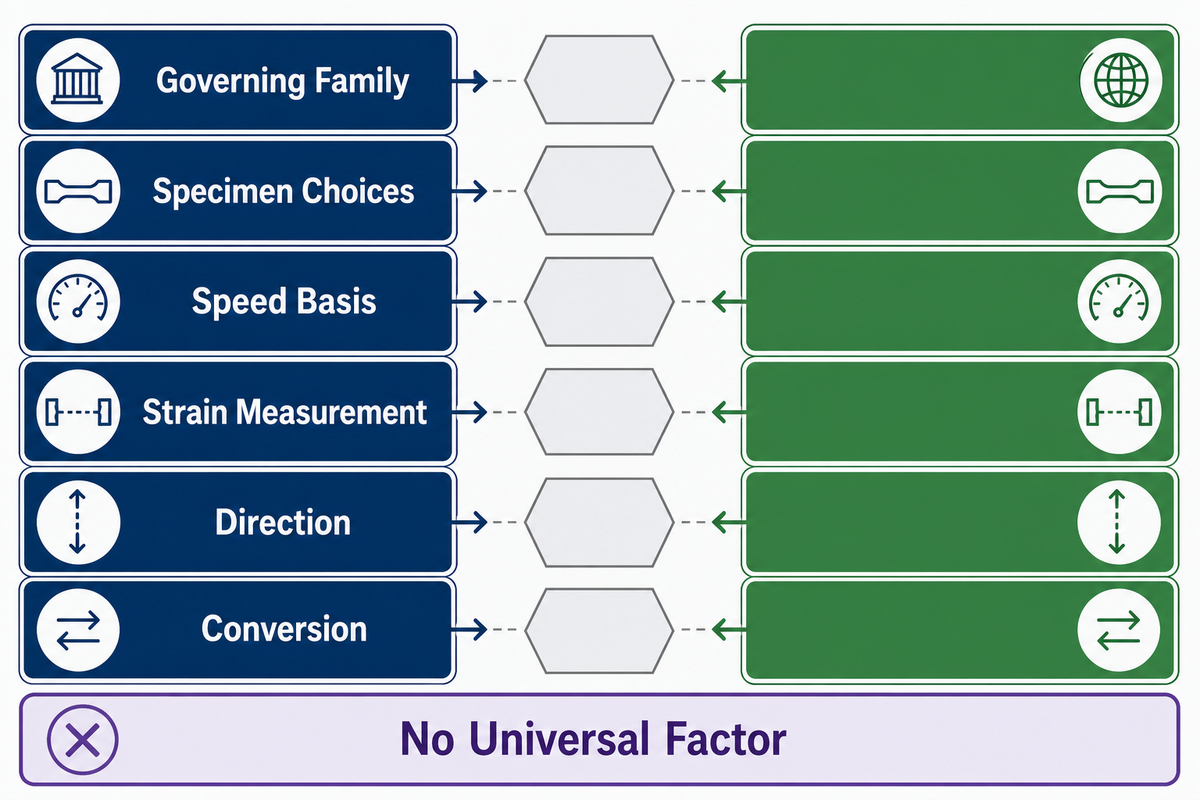
| Decision field | ASTM D882 | ISO 527-3 | Why it matters |
|---|---|---|---|
| Governing family | ASTM film and thin-sheet method | Part 3 used with ISO 527-1 | The named standard alone may not contain the whole test framework |
| Specimen choices | Method-specific thin-sheet options | ISO film-and-sheet specimen conditions | Geometry changes stress distribution and gauge interpretation |
| Speed basis | Selected under the D882 framework | Selected under the ISO 527 framework | Polymers can respond to strain rate |
| Strain measurement | Permitted measurement route must be reported | Gauge and extension framework must be reported | Crosshead travel and direct gauge strain are not automatically the same |
| Direction | Retain MD and transverse identity | Retain orientation and specimen identity | Oriented films can be anisotropic, but the size of the effect is material-dependent |
| Conversion | No universal factor | No universal factor | A correlation must be validated for the exact material and controlled setups |
Which standard should you specify?
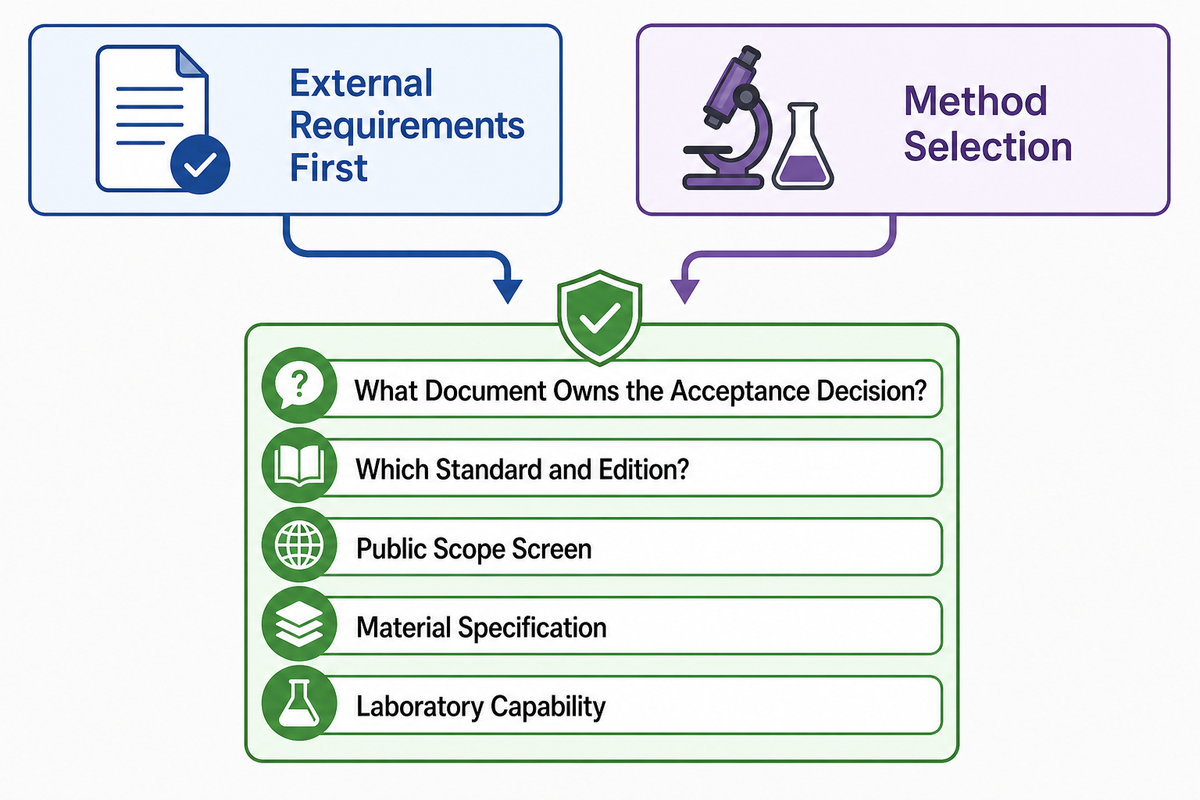
Consider external requirements first. When a client drawing, purchase specification, or other market requirement names ASTM D882 or ISO 527-3, consider that requirement first. Record the revision of the document for every reported result if an edition is not specified.
Method Match Gate
- What document owns the acceptance decision?
- Which standard and edition does it name?
- Does the material fall within the public scope screen?
- Does another material specification modify the general method?
- Can the selected laboratory execute and report every required field?
When no external document decides, define your testing needs and choose the method that best supports the intended comparison. A North American customer history may favor D882; a global program organized around the ISO 527 family may favor ISO 527-3. A repeatable testing system across supplier, incoming, qualification, and troubleshooting data is usually more valuable than switching methods mid-program.
Can you compare or convert existing results?
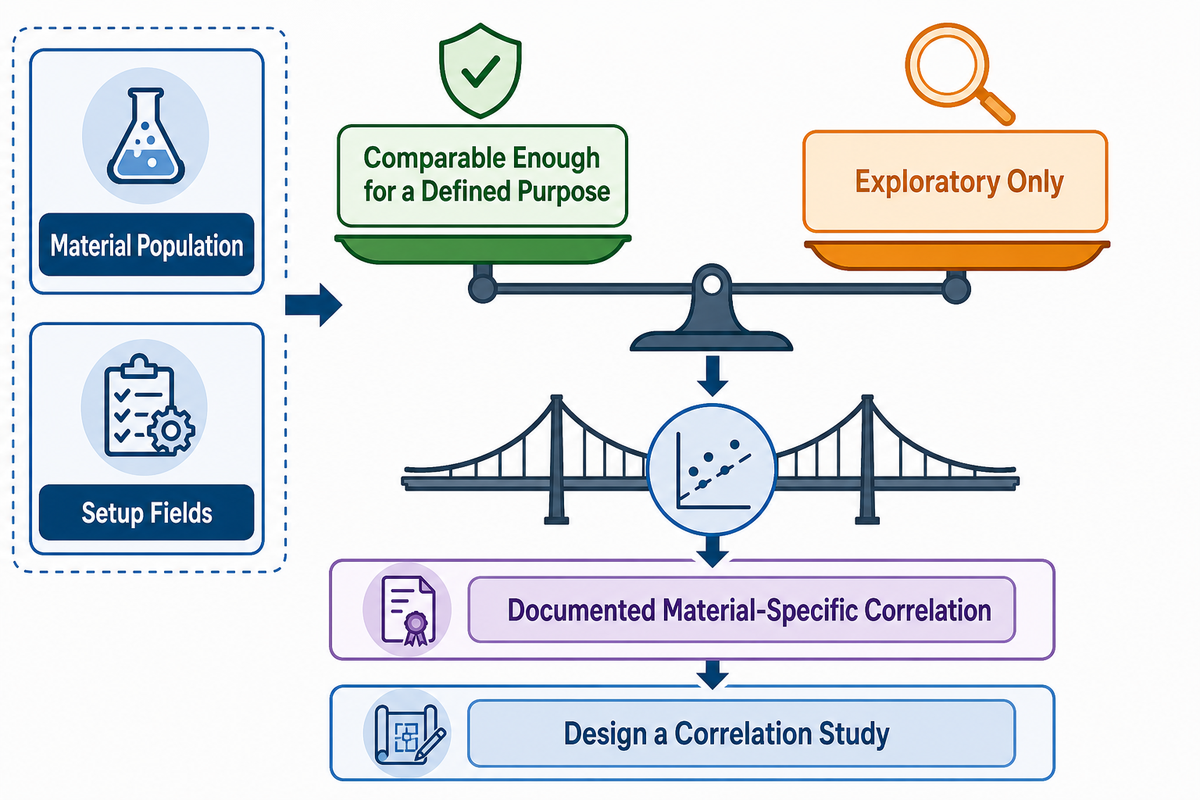
You can review your existing reports side by side. However, you can’t present values as direct equivalents if they aren’t comparable. True comparability requires a detailed description. For example, some of the things you may want to include in your description are: specimen dimension, form, and shape; specimen condition and history; marks on the specimen; measurement, grip, and strain; units; the number of specimens; exclusions and limitations; and the results.
Comparable enough for a defined purpose
The material population and setup fields match, or a documented material-specific correlation has been validated across the intended range.
Exploratory only
A key field is missing or different, and no validated correlation connects the methods for that exact material and decision.
It’s better practice to design a correlation study to validate a conversion rather than to assign a multiplier. You should collect material from the same position and define what MD and transverse means. You should perform sufficient replicates and determine the operating range and bias. You should set a tolerance limit and define the intended decision and acceptance error.
The Same-Data Test for reviewing reports
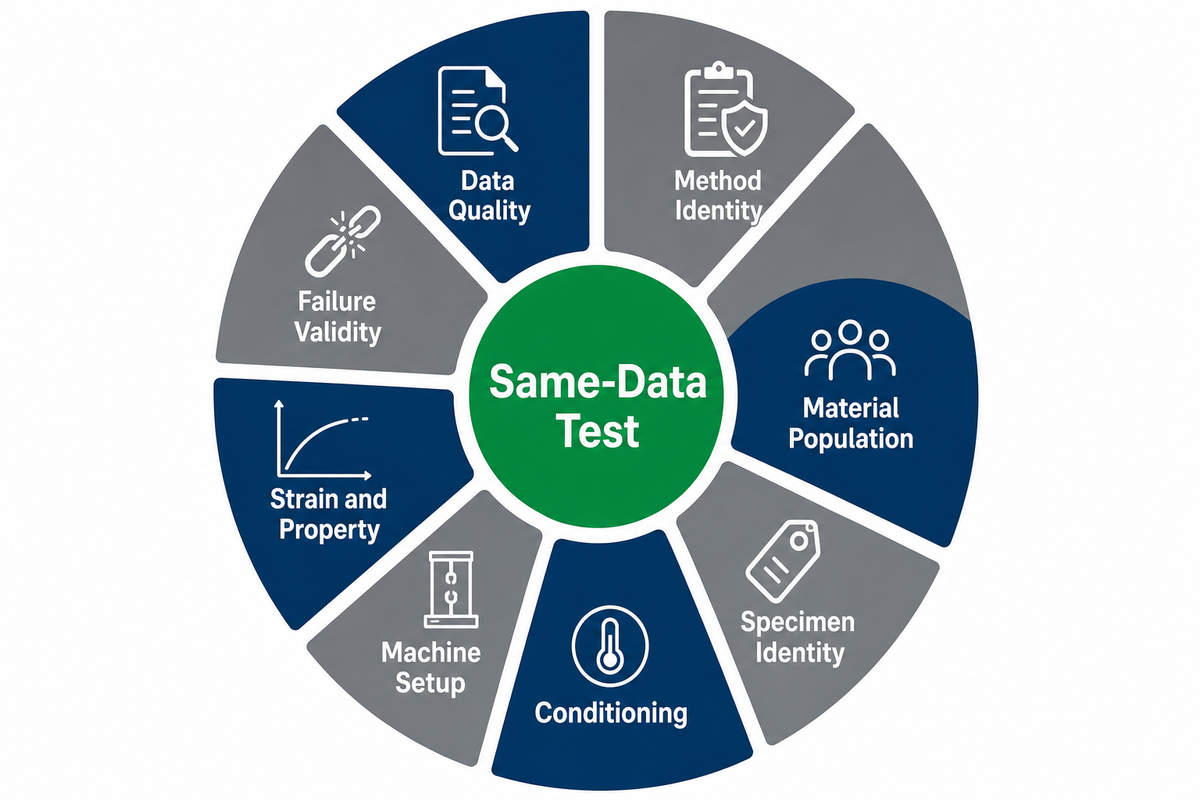
To perform the Same-Data Test, provide the two values and their reports, then ask whether another laboratory could understand why the values should be compared. Then determine whether the method, material, and setup fields behind the two values are the same, different, or unknown. Indicating something is “unknown” doesn’t mean it’s the same as something else.
| Control category | What to verify | If missing or different |
|---|---|---|
| Requirement | Contract, material specification, market rule, intended decision | Resolve ownership before comparing values |
| Method identity | Standard, edition, referenced documents, permitted deviations | Do not label the data method-equivalent |
| Material population | Resin or construction, lot, roll position, aging, state | Do not attribute the difference to the standard alone |
| Specimen identity | Form, dimensions, thickness, MD or transverse direction | Separate populations or qualify the comparison |
| Conditioning | Temperature, humidity, duration, dry or wet state | Treat environmental history as a changed variable |
| Machine setup | Load cell, grips, faces, alignment, preload, speed basis | Treat the result as method-and-lab specific |
| Strain and property | Measurement route, gauge basis, result definition, units | Do not combine unlike properties in one trend |
| Failure validity | Break location, edge damage, slip, tearing, trace behavior | Investigate before accepting or excluding a value |
| Data quality | Individual values, exclusions, replicate count, statistics | Request raw records before pass/fail use |
A report can indicate all values are within tolerance while the compared values may still not be comparable.
Illustrative record format, not a prescribed setup
A complete row might record 23 °C, 50% RH, 0.050 mm measured thickness, 15 mm width, 50 mm initial separation, and 100 mm/min, followed by the strain-measurement route and break location. Those six example fields demonstrate traceability only; obtain the permitted values from the governing licensed standard and material specification.
How this applies to packaging procurement
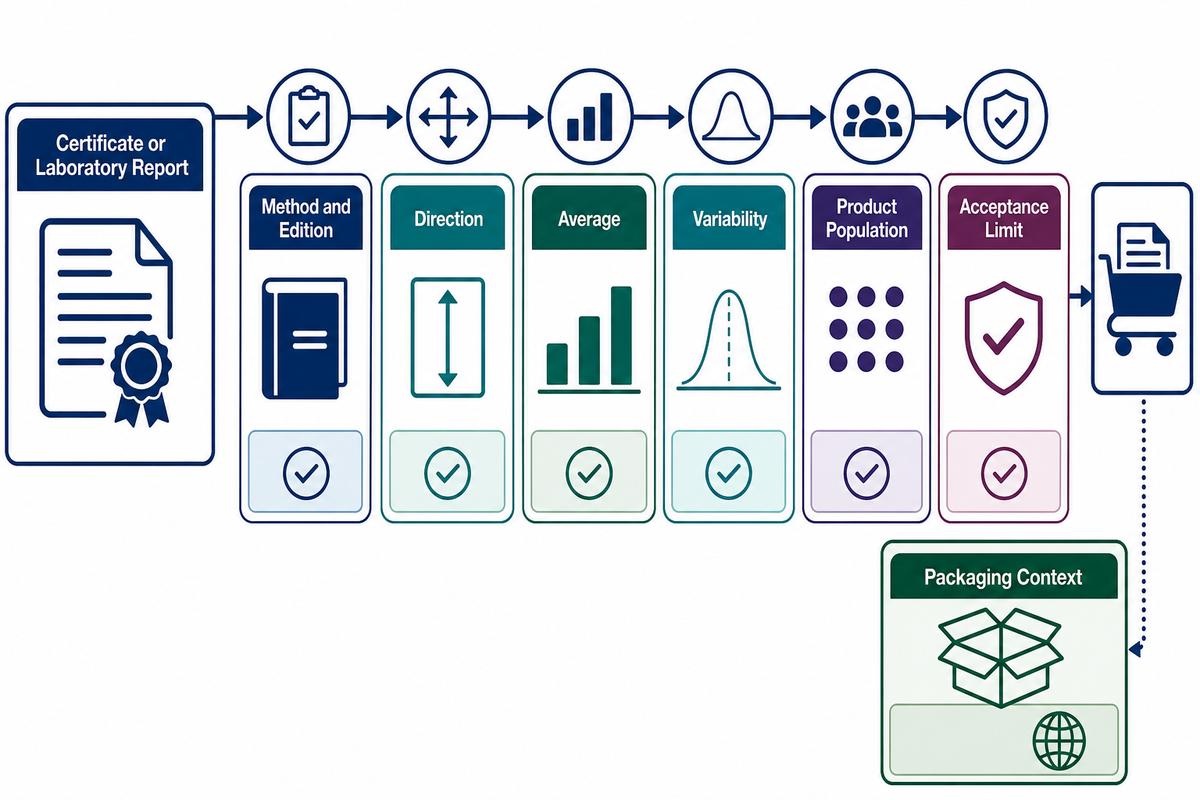
The comparison of tensile data (or any other mechanical property data) is commonly performed by packaging buyers to decide what specification level of the product they’ll purchase. The data should be provided on a certificate, or laboratory report and should include the average, variability, and be traceable to the method and edition, direction, and specimen.
The supplied quality brief says UD Packaging products undergo quality control. UD Packaging’s supplied quality brief states that its products undergo quality control and that the company implements GB/T 1040.1-2018 and GB/T 1040.3-2006 for plastics tensile properties and joint-strength-related testing. Finally, it should be noted that the company-supplied information does not substantiate accredited testing laboratory status under ASTM or ISO. Nor does it make GB/T, ASTM, and ISO results automatically interchangeable.
Before approving a supplier result
Confirm which test method governs the purchase, which product population was sampled, what direction was tested, how the property was defined, and whether the acceptance limit was developed with the same method. UD Packaging’s broader testing and quality-control overview can help buyers frame those questions.
Decision framework: use the Method Match Gate
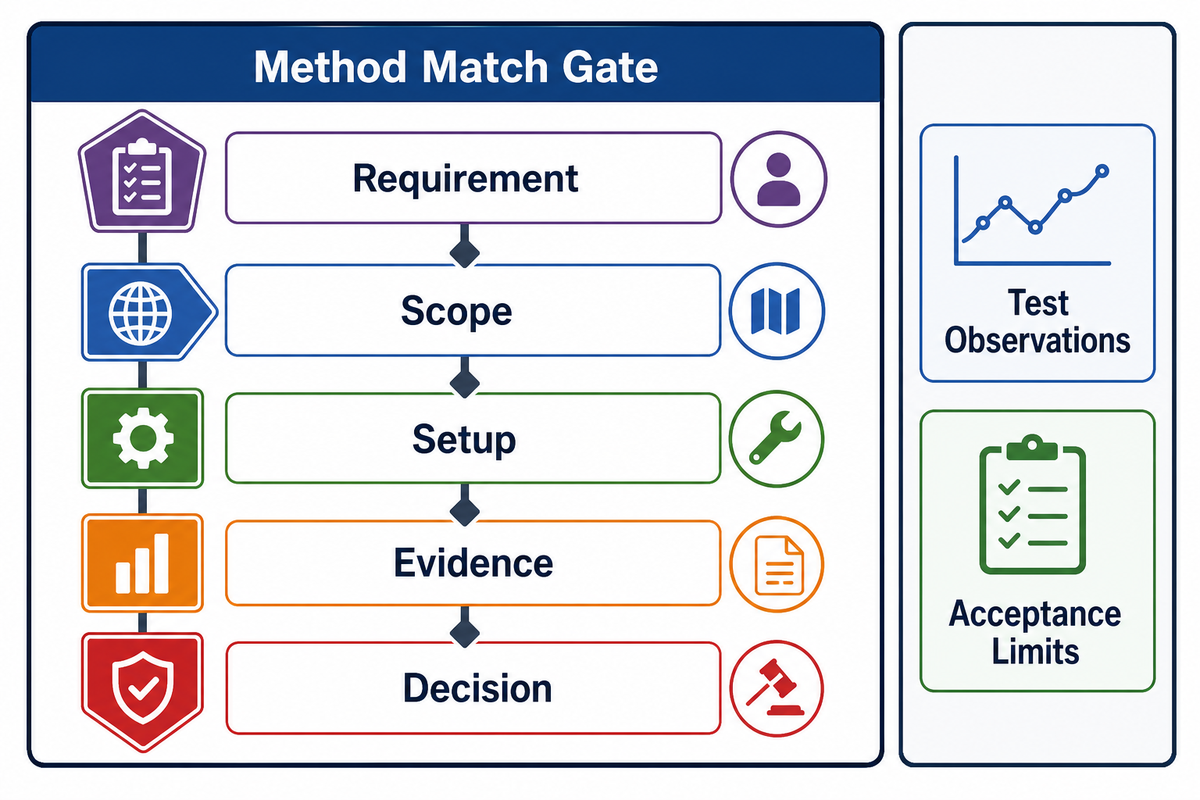
Five passes can structure the method decision. The first pass is to identify the authority or owner of the requirement. The second pass is to check the scope of the requirement and obtain the latest standards, if any. The third pass is to fix the specimen and test plan. The fourth and fifth passes are to perform a Same-Data Test on each result and compare acceptance limits, respectively. Acceptance limits should be kept separate from test observations.
- Requirement: name the contract, regulation, material specification, or internal validation that controls.
- Scope: confirm thickness, material type, and any stated exclusions or referenced standards.
- Setup: freeze direction, sampling, preparation, geometry, state, grips, speed, and strain measurement.
- Evidence: preserve raw values, failure observations, exclusions, variability, and uncertainty context.
- Decision: apply only an acceptance limit built for the same evidence basis.
Need to align test data with a packaging specification?
Share the product, market, governing method, and report fields you already have. UD Packaging can discuss the packaging context while your qualified laboratory and governing documents control the test procedure and acceptance decision.
Frequently asked questions
Are ASTM D882 and ISO 527-3 equivalent?
No. ASTM’s public page describes the methods as technically similar, but that is not a declaration that every setup or result is equivalent. They belong to different standards frameworks and can differ in specimen selection, test-condition logic, strain measurement, calculations, and reporting. Treat results as comparable only when the governing requirement and the critical setup fields match or when a material-specific correlation has been validated.
A close pair of results doesn’t change that rule. It shows only that a particular material and setup produced similar values. For supplier approval or pass/fail use, retain the exact method identity beside the result and use an acceptance limit developed on the same basis.
What is the main difference between ASTM D882 and ISO 527-3?
The main difference is not one isolated dimension or speed. ASTM D882 is an ASTM method for thin plastic sheeting, while ISO 527-3 supplies film-and-sheet conditions within the ISO 527 family and relies on ISO 527-1 general principles. That structural difference affects how a complete test plan is assembled, so a comparison should review specimen, rate, strain measurement, property definition, and reporting together.
Which standard should I use for plastic film?
Use the method required by the customer, contract, regulation, product specification, or validated quality system. If no document controls the choice, define the decision and select one framework that your suppliers and laboratories can apply consistently. Verify material scope and edition before testing, and don’t switch between methods merely to meet a target value established with another setup. For a multi-supplier program, freeze the report template as well as the method so direction, specimen state, raw values, exclusions, and variability arrive in a comparable form.
Can I convert ASTM D882 tensile results to ISO 527-3?
There’s no universal conversion factor. A conversion can be considered only after a matched study demonstrates a stable relationship for the exact material family, thickness range, orientation, property, specimen preparation, equipment, and laboratory controls involved. Even then, document the uncertainty and intended decision range. An isolated pair of close results, or a single published material study, can’t validate conversion for other films.
Do both standards apply to films below 1 mm?
Their current public scope pages both use a below-1-mm boundary for film or sheet, but thickness alone is not enough. ISO 527-3 states that it is not normally suitable for cellular materials or textile-fibre-reinforced plastics and works with ISO 527-1. ASTM D882 has its own scope, significance, limitations, and relationship to material specifications. Confirm the complete licensed requirements before declaring either method applicable.
Conclusion
The safest ASTM D882 vs ISO 527-3 decision is a traceable one. Assuming equivalence should be avoided when evidence and reasoning fail to support the assumption.
References & sources
- ASTM D882-26 official public scope and significance page
- ISO 527-3:2018 official catalog record
- Influence of the Test Method on Tensile Properties of Thin Polymeric Geosynthetic Barriers
- Peer-reviewed thin-film tensile measurement study
- ZwickRoell practical ISO 527-3 film-testing overview
- Instron ASTM D882 application overview