
Transparent plastic materials include acrylic, polycarbonate and PETG. When selecting a polymer for a display, consider the view the customer needs. For a protective cover, account for the expected impact. Then evaluate the exact grade, finished thickness and the surface of the part after fabrication and cleaning. A clear sample on the desk addresses only part of the concern.
Quick selection guide
- Acrylic: shortlist for clear displays and signage.
- Polycarbonate: shortlist when resistance to impact drives the choice.
- PETG: shortlist for formed indoor display parts.
- Record transmission, haze and the intended viewing arrangement separately.
Transparent plastic materials are polymers that transmit light with enough image detail for the intended use. Acrylic, PC and PETG offer different fabrication and durability choices. Select a named grade at the finished thickness and evaluate the part.
Key points
- High impact resistance and scratch resistance are different properties.
- Total light transmission and haze describe different optical behavior.
- Thicker specimens can give different results within one grade.
- Compare batch cost per accepted part when quotes produce different usable yields.
Which transparent plastic materials fit each application?
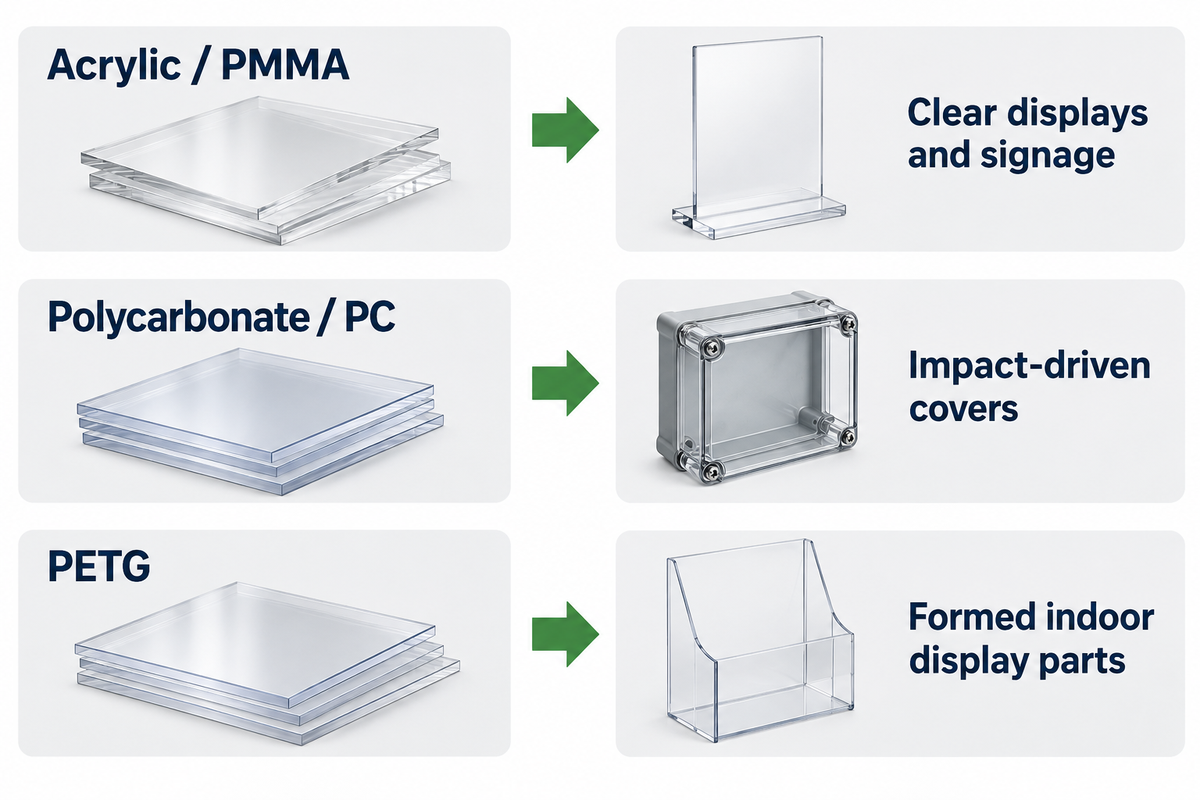
For a first look at signage, consider clear acrylic; for impact-driven covers, polycarbonate; and for a formed indoor display, PETG. These are starting shortlists rather than interchangeable specifications. The right grade of a given polymer must be considered for the part’s finish, exposure and use, especially in the case where the part is expected to be used outdoors and/or cleaned frequently.
| Material | Starting application | Decision that follows |
|---|---|---|
| Acrylic / PMMA | Clear signs, retail displays, viewing panels | Cast or extruded sheet, edge finish and cleaner compatibility |
| Polycarbonate / PC | Impact-driven covers and glazing candidates | Impact method, mounting, coating and abrasion exposure |
| PETG | Thermoformed indoor display parts | Draw depth, finished wall distribution and appearance |
PLASKOLITE identifies VIVAK as PETG sheet for deep thermoforming and precise details. Eastman’s Spectar products are described as copolyesters; use their exact product identity rather than treating every copolyester as PETG. Within this range of transparent materials, polymer family, commercial grade and sheet finish belong on separate lines of a purchase specification.
What is hard transparent plastic called?
Hard transparent plastic is commonly acrylic, also called PMMA, or polycarbonate; PETG is another rigid clear-sheet option. Acrylic plastic is often sold as plexiglass and is also known as acrylic glass. A clear sample doesn’t necessarily enable identification of the polymer. A part should retain its grade or supplier’s material record.
Cast acrylic and extruded acrylic are different sheet routes within the acrylic family. A cast acrylic sheet, a molded PC part and a PETG sheet, can all look clear, but need different process instructions. A rod or tube has a different viewing path than a flat pane. When comparing plastic physical properties, keep the product form with the material name.
Clarity, transmission and haze answer different questions
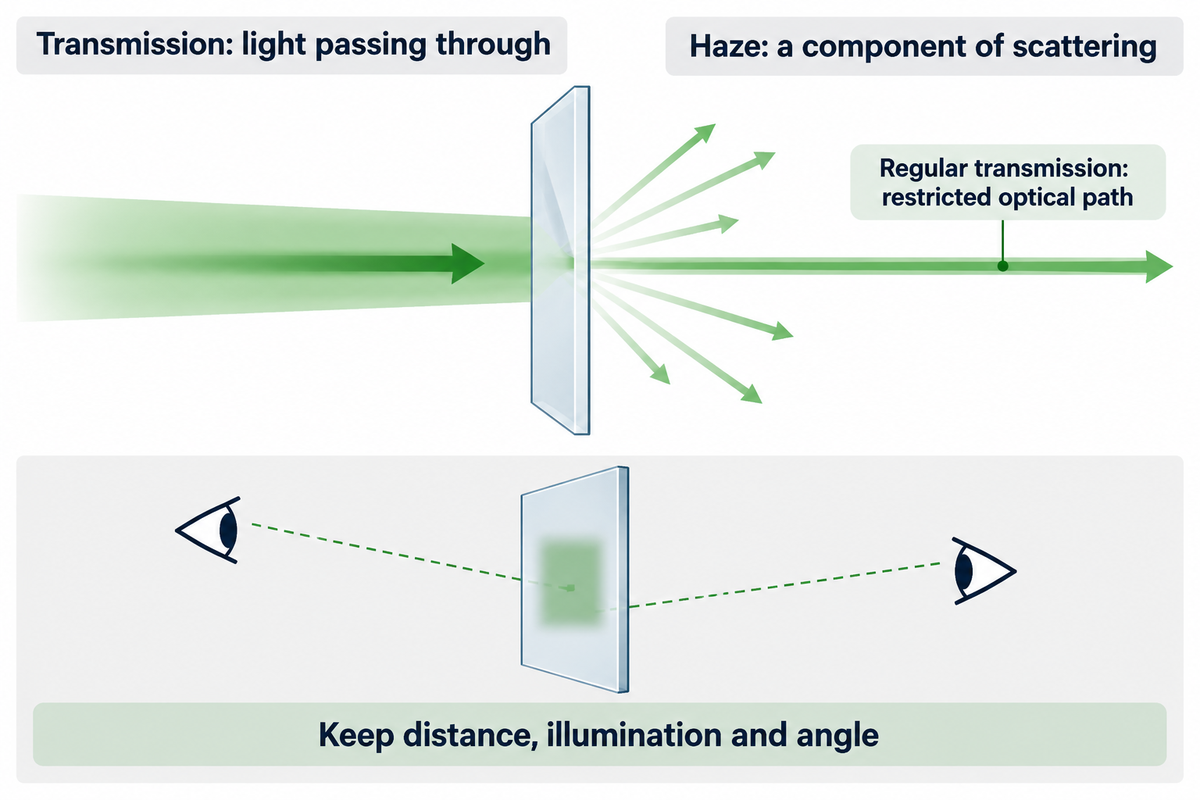
Transmission measures how much light passes through a material; haze measures a particular component of light scattering. When discussing clarity, the focus is on the image that reaches the viewer. A pane can allow light into a display, but can also soften lettering behind it; therefore a lighting cover and a viewing window need different optical decisions.
ASTM D1003-21 addresses luminous transmission and wide-angle scattering. Eastman’s Spectar 14471 technical data sheet makes the endpoint distinction concrete: it lists total transmission of 91%, regular transmission of 89%, and haze below 1% under ASTM D1003. The sheet thickness is 3 mm; its default test conditions are 23°C and 50% relative humidity.
The two transmission values describe different measurements for the named grade. Their two-percentage-point difference is not the haze value. Regular transmission is restricted to a particular optical path, whereas total transmission includes scattered light.
ASTM D1746-23 relates see-through behavior to regular transmission and explains the influence of beam and receptor angles. For a viewed label, retain the target distance, illumination and angle alongside the measured values. A glossy surface and high transparency do not in themselves resolve image distortions and reflections.
How is plastic made clear?
Plastic is made clear by selecting a suitable polymer and controlling the structures, additives and surface features that scatter or absorb light. Amorphous polymers are common choices, but how a part is processed is also important. Contaminants, voids, rough surfaces, and regions of crystallinity in a part can affect how light is transmitted, even if the resin family is the same.
Pedroso and colleagues’ 2023 polypropylene study changed molding conditions and measured resulting haze differences. That’s a process-specific example of morphology affecting optics. Transparent acrylic, translucent plastic and opaque materials describe different viewing behavior; a frost or non-glare finish deliberately adds diffusion. For lamp covers that may be useful. For a readable image behind a cover, the same diffusion may be undesirable.
Thickness changes the optical comparison
A meaningful optical comparison keeps specimen thickness with the reported value. Covestro’s clear Makrolon 2805 data show a change in typical luminous transmission across a 1–4 mm thickness series. Comparing two materials at different thicknesses can mix a material choice with a light-path difference before the application is designed or the trial begins.
| Material / measurement type | Thickness | Typical value | Method / conditions |
|---|---|---|---|
| Makrolon 2805 / luminous transmission | 1 mm | 89% | ISO 13468-2 |
| Makrolon 2805 / luminous transmission | 2 mm | 89% | ISO 13468-2 |
| Makrolon 2805 / luminous transmission | 3 mm | 88% | ISO 13468-2 |
| Makrolon 2805 / luminous transmission | 4 mm | 87% | ISO 13468-2 |
| Makrolon 2805 / haze | 3 mm | <0.8% | ISO 14782 |
| Spectar 14471 / total transmission | 3 mm | 91% | ASTM D1003; default 23°C, 50% RH |
| Spectar 14471 / regular transmission | 3 mm | 89% | ASTM D1003; default 23°C, 50% RH |
| Spectar 14471 / haze | 3 mm | <1% | ASTM D1003; default 23°C, 50% RH |
| Clear-transparent PLEXIGLAS products / visible transmission | Product-specific | Up to 92% | Brand product statement; no matched test condition stated |
Covestro’s product page also lists typical haze below 0.8% at 3 mm under ISO 14782. These values describe the named resin grade’s tested specimens. Converting resin into a commercial plastic sheet or a molded cover adds its own surface and processing history.
Use a Thickness-to-View Record
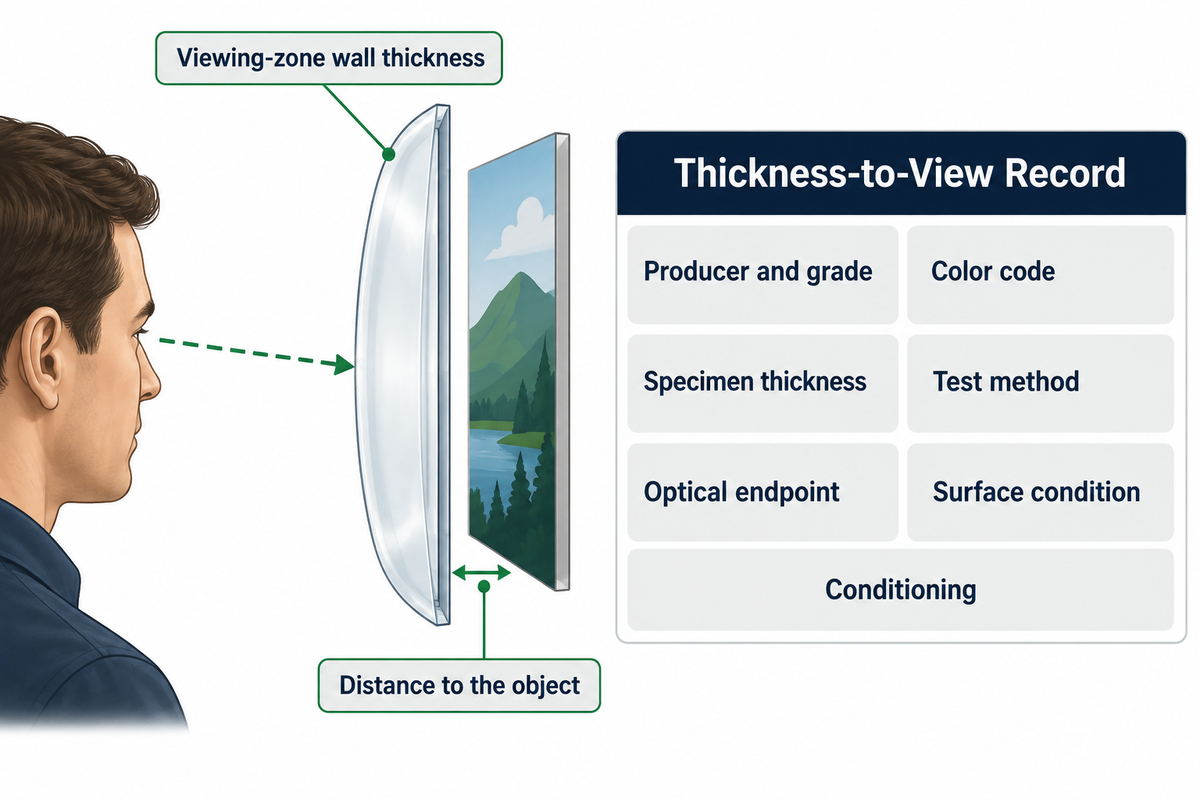
The Thickness-to-View Record pairs a grade-level measurement with the part being purchased. Record the producer and grade, transparent color code, specimen thickness, test method, optical endpoint and surface condition. Keep conditioning with each result. Then add the wall thickness at the viewing zone and the distance to the object behind it.
PLEXIGLAS describes visible transmission up to 92% for clear-transparent branded products. Use that as a product statement, rather than subtracting a Makrolon table value to calculate an acrylic-versus-PC advantage. A matched comparison needs the same endpoint and comparable specimen conditions. The site’s test-data comparability checker helps organize those records.
Example: a display designer compares a thin, flat sample with a thicker, curved replacement cover. Both samples, when placed on a white desk, appear clear. Both look clear against a white desk, but the replacement must show small text across an air gap. The useful trial places the printed insert behind the finished curve, at its intended distance and under the display lighting. A local wall thickness is recorded to help verify the view of the text from the customer’s approach angle. A flat, clear sample of resin is used to obtain a starting optical value for the proposed design. The assembled view is used to validate the proposed design.
Impact, scratches and forming create different trade-offs
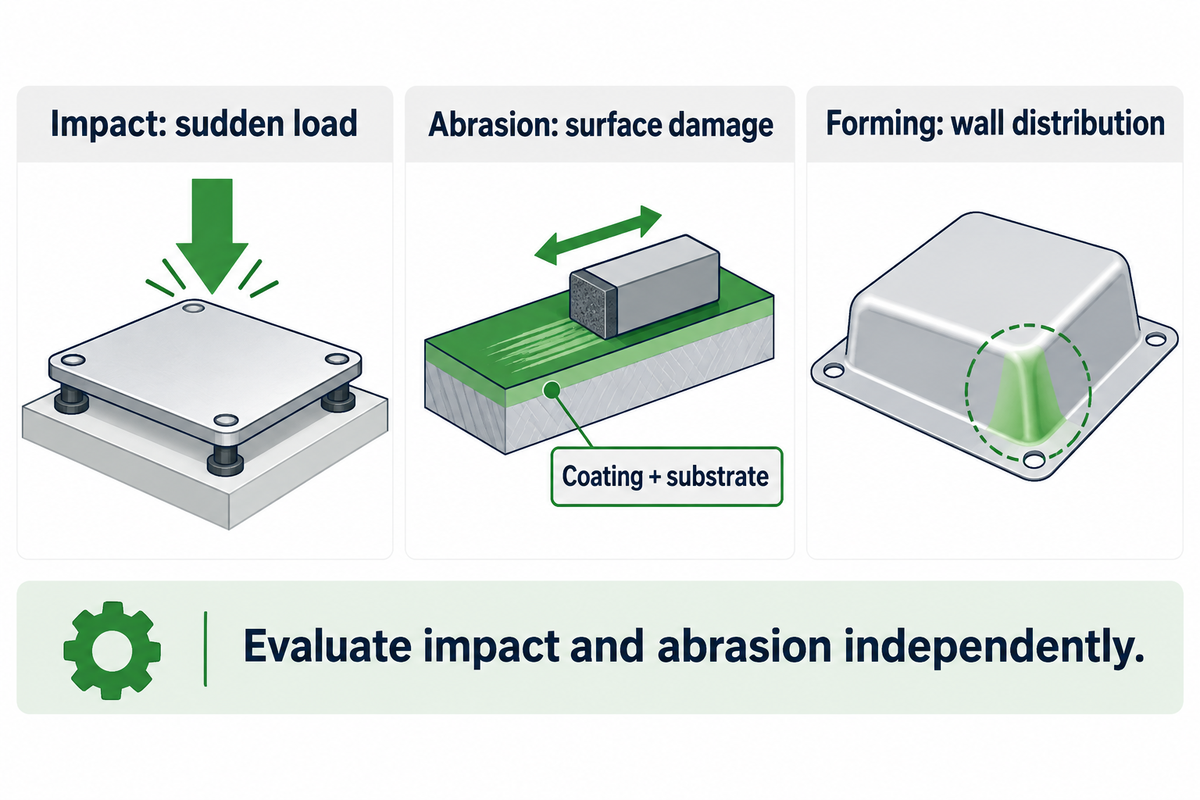
Impact resistance concerns a response to a sudden load; scratch resistance concerns surface damage. Choose the impact test around the expected event and evaluate abrasion separately. For a cover that’s frequently wiped, both the substrate and its scratch-resistant coating function as a system. A formed cover also needs a usable wall distribution and an adequate surface.
PLASKOLITE’s TUFFAK HC hard-coated polycarbonate exemplifies this case. The product is a lightweight PC substrate with a coating for abrasion and chemical resistance. Its availability is regional. A durable alternative to glass needs a surface decision, as well as a structural decision. The coating, substrate and product should be evaluated as a system; a PC label, for example, loses the system detail.
In this article, ASTM D1044-24 discusses the use of surface abrasion to evaluate the change in optical properties of a sample. An impact value, pencil-hardness result and abrasion haze change answer separate questions. To rank the two surfaces, the test load, abrasive media, cycle count and optical evaluation all have to be the same.
PETG is a good shortlist where draw detail matters, as described in the VIVAK producer page, when considering formed parts. A flat starting gauge does not fix the wall thickness at every corner after forming. Draw geometry and the fabrication route therefore belong beside mechanical properties, rather than beneath a universal strength multiplier.
Laser cutting and engraving also belong to the exact material’s fabrication route. A clean result on acrylic sheets isn’t a transferable PC cutting recipe. Architectural glazing, an aquarium wall and a small decor panel impose different structural demands; their designs need the appropriate load and mounting assessment. For stress values, reported in different units, use the stress and force unit converter, to compare like-for-like results.
Cleaning and handling can change a clear surface
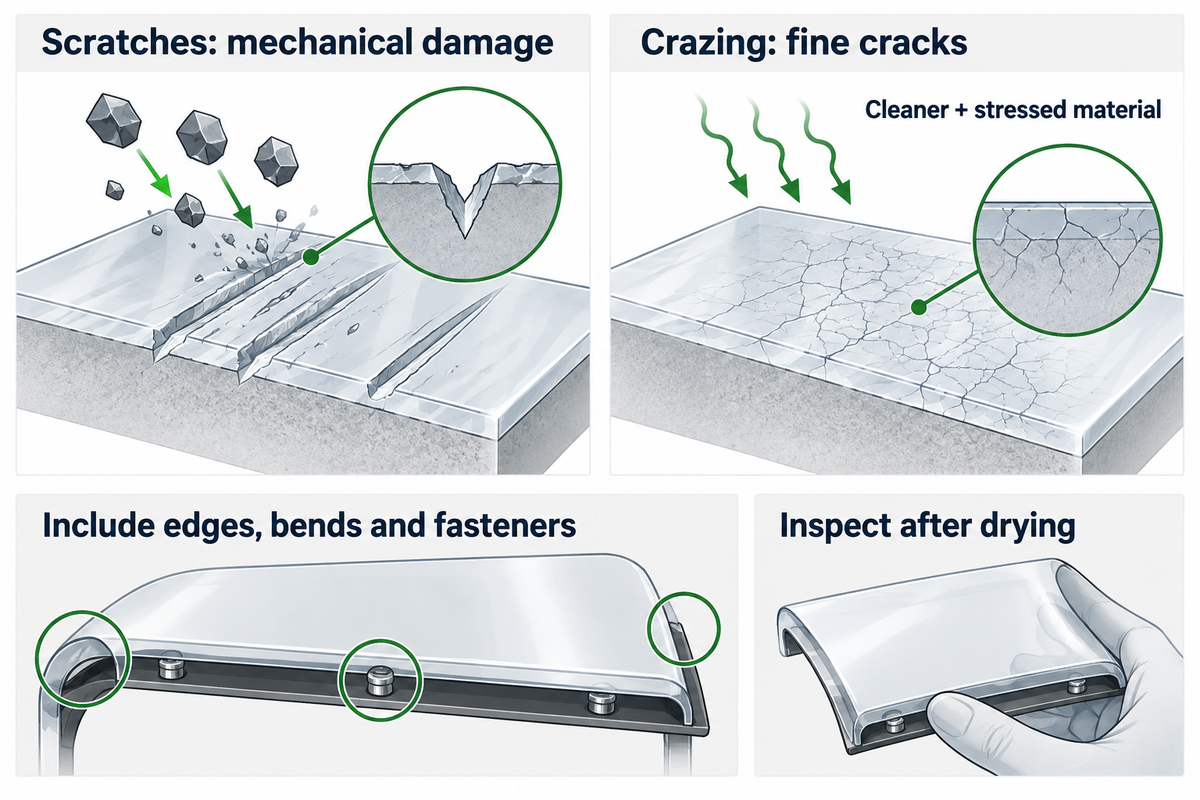
Abrasive scratches, for example, from sandpaper, create mechanical damage to a surface. Cleaner compatibility and wiping exposure should be assessed on the fabricated part, because machining, bending and assembly can leave stresses that a flat untouched sample does not share. Crazing creates fine cracks through a different mechanism, which can involve an incompatible chemical acting on a stressed material.
The Canadian Conservation Institute’s acrylic display-case guidance separates those risks. ACRYLITE’s annealing guidance also connects fabrication stresses with crazing after solvent contact. The practical response is a compatible cleaning process and controlled fabrication, rather than treating a clear surface as chemically interchangeable with glass.
“Many household cleaners contain abrasives that may scratch acrylic sheet, and some also contain solvents that can cause crazing”
Example: A store wants a clear counter display, where staff will wipe it during each shift. The purchasing sample arrives unbent, still carrying its protective film. A useful trial instead includes the cut edges, bends and fastener locations of the finished display. Staff uses the cleaner and the cloth as per the instructions for the trial. Inspection will be after the surface is dry. Lighting will be the same as for the original evaluation. Separate notes for scratches, fine cracks and image quality help the team distinguish a surface-wear problem from a cleaner or stress problem. A better-looking wet surface is not the acceptance point.
Outdoor applications need a separate exposure decision. Pickett and colleagues’ 2020 weathering research examines the effects of UV wavelength, temperature and humidity on specified engineering thermoplastics. An appropriate weather resistant or UV-protected product should be used for that exposure. Cleaning trials aren’t sufficient to determine the service life of an outdoor cover.
Cost the accepted part, not just the sheet
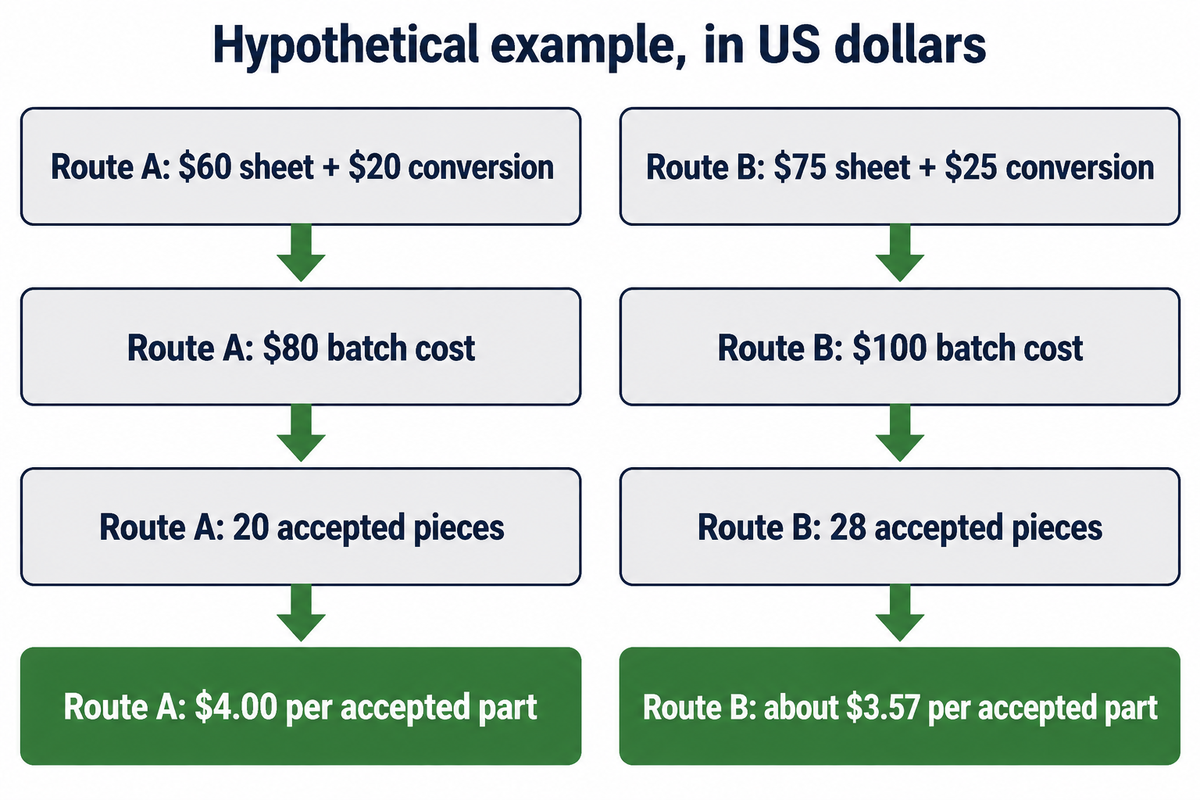
A lower price for sheet can produce a higher cost per usable part when nesting, conversion or appearance rejection changes the accepted output. A common batch cost boundary should be identified and divided by pieces that are compliant with the same requirements. In cases where the proposal boundaries differ, tooling and other one-time costs should be expressed separately.
The American Society for Quality classifies verification as an appraisal cost and scrap or rework as costs of internal failure. These categories help purchasing include work that may be hidden in a material-only quotation.
Hypothetical example, in US dollars: Route A costs $60 for the sheet and $20 for conversion, producing 20 accepted pieces. Route B costs $75 for the sheet and $25 for conversion, producing 28 accepted pieces. Conversion costs in the example include the same scope of cutting and inspection for both routes.
| Calculation | Route A | Route B |
|---|---|---|
| Batch cost | $60 + $20 = $80 | $75 + $25 = $100 |
| Accepted output | 20 pieces | 28 pieces |
| Cost per accepted part | $80 ÷ 20 = $4.00 | $100 ÷ 28 ≈ $3.57 |
The higher price for sheet in Route B allows the lower accepted-part cost to be accounted for with these data. Nesting loss is absorbed in the cost of sheet, so double-counting isn’t appropriate. Extra rework labor, freight, tooling or disposal belongs in both routes under the same accounting rule. Procurement should account for the quote, while production should account for conversion, and quality for the accepted output.
Build a supplier sample request that can be checked
An appropriate supplier request connects identified material to finished sample and specified acceptance. Keep producer, distributor, and fabricator information separate. A brand’s published resin properties address a different concern than whether a local supplier can provide the finish, dimensions and quantity specified.
Follow the Clear-Part Acceptance Route
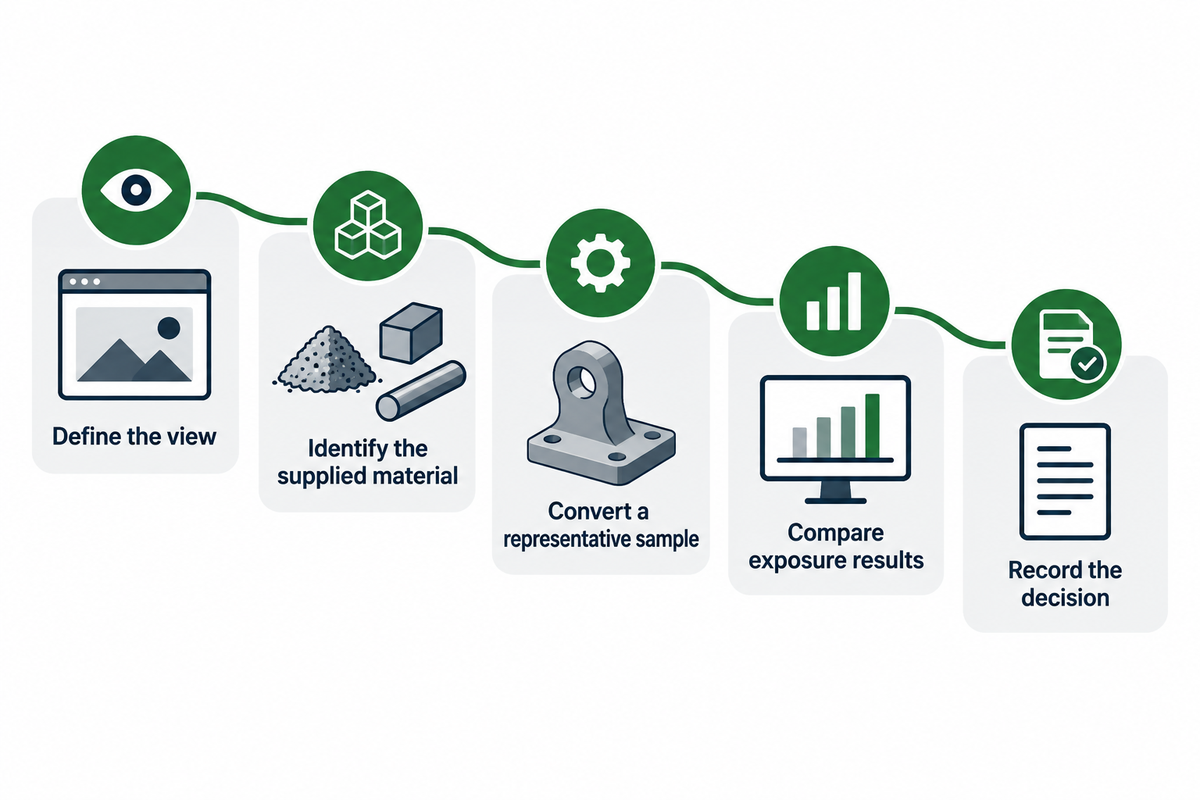
The Clear-Part Acceptance Route puts the viewing requirement before the sample order and compares the converted part before and after its intended exposure. ASTM D543-21 explains why reagent concentration, contact duration, temperature and stress belong with chemical-resistance results. A short screening exposure is useful for selection; long-term use needs its own evaluation.
- Define the view. Set the target, viewing distance, lighting and critical cosmetic zone.
- Identify the supplied material. Record producer, grade, finish, color code, sheet thickness and lot.
- Convert a representative sample. Include formed regions, cut edges, mounting and surface treatment.
- Compare exposure results. Retain an unexposed control and record appearance after the agreed cleaning or environmental exposure.
- Record the decision. Link the agreed limits, inspected parts and responsible approver to the next order.
In the request, specify the optical endpoint and method, thickness tolerance, dimensions, quantity and required fabrication. Confirm the cleaner identity, concentration, contact time and wiping media for the trial. Request that grade-specific information and an example of the finished product be provided, as well as regional availability and lead time. An excellent optical finish is useful only if it survives the agreed handling and remains repeatable on supplied parts.
New clear grades still need an application trial
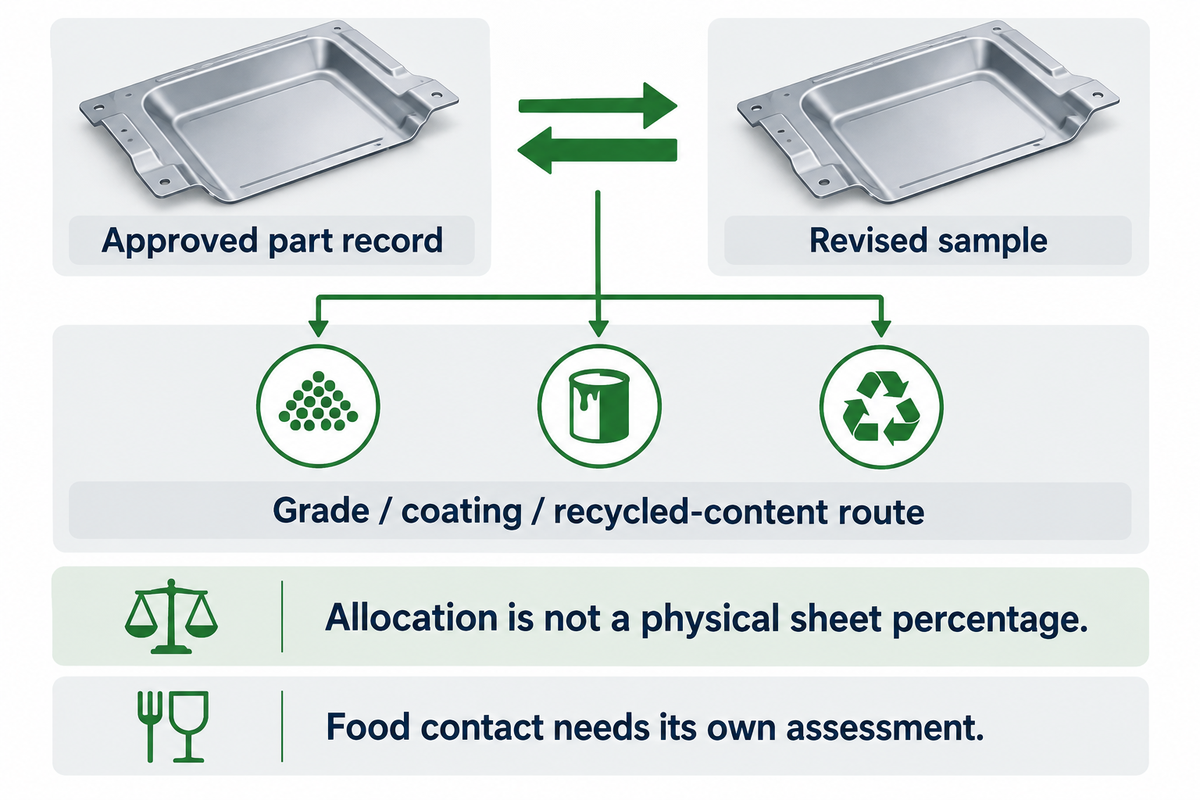
Revising resin grade, coating or recycled-content routes requires reevaluation of the part requirements. Keep the approved part record and compare to the revised sample. The same polymer family name can encompass different colors, additives and surfaces, so describe material identity with more detail than ‘transparent’ vs. ‘opaque’.
Eastman’s Spectar Renew product page describes circular content using mass balance. Sustainability claims have to retain the mass balance allocation basis when used in a supply chain context, rather than assume a physical percentage in every sheet. Optical, forming and cleaning decisions still have to be made according to the exact grade and finish.
Additional conditions apply to food contact based on the constituents of the plastic and the conditions of use. The US Food and Drug Administration’s recycled-plastics packaging guidance addresses contaminants, additives, food type, temperature, contact duration and repeated use. A clear appearance or a successful cleaning trial cannot replace that application assessment.
Key takeaway
Approve transparent plastic by its viewing task, named grade and converted-part behavior. Keep optical measurements, surface durability and accepted-part cost in the same purchasing decision.
Frequently Asked Questions
Is there a difference between acrylic and plexiglass?
Usually not: in everyday use, plexiglass is a common name for acrylic sheet.
PMMA is the polymer name, while PLEXIGLAS is a brand and plexiglass is a common generic spelling. Different brand names can describe acrylic products with different grades and finishes. When replacing plexiglass sheets, retain the specified thickness, manufacturing route and surface treatment instead of treating every sheet sold under that common name as identical.
Can I print on transparent plastic?
Yes, with a print process matched to the sheet and finish.
Printing changes the viewing surface and can add chemical exposure. The material, ink system and preparation method need to work together. PLASKOLITE lists painting, silk screening and hot stamping for VIVAK PETG. For a production display, evaluate the decorated part after drying and cleaning, including ink adhesion and the clarity of areas intended to remain transparent.
Where does the thickness of acrylic come in?
Thickness affects the panel design, fabrication and optical path.
Suppliers offer several acrylic gauges, but choosing among that variety of thicknesses requires the span, supports and loading as well as the appearance requirement. Keep the nominal thickness and its tolerance on the order. A viewing trial should use the finished thickness and mounting, rather than a thinner sample that’s easier to hold against a label.
Are transparent plastic materials recyclable?
Some are recyclable through suitable collection and processing routes.
Local acceptance follows the polymer, product form, additives and collection system. Clear appearance alone doesn’t identify a recycling stream; a PETG display sheet and a PET bottle shouldn’t be assumed interchangeable.
What are the disadvantages of polycarbonate?
Polycarbonate’s drawbacks are surface wear, chemical compatibility and, outdoors, UV exposure, which need attention alongside its impact performance.
An uncoated PC surface can need a different wiping and abrasion strategy from a hard-coated product. The cleaner, processing stresses and service environment also affect the finished part. Select coating and fabrication together, then evaluate the relevant exposure. A shatter-resistant sheet is not scratch-proof: the Canadian Conservation Institute notes that uncoated plastic glazing is susceptible to scratching and abrasion unless carefully handled and cleaned. For outdoor use, include UV exposure in the material and surface specification.
Where can I buy clear plastic?
Buy through a sheet distributor, fabricator or the material maker’s distribution channel.
Provide the polymer, grade, thickness, finish and cut dimensions. For a DIY project, retain the material label with any offcuts. For repeat orders, use an approved sample and a record of the converted-part requirements.
Preparing a material comparison for a packaging or display project? Use the UD Packaging materials hub to organize the selection, then share the application, dimensions, proposed grades and available test records. A clear brief keeps the optical comparison tied to the part you intend to use.
This guidance integrates published data on material identity, public descriptions of tests and methods and application-planning advice. Provider values represent typical grade examples. Cost examples use hypothetical data; examples of proposed evaluations are given.
References & Sources
- ASTM D1003-21: Haze and Luminous Transmittance of Transparent Plastics ASTM International.
- ASTM D1746-23: Transparency of Plastic Sheeting ASTM International.
- From Transparent to Opaque: A Route towards Multifunctional Parts Pedroso and colleagues, 2023, Materials.
- ASTM D1044-24: Resistance of Transparent Plastics to Surface Abrasion by the Taber Abraser ASTM International.
- Cleaning Glass and Acrylic Display Cases Canadian Conservation Institute.
- Accelerated Weathering Parameters for Some Aromatic Engineering Thermoplastics, Part 2 Pickett and colleagues, 2020, National Institute of Standards and Technology. Published in Polymer Degradation and Stability; SABIC-HPP funded this NIST consortium study.
- Cost of Quality American Society for Quality.
- ASTM D543-21: Evaluating the Resistance of Plastics to Chemical Reagents ASTM International.
- Recycled Plastics in Food Packaging US Food and Drug Administration.