
Updated September 2026
Plastic film tensile test speed is not universal; choose it from the current test method and route, the tensile property being measured, the specimen-length basis, and the film’s expected deformation behavior.
Short answer
Do not copy a speed from another supplier’s report until you can match its method edition, property route, initial grip separation or gauge basis, specimen direction, expected elongation, and extension measurement. Matching only the value in mm/min does not make two tests comparable.
Plastic Film Tensile Test Speed: The Short Answer
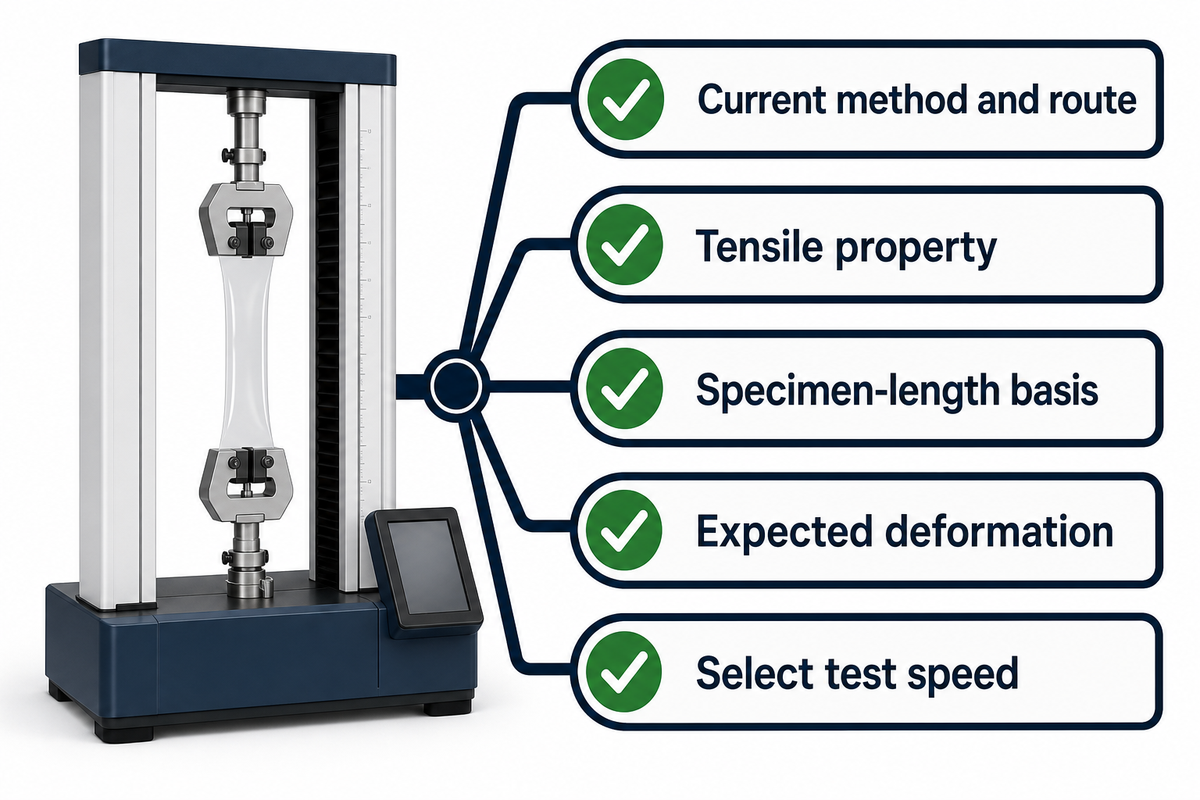
The response to the question, “Which speed should I enter?”, is to request the method and edition, state the property, define the specimen-length basis, consider the film’s strain behavior, and then choose a route that keeps the machine setting distinct from the method itself.
1. Lock the methodASTM D882, ISO 527-3, or another applicable procedure, including the current edition and permitted route.
2. Name the propertyTensile modulus, yield behavior, tensile strength, break stress, or elongation at break are not interchangeable outputs.
3. Fix the length basisRecord the initial grip separation or other gauge basis used to relate machine travel to nominal deformation.
4. Check expected behaviorUse the film type, prior evidence, and current method to select the appropriate expected-elongation route.
A previous method statement may provide comparison guidance, but it is not authority for the next setup. However, if route-defining information is missing, the statement should be regarded as incomplete, and the missing information should be requested instead of treating precedent as method equivalence.
ASTM D882-26 covers tensile properties of thin plastic film and sheeting less than 1.0 mm. Its public significance text says thickness, specimen preparation, test speed, grips, and extension measurement can influence results, which is why one copied setting cannot establish comparability by itself.
Why Test Speed Can Change a Film Tensile Result
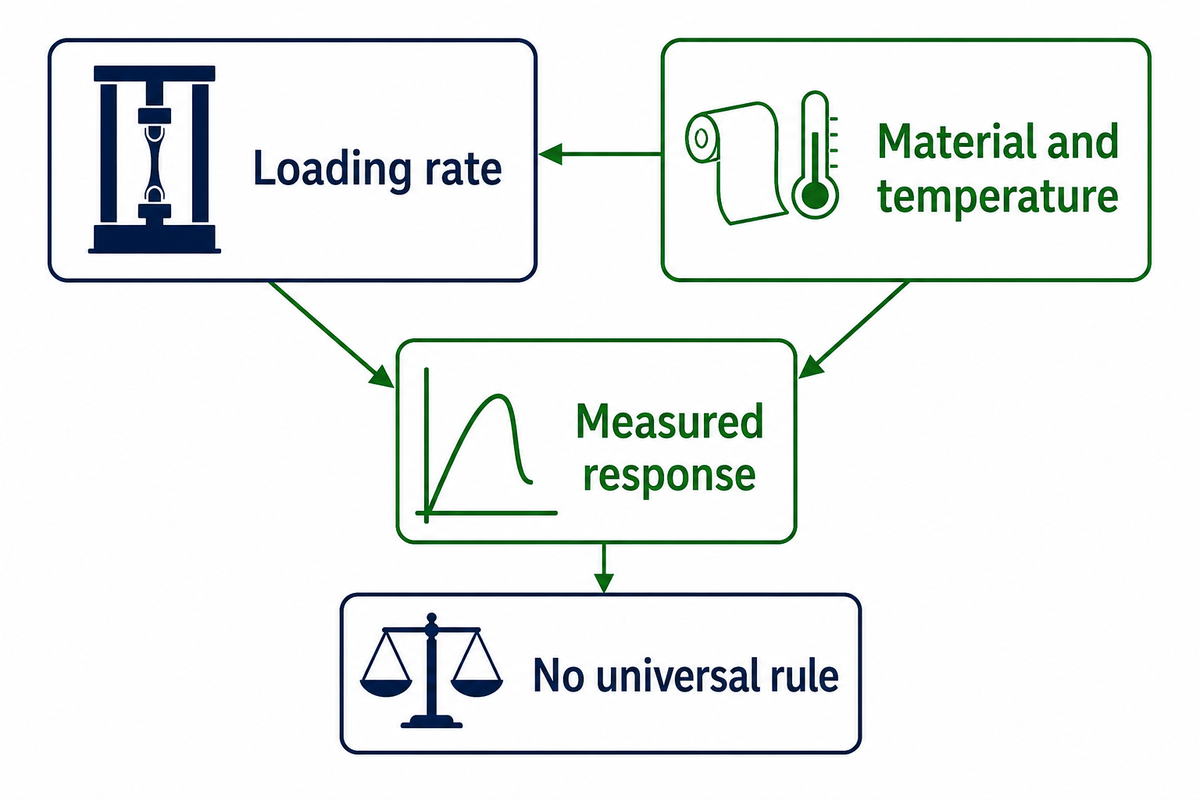
Because many variables affect a measurement, no universal correction factor is defensible; a peer-reviewed HDPE study shows rate effects only for its specific material and temperature conditions, so different test speeds can alter measured response without providing a universal rule for the speed of testing across every film specimen or high elongation at break case.
| Reported property | Why speed context matters | What must travel with the value |
|---|---|---|
| Modulus | It depends on the early stress-strain region and the strain-measurement route. | Method route, measurement device, calculation interval, and speed basis |
| Tensile strength or stress | The peak or named event occurs within a time-dependent deformation history. | Property definition, specimen dimensions, direction, conditioning, and test speed |
| Elongation at break | Large extension can interact with grip behavior, travel, and extension measurement. | Initial length basis, extension route, invalid-event rules, and failure location |
Calling tensile strength a fixed material constant hides the controlled test variables. A peer-reviewed HDPE study indexed in PubMed Central reports strain-rate-dependent tensile response under its specific material and temperature conditions; that shows rate can matter without predicting every packaging film.
Interpretation boundary
If two results differ, speed may be one cause, but it isn’t automatically the cause. First check film identity, direction, thickness, conditioning, geometry, grip behavior, alignment, extension measurement, and the calculation basis.
Crosshead Speed, Strain Rate, and Grip Separation Are Not Synonyms
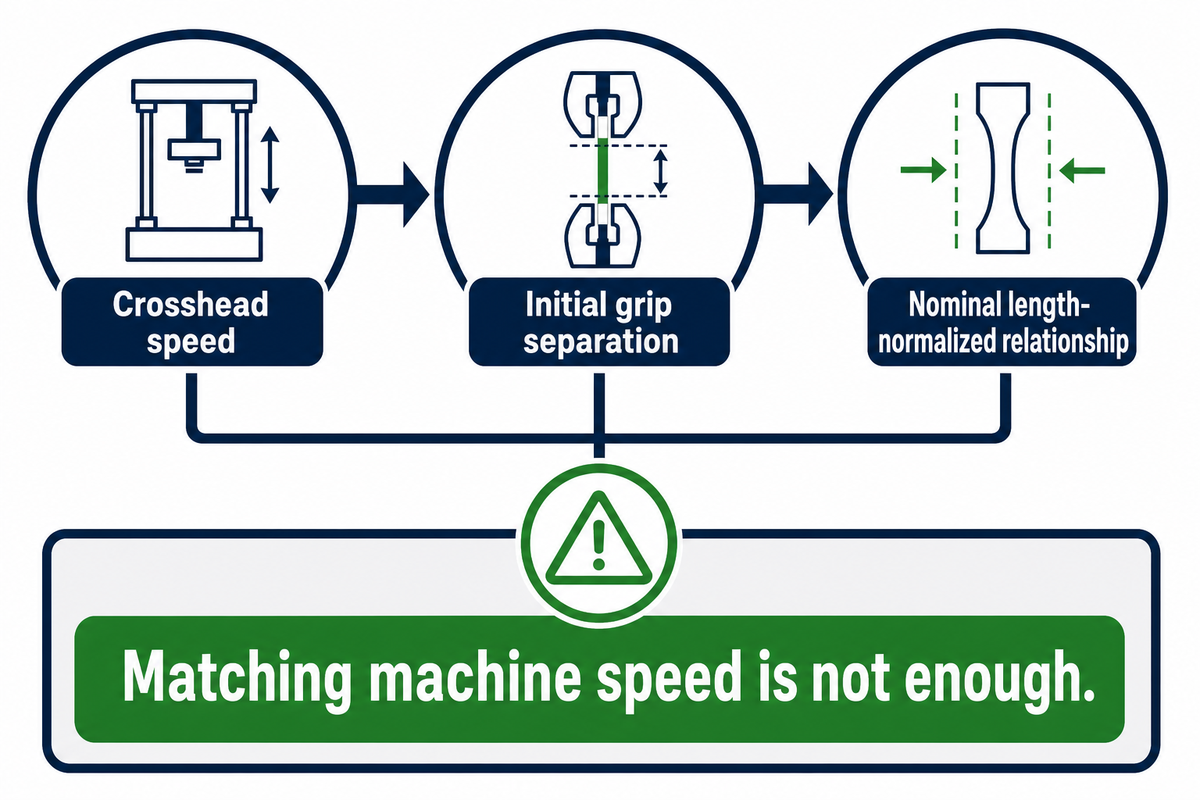
Crosshead speed describes machine travel per unit time, while nominal strain rate relates deformation rate to an initial length basis. Public ASTM D882 implementation guidance from Instron expresses the selection relationship conceptually as crosshead speed equals the selected initial strain rate multiplied by the initial grip separation.
Conceptual relationshipcrosshead speed = initial strain rate × initial grip separationUse the governing method’s definitions and permitted route; this relationship doesn’t reproduce a normative speed table.
Imagine two reports that state the same crosshead speed. Report A has one initial grip separation, while Report B has another initial grip separation. Grip separation in Report B therefore differs from the other report. Then, the same mm/min setting doesn’t mean the same nominal length-normalized speed relationship. Also consider the basis of extension measurement, because a different basis increases the number of unresolved variables.
Comparison disposition: not yet comparable
- Retain both reported speeds exactly as written.
- Request the initial separation or gauge basis and the strain-measurement route.
- Confirm method edition, property definition, specimen direction, and units.
- Compare only after the route differences are aligned or evaluated.
Arithmetic can’t determine which case is permissible and, therefore, an automatic suggestion method would be unsafe. The universal testing machine is a test machine, not the method owner. The tensile test machine is free to make a setting; however, determining the suitability of the setting in relation to the requirement would require judgment.
How ASTM D882 Frames Speed Selection
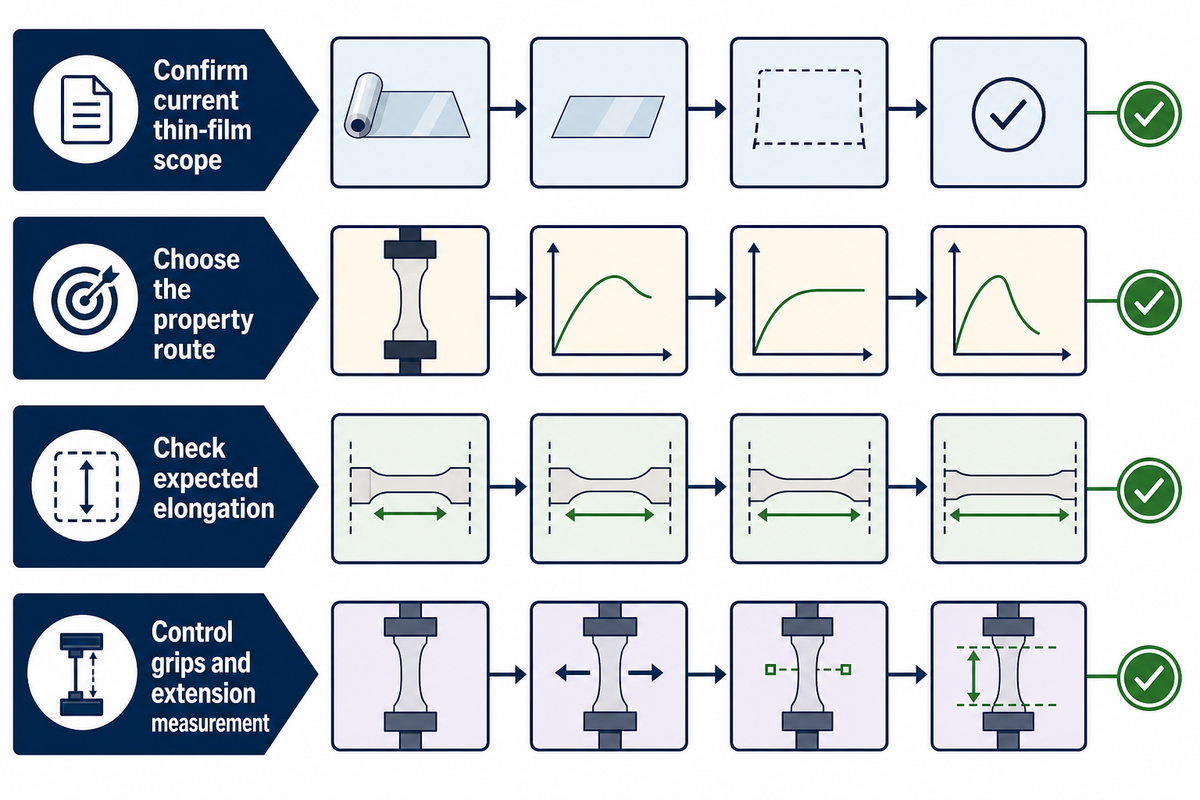
ASTM D882 is a method route, not a synonym for one speed. For the scope of interest, first confirm that the current thin-film edition applies. Determine the required tensile property, then use the applicable procedure logic for expected elongation and initial separation.
Method and editionRecord ASTM D882-26 when that is the governing current edition, plus any authorized deviations.
Property routeState whether the request concerns modulus, yield, tensile strength, break stress, or elongation.
Behavior and geometryUse expected elongation and the initial length basis required by the selected route.
The statement “ASTM D882 means 500 mm/min” is therefore incomplete. A value can be appropriate only within its route, specimen, property, and expected-behavior context, and a public equipment guide is not a substitute for the full current standard.
The official ASTM D882-26 page lists the standard as active and updated on April 29, 2026. It also warns that results are affected by variables including speed, grips, thickness, preparation, and extension measurement, so report review must go beyond the method number.
“ASTM D882 specimen size” is not a complete setup. The same is true of “tensile strength of plastic film” or “tensile strength of polyethylene film”: each search phrase still needs a method route, specimen geometry, direction, thickness, conditioning, and result definition.
How ISO 527-3 Frames Speed Selection
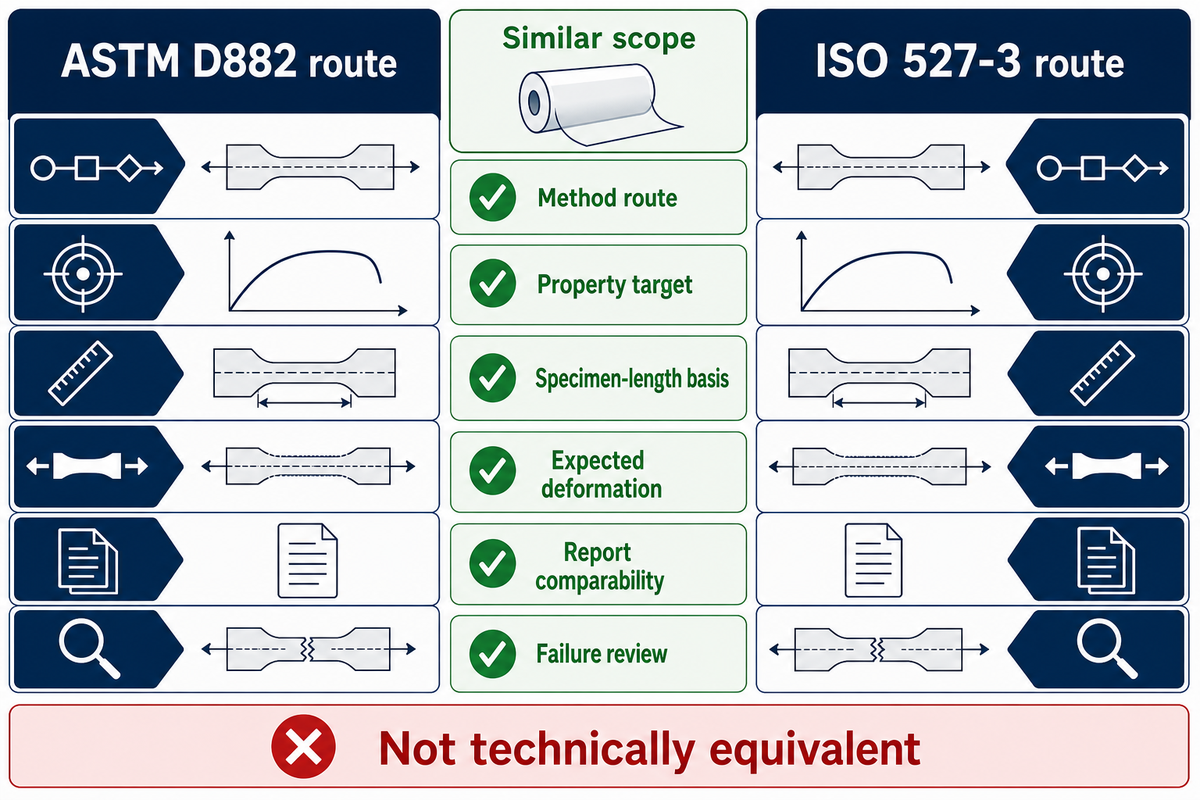
ISO 527-3:2018 specifies tensile-test conditions for plastic films and sheets below 1 mm and remains current after confirmation in 2024. Its route should be followed with the applicable material specification and property requirements rather than populated with an ASTM setting by analogy.
| Boundary | ASTM D882 | ISO 527-3 |
|---|---|---|
| Public scope | Thin plastic sheeting below 1.0 mm | Plastic films or sheets below 1 mm |
| Speed decision | Use the applicable D882 property and expected-elongation route | Use the ISO route and relevant material specification |
| Comparison rule | Do not assume technical equivalence or interchangeability from similar scope or matching mm/min values. | |
Public technical guidance from ZwickRoell notes that ASTM D882 and ISO 527-3 are similar but not technically equivalent. Geometry, test speed, and strain-measurement differences can matter, while modulus work may use a different speed basis from strength or elongation work within the selected framework.
Do not translate by number alone
If an ISO request arrives with an ASTM program attached, treat the program as background information. Rebuild the setup from the ISO method, the relevant material requirement, and the intended property, then document any difference.
Use the Five-Lock Film Speed Card
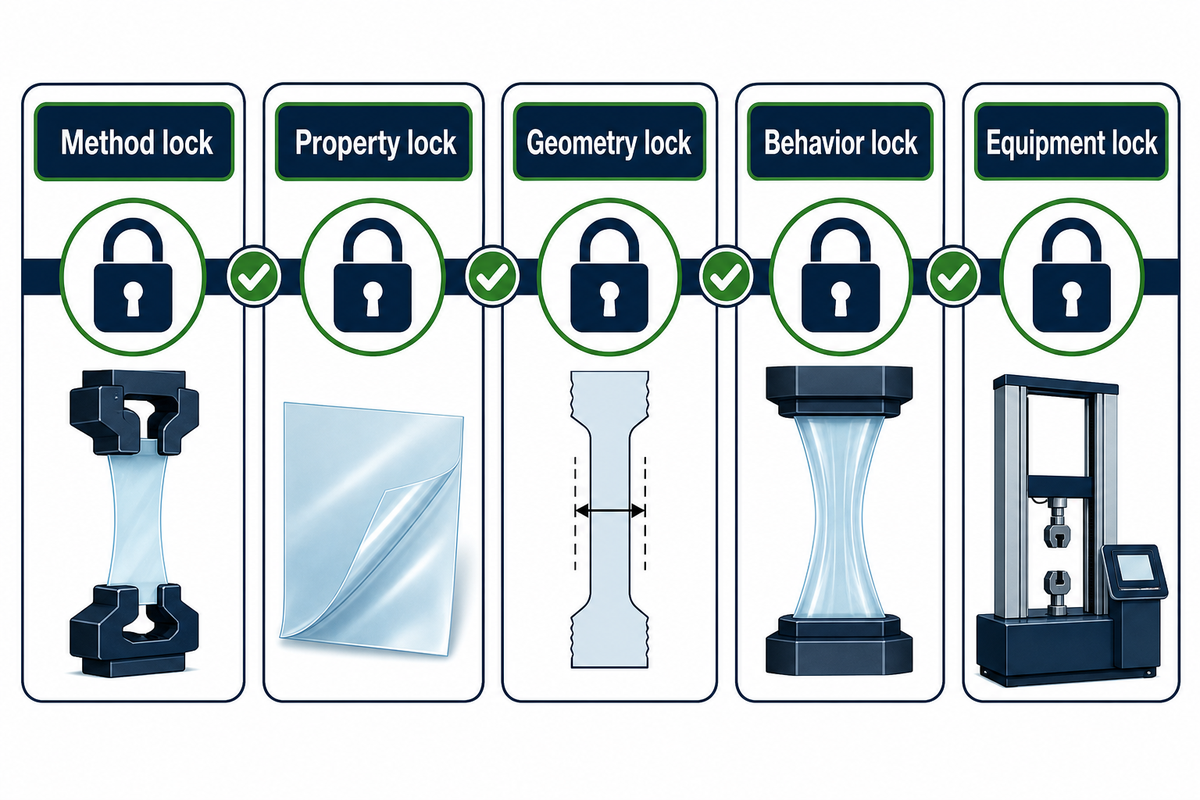
The Five-Lock Film Speed Card is an editorial risk-management aid, not a validation or attestation of ASTM, ISO, or NIST requirements; its fields organize variables that the current ASTM D882 page identifies as affecting tensile results, including speed, grips, thickness, specimen preparation, and extension measurement. Using this tool, you may classify a given case as traceable, incomplete, or not comparison-ready prior to testing or report release.
Five-Lock Film Speed Card
- Method lock: standard, edition, procedure route, and authorized deviations.
- Property lock: the exact tensile property, definition, units, and calculation basis.
- Geometry lock: specimen width, thickness, direction, and initial grip separation or gauge basis.
- Behavior lock: film identity, conditioning, prior evidence, and expected elongation range used to choose the route.
- Equipment lock: machine, grips, alignment, strain measurement, travel, and data-acquisition configuration.
You may classify the card as traceable, if all five locks align to the same case definition. Incomplete means that one or more locks are missing, and not comparison-ready indicates that case definitions provided in the two reports are conflicting and haven’t been aligned.
TraceableAll route-defining fields are present and internally consistent.
IncompleteOne or more locks are missing; request records before approval.
Not comparison-readyConflicting routes, definitions, or conditions require technical evaluation.
What to Record So Results Stay Comparable
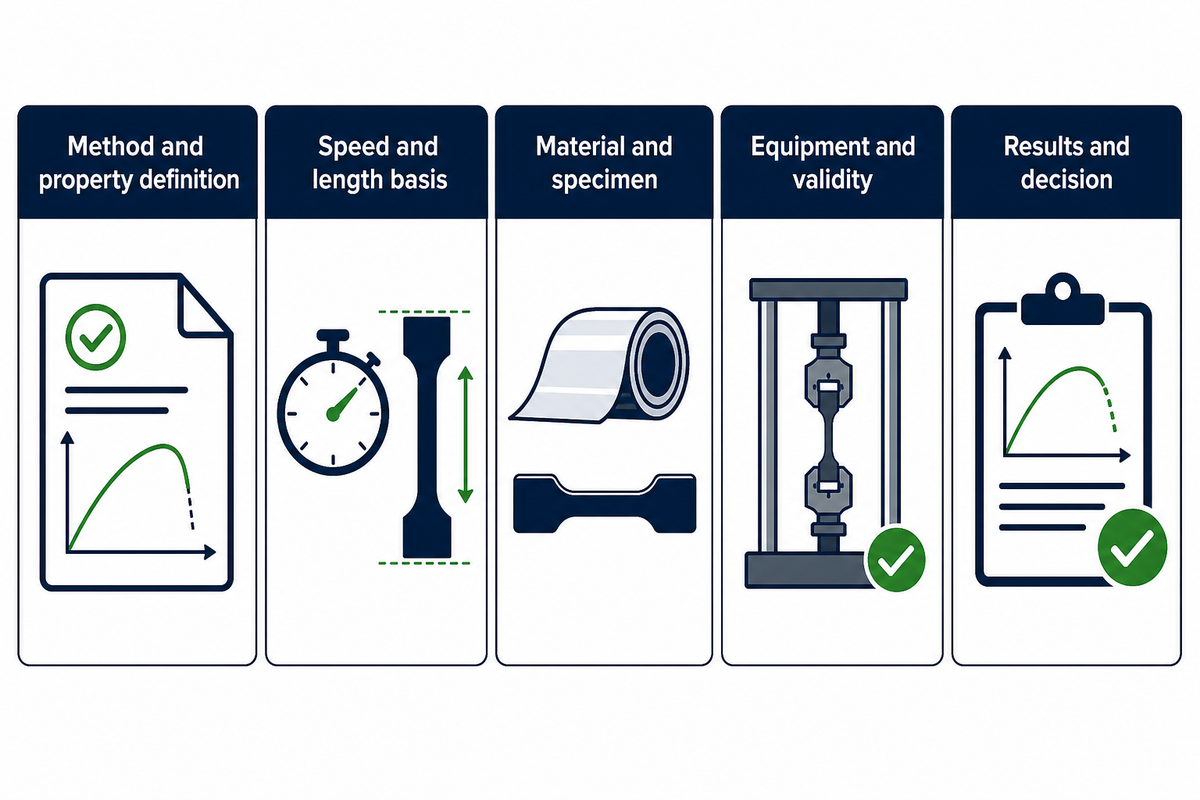
Comparison evidence of tensile values, or other properties of interest, may be stated in a report; however, that evidence may not represent the same property of interest or alignment of conditions, while a comparable mechanical testing report for a standard test method records the test parameters, test equipment, testing software, film materials, specimen thickness, width of the specimen, length of the specimen, range of specimen dimensions, and identification of the test specimens for a repeatable test.
| Record category | Required fields | If missing |
|---|---|---|
| Method | Standard, edition, route, deviations, property definition | Clarify before interpreting |
| Speed basis | Crosshead speed, initial separation or gauge length, strain measurement | Do not equate matching mm/min |
| Material identity | Film construction, supplier, lot, roll position, treatment, and side | Do not assume the samples match |
| Specimen | Direction, width, thickness, edge preparation, and initial length | Do not rank lots or suppliers |
| Condition | Storage, temperature, humidity, duration, and time since manufacture | Treat environmental effects as unresolved |
| Equipment | Machine, grips, alignment, extension device, travel and acquisition limits | Review traces and failure events |
| Validity | Slip, jaw breaks, tearing, exclusions, repeats, and disposition rules | Do not combine questionable events |
| Results | Individual values, units, statistics, and calculation basis | Treat the summary as non-actionable |
| Decision | Comparator, requirement, rounding rule, authority, and intended use | Do not infer acceptance or release |
For example, Report A and Report B may both state 100 mm/min without identifying the same property route or initial separation. The correct disposition is “clarify,” not “equal speed,” and the test results should not be used to rank films until the missing fields are resolved.
Keep units explicit
Report crosshead speed in mm/min, initial separation and specimen width in mm, thickness in µm or mm, force in N, stress or modulus in MPa, strain or elongation in %, temperature in °C, relative humidity in % RH, and time in s or min as the method requires. Don’t convert units without preserving the original value and calculation path.
Young’s modulusA named early-slope property whose calculation and measurement route must be stated.
Stress (mechanics)Force normalized by the declared cross-sectional basis.
Strain (mechanics)Extension related to the stated initial length basis.
ExtensometerA measurement device whose range and use must match the property route.
According to NIST guidance, specified measurement conditions should be defined along with repeatability and reproducibility. Traceability supports the identification of a result. It should not be interpreted to mean that test conditions that do not meet acceptance criteria are comparable or that a result is acceptable for procurement.
When the Chosen Speed or Result Should Be Questioned
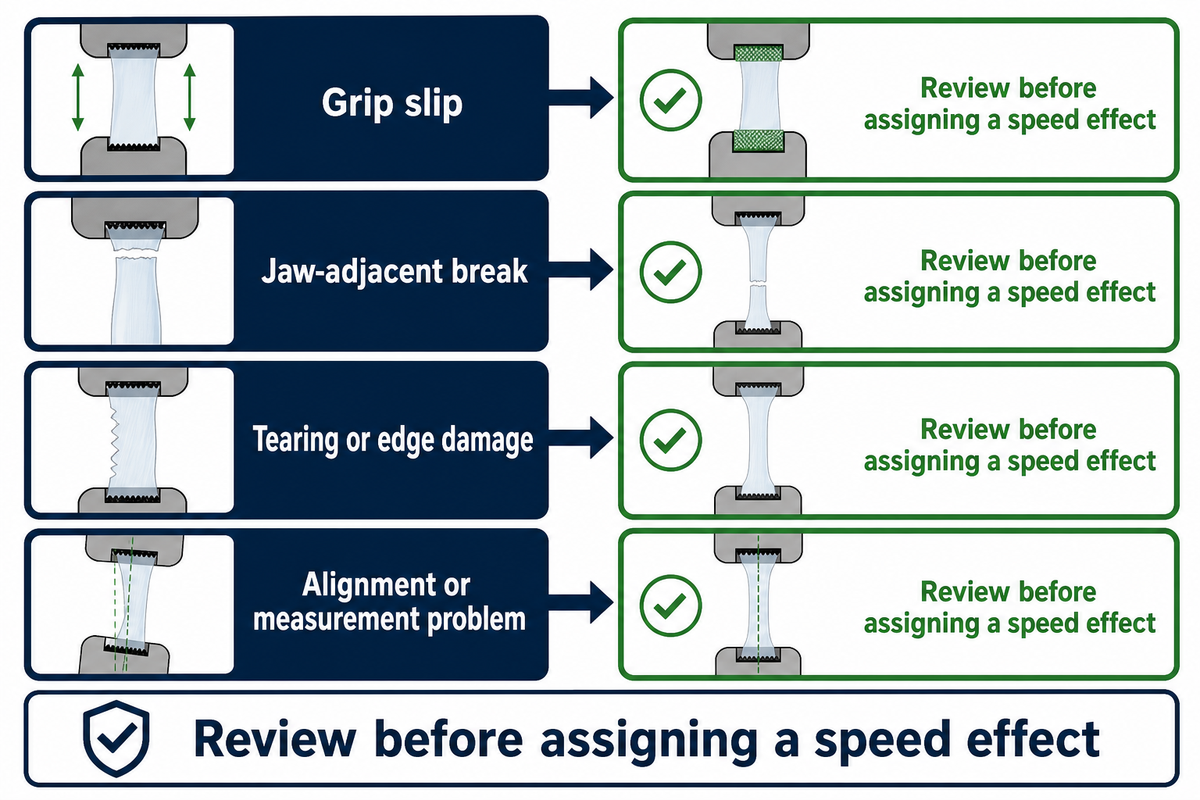
When reviewing elongation of the specimen, don’t assume an unexpected result is a speed effect. In the case of grip, consider the force-extension curve, the physical failure mode, and whether there was edge tearing, misalignment, a slip at the jaw, or inadequate extension. It’s also important to consider measurement and acquisition limitations.
| Symptom | Check | Disposition |
|---|---|---|
| Specimen moves in the grips | Grip marks, preload, clamping, and trace shape | Reject or repeat under the governing invalid-test rule |
| Break occurs at or beside the jaw | Damage, stress concentration, alignment, and failure-location rule | Clarify validity before retaining |
| Film tears instead of separating normally | Edge quality, geometry, and method treatment of tearing | Do not combine with normal failures |
| Extension reaches machine or device limit | Travel, gauge range, and extension-measurement configuration | Revise the valid setup and repeat |
| Valid traces shift with an intentional rate change | All five locks, material identity, conditions, and repeat evidence | Retain as bounded rate evidence |
Variation in tensile strength of a polymer film is described in DDL’s laboratory guidance as resulting from numerous sources including measurement and methodology. ASTM’s content also states that tearing should be considered abnormal. Therefore, a measured result should be questioned when the measurement event may be invalid, in error, or poorly documented.
Retest rule
Don’t invent a retest policy after seeing an unfavorable value. Use the governing method, project specification, and pre-agreed invalid-test and disposition rules, then retain the excluded event and reason in the record.
Build a Film Tensile Test Request That a Supplier or Lab Can Answer
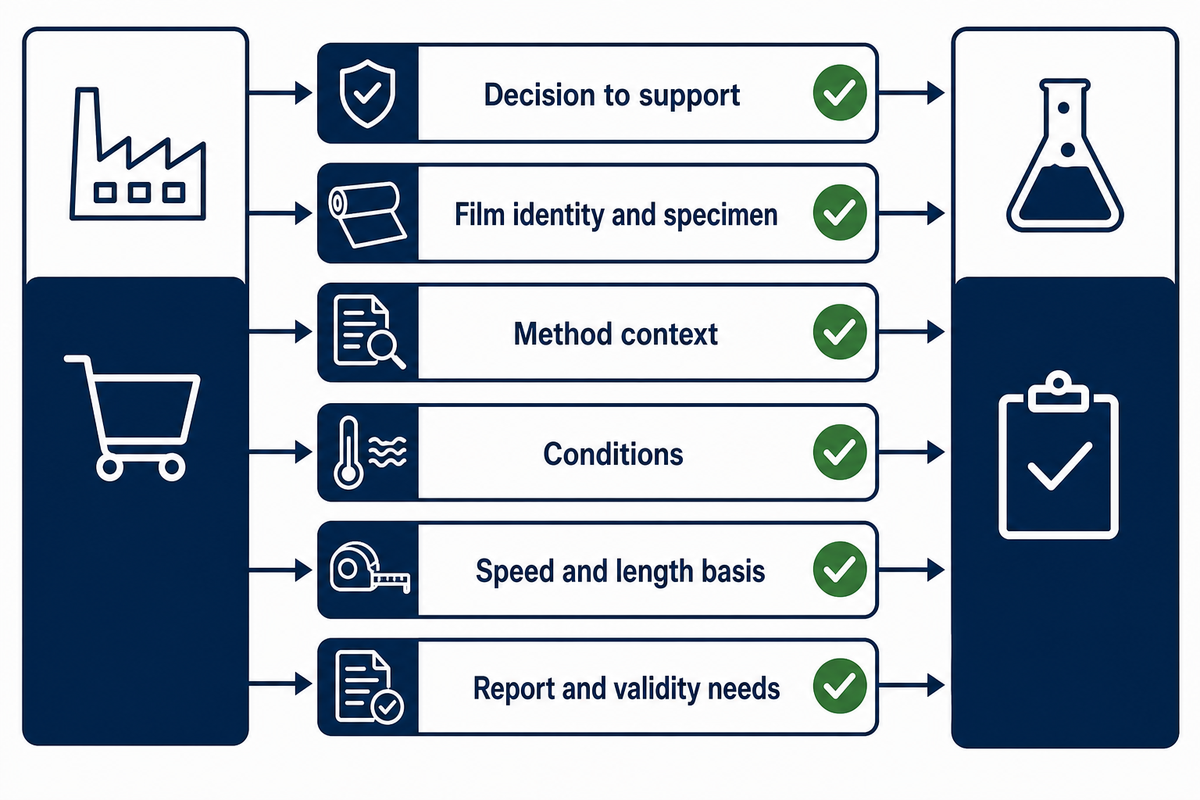
The sample request “Please test tensile strength” is incomplete. For the lab or supplier to select a suitable method, prepare a representative test sample, and choose a justifiable speed, the requesting party should provide sufficient context. The lab or supplier should return data that’s suitable for comparison to the properties of plastics review or quality control decision.
- ✔ Film identity: material or construction, supplier, lot, roll position, treatment, and side if relevant.
- ✔ Specimen basis: machine or transverse direction, width, measured thickness, initial separation, and preparation route.
- ✔ Method: standard, current edition, requested property, expected elongation, and authorized deviations.
- ✔ Conditions: storage, conditioning temperature and humidity, duration, and visible damage.
- ✔ Output: speed, extension measurement, individual results, statistics, invalid events, units, and traces if required.
- ✔ Decision use: investigation, development comparison, specification check, or lot-release support.
For the broader method-selection and sample-submission context, use UD Packaging’s guide to plan the wider plastic-film testing program. For a film-specific topic map, continue to UD Packaging’s plastic film testing hub. This information assists in the planning and integration of the test and report. It doesn’t serve to validate or accredit a lab, nor serve to set a buyer’s acceptance limit.
Prepare a speed-comparable film request
UD Packaging supplies industrial stretch film, PET strapping, related consumables, and packaging equipment. Share the application, film identity, failure question, test route, comparison target, and required report fields so the team can help organize the packaging-material inquiry without replacing the governing standard or decision authority.
Frequently Asked Questions
What speed should I use for a plastic film tensile test?
Choose the speed from the current method, property target, specimen-length basis, and expected deformation behavior; a copied machine setting is not a valid substitute for those controls.
Start with the named test method and edition, then identify the property you need, the specimen and initial-separation basis, and the film’s expected deformation behavior. A speed copied from another report is not automatically valid because that test may use a different method route, gauge basis, direction, or result definition. Record the selected speed, the initial length, the extension-measurement route, the specimen direction and conditioning, and the invalid-test rule so another reviewer can reproduce the decision and judge whether a comparison is legitimate.
Is ASTM D882 test speed always 500 mm/min?
No; ASTM D882 cannot be reduced to one universal speed because the applicable property route, expected elongation, initial grip separation, extension-measurement basis, and specific test context also govern the setup.
Treating ASTM D882 as a one-speed method removes the context that makes the setting meaningful. Public implementation guidance describes speed selection in relation to the applicable method route, initial strain-rate logic, initial grip separation, and expected elongation behavior. Use the current standard and relevant material or project requirements, preserve the route in the report, and do not turn a value from a supplier page into universal normative text.
What crosshead speed is needed for ISO 527-3 tests?
ISO 527-3 does not reduce every film tensile determination to one universal crosshead speed; use the applicable property route, material specification, specimen geometry, and measurement configuration.
The appropriate setting depends on the property being determined, the applicable method route and material specification, and the specimen and measurement configuration. Modulus work may not use the same speed basis as strength or elongation work. Document the selected route, speed, initial length, direction, conditioning, extension measurement, and property definition, and avoid comparing an ISO result with ASTM data by speed alone.
Can two reports be compared if both list the same test speed?
Not necessarily; matching mm/min values do not prove that the methods, property routes, specimen geometry, conditioning, extension measurement, and result definitions are aligned between the two reports.
Not necessarily. Matching speed values do not prove matching routes, specimens, conditions, or property definitions. Resolve those fields before ranking lots.
Why do plastic film tensile results vary between laboratories?
Variation may come from the material or from differences in specimen cutting, direction, conditioning, gripping, geometry, speed, extension measurement, validity rules, and calculations between testing laboratories.
Real material variation is one cause, but specimen cutting, direction, thickness, conditioning, grip behavior, alignment, initial separation, speed, extension measurement, invalid-test rules, and calculations can also differ. Align the method fields before attributing the gap to the laboratories.
How UD Packaging Approaches Tensile-Test Questions
UD Packaging is an integrated industrial packaging supplier focused on PET strapping, industrial stretch film, supporting consumables, and equipment. This guide organizes speed-selection and reporting questions for plastic film; it doesn’t claim a universal setting, laboratory accreditation, or measured performance for a specific product or lot.
References & Sources
- ASTM D882-26 public scope and significance ASTM International
- ISO 527-3:2018 public scope and lifecycle International Organization for Standardization
- ASTM D882 testing guide Instron
- ASTM D882 and ISO 527-3 technical comparison ZwickRoell
- ISO 527-3 testing guide Instron
- Common Problems with Tensile Testing of Films DDL
- Metrological Traceability National Institute of Standards and Technology
- Bounded peer-reviewed example of strain-rate-dependent HDPE response PubMed Central
This guide supports test planning and report review. It does not replace a current standard, material specification, laboratory procedure, statistically valid sampling plan, product requirement, or decision by the responsible authority.