

Film testing guide for buyers and quality teams
Plastic Test Methods: Film Specimens and Report Fields refers to the method-selection, specimen-control, and reporting chain needed to compare plastic-film data responsibly. A useful report connects the property question, the sampled population, each specimen, the test execution, and the decision rule behind any pass or fail.
Two suppliers can report the same property in the same unit, and yet give results which shouldn’t be evaluated against each other. The methods in question can define failure events in different ways. The specimens can refer to different sub-units of a roll. It’s also possible that the two laboratories have applied different acceptance criteria and conditions on the sample.
Key takeaway
Choose the method by the property and failure mode, then require a traceable sample record, execution record, and result record before making a supplier decision.
Plastic Test Methods: The Short Answer
State the question the result seeks to answer. Tensile behavior, tear initiation, tear propagation, impact, puncture, slip, seal strength, oxygen transmission, and water-vapor transmission describe different aspects of film performance; one cannot stand in for another.
Polymer film and sheeting shouldn’t be treated as one uniform material class. Polyethylene structures, including LDPE, can show direction, thickness, processing, and formulation effects in mechanical properties, so test results stay meaningful only when the specimen and method conditions travel with the number. Use the ASTM plastics standards catalog to identify the property-specific standard before turning an instrument reading into a supplier comparison.
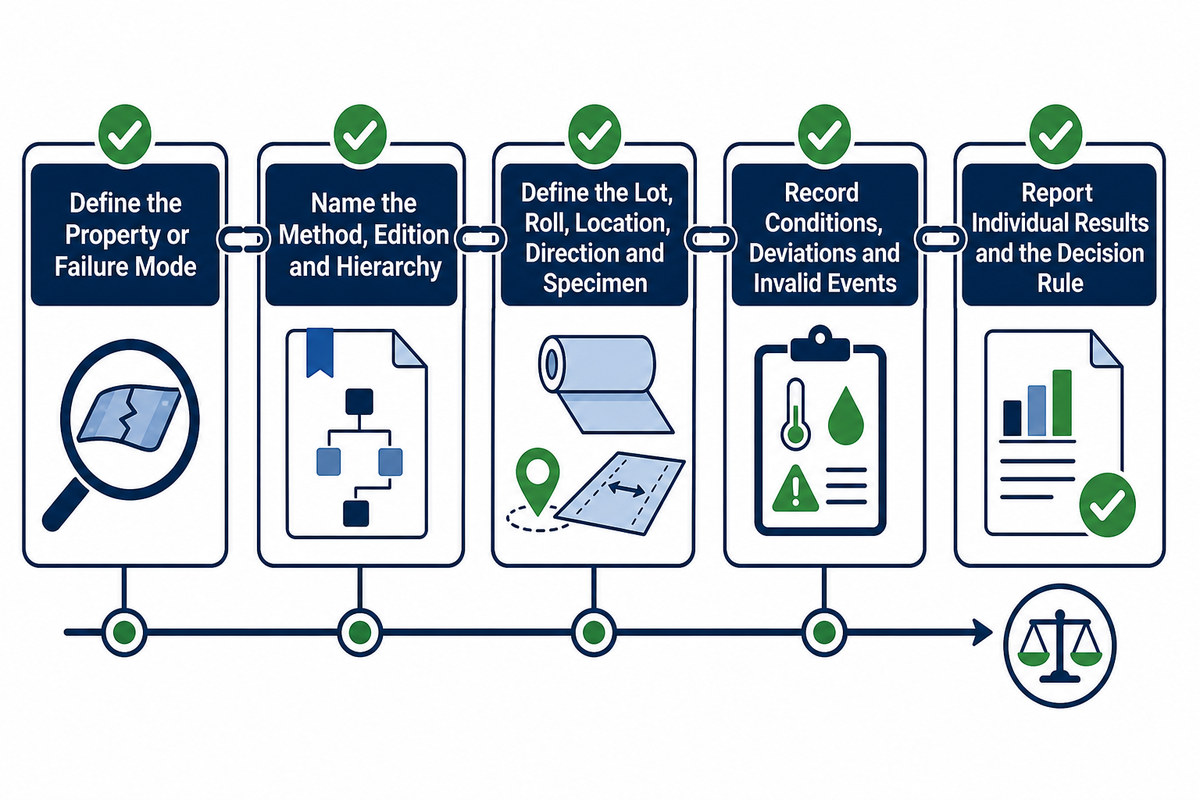
A decision-ready film test has five links
- Define the property or failure mode.
- Name the governing method, edition, and specification hierarchy.
- Define the sampled lot, roll, location, direction, and specimen.
- Record the conditions, deviations, and invalid-event rules.
- Report individual results and the rule used to interpret them.
Treat the standard designation as the start of the instruction chain, not proof that the chain was followed. Use the current licensed method and the governing product specification for the actual procedure, specimen geometry, count, calculation, and mandatory report fields.
Start With the Property Question, Not the Machine
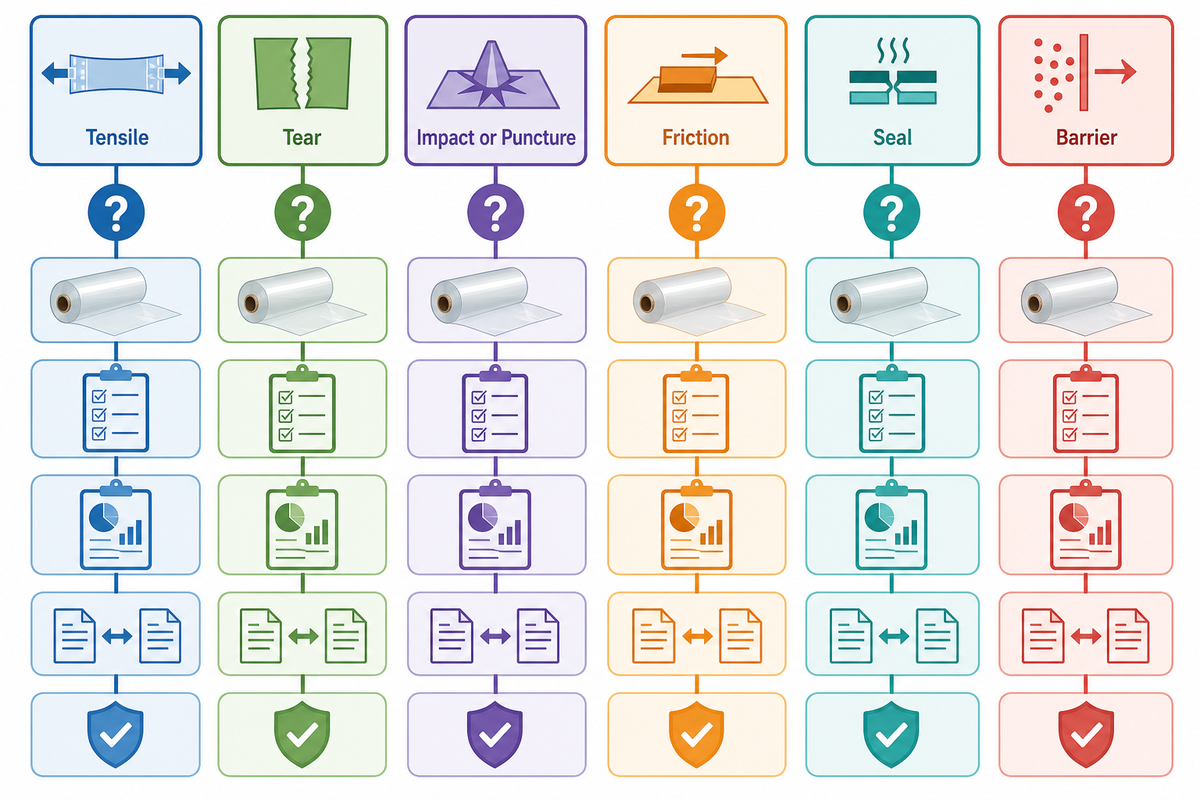
Universal testing machines can measure force and extension, but they do not decide whether a buyer needs tensile strength, tear resistance, seal strength, or puncture behavior. The business risk must define the property first. The ASTM plastics standards catalog is a starting point for matching that property question to a current method family.
Tensile
How the film carries load and extends under a defined tensile setup.
Tear
How a tear starts, propagates, or follows a defined specimen geometry.
Impact or puncture
How the film responds to a falling mass or a probe under a named configuration.
Friction
How two identified surfaces start or continue sliding under defined conditions.
Seal
How a prepared seal opens or fails under the selected seal-strength method.
Barrier
How oxygen or water vapor passes through a specimen under stated test conditions.
Consider the concern presented in the application and capture it in a single sentence. Examples might include “We must assess propagation tear across the roll.” or “We must evaluate seal strength against the specification.” This will help avoid using an easy to measure parameter or standard to define an answer to a question that may not be correct.
Do
- State the property and failure definition.
- Name the decision the result will support.
- Use the governing contract or specification hierarchy.
Don’t
- Choose a test because the machine is available.
- Treat different tear or puncture methods as conversions.
- Turn one laboratory property into a package-performance guarantee.
A Practical Map of Film Test Method Families
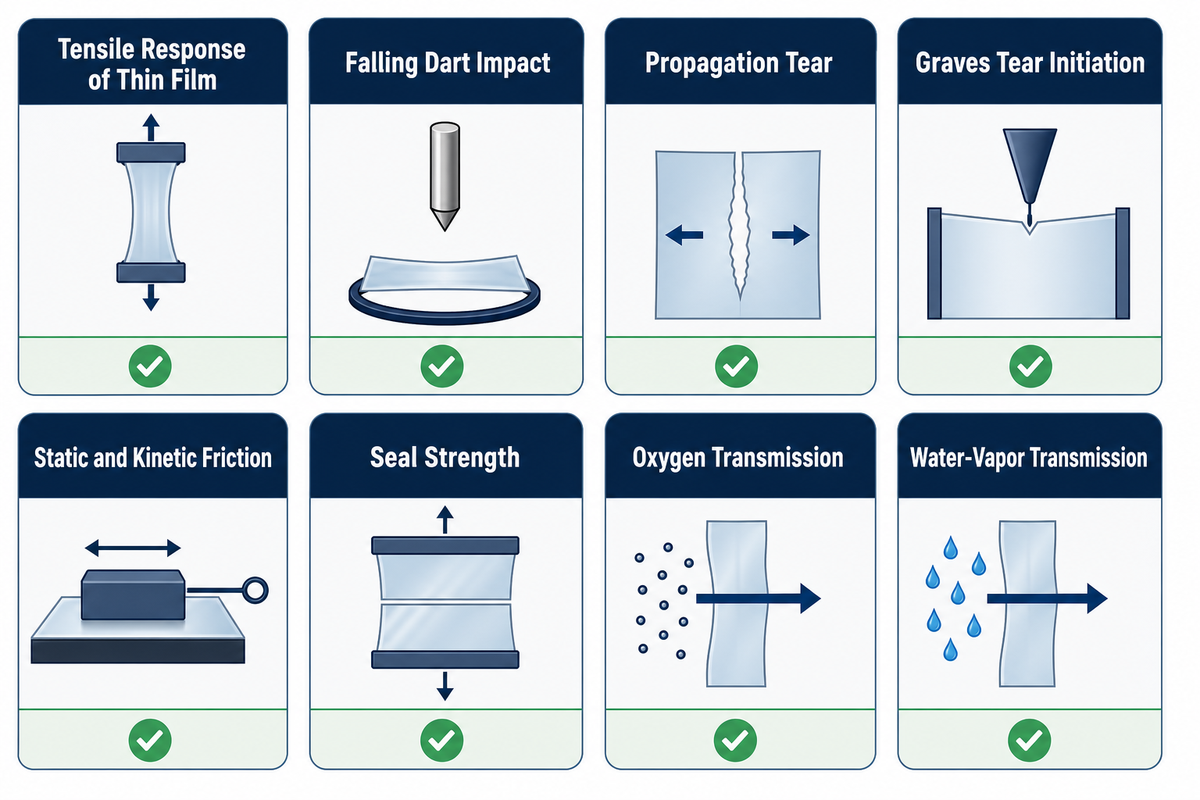
The examples below, alongside the film method selection router, are navigation aids, not procedures. Edition status can change, and a material or product specification can modify which method or conditions govern, so verify the current publisher page before issuing a request. Search labels such as “ASTM D882 specimen size” or “ASTM D882 procedure” do not establish the current requirements, and older-edition searches such as “ASTM D882-18” should be checked against the publisher’s active listing.
| Property type and decision question | Example method | Specimen emphasis | Report emphasis | Do not infer |
|---|---|---|---|---|
| Tensile response of thin film | ASTM D882-26; ISO 527-3:2018 | Direction, thickness, preparation, geometry | Speed, grips, extension route, failure mode | That the two standards are technically identical |
| Falling dart impact | ASTM D1709-24 | Sampling locations, thickness, specimen condition | Method choice, failures, calculation basis | Puncture behavior under a different probe or speed |
| Propagation tear | ASTM D1922-23 | Cut, direction, thickness, tear path | Valid path, invalid events, individual values | Tear initiation under another geometry |
| Graves tear initiation | ASTM D1004-21 | Specimen geometry, direction, cut quality | Peak event and observed failure | Propagation-tear equivalence |
| Static and kinetic friction | ASTM D1894-24 | Contact pair, face, age, surface state | Motion, loading timing, temperature, conditioning | Direct comparability with ISO 8295 |
| Seal strength | ASTM F88/F88M-23 | Seal preparation, width, orientation | Fixture, failure mode, individual curves or values | Package integrity under every distribution hazard |
| Oxygen transmission | ASTM D3985-24 | Exposed area, structure, thickness, pinholes | Temperature, humidity, gas conditions, units | Water-vapor transmission |
| Water-vapor transmission | ASTM F1249-25 | Exposed area, structure, thickness, sealing | Temperature, humidity gradient, units | Oxygen-barrier performance |
The table separates the property question from the instrument and from the final commercial decision. For example, a high tensile value does not demonstrate low oxygen transmission, and a dart-impact result does not replace a probe-puncture result from another configuration.
Define the Film Specimen Before You Test
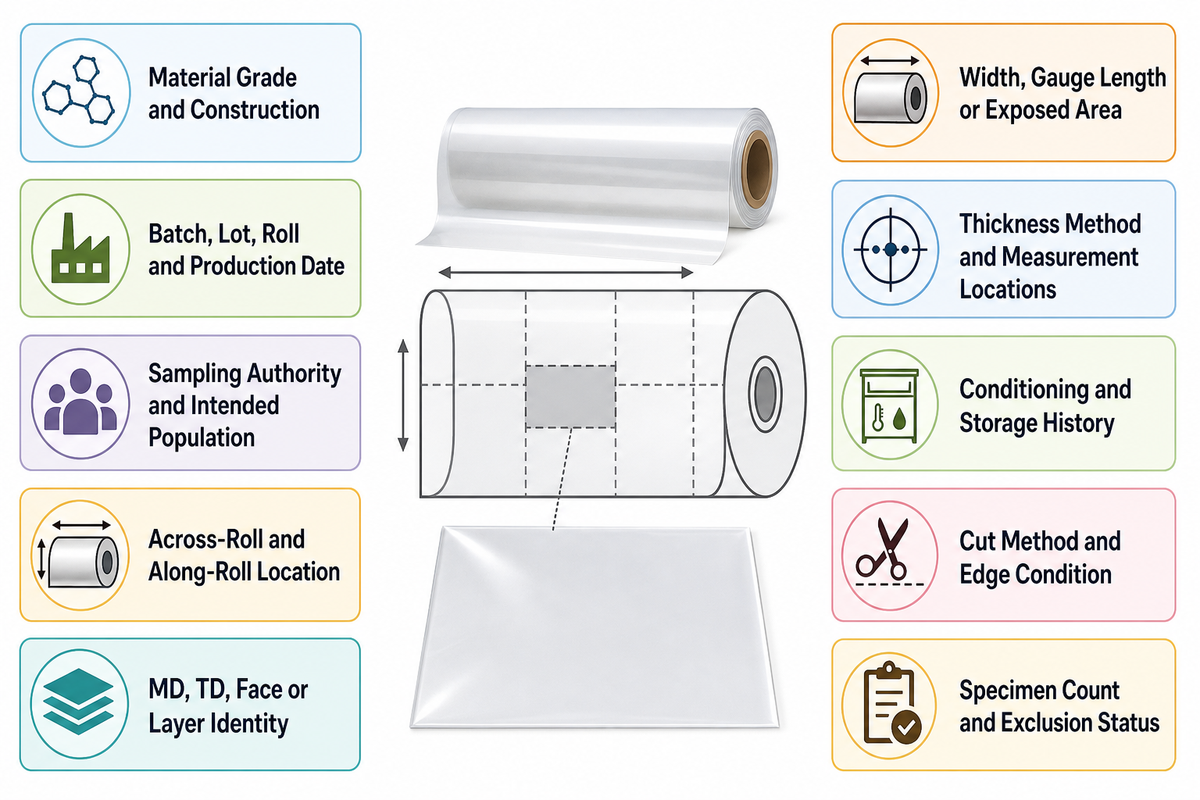
Each specimen is more than a simple sample. Its identity should define the material being tested as well as the lot, the roll, when and where the sample was taken, the direction of the sample, the face of the film, and the population being studied.
Specimen identity card
- Material grade and construction
- Batch, lot, roll, and production date
- Sampling authority and intended population
- Across-roll and along-roll location
- MD, TD, face, or layer identity
- Width, gauge length, or exposed area
- Thickness method and measurement locations
- Conditioning and storage history
- Cut method and edge condition
- Specimen count and exclusion status
Sample identity and sample representativeness are different claims; the report-field completeness check can flag missing documentation without proving representativeness. Even a report that perfectly describes five tested strips may say nothing about whether those strips represent the full roll, the shipment, or production over time; the request should name that intended inference before sampling.
Thickness belongs in the audit trail when it is used directly to calculate a reported property. Record the measurement route and locations rather than treating one nominal gauge as a complete specimen description.
Current ASTM D6988-26 addresses thickness measurement for plastic-film test specimens, while the applicable property method or material specification can govern a different route. That is why a report should state the thickness method, not only a number.
Record the Test Conditions That Can Change the Result
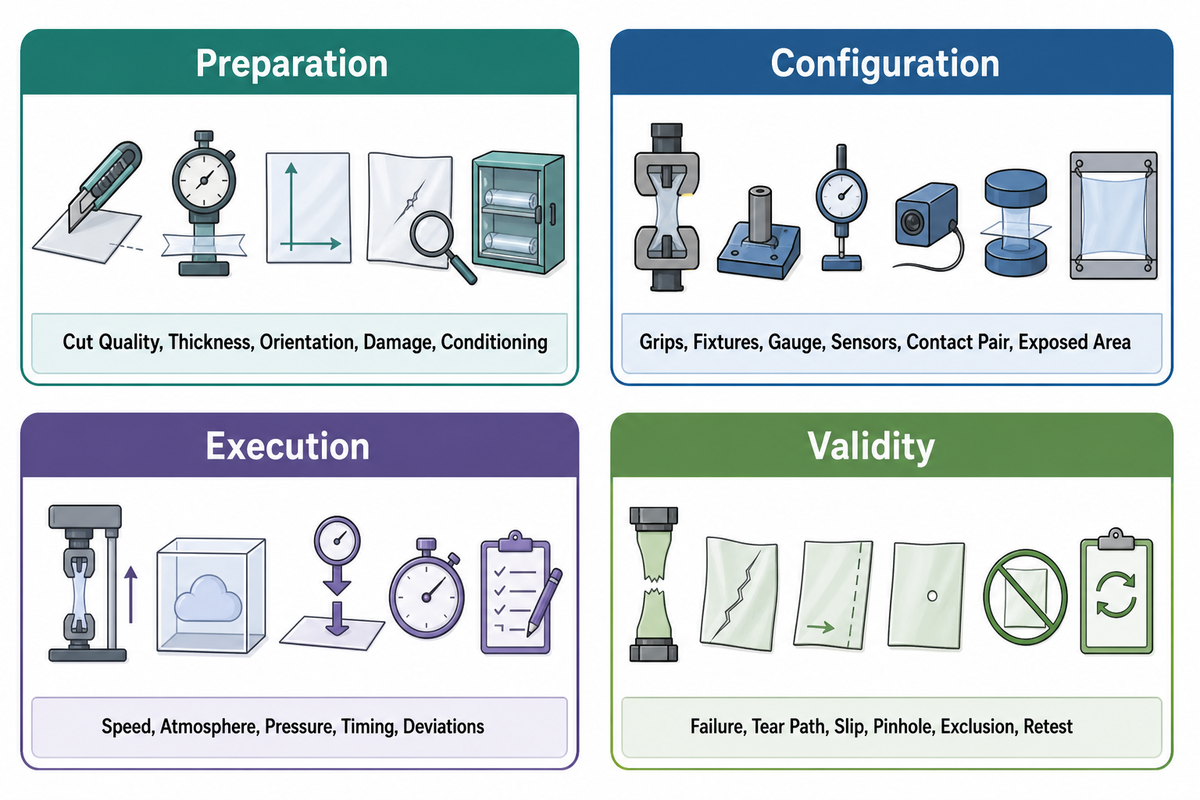
The sample execution record should state the name of the method, the name of the laboratory and the date the method was performed, the specification of the product, the environment and conditions of the laboratory, the name of the equipment and sensor, the fixtures and calibration, setting of the method, deviations, and the reason the method was considered invalid.
Preparation
Cut quality, thickness, orientation, visible damage, conditioning.
Configuration
Grips or fixtures, gauge or span, sensors, contact pair, exposed area.
Execution
Speed, atmosphere, pressure differential, loading timing, deviations.
Validity
Failure location, tear path, slip, pinhole, exclusion and retest rule.
ASTM D882-26 publicly notes that tensile results can vary with thickness, preparation, test speed, grips, and the way extension is measured. It also warns that tearing failures produce anomalous data that should not be compared with normal failures, making the observed failure mode a report field rather than a laboratory footnote.
Friction provides a second warning. ASTM D1894-24 describes time-dependent additive blooming, surface condition, loading timing, and motion control as influences, so two films produced or aged differently can resist a simple coefficient-to-coefficient ranking.
Method-specific beats generic
Use a cross-method checklist to find missing context, then return to the current property method for its exact configuration, validity, calculation, and reporting requirements.
One Sample, Three Records: The 3-Record Framework
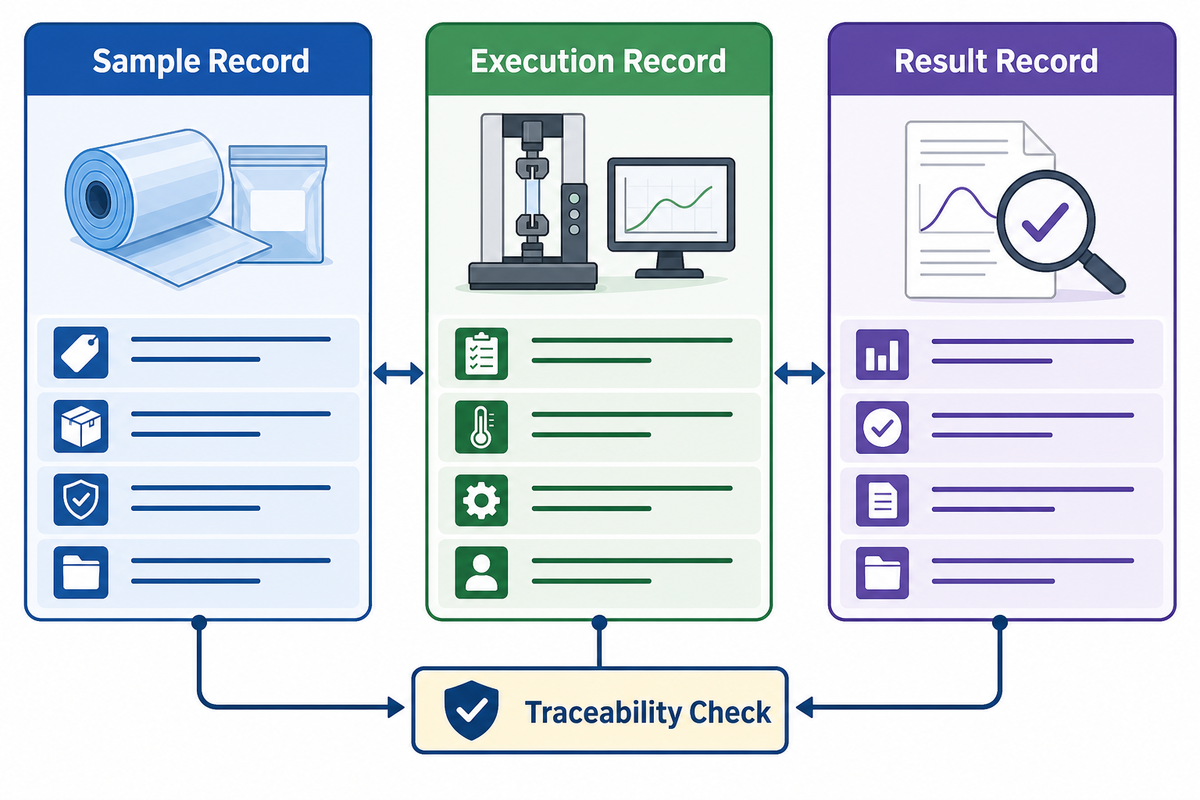
One Sample, Three Records is an editorial traceability framework, not a term defined by ASTM or ISO. It keeps procurement, the laboratory, and the technical reviewer aligned without pretending that documentation alone proves the sample represents a whole lot.
1. Sample record
What was received, how it was sampled, where each specimen came from, and what population it’s intended to represent.
2. Execution record
Which method and edition governed, the configuration used, and every deviation or abnormal event.
3. Result record
Individual valid results, exclusions, units, summary statistic, uncertainty context, and the decision rule used.
All three share one sample identifier. A fictional chain might read Roll R07 → MD specimen R07-MD-03 → execution run T-118 → result row T-118-03; it adds traceability without inventing a performance value.
ASTM’s 2026 Plastic Film Testing proficiency program illustrates why test execution, submitted data, and statistical comparison are separate layers. Its public description has participating laboratories test distributed film materials, submit results, and receive coded results and statistical comparison reports.
Traceability check
If a result row can’t lead backward to one specimen and one execution record, or forward to the rule used in the decision, the chain is incomplete.
How to Compare Two Supplier Reports
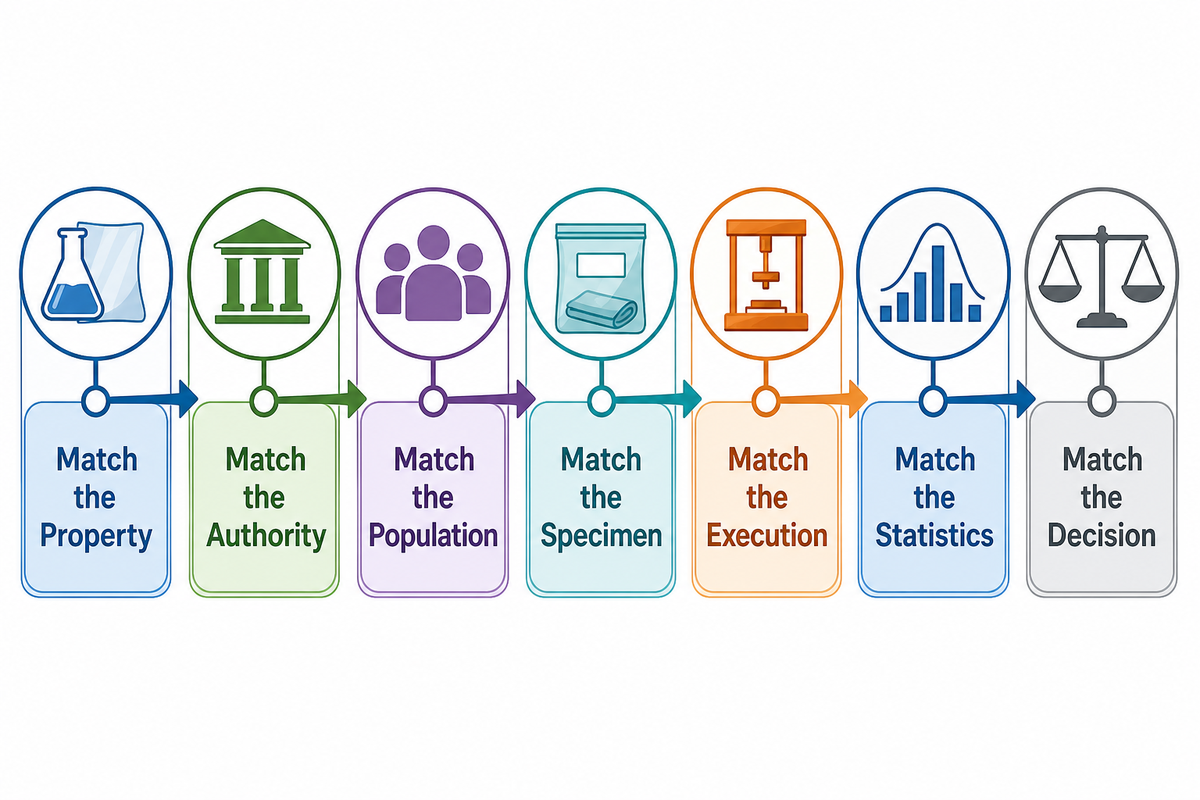
Comparison is a sequence of gates, not a subtraction between two averages; the cross-report alignment matrix can surface method and field mismatches before numerical comparison. Stop at the first material difference and classify the reports as not yet comparable until the gap is resolved.
- Match the property — confirm the same measurand, failure event, calculation basis, and units.
- Match the authority — compare the method, edition, product specification, deviations, and any documented equivalence study.
- Match the population — compare the lot or roll definition, sampling plan, production or age state, and intended inference.
- Match the specimen — compare structure, face, direction, thickness route, geometry, conditioning, and validity rules.
- Match the execution — compare laboratory, configuration, speed, fixtures, sensors, atmosphere, and failure handling.
- Match the statistics — require individual values, count, exclusions, summary statistic, uncertainty, and coverage factor where relevant.
- Match the decision — identify the acceptance authority, specification limit, decision rule, and sign-off owner.
ASTM D1894-24 supplies a direct counterexample to “same property name means comparable”: its public scope says the method is not equivalent to ISO 8295 and the results cannot be compared directly. No universal conversion should be applied to make unlike friction results look aligned.
Matching fields are necessary, not sufficient
NIST has reported that dispersion between laboratories can be substantially larger than the measurement uncertainties those laboratories report. Method and field alignment therefore doesn’t establish laboratory equivalence.
Near a specification limit, the same measured value can support different conformity decisions if uncertainty and the acceptance rule differ. Ask for the decision rule instead of assuming that the word “pass” has one universal calculation behind it.
Four questions that a matching number cannot answer
Comparing suppliers often results in failure because a single measured value is required to represent multiple conclusions. Identify the measured value as separate from the sampled population, the laboratory process, and the conformity decision.
What was measured?
The property, failure definition, unit, method, edition, and calculation basis.
What does it represent?
The sampled pieces, their locations, the lot or roll boundary, and the intended population.
How stable is the measurement?
The laboratory, calibration and quality context, individual variation, uncertainty, and any known laboratory effect.
How was the decision made?
The specification limit, acceptance zone, guard band if used, decision rule, and risk owner.
A report can be complete for the first question and silent on the other three. In that case, preserve the result as evidence about the tested specimens, but do not quietly upgrade it into a lot-wide guarantee or an unconditional supplier ranking.
Example screening verdict
“Both reports name the same tensile method, but the sampling population, failure disposition, uncertainty, and decision rule aren’t aligned. The data are useful for follow-up, yet not sufficient for a direct supplier comparison.”
Report Red-Flag Ladder
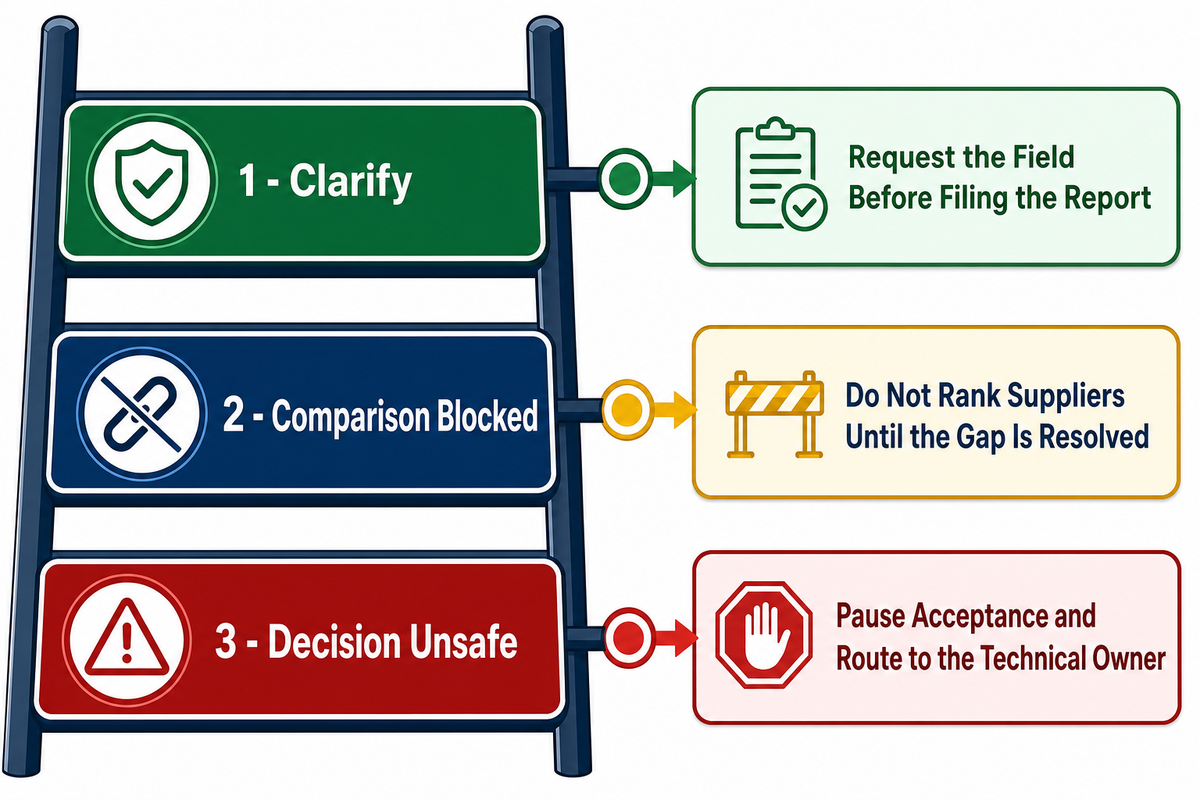
The Report Red-Flag Ladder prioritizes follow-up; it does not certify a laboratory or replace a technical review. Escalate according to the decision impact of the missing field. For a near-limit conformity decision, NIST’s decision-rule and risk-analysis guidance explains why uncertainty and the rule used to accept or reject the result belong in the review record.
| Level | Examples | Disposition |
|---|---|---|
| 1 — Clarify | Edition, test date, units, analyst sign-off, or specimen count is missing. | Request the field before filing the report. |
| 2 — Comparison blocked | Sampling population, MD/TD, thickness method, conditioning, configuration, laboratory context, individual values, or exclusions are missing. | Do not rank suppliers until the gap is resolved. |
| 3 — Decision unsafe | Property mismatch, undisclosed method change, unexplained invalid events, or a pass/fail claim without governing criteria, uncertainty context, or a decision rule near the limit. | Pause acceptance and route to the technical owner. |
Method-specific exceptions belong above generic neatness. A D882 tearing failure should not disappear into an average of normal breaks, and a D1894 friction comparison should not ignore film age or surface condition simply because both reports show a coefficient.
Silent deletion is a red flag
Record the specimen identifier, observed event, validity rule, exclusion decision, and any replacement test. A cleaner mean isn’t a better report when the audit trail has been removed.
Build a Buyer-Ready Film Test Request
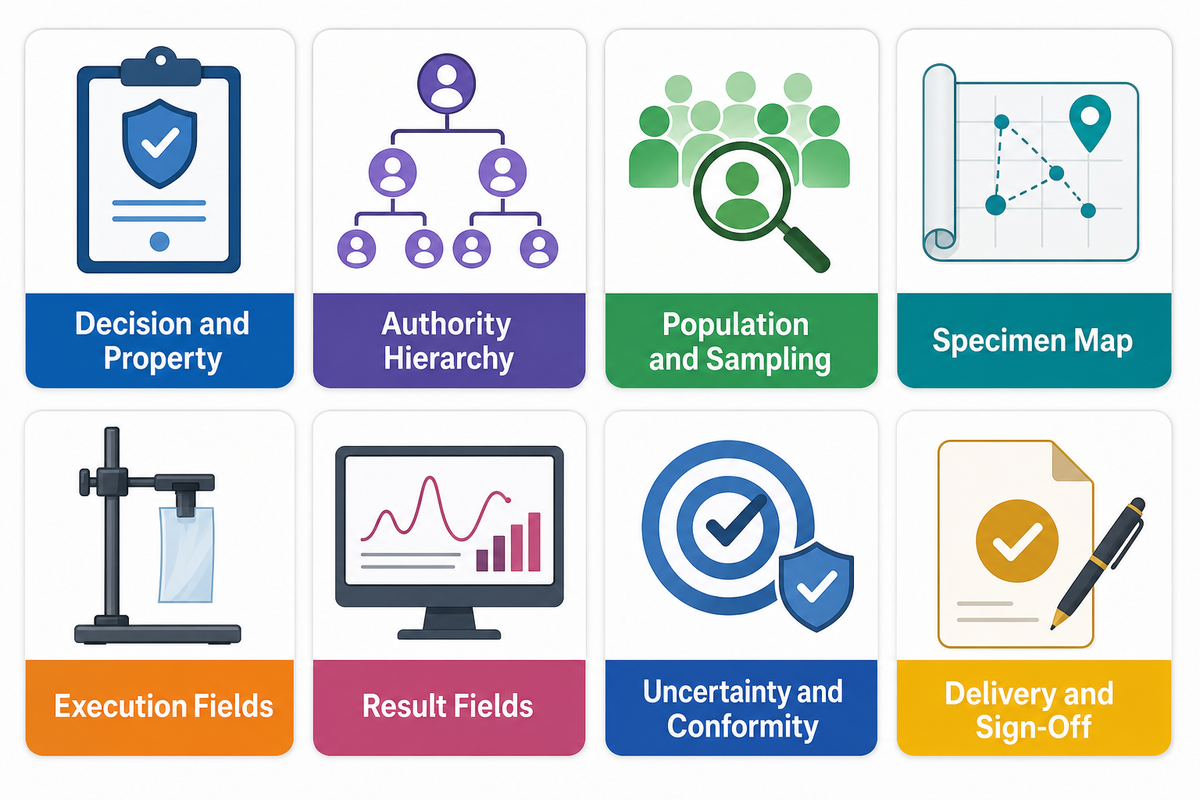
The Buyer Film-Test Request Sheet should be agreed before material is cut. It converts a business concern into a traceable request while leaving the laboratory procedure to the current method and qualified technical owner.
| Field | What to state | Why it matters |
|---|---|---|
| Decision and property | Failure mode, measurand, use decision, and prohibited inference | Prevents the wrong method from answering a different question |
| Authority hierarchy | Contract, product specification, method, edition, and approved deviations | Shows which document wins when instructions differ |
| Population and sampling | Lot/roll boundaries, sampling authority, locations, production/age state, intended inference | Separates tested-piece identity from lot representativeness |
| Specimen map | Face/layer, MD/TD, geometry, thickness route, count, conditioning | Makes direction and preparation auditable |
| Execution fields | Laboratory, equipment, fixtures, sensors, settings, atmosphere, calibration and deviations | Exposes condition differences that can change interpretation |
| Result fields | Individual values, invalid events, exclusions, units, statistic, curves or observations required | Stops the average from hiding the test set |
| Uncertainty and conformity | Uncertainty, coverage factor, limit, decision rule, guard band if used, and risk owner | Makes a pass/fail statement interpretable near the limit |
| Delivery and sign-off | File format, traceable identifiers, raw-data retention, reviewer and acceptance authority | Keeps the evidence connected to the procurement decision |
NIST describes conformity decisions as involving measurement uncertainty, acceptance boundaries, and the competing risks of accepting nonconforming products or rejecting conforming ones. The laboratory can report the technical inputs, but the governing decision rule and risk ownership must be explicit in the purchase specification or approved quality plan.
Do not write a procedure into the RFQ
State the question, hierarchy, evidence, and decision fields. Let the licensed method and competent technical owner govern the detailed execution.
Where UD Packaging Fits
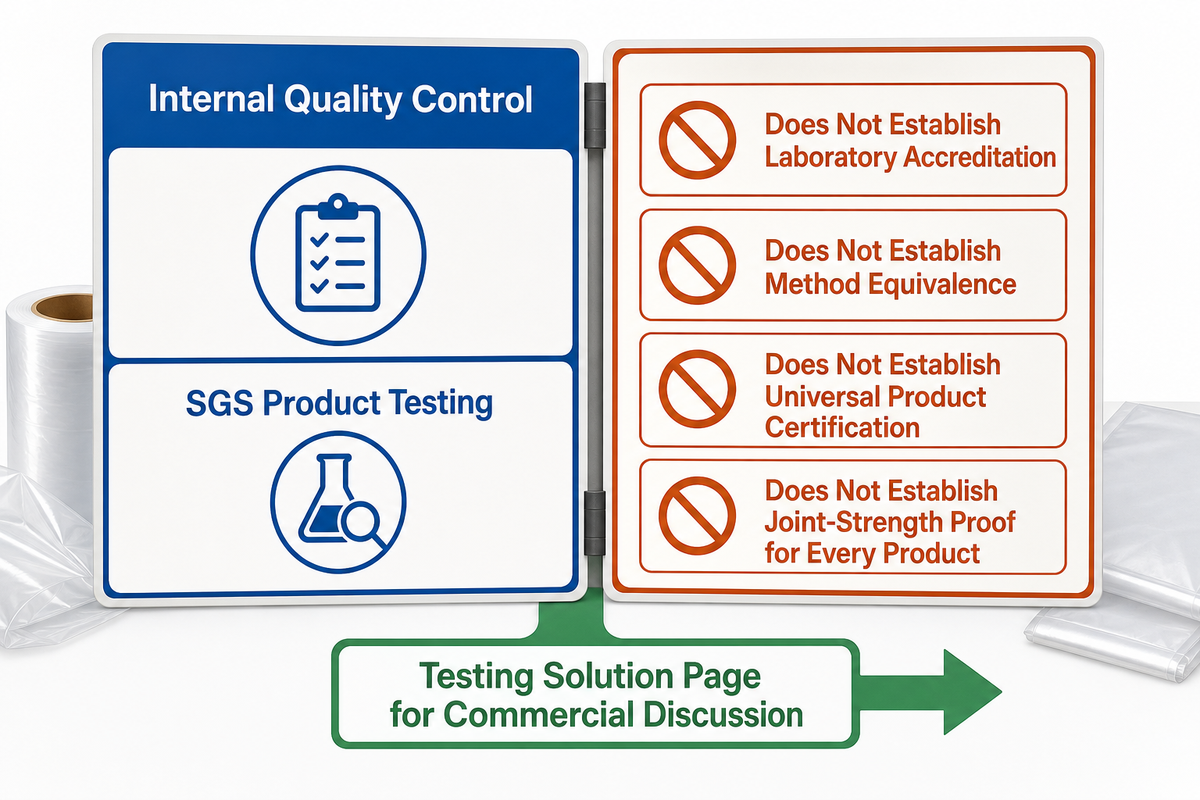
UD Packaging supplies industrial packaging materials including PET strapping, industrial stretch film, supporting consumables, and strapping equipment. For this guide, the relevant next step is to turn the buyer’s property question and report-field list into a test brief, not to treat a commercial page as independent proof.
Company statement and evidence boundary
According to the company information supplied for this article, UD Packaging applies internal quality control, cites SGS product testing, and references GB/T 1040.1-2018 and GB/T 1040.3-2006 for applicable tensile testing. Those statements don’t by themselves establish laboratory accreditation, equivalence to another method, universal product certification, or joint-strength proof for every product.
Use the UD Packaging testing solution page for the commercial capability discussion. Keep the method, specimen, uncertainty, and acceptance requirements in the request so the resulting evidence stays decision-ready.
Frequently Asked Questions
Which plastic test method should I use for film?
Answer
Start with the property and failure mode that drive the decision. Use the method named by the governing specification, contract, regulator, or approved control plan; tensile, tear, impact, friction, seal, and barrier methods are not substitutes. Confirm the current edition and applicable product specification before cutting specimens, because a familiar instrument does not choose the property for you.
What specimen details must a plastic film test report include?
Answer
Trace every result to the material, lot or roll, intended sampling population, sampling rule, location, and direction. Record specimen geometry or exposed area, edge preparation, thickness method and readings, conditioning, method and edition, laboratory, equipment and configuration, calculation basis, units, deviations, individual results, summary statistics, validity decisions, and exclusions. For conformity or a near-limit result, request the uncertainty statement, coverage factor, and decision rule as well. Photographs or a sampling map can preserve details that a short table misses.
Can reports using different standards be compared?
Answer
Not from the final numbers alone. Compare the property definition, specimen, method edition, configuration, units, uncertainty, validity rules, and decision rule. The same property name and unit are not enough. Without a documented, material-specific equivalence or correlation, treat the reports as not yet comparable and do not apply a universal conversion.
Should film be tested in both machine and transverse directions?
Answer
Test MD and TD separately when orientation can influence the decision. Keep both directional results visible; one combined average can hide anisotropy.
How should invalid or abnormal specimens be reported?
Answer
Keep the specimen ID, observed event, classification rule, exclusion decision, and any replacement result. Report the failure mode beside the value instead of deleting it silently.
Does one film test prove packaging performance?
Answer
No. A laboratory method isolates a property under defined conditions. Package performance can also depend on conversion, sealing, thickness distribution, storage, load geometry, handling, route, and environmental exposure. Use the result as one input to a risk-based validation plan, then confirm the intended package under representative filling, sealing, storage, and distribution conditions. If the decision is high consequence, document how the laboratory endpoint connects to the field failure mode before release.
References & Sources: current-edition checks
- ASTM D882-26, Tensile Properties of Thin Plastic Sheeting
- ISO 527-3:2018, Test Conditions for Films and Sheets
- ASTM D1894-24, Coefficients of Friction
- ASTM D6988-26, Thickness of Plastic Film Test Specimens
- ASTM 2026 Plastic Film Testing Proficiency Program
- NIST, Laboratory Effects Models for Interlaboratory Comparisons
- NIST, Assessment of Conformity, Decision Rules and Risk Analysis
- Packaging Strategies, Common Problems with Common Film Tests
Prepare a film-test brief before comparing results
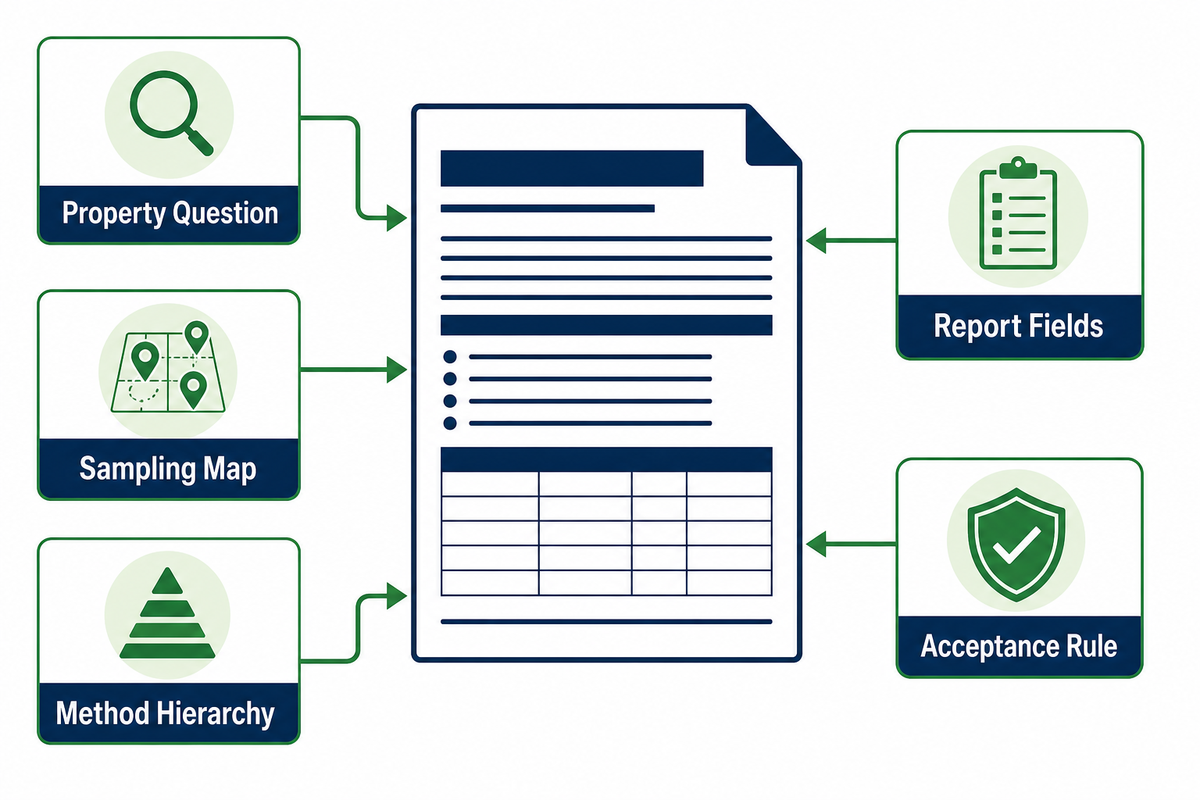
Bring the property question, sampling map, method hierarchy, report fields, and acceptance rule into one request. Before sending it, confirm the current edition in the ASTM publisher catalog or the relevant standards publisher’s active listing. UD Packaging can review the packaging context and help route the next commercial discussion.