

At a glance
Tack: brief-contact adhesion. Main comparison: loop, probe, rolling ball and film peel cling. Report: the method, specimen, contact conditions, measured quantity and failure location.
Tackiness is the ability of a material to form an initial adhesive bond during very brief contact. A label that grabs immediately and a wrap film that clings to itself both may feel sticky, but they require very different measurements. Begin with the contact pair and the job the bond must do.
Tackiness describes rapid bond formation under defined contact conditions. Loop and probe tests measure separation responses; rolling-ball testing gives a comparative stopping distance. Stretch-film cling needs a film-to-film method.
Keep together
- Match the method and output quantity.
- Record the surface and contact history.
- Inspect spread and failure location.
Keep separate
- Initial tack and sustained holding.
- Tape-to-panel and film-to-film results.
- Instrument settings and product acceptance.
What is the meaning of tackiness?
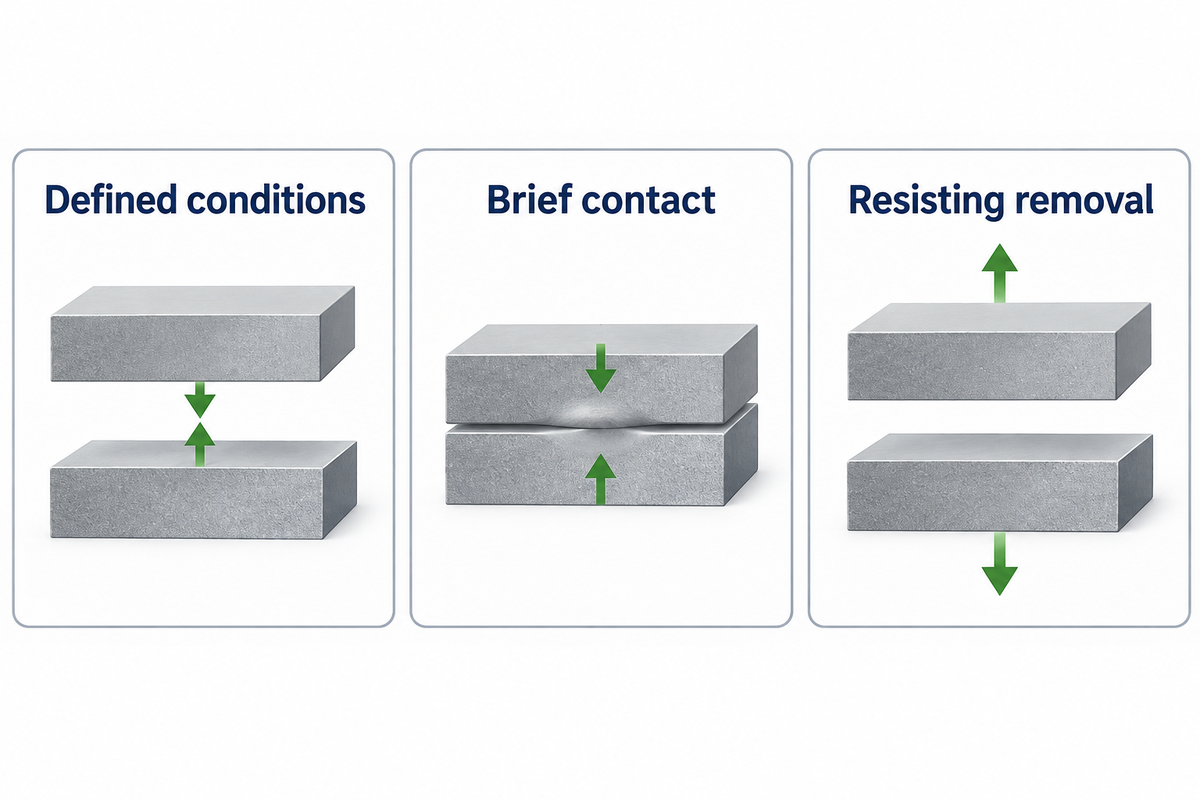
Tackiness means initial stickiness when surfaces meet briefly and then separate under stated conditions. A useful material definition includes both forming contact and resisting removal. The word doesn’t identify a single universal force. It includes the surface, specimen construction, history of contact and separation, and motion of separation, amongst others.
The National Physical Laboratory’s intercomparison of tack measurements treats the adherends and bonding process as part of the result. For polymers, surface wetting helps create intimate contact, while deformation during separation contributes to the response. A soft-feeling surface can therefore behave differently when contact is shorter, colder or made against another substrate.
“Adhesive tack is critical in the initial formation of an adhesive bond.”
Are tacky and sticky the same thing?
Tacky and sticky overlap in ordinary usage, but tack has a more specific role in adhesive testing: rapid bond formation under a defined procedure. Sticky is a good synonym to describe the feeling. A technical comparison still needs the method, contact surface and measured quantity, rather than a stronger adjective.
An English dictionary also provides tacky an informal meaning relating to cheap or bad taste. This informal meaning applies to language rather than the selection of materials. A broader view of polymer families and product forms may be found in the polymer families and product forms.
Tack, peel adhesion and shear answer different questions
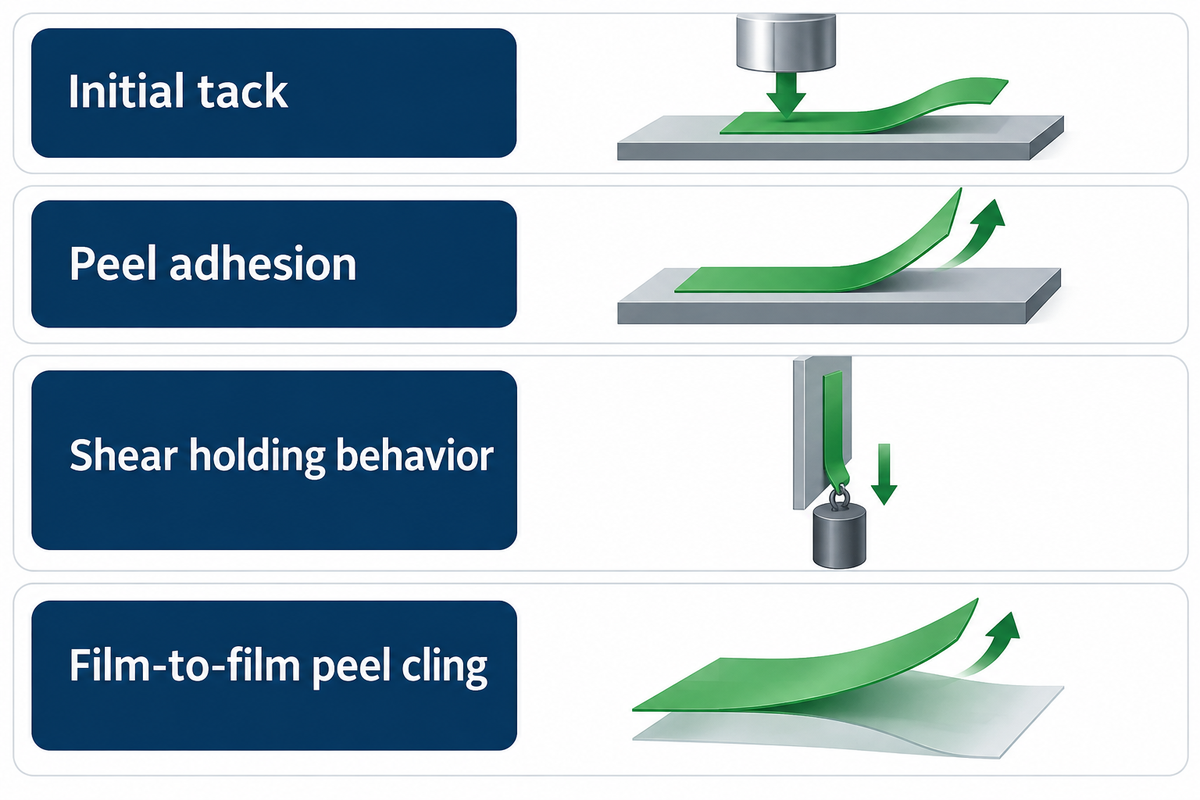
Initial tack addresses first grab, peel addresses progressive removal, and holding behavior addresses a bond under load over time. Match the property to the observed failure. A tape can perform well in one situation and poorly in another because the loading history and failure process have changed.
Consider an illustrative label that remains in place during application but later lifts at an edge. Grabbing during application reflects initial tack; the later edge lift is a question about the established bond in service. Now, think of a case in which an item is mounted and slowly slips, with the tape remaining attached. That is a shear holding question, so the appropriate test loads the bond for a sustained period rather than using a tack method.
Tack-to-Task Matrix
| The question in front of you | Property or test route | Keep with the result |
|---|---|---|
| Will the label grab during brief placement? | Initial tack, often loop tack | Backing, test surface and contact/separation sequence |
| What happens when a controlled probe pulls away? | Probe-tack response | Probe geometry, force curve and chosen output metric |
| Has this adhesive batch changed in a rolling-ball screen? | Comparative rolling-ball tack | Ball/track conditions, coating thickness and stopping distance |
| How hard is the established bond to peel? | Peel adhesion | Angle, width, dwell, rate and substrate |
| Will a bonded item slip under a sustained load? | Shear holding behavior | Load, bonded area, duration, environment and failure criterion |
| Will overlapping stretch-film layers cling? | Film-to-film peel cling | Film faces, stretched state and overlap conditions |
| Will the film slide against the contact surface? | Static or kinetic friction | Contact pair and friction procedure |
| Will adjacent layers stick during storage? | Blocking behavior | Storage pressure, time, temperature and layer pairing |
| Will the film itself stretch or break? | Tensile response | Specimen direction, dimensions and loading procedure |
The last three rows describe different material questions, even when the operator uses the same word, sticky. The site’s guide to static and kinetic film friction covers sliding behavior. Keep those measurements with the tack data when both affect the job, with their different units and methods.
Choose a tack test for the decision you need to make
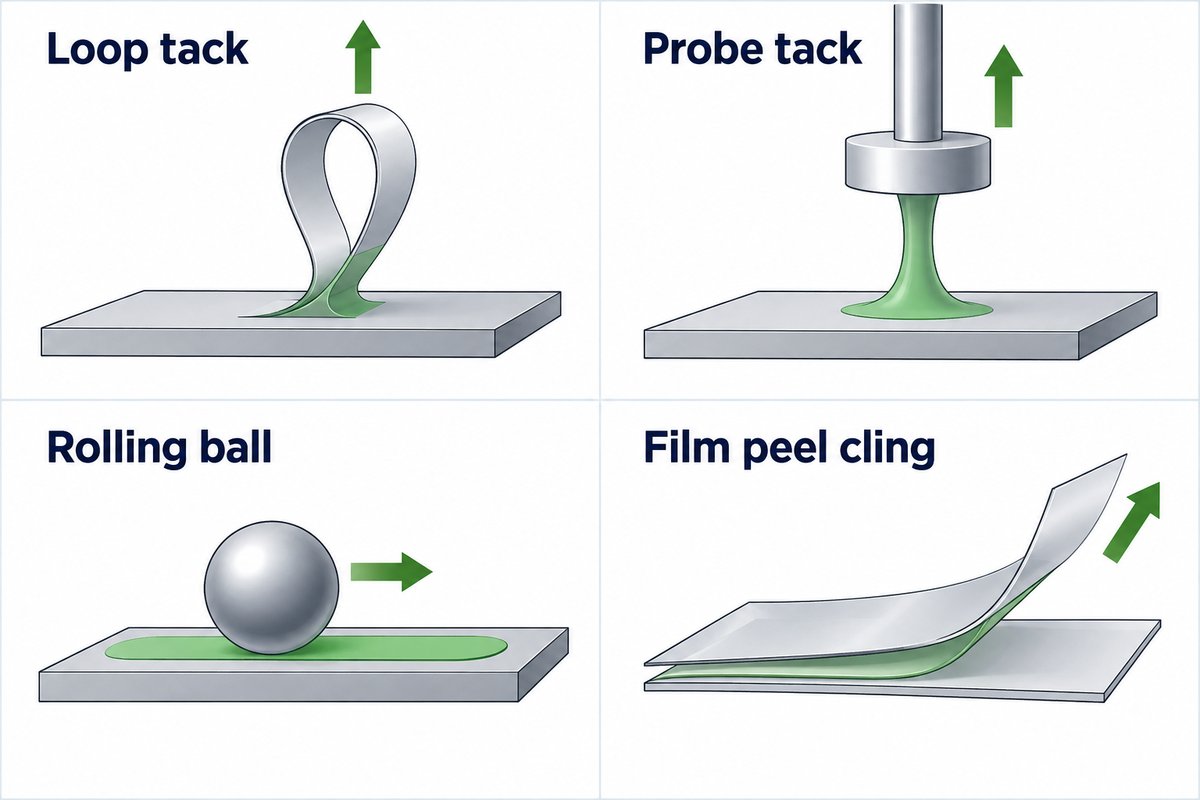
Use loop tack for the relevant brief-contact tape or label comparison, a defined probe procedure when controlled contact and separation are needed, and rolling ball for an appropriate comparative screening task. Each of these creates a different contact geometry and response.
| Route | What is observed | Useful boundary |
|---|---|---|
| Loop tack | Force while an adhesive-out loop separates after brief contact | Backing and loop geometry participate in the result |
| Probe tack | Force/displacement response while a defined probe withdraws | Specify the output metric and actual laboratory procedure |
| Rolling ball | Distance travelled before a released ball stops | Current ASTM scope favors low-tack comparative quality control |
| Film peel cling | Separation of contacting film layers | Keep film-to-film results separate from a rigid-panel tack test |
A loop test brings an adhesive-out strip into contact and measures separation. ASTM D6195-22 identifies two arrangements, including a 7 in. (175 mm) strip for Method A and a 5 in. (125 mm) strip for Method B. Stiffer backings generally yield higher tack values; when the adhesive isn’t already coated, the method uses a clear 2 mil (0.05 mm) polyester film backing. Keep the construction with the number.
For a rolling-ball test, the ball is released from a ramp to roll down and stop on the adhesive. The current ASTM D3121-25 public scope mentions low-tack adhesives and comparative quality control. It states that the method should not be used for end-use product specification. Thickness control is important when investigating batch differences; however, the method is not a complete application rating.
A probe test can control approach, contact, and withdrawal, making the sequence easier to study. Its results include the probe used, adhesive thickness and sample support. ASTM D2979-16 is listed as withdrawn in 2019 with no replacement. When that method is referenced, find the edition and the actual procedure used.
Control contact and separation before ranking results
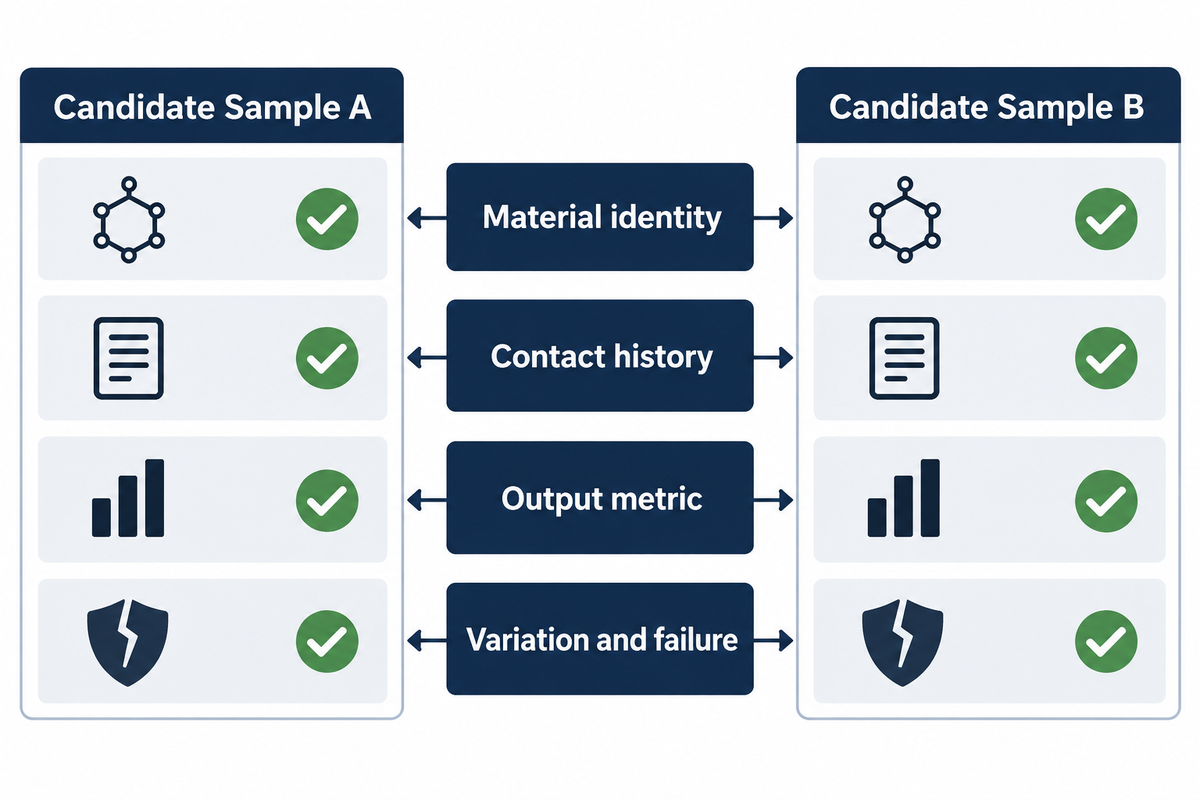
Maintain the specimen, surface and test sequence on a common basis before ranking two tack results. Record the output quantity explicitly: a peak force and the work associated with separation describe different features of the response. The comparison becomes useful when another person can replicate its conditions and understand its limits.
Controlled Tack Comparison Card
| Record field | Sample A and sample B must identify | If the field differs |
|---|---|---|
| Material identity | Grade, batch, coating or film construction and age | Compare products as supplied; do not call the change a formulation-only effect |
| Manufacturing history | Coat weight/thickness, drying or cure history where relevant | Retain the history as a possible cause of the response |
| Backing and support | Backing type, thickness and how the sample is supported | Treat bending/support changes as part of the specimen |
| Contact surface | Material, finish, preparation and condition | Repeat on a common surface or report the datasets separately |
| Geometry | Probe shape/area or loop dimensions and specimen width | Keep the geometry with the result rather than applying a generic conversion |
| Contact history | Approach, applied contact force/pressure and dwell | Use the selected procedure; change one condition at a time |
| Environment | Conditioning, test temperature and relevant humidity | Condition and test on the agreed basis |
| Separation | Withdrawal/peel rate and, where relevant, angle | Compare at the agreed rate and geometry |
| Output metric | Peak force, force per width, work or another defined quantity | Choose one matched response before ranking |
| Variation and failure | Replicate count, individual results/spread and where separation occurred | Investigate overlap and failure changes before approving a difference |
Use the card as a paired record with a filled-in column for each candidate in the laboratory worksheet. Record each specimen result as a separate entry, and take averages later. This method helps document evidence for analysis of scatter and outlying failures. For example, if a label sample is changed from a relatively stiff backing to a more flexible construction, maintain this in the interpretation. A different loop response may represent the construction as well as the adhesive mass.
A distinction should be made between outputs even for the same instrument. A force curve with a narrow peak and one with a longer separation tail can have the same maximum while requiring different work to separate. In a model adhesive study, NIST researchers examined adhesion energy and elongation at break while observing contact behavior across temperature.
Preparation of a sample is usually done before a measurement. Associate conditioning and storage history with the sample, using the film-conditioning guide for the preparation record. When appropriate, include coating, drying or curing history. Distinguishing a changed measurement from a changed sample material state is dependent on the history.
Stretch-film cling is a film-to-film measurement
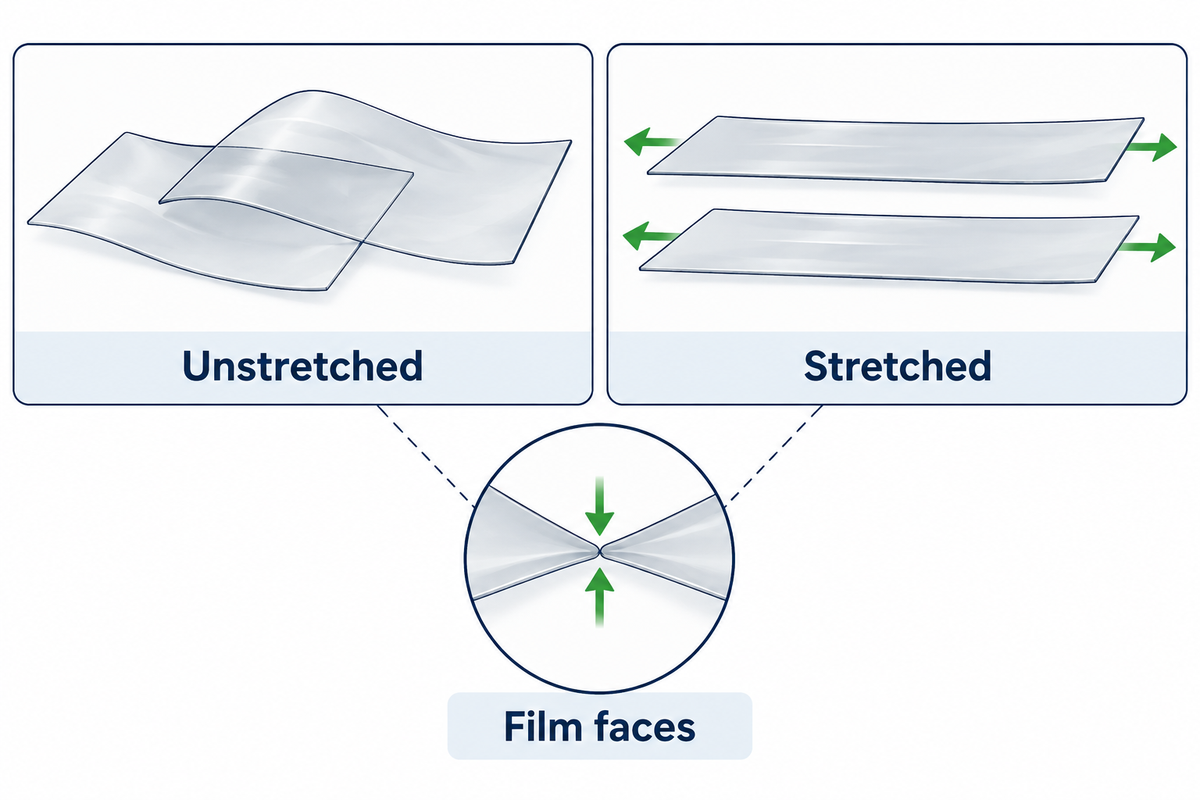
For measuring the cling of film layers, stretch the film to the required state and measure contact between the film layers that will touch each other in that state. A film-to-film result describes overlap behavior more directly than a tape-to-steel tack value. Keep film face pairing and stretch history visible so that a change in contact arrangement does not masquerade as a better material.
In ASTM D5458-95 (2025) the cling of two film layers in stretched and unstretched conditions is assessed. This provides a starting point for selecting evidence in a clear case. In both the stretched and unstretched conditions, comparisons should be kept separate.
In an illustrative pallet-wrapping investigation, an overlap tail releases after application. Start by identifying which film faces met, their stretch state and the contact conditions at the overlap. The actual wrapping process also needs to be reviewed. The same load may also require evaluation for tension retention, puncture resistance and ease of handling.
For the broader relationship between resin data, converted materials and packaging behavior, see plastic material properties and test comparisons. The material family is a screening input; the finished film and its application remain the comparison objects.
Read failure modes before changing the formulation
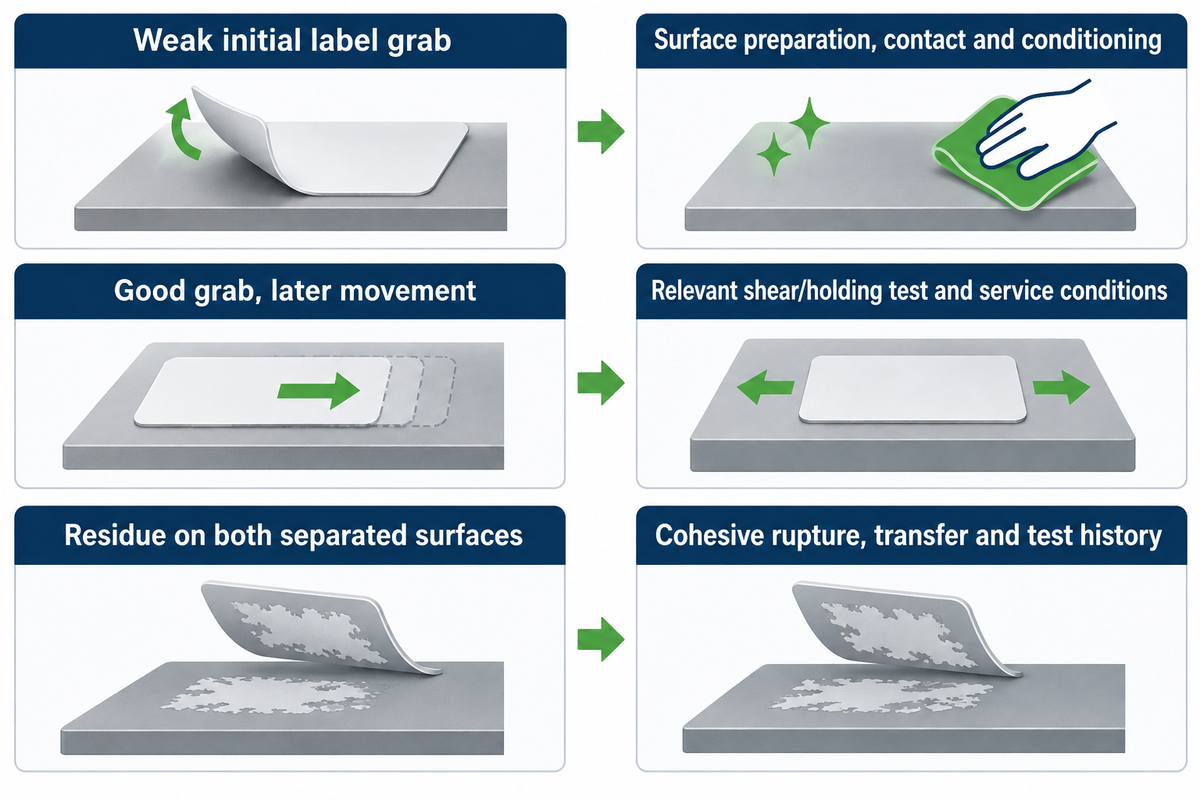
Determine where separation occurred prior to reformulation of adhesive. Appearance of the interface is just one of many factors that influence the next step in an investigation. Residue on both interfaces, damage to the backing, or gradual separation may also be considered. Photograph the separated surfaces and retain the force response. The NPL intercomparison examines contact pressure, dwell time, test speed, temperature and adherend stiffness; keep those variables with the failure observation. Failure appearance of a system may be used to organize the next steps in an investigation, but may not point to the ultimate root cause of a failure.
| Observation | First controlled check | Interpretation to avoid |
|---|---|---|
| Weak initial label grab | Surface preparation, contact and conditioning | Assuming a different adhesive is the only remedy |
| Good grab, later movement | Relevant shear/holding test and service conditions | Treating tack as a sustained-load rating |
| Residue on both separated surfaces | Cohesive rupture, transfer and test history | Naming one additive as the unique cause |
| Clean separation at one interface | Surface identity and the actual separation conditions | Assuming the bulk adhesive has no role |
| Backing stretches or tears | Backing response and fixture/support | Reporting the peak as a pure interface property |
| Large specimen-to-specimen scatter | Loop formation, alignment, contamination and repeat measurements | Approving a small mean difference immediately |
| Film overlap releases | Face pairing and film stretch state | Substituting a steel-panel tape result |
Can tackiness be fixed?
Tackiness can often be changed, but the successful remedy depends on whether the observed behavior was intentional and what caused the change. Check preparation, conditioning, contact and test settings before altering a formulation. If the measurement is consistent and the product still misses its application requirement, investigate the exact material construction with its supplier.
In an illustrative residue complaint, stronger initial grab is not the immediate target. First establish whether the adhesive split, transferred from its carrier or separated at another interface. Keep time, temperature and removal motion with that observation. Make a controlled change, one condition at a time; altering the surface preparation and the adhesive together leaves the cause of any shift unclear. With rubber-type tapes, note the polymer grade, tackifier content and backing, in addition to the result.
Choose equipment or a testing service
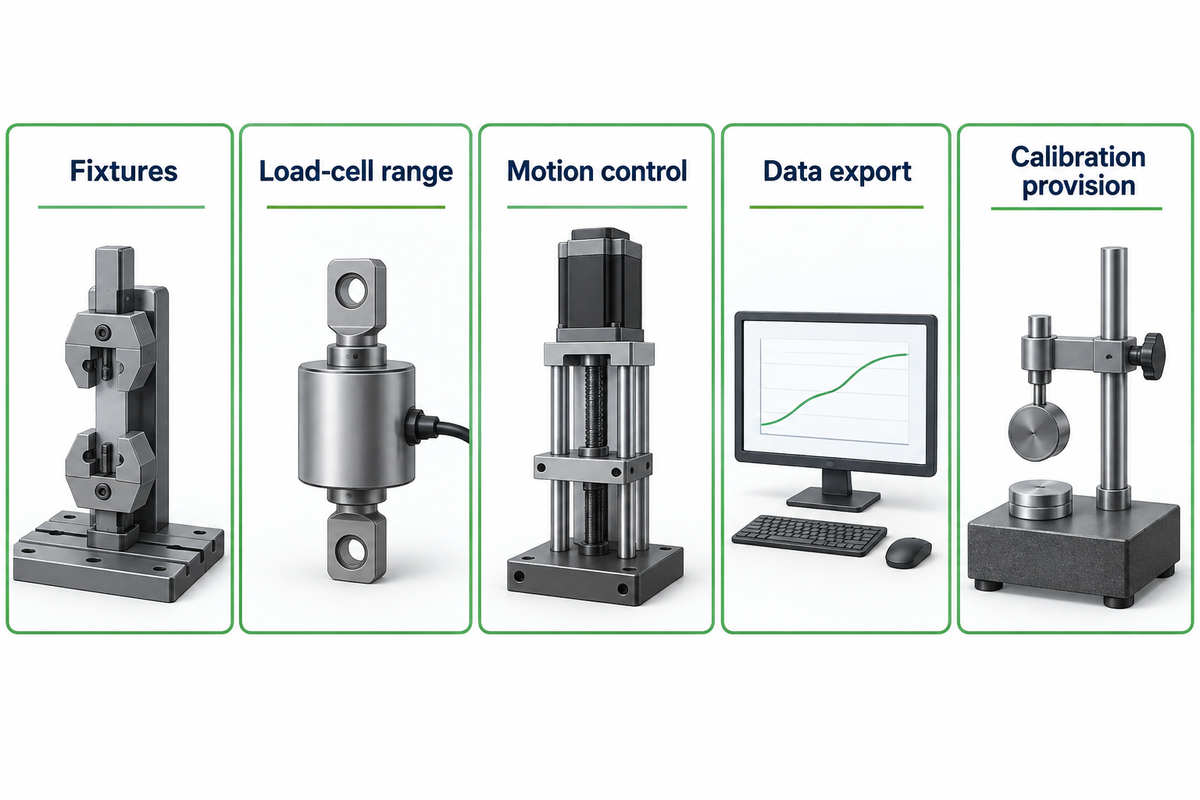
Compare a complete test configuration or a defined laboratory service, then request its price. A rolling-ball fixture, loop-tack instrument and programmable test frame provide different capabilities. The key question is whether the setup can perform the method on your specimens and give the results you need.
Who makes loop and probe tack testers for packaging tapes and labels?
ChemInstruments sells a loop-tack tester (LT-2000) as well as a separate probe-tack tester. Mecmesin describes loop-tack configurations built around a motorized frame, load cell and fixture. Check the proposed loop-tack arrangement against ASTM D6195-22, and specify which of its methods the configuration supports.
The RBT-100 rolling ball tester, also offered by ChemInstruments, has a different function from a system that captures a controlled force curve. Ask suppliers to identify the supplied fixtures, usable load-cell range, motion control, software/data export and calibration provision. Be sure to include specimen preparation and control of the environmental conditions if that’s part of the test method to be performed.
For external testing, provide requested method and edition, number of specimens, conditioning, contact surface, output metric, and required report. Also provide material and batch. One example of a price basis is the cost of using an instrument for a defined amount of time. The other price basis is the cost of a completed tack-testing project. The quote should make clear whether the price is for preparation and method development, repeat tests, and interpretation.
Approve a comparable result and a real-use trial
Approve the exact material against an agreed method and application requirement, with repeat measurements and their spread available for review. A difference between averages deserves attention only in the context of the observed variation and the measurement’s ability to resolve it. Set the acceptance limit and rule before deciding which measurement result to accept. Use the NPL comparison of tack methods as evidence that adherend properties, bonding process and test conditions belong in the acceptance record.
A laboratory comparison can then lead into a representative application trial: label placement and later removal for a label, or film overlap and the separate wrapped-load requirements for stretch wrap. Define what changes to the material, process and equipment will require a new comparison.
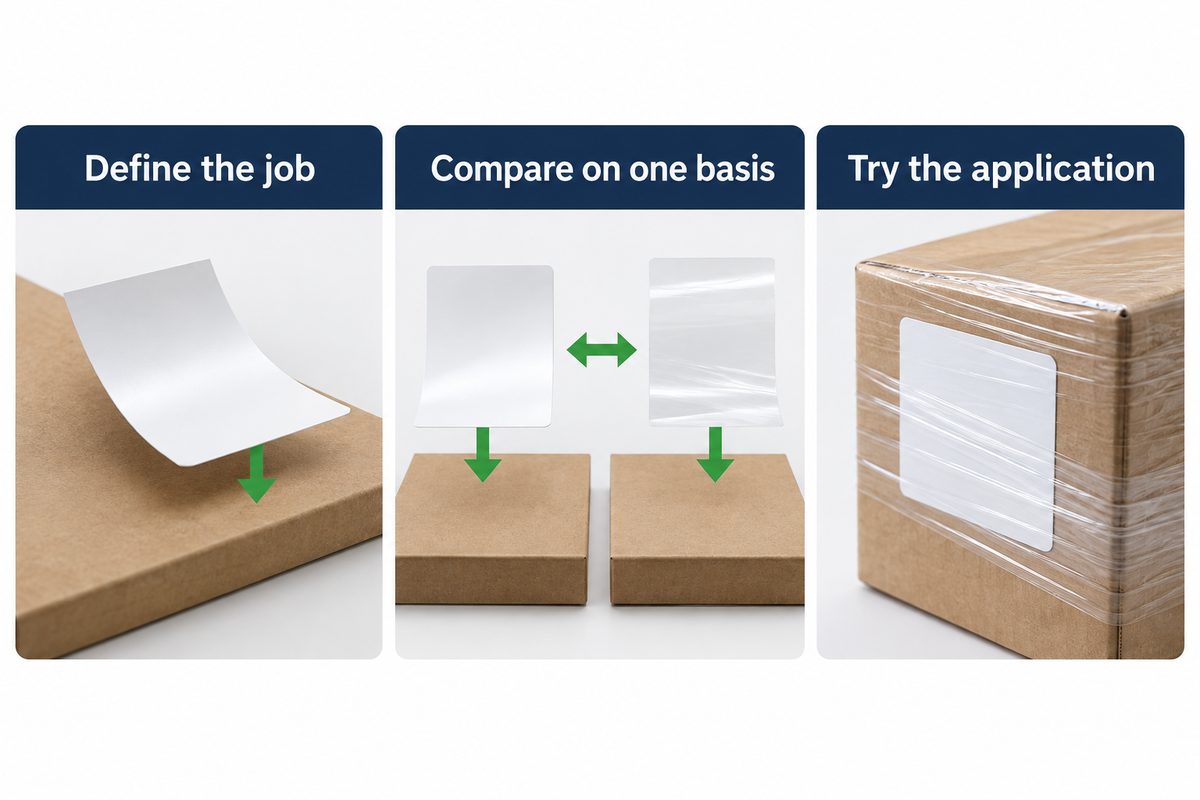
Define the job
Identify the contact pair and failure question.
Compare on one basis
Match the method, output and specimen history.
Try the application
Evaluate the actual product against its agreed use.
Frequently asked questions
What does the word “tacky” mean?
Tacky describes a surface that feels slightly sticky or forms an initial bond on contact. In materials work, that description needs a test context before it becomes a purchasing value. Ordinary English also uses tacky for poor taste; that separate meaning says nothing about adhesive chemistry or measured performance under the chosen conditions.
What does “tacky surface” mean?
A tacky surface offers some immediate resistance when another surface touches it and is pulled away. That response may be intentional in a pressure-sensitive adhesive or unwanted in a coating that hasn’t reached its specified condition. Check the product’s intended state and test method before deciding whether the surface is defective.
Can two tack test numbers be compared directly?
Two tack test numbers can be compared directly only when the measured quantity, method, specimen construction, substrate and contact history are the same. Temperature, separation speed and the reported statistic also need a common basis. A loop-tack force, a rolling-ball distance and a film peel-cling result answer different questions, so their magnitudes can’t establish a shared ranking.
Is tackiness bad?
Tackiness is useful when a label must grab quickly, but troublesome when adjacent film layers block during storage. Judge the response against the intended contact pair and use conditions. A stronger initial grab is valuable only when the application requires it.
Why is a finger test insufficient for a purchasing specification?
A finger test changes with the operator, skin condition, contact area, pressure, dwell and removal motion. Those inputs are rarely recorded well enough to reproduce a purchasing limit. The test can flag an obvious change during familiar handling, but an agreed instrumental method gives a clearer basis for comparing batches or suppliers. Keep the practical observation in the investigation and pair it with measurements made on identified specimens, under defined conditions, with a recorded failure location.
Is higher tack always better?
No. Higher tack isn’t always better: it can help immediate placement, while a removable film may need gentler attachment and clean release. Compare initial grab with later peel, residue and the required holding behavior. Choose the balance that fits the actual service substrate and application.
Does good cling prove a stretch-wrapped load is secure?
No. Good cling describes how overlapping film layers interact under the specified test, but doesn’t by itself prove that a stretch-wrapped load is secure. A wrapped load also depends on film tension, puncture behavior, geometry, wrapping pattern and the conditions encountered during handling. Keep film-layer measurements in the material comparison, then evaluate the wrapped load against its own requirements. For EU road transport, for example, Annex III of the roadside-inspection directive sets the benchmark that cargo securing should prevent tilting or tipping at 0.8 g in the driving direction and 0.5 g laterally; that is a load-level requirement, separate from a peel-cling result. Agree the relevant handling trial and acceptance criteria for the actual goods, package and distribution route before approving a change.
Working on an industrial packaging comparison? Send UD Packaging the film or strap grade, available test report and intended handling conditions. Our materials hub puts the wider selection questions in context. Contact UD Packaging with the exact product requirement so the conversation starts from the material and application you’re evaluating.
Scenarios in this guide are for illustrative purposes and aren’t UD Packaging customer trial cases. Standard references identify public scopes and edition status checked in October 2026; use the full applicable procedure for testing. Historical research describes its own material and conditions. Equipment capabilities are attributed to their suppliers.
References & Sources
- An intercomparison of tack measurements B. C. Duncan and L. A. Lay, National Physical Laboratory, 1999.
- ASTM D6195-22: Loop Tack ASTM International.
- ASTM D3121-25: Rolling-Ball Tack ASTM International.
- ASTM D2979-16: Inverted Probe Machine, withdrawn 2019 ASTM International.
- ASTM D5458-95(2025): Peel Cling of Stretch Wrap Film ASTM International.
- Evaluation of Temperature-Dependent Adhesive Performance via Combinatorial Probe Tack Measurements NIST, 2005.