
ISO CERTIFIED
plastic material properties
Plastic Material Properties: Reading Mechanical Test Data
- 8-Point Plastic Test Data Comparability Gate
- PET vs PP Test Field Matrix
- Resin-to-Distribution Evidence Map
Plastic material properties become useful when each reported value retains its material grade, specimen, conditioning state, test speed, method and statistic. Generic headline rankings are only a first-stage screen. This page helps engineers and procurement teams compare mechanical test data, challenge weak comparisons and request evidence that matches the packaging product under approval.
Send a Test Report for Review
UD Packaging’s technical team can review PET or PP packaging requirements along with the given test fields.
Start with context
Grade, specimen, orientation and conditioning
Match the method
ASTM D638, ASTM D882 and ISO 527 answer defined test questions
Read the curve
Modulus, yield, strength, break and elongation are different events
Separate the layers
Resin, strap, joint and unit-load data are not substitutes
Use exact identity
Request SKU, batch, sample and report linkage
Validate the use
Confirm the final packaging system under relevant handling conditions
Plastic Property Families and the Page’s Mechanical Focus
Thermoplastic context
PET is a polyester thermoplastic polymer, while PP is a polyolefin thermoplastic. Their mechanical properties change with grade, formulation and processing, so the family label is a starting point rather than a finished specification.
Mechanical properties
Tensile strength, tensile modulus, yield strength, elongation at break, impact resistance and hardness describe different responses to load. They must be read with the test method and specimen state.
Physical properties
Density, moisture response, shrinkage and dimensional behavior influence conversion and fit. For semi-crystalline polymers, processing history can change crystalline structure and the resulting behavior.
Thermal properties
Glass transition temperature, melting behavior, heat deflection and long-term temperature exposure address different limits. Short tests do not automatically predict long-duration service.
Chemical properties
Chemical resistance depends on the medium, concentration, exposure time, stress and temperature. Generic compatibility labels cannot replace a grade-specific check.
Electrical properties and optical properties
Dielectric behavior, surface resistivity, clarity and ultraviolet response matter in selected applications, but they do not explain a tensile curve. Keep these property families in the screening record without mixing their conclusions.
Barrier and packaging properties
Barrier properties concern transfer through a material, while packaging performance also includes geometry, joints, sealing, puncture and distribution loads. The material data sheet is one evidence layer in that larger system.
Material family is not material grade
Polyethylene terephthalate, polypropylene and polyethylene are polymer families. A commercial resin grade may also carry a copolymer design, molecular-weight range, stabilizer, pigment, filler or processing history that changes the measured result.
Plastic will rarely be selected on a single property. Impact resistance, stiffness and other properties may appear suitable for an application; however, the plastic can still fail when its chemical, thermal, barrier, electrical or optical behavior does not fit the service environment.
Strength, Stiffness, Time and Failure in Context
What happens inside a plastic under load must be considered along with the service conditions. Tensile strength cannot describe impact conditions, toughness or how the plastic loses strength over time; it is not a substitute for creep, recovery or joint-performance data.

Property or result
What it helps answer
What it does not answer alone
Tensile modulus
How stiff the initial elastic response is
Whether the specimen will resist impact or hold tension for a long period
Yield strength
Where permanent deformation begins under the defined procedure
The force at final break or the behavior of a different specimen shape
Tensile strength
The maximum engineering stress recorded in the test
Joint efficiency, retained tension or complete-load stability
Elongation at break
How far the specimen extends before rupture under that method
Elastic recovery after the load is removed
Impact resistance
Response to a rapid loading event under a named impact method
Slow creep or tensile behavior under steady load
Hardness
Resistance to an indentation method and scale
Bulk toughness or long-term environmental resistance
Creep
Time-dependent deformation under sustained load
Immediate break strength or recovery after load removal
Elastic recovery
How much extension is recovered after a changing load
The strength of the joining method
Joint strength
How the sealed, buckled or welded connection performs
The independent tensile properties of the resin
Unit-load test
How product and package behave together in a defined test sequence
Every route, handling event or field condition outside that sequence
“A tensile number becomes useful only when the report identifies material grade, specimen, conditioning, speed and statistic.”
SPEC-08 PROTOCOL
Eight Checks Before Comparing Plastic Test Data
The easiest way to reject a poorly scoped property comparison is to check the scope before making the comparison. A tensile value without its grade, specimen and method can lead to the wrong material selection, and ASTM D638 and ISO 527 results are not interchangeable by default.
1. Exact material grade
Record the supplier, grade code, resin family, filler or reinforcement, color package and relevant additive state. “PET plastic” or “PP” is not a complete material identity.
2. Specimen form and dimensions
Identify molded dumbbell, machined specimen, sheet, film, strip or finished product. ASTM D638 covers defined plastic specimens, while thin film and sheeting can fall under ASTM D882.
3. Orientation
Note machine direction, transverse direction and specimen cutting direction. Oriented polymer products can return different values along different axes.
4. Conditioning
Record drying, moisture conditioning, storage time and pre-test environment. Condition history can change a polymer response before the test begins.
5. Test temperature
Keep the actual test temperature and tolerance with the result. A material close to a thermal transition may respond differently from the same grade at another temperature.
6. Test speed or strain rate
Confirm crosshead speed or strain rate and the part of the method used. Polymer response is rate-sensitive, so speed is not an administrative detail.
7. Standard and procedure
Name the full method, edition and specimen type where applicable. ASTM D638 and ISO 527 are similar in purpose but not technically equivalent.
8. Statistic and sample count
Distinguish a single result from mean, median, minimum or characteristic value. Ask for replicate count and dispersion when the decision depends on a narrow acceptance band.
Reading a Plastic Stress-Strain Curve
A stress-strain curve is not a single value. Read the initial slope, yield point, tensile-strength point and break region as distinct events on the engineering-stress record. Then check the specimen and method before using the curve in a material-selection decision.
Curve-Reading Sequence
- Verify the axes and units. Stress may be represented using MPa, and strain may be expressed as a ratio or percentage. For the calculation, the definition should be the same as that which was reported.
- Read the initial slope. While tensile modulus signifies stiffness, the definition for tensile modulus refers to a strain range. This is not the strain at which the maximum load is carried by the specimen.
- Locate yield. Under the named procedure, yield is the point at which permanent deformation begins.
- Find the tensile-strength point. This is the maximum engineering stress recorded before rupture or near the rupture point, depending on the material’s curve.
- Inspect the break region. The elongation at break is a combination of the specimen, the gauge length, test speed, data processing, etc. and the material.
Engineering Stress and True Stress
Engineering stress uses the original cross-sectional area. When a specimen necks or changes area substantially, true stress answers a different analytical question, so the two should not be mixed in one purchasing comparison.
Test Conditions That Move the Result
| Check | Required Report Field | Decision Rule |
|---|---|---|
| 01 | Grade and formulation | Compare only when the commercial material identity is known |
| 02 | Specimen type and thickness | Separate molded, machined, film, strip and finished-product results |
| 03 | Direction or orientation | Match machine and transverse directions before ranking |
| 04 | Conditioning history | Match moisture and thermal preconditioning |
| 05 | Test temperature | Compare values taken under one defined environment |
| 06 | Speed or strain rate | Use the same procedure and rate window |
| 07 | ASTM D638, ASTM D882 or ISO 527 | Do not merge unlike method outputs into one rank |
| 08 | Replicate count and statistic | Compare mean with mean, minimum with minimum and record dispersion |
PET and PP as a Worked Packaging Example
PET plastic and polypropylene are both used in packaging, but a family-level comparison is the wrong call when the decision depends on a specific grade or converted product. PET can be amorphous or semi-crystalline, while the polypropylene grade can be a polypropylene homopolymer or polypropylene copolymer with a different balance of stiffness and impact response.
The comparison trap
The mistake is to rank two family-level values before checking the specimen and method. Unlike a generic property table, the field matrix keeps converted-product form, joining method and retained tension inside the decision; the family-level leader is not always the right grade or finished product.

| Comparison field | PET record | PP record | Buyer decision |
|---|---|---|---|
| Exact grade | Supplier and PET grade code | Supplier and PP grade code | Reject family-only labels |
| Morphology | Amorphous or semi-crystalline state and processing history | Crystallinity and cooling or orientation history | Keep structure with the value |
| Specimen or product form | Resin specimen, sheet, film or PET strapping | Resin specimen, film or PP strapping | Do not transfer a resin result to a finished strap |
| Mechanical response | Modulus, yield, strength and elongation under a named method | Modulus, yield, strength and elongation under the same or a different method | Run the eight comparability checks |
| Time response | Recovery and creep under relevant tension and environment | Recovery and creep under the same test design | Use a retained-tension comparison |
| Joining method | Weld, seal or buckle result for the exact strap | Weld, seal or buckle result for the exact strap | Compare joint strength beside strip strength |
| Equipment | Tensioner, sealer and operating window | Tensioner, sealer and operating window | Include conversion and tool compatibility |
| Distribution evidence | Defined package and product test | Defined package and product test | Approve the system, not a resin label |
No universal winner
A controlled test can show that one selected PET specimen exceeds one selected PP specimen for a named property. That result remains tied to the grades, processing history, specimens and test conditions; it does not make every PET product superior to every PP product.
Resin, Strap, Joint and Distribution-Test Evidence Map
Packaging decisions fail when evidence is asked to prove more than it measured. The ladder below captures each test at its level and exposes the unanswered risk.
| Evidence Layer | Object Tested | Decision It Supports | Next Unanswered Question |
|---|---|---|---|
| 1. Resin data | Specified polymer grade or standard specimen | Early plastic material selection and process screening | Does the converted product preserve the required behavior? |
| 2. Converted strap data | Finished PET or PP strap sample | Strip tensile behavior, width, thickness and elongation under the named method | How much usable strength remains at the joint? |
| 3. Joint data | Strap plus weld, seal or buckle | Joining-method performance for the selected strap and tool setting | Will tension be retained as the load settles? |
| 4. Time and environment | Tensioned strap under defined duration and condition | Recovery, creep and retained-tension comparison | How does the whole package respond to handling? |
| 5. Package screening | Product and package together | Damage or stability screening under a defined sequence | Does the test reproduce the intended distribution hazards? |
| 6. Distribution validation | Representative unit load and route-relevant sequence | Release decision against written acceptance criteria | What monitoring or revalidation is needed after change? |

Industries We Serve: UD Packaging’s Industrial Packaging Context
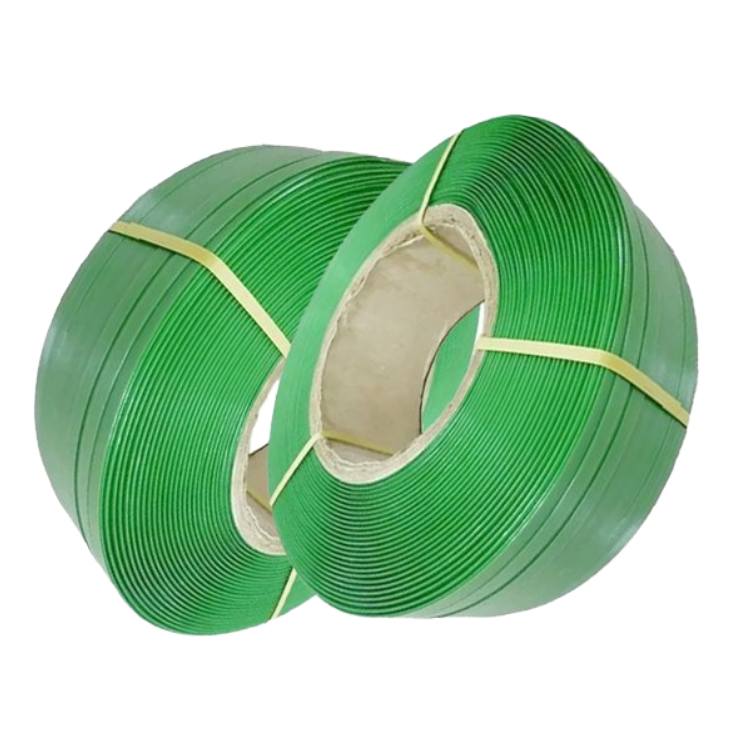
UD Packaging is an integrated industry and trade enterprise focused on plastic packaging materials. Our manufacturing base is in Jiangyin, Wuxi, Jiangsu Province, China, and our PET operation covers PET granulation through finished PET strapping.
We focus on researching and producing new environmentally friendly packaging materials. We provide one-stop packaging procurement across PET strapping, industrial stretch film, seals and strapping machines.
Manufacturing and technical handoff
At our Jiangyin factory, the PET chain runs from granulation to finished strapping. UD Packaging’s sales and technical team carries the buyer’s grade, joint, machine and handling inputs into the packaging review.
PET strapping
PET strapping is our flagship product. We review the strip, joint, equipment and load requirement as connected parts of the packaging system.
Stretch film
We supply industrial stretch film for palletized-goods protection. Film selection is handled as a converted-product decision, not inferred from resin-family data alone.
Seals and machines
We supply strapping seals and manual, semi-automatic, and fully automatic strapping machines. A professional sales and technical team provides packaging-solution customization support.
Industries in our service scope
We serve metal manufacturing, solar photovoltaics, building materials, wood, papermaking, chemical fibers, cotton textiles, agriculture, food, electronics, and tobacco. We use the load, handling and route information from each enquiry to frame the packaging requirement.
Limits of Material-Property Tables
A material-property table is useful for screening. It is a bad decision support tool when the open risk is for the product geometry, joint, time under tension, specific chemical or temperature exposure, or the entire distribution system.
Headline strength can mislead
Many buyers carry a common assumption: the strongest headline value must be the safest choice. This counter-intuitive result appears when stiffness, recovery, joint behavior or time under tension controls the outcome instead; the trade-off belongs in the test plan.
Situation
Why the table stops short
Better next step
Different test standards
Specimen and procedure can change the result
Repeat under one agreed standard or keep the datasets separate
Oriented film or strap
Direction and conversion history are part of the response
Test the finished product in the relevant direction
Long-duration tension
A short tensile test does not measure creep and retained tension
Add a time- and environment-defined tension test
Joining failure risk
Resin and strip data do not measure the weld, seal or buckle
Test the exact joint made with the intended tool setting
Transit damage risk
A coupon does not reproduce package geometry or handling
Use a representative product-and-package procedure with written acceptance criteria
Grade substitution
Family names hide additive, crystallinity and process changes
Requalify the exact replacement grade and converted product
Advanced Plastic Material Properties Analytical Tools
8-Point Test Data Comparability Checker
Mark each field as matched only when both datasets identify the same basis. The result screens comparability; it does not declare one material superior.
Access ToolEngineering Stress and Strain Calculator
Enter force, original cross-sectional area, extension and original gauge length. The calculator returns engineering stress in MPa and engineering strain as a percentage.
Access ToolPET and PP Test-Field Selector
Choose the object being compared and the decision you need to make. The tool returns the evidence fields to request before ranking PET and PP data.
Access ToolFAQ: Plastic Material Properties
What are the main properties of plastic?
The main groups are mechanical, physical, thermal, chemical, electrical, optical and barrier properties. The right group depends on the failure mode or purchasing decision being evaluated.
What is the difference between a polymer and a plastic?
A polymer is the macromolecular material. A plastic is a formulated material that can include the polymer plus additives, colorants, fillers or reinforcement, so a polymer name alone does not define a commercial grade.
Are ASTM D638 and ISO 527 tensile results interchangeable?
No. The methods serve similar purposes, but specimen dimensions, speed choices and procedures differ, so a direct comparison requires a method-level review.
When should ASTM D882 be used?
ASTM D882 is used for tensile properties of thin plastic sheeting and film within its scope. Do not substitute an ASTM D638 result when the product form and procedure call for D882.
Why can two datasheets give different tensile strength for the same polymer?
The grade, formulation, crystallinity, specimen, orientation, conditioning, temperature, speed, method and statistic may differ. Run all 8 checks before deciding that either value represents the purchased product.
Which PET grade should be selected?
Select the grade against the required mechanical strength, chemical resistance, thermal properties, barrier properties, conversion route and product validation. A PET family label is not enough to approve a packaging material.
How do additives change polypropylene properties?
Additives, fillers, copolymer design and processing can change stiffness, impact resistance, ultraviolet response, color and long-term behavior. Compare the exact polypropylene grade and condition, not a generic PP average.
Is PET always stronger than PP?
No universal ranking is valid. One controlled test can show a property-specific result for named grades and conditions, while another formulation, orientation or finished-product design can produce a different purchasing outcome.
Does high elongation mean good recovery?
No. Elongation describes extension under the test, while recovery describes how much extension is regained after loading changes; creep addresses time-dependent deformation under sustained load.
Does strap tensile strength prove the joint is strong enough?
No. ASTM D3950-23 treats strapping and joining methods as distinct evidence fields, so request the exact joint result beside the strip result.
What should be included in a supplier test report?
Ask for the exact SKU and batch, sample form, dimensions, orientation, conditioning, temperature, test speed, full method, replicate count, statistic, units and acceptance criterion. Add joint and unit-load evidence when those are the open risks.
Can UD Packaging review an existing PET or PP report?
Yes. Send the report with the product requirement through the review request, and our technical team will organize the available fields around the 8-point gate and packaging evidence map.