
The polyethylene melting point describes a measured melting transition, rather than one absolute temperature for each PE product. Resin grade, crystalline structure and the test program affect the outcome. A supplier’s single number is helpful only if you know whether it represents the onset, the peak, or another reported feature of melting.
Updated October 2026
Polyethylene melting point depends on the grade and measurement. NETZSCH reports example peaks of 115°C, 127°C and 137°C for selected LDPE, LLDPE and HDPE samples. Those examples are not universal family ranges or film operating limits.
- Similar melting peaks can accompany different heat-sealing behavior.
- A melting peak, Vicat softening temperature and machine setpoint address different questions.
- Supplier comparisons require the precise grade and the same definition of temperature and history of heat treatment.
Examples here pertain to un-crosslinked ordinary PE packaging resins and identified laminates. Crosslinked products require separate treatment. Start with interpreting plastic properties for context.
Polyethylene Melting Range by Resin Family
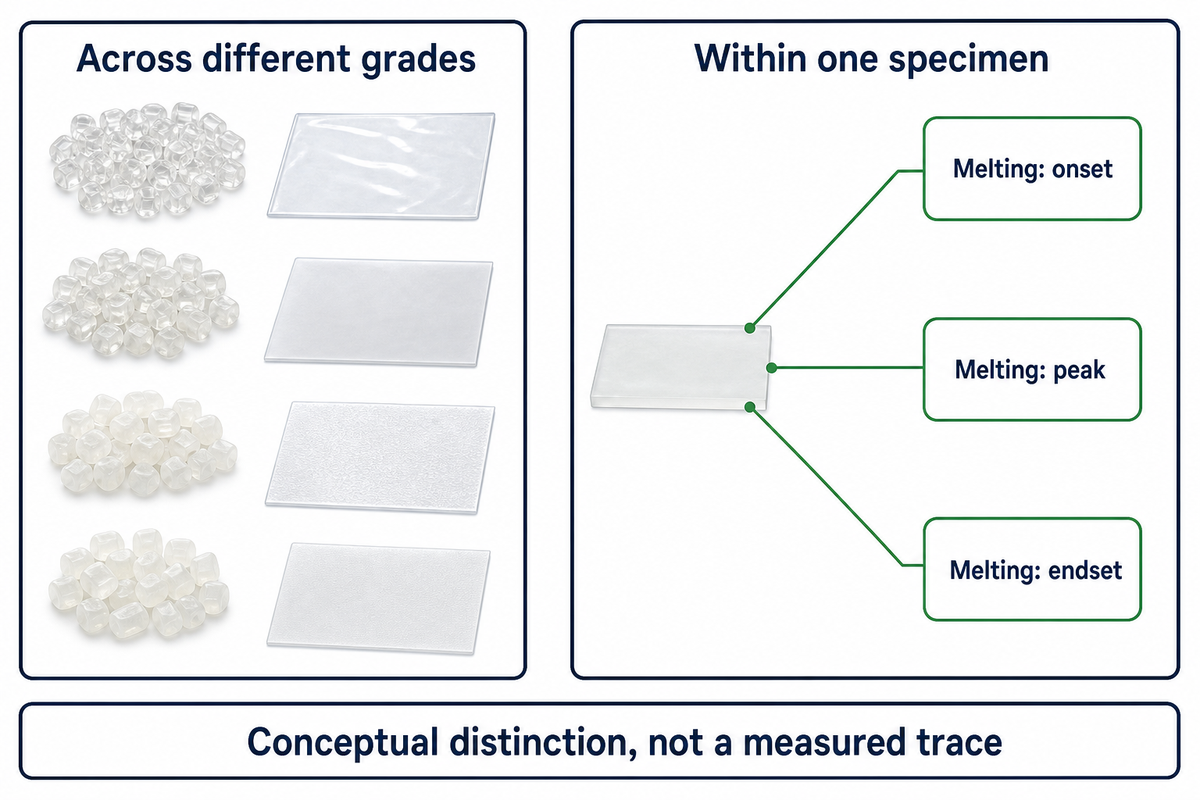
Member names of the PE family indicate molecular architecture, but a family name doesn’t indicate a melting temperature. Published examples can provide a frame of reference for comparison if their origin and samples are clear. Treat the range across different grades as distinct from the melting range of a single specimen’s heat-flow curve. The former describes variation across grades; the latter describes variation within a single specimen.
| Sample family | Reported peak | Limitations |
|---|---|---|
| Low density polyethylene (LDPE) | 115°C | One instrument example |
| Linear low-density polyethylene (LLDPE) | 127°C | Not a grade guarantee |
| High density polyethylene (HDPE) | 137°C | Not a service limit |
Source: NETZSCH’s Test Results. The instrument manufacturer lists 10 K/min heating and an 8 mg sample mass. The numbers are single-source examples.
What is the melting point of high-density polyethylene?
Britannica puts the melting point of high-density polyethylene more than 20°C higher than that of LDPE; the exact transition still shifts with the grade. NETZSCH’s selected HDPE specimen had a reported peak of 137°C. That figure is one specimen under NETZSCH’s test conditions; other HDPE grades can peak at different temperatures.
For PE melting point, ask for grade before consulting the chart of plastic melting points. A high melting point can’t identify the film construction by itself. Rather, request the original result with its temperature label, instead of filling in a missing specification based on a broad family description.
Why Density and Branching Affect Melting
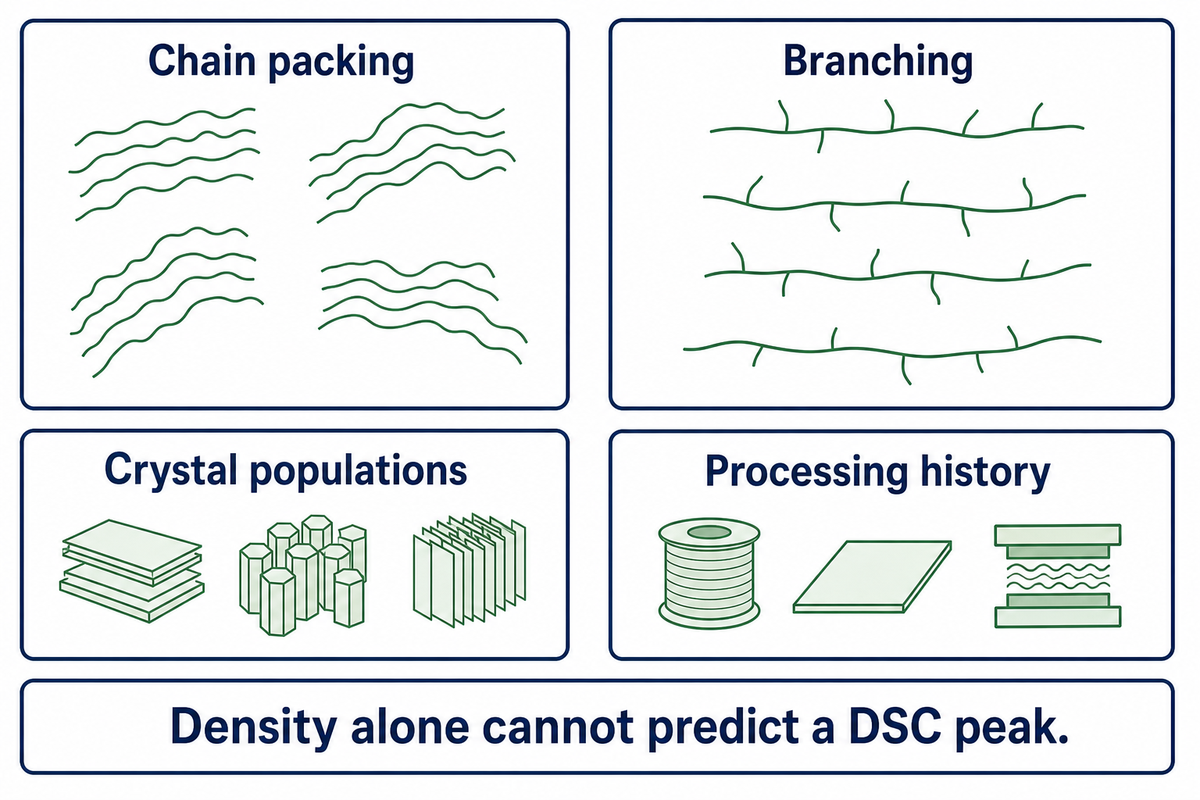
Branching affects how polyethylene chains pack into crystals, and molecular structure helps explain differences in melting behavior. Density, however, can’t predict a grade’s DSC peak. Additional factors such as crystal populations and processing history also need to be considered; selecting a resin from density alone disregards pertinent information required for a thermal comparison.
Schwab and colleagues’ 2024 review describes crystalline packing in linear HDPE chains and the disruption caused by branches. The review supplies the structural explanation, rather than measurements of the grades in the worksheet.
Polymerization of ethylene units links monomer units into chains. The effect of copolymerization and the choice of catalyst alter the architecture. Packing can be interrupted by a branch, which can also impact crystallinity. Molecular weight distribution defines another characteristic, and not a temperature scale.
Material selection requires an exact family and formulation. High molecular weight doesn’t define a peak. Ultra-high molecular weight polyethylene requires more than comparisons of packaging film.
Dow’s 608A density is 0.923 g/cm³, while ExxonMobil lists 0.918 g/cm³ for C4LL 1018.AN. They use different labels and methods to determine melting. Therefore, the two density entries can’t support a density to temperature conversion, or a purchasing rule that denser always means higher melting.
Melting Point vs Glass Transition and Softening
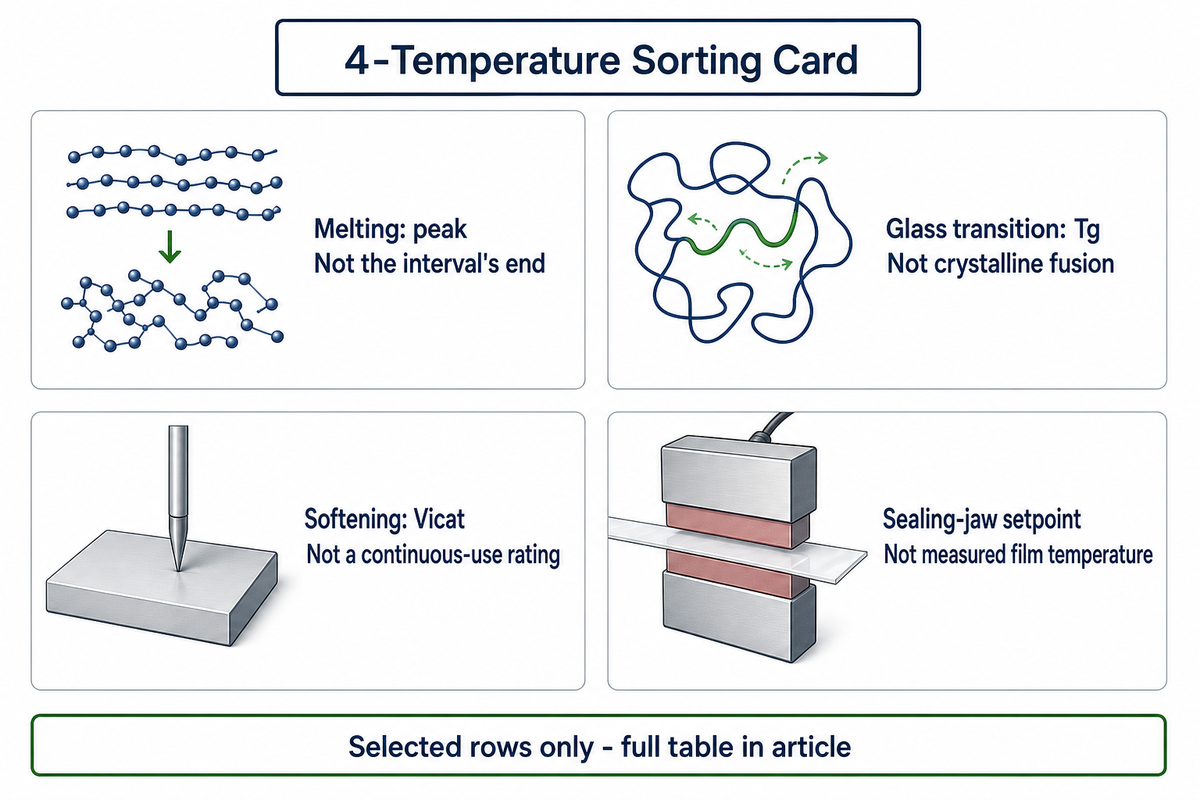
Melting concerns crystalline regions, glass transition concerns mobility in amorphous regions, and Vicat measures a defined penetration response during heating. Processing temperatures describe manufacturing conditions. Sorting these thermal properties before comparing values prevents a softening result, or machine setting being mistaken for the temperature at which crystalline material melts.
4-Temperature Sorting Card
The 4-Temperature Sorting Card classifies reported temperatures by measured event, useful decision and excluded inference.
| Group / label | Useful question | Limitations / Not suitable for |
|---|---|---|
| Melting: onset | Where does the defined melting onset occur? | Not the peak or complete melting |
| Melting: peak | Where is the endotherm maximum? | Not the interval’s end |
| Melting: endset | Where is the defined end of the event? | No numerical PE endset supplied here |
| Melting: interval | How broad is this specimen’s transition? | Not a range across resin grades |
| Glass transition: Tg | Where does amorphous mobility change? | Not crystalline fusion |
| Softening: Vicat | When does specified needle penetration occur? | Not a continuous-use rating |
| Process/application: melt temperature | What melt condition was used during processing? | Not a DSC transition |
| Process/application: sealing-jaw setpoint | What heating-tool setting was used? | Not measured film temperature |
| Process/application: continuous exposure | Does the finished film meet the stated duty? | Requires duration, load and acceptance criteria |
ASTM D1525-25’s public scope defines the needle-penetration endpoint. For other thermal and mechanical property families, keep heat deflection temperature distinct too; its label is not interchangeable with Vicat.
Procurement Scenario Illustrated. A buyer receives Dow 608A’s 113°C melting entry beside another quotation marked only “softening.” The cheaper quotation appears to offer a lower melting point. Before rejecting it, the buyer sorts the labels, and asks which property the second number represents. Finance can keep both offers under consideration while quality requests the missing method. No temperature difference has yet established inferior material. The buyer gets a useful purchase outcome by correctly interpreting the comparison, followed by film evidence for the intended duty, instead of a price premium paid for a number measured in a different way.
ExxonMobil’s C4LL 1018.AN datasheet separates its 120°C peak melting temperature from a 97.0°C Vicat value. Its blown-film example uses a 202–213°C melt temperature. Those three entries belong to one named resin record, yet represent a thermal transition, penetration response and processing condition respectively.
Read a Polyethylene DSC Curve Correctly
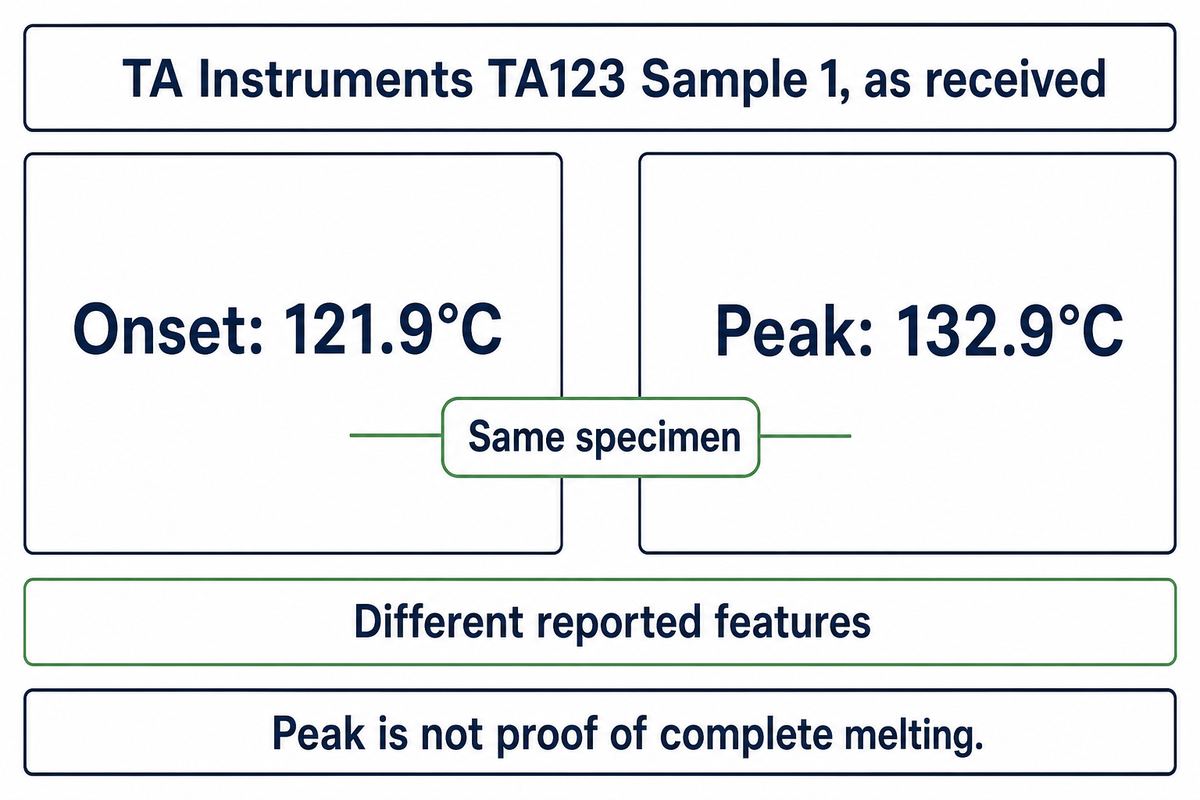
Differential scanning calorimetry records changes in heat-flow during a specified temperature program. A polyethylene melting peak marks the maximum of a melting endotherm, and onset and endset define the boundaries of the endotherm, according to analysis conventions. Ask which feature supplies the reported value before treating two thermal analysis curves as demonstrating a material difference.
In Bamps et al.’s film study, onset was the intersection of a peak tangent with the extrapolated baseline. The authors used second heating. At the peak maximum some crystalline material is still melting; the endotherm runs on to its endset.
A shoulder also requires cautious interpretation. The NIST record of Jin et al.’s 2017 research provides evidence of several HDPE melting peaks following a complex thermal treatment. The combined Raman and DSC results were consistent with lamellae of different thicknesses. In the absence of other information, the presence of multiple peaks doesn’t necessarily indicate multiple types of materials or contamination.
Request the trace and sample description before accepting a filler, blend or foreign-polymer explanation. For a coating or laminate, identify the tested layers. One unexplained shoulder isn’t sufficient grounds to reject a delivery.
TA Instruments’ TA123 mentions 121.9°C and 132.9°C as the onset and peak, respectively, of its as-received sample 1. Both of these values pertain to the same sample. A report that quotes either of these values, in the absence of labeling, can lead to a conflict even before issues related to grade identity or laboratory conditions come into play.
First and Second Heating: What Changed?
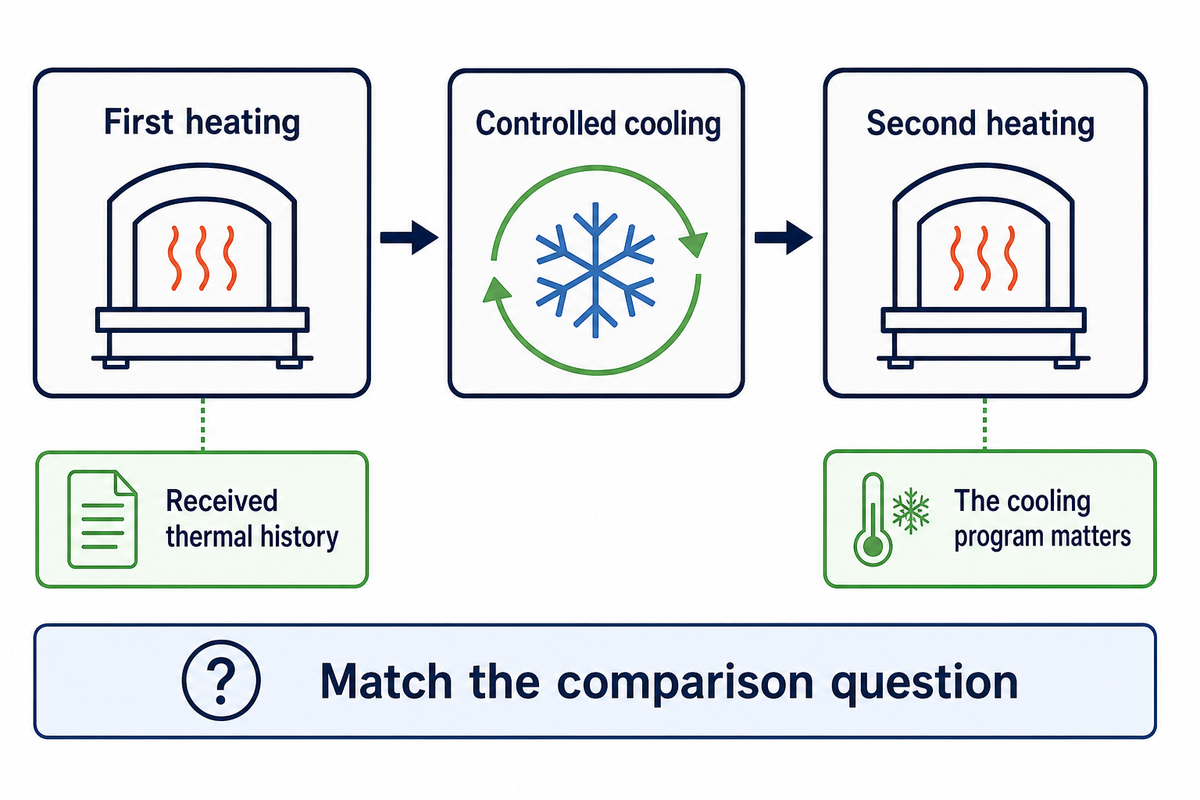
First heating retains information about the thermal history of the sample received. Second heating examines the material after the instrument has enforced a cooling program. A change in peak can happen due to a change in the history of crystallization. The comparison depends upon whether the question is related to the received film or the materials that have been subjected to the same sequence in the laboratory.
NETZSCH’s example used controlled cooling before comparing second heats. This approach doesn’t make second heating independent of cooling rate. If storage or the production process is being investigated, preserve the first trace together with the specimen conditioning history.
- Identify the comparison question. Choose received-film behavior or a matched laboratory history.
- Collect both programs. Record heating, cooling and reheating conditions.
- Align the reported feature. Compare the same onset or peak definition.
Illustrative quality scenario. A quality reviewer receives an incoming-film first scan and a supplier’s second-scan certificate. The purchasing team wants an immediate pass/reject since the supplied materials match the names. The reviewer leaves the shipment comparison open and requests the missing cooling and reheating program. Engineering determines if received-film history or a common thermal history is the deciding question. In the absence of other evidence, discarding first-scan data and treating unlike cycles as equivalent is not justified. No conclusions can be drawn from the difference in these two results alone as to the possible presence of recycled content or degradation. Either could be legitimate depending on additional evidence.
TA123’s Sample 1 changes from 121.9/132.9°C onset/peak as received to 119.9/132.7°C after a common thermal history. In this case, onset change is more than peak change. Capturing both features of the change allows a more informative comparison than capturing whether a single “melting point” moved.
ASTM D3418 and ISO 11357-3: Match Test Conditions
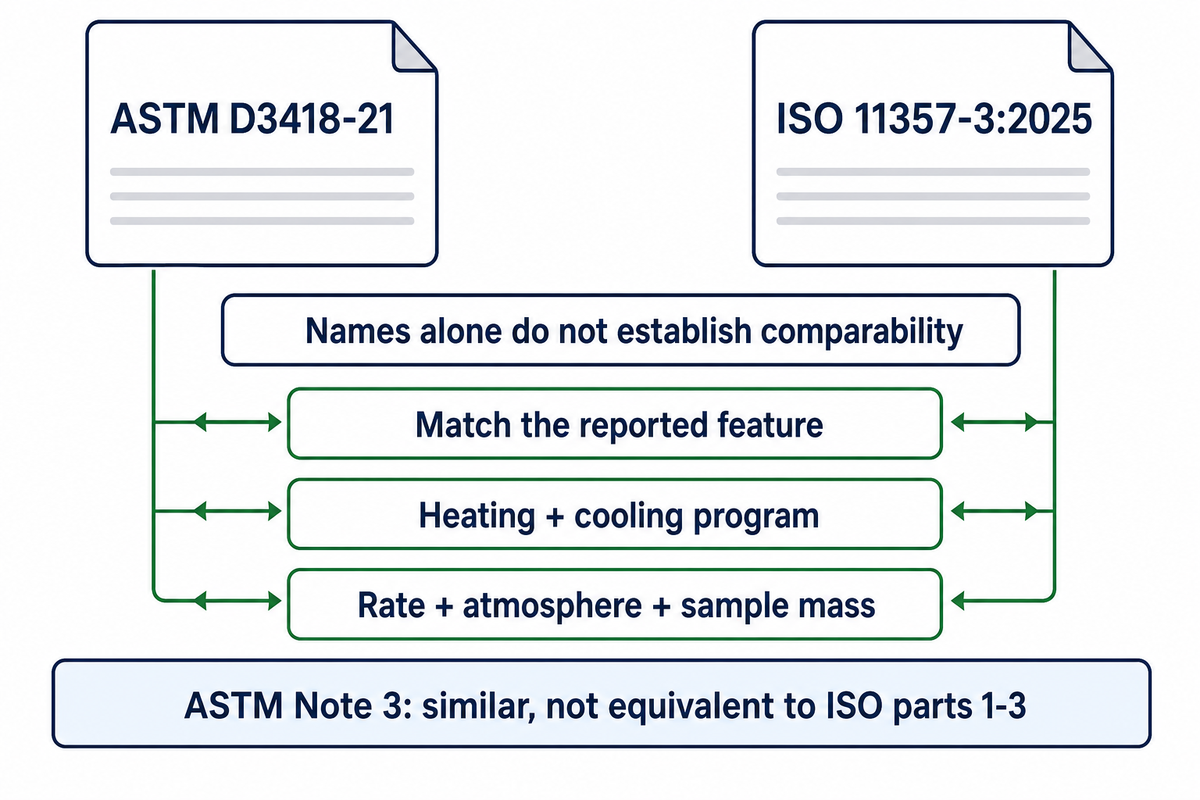
ASTM D3418 and ISO 11357-3 provide frameworks for thermal-transition measurement, but the names alone do not establish comparable results. A useful report states the edition referenced, the specimen, and the reported temperature feature, as well as the heating and cooling programs. A matching acronym cannot resolve an unstated difference between first and second heating.
As checked in October 2026, ASTM lists D3418-21 as Active. Its publicly available scope covers transition temperatures and fusion/crystallization enthalpies. Note 3 says the method is similar but not equivalent to ISO 11357-1, -2 and -3.
ISO 11357-3:2025 addresses conventional DSC for crystalline or partially crystalline plastics; fast DSC is excluded.
State the actual rate, atmosphere, sample mass and temperature endpoints used. The specimen and report controls guide can assist in separating a missing report field from a failed material. If both suppliers cite a standard and omit a cycle, comparison should also await that cycle.
Bamps et al. heated and cooled their studied films between 10°C and 200°C at 10°C/min, then read the second heat. Those stated conditions make the paper’s comparison interpretable. They are the authors’ experimental program and should not be construed as a generalized program for heating or cooling at a given rate inferred from the titles of ASTM or ISO standards.
How Much Heat Can Polyethylene Withstand?
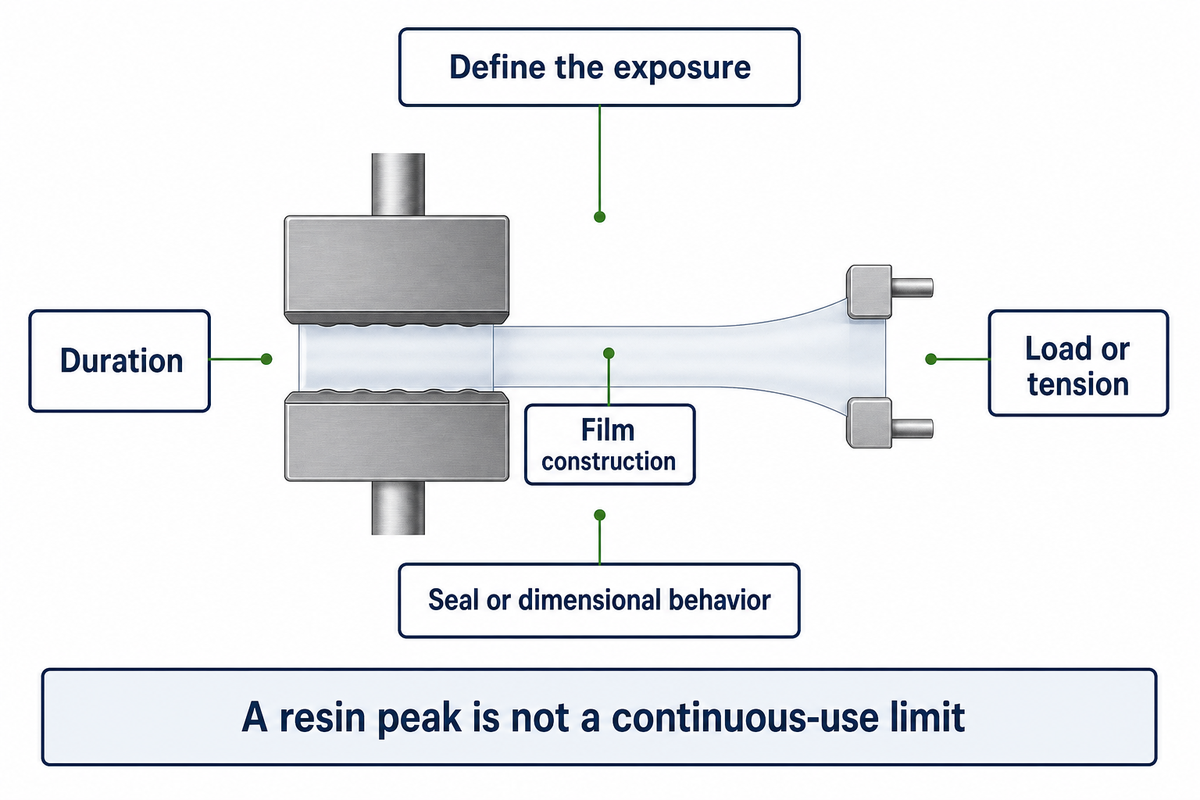
Plastics Europe says LDPE can withstand 80°C continuously and 95°C for a short time; the heat resistance of a finished film still needs defined exposure and performance criteria. For HDPE, Plastics Europe gives 120°C for short periods; a resin melting peak is not a continuous-use limit, and a sealing-jaw setpoint does not measure the whole film’s temperature. State the duration, loads or tensions and construction, and specify what the seal or the dimensions should be and what behavior should be accepted, before a temperature rating is requested.
Extrusion, injection molding and blow molding use process conditions to shape a thermoplastic. Those conditions don’t determine the temperature resistance of polyethylene products after fabrication. Engineering applications that require sustained loads also need different proof for tensile strength and dimensional retention.
Merabtene et al. (2022) evaluated PE-coated papers and an oriented polypropylene/PE laminate. They found that construction and sealing conditions affected the behavior of the samples.
“each material behaves differently and requires different sealing conditions.”
Does a higher softening point require more heat to seal?
Not necessarily: a higher softening point alone does not set the sealing temperature. The seal-layer composition and the finished construction need their own evaluation. Bamps et al.’s PET-containing films illustrate the problem: films 1 and 2 had melting peaks of 112°C and 113°C, but hot-tack initiation temperatures of 105°C and 90°C respectively.
The hot-tack comparison in the paper used 1.0 s sealing, 0.3 N/mm² pressure and 0.1 s cooling. Those conditions need to be considered with the results. Neither value provides settings for a different film.
Illustrative engineering scenario. A packaging engineer examines a substitute film with comparable resin peak. The goal is to not have to change the existing jaw setting and move to mass production. The engineer looks at the construction of the seal layer, considers dwell time, examines the pressure and temperature records, and requests data and evidence on the seal strength and potential leakage under the conditions of use. Quality checks the film direction and orientation which impacts dimensional behavior. A purchasing saving is possible, but an unchanged peak doesn’t justify an unchanged process. The response of the finished package should dictate the decision, rather than a thermal number borrowed from resin pellets.
Packaging films for different application areas require different acceptance tests. Temperature control at high temperatures can’t establish toughness or elasticity in cold storage. Impact resistance, thermal stability and chemical resistance also require evidence. To improve product quality, define the failure being prevented, before choosing the test.
Industry Outlook: Compare PE Datasheets Before Choosing a Film Grade
ISO’s publication of the 2025 edition of ISO 11357-3, replacing the withdrawn 2018 edition, gives buyers a concrete reason to check report versions. Update the comparison fields before requesting new results. An older edition reference needs clarification; it does not alone prove that the supplied polyethylene resin is unsuitable.
Source-Labeled PE Comparison Worksheet
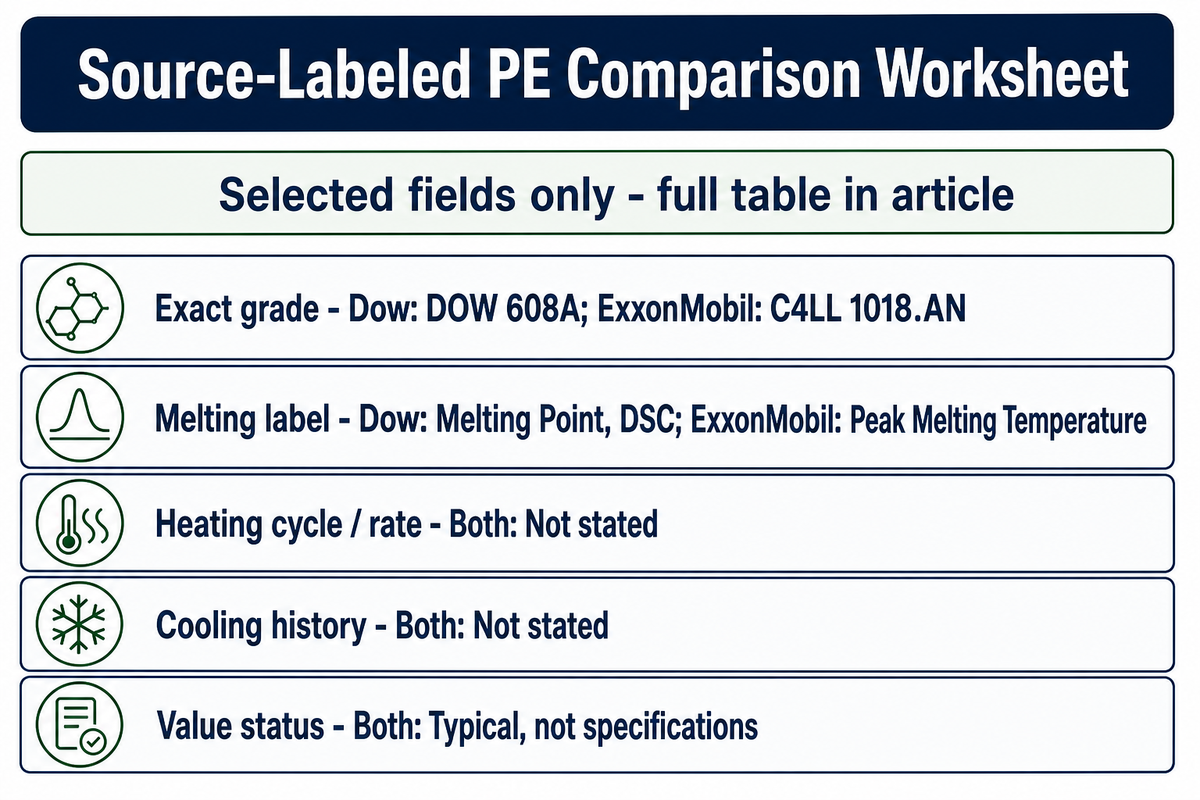
The Source-Labeled PE Comparison Worksheet separates published grade facts, missing method information and application evidence before a buying decision.
| Comparison field | Dow | ExxonMobil | Limitations / Not suitable for |
|---|---|---|---|
| Exact grade | DOW 608A | C4LL 1018.AN | Not interchangeable grade names |
| Family | LDPE | LLDPE, ethylene/1-butene | Different types of PE |
| Density | 0.923 g/cm³ | 0.918 g/cm³, ASTM D792 | No exact melting prediction |
| Melting label | Melting Point, DSC | Peak Melting Temperature | Dow does not specify peak |
| Melting value | 113°C | 120°C | Not matched-method ranking |
| Vicat value | 97.2°C | 97.0°C | Not operating ceilings |
| Melting method | Dow Method | ExxonMobil Method | Detailed methods not given |
| Heating cycle / rate | Not stated | Not stated | Ask before direct comparison |
| Cooling history | Not stated | Not stated | Do not assume second heat |
| Value status | Typical, not specifications | Typical, not specifications | Not delivery acceptance limits |
| Original record | 608A product properties | 1018.AN datasheet, 2025-01-28 | Each manufacturer reports its own data |
Procurement can copy the fields into a request; quality should resolve missing methods. Engineering should include film testing evidence for practical applications. “Not stated” indicates missing information, not failure.
Key takeaway
Choose comparable evidence before choosing between temperature numbers. A resin datasheet and a finished-film acceptance requirement are separate records.
Frequently Asked Questions
What is LDPE plastic?
Low-density polyethylene is a branched polyethylene family used in flexible products such as plastic bags.
Its branch structure affects the packing of crystalline regions. Britannica gives the melting point of LDPE as approximately 110°C, but the family name alone does not fix an exact grade or the material properties of a finished film. For a thermal comparison, obtain the supplier’s grade and measurement method, then distinguish the reported transition from the conditions used to make or seal the product.
Is polyethylene just plastic?
Polyethylene is one plastic family, not a name for every plastic material.
Different polymers and different polyethylene materials have distinct structures and formulations. Polypropylene, for example, is a separate polymer family. For industrial applications, identifying a product only as plastic leaves its thermal behavior unspecified. Start with the material identity and intended duty, then select the measurements needed to compare candidate products fairly.
What is the structure of polyethylene?
Polyethylene has a carbon-chain backbone with hydrogen atoms attached; its repeating-unit chemical formula is (C₂H₄)n.
Commercial types differ in branching and molecular architecture. A copolymer introduces another building block alongside ethylene. Ordered crystalline regions coexist with amorphous regions, so melting and glass transition describe different events. Those structural distinctions help explain the properties of polyethylene, but they cannot replace a measurement of the particular grade being purchased.
Does a higher melting point mean a better packaging film?
Not by itself: a higher melting point alone does not mean better packaging performance.
A film intended to seal at lower temperatures faces a different requirement from one evaluated at a higher temperature under load. Compare the finished construction against its intended duty.
Can recycled polyethylene have more than one melting peak?
Multiple peaks can occur, but peak count alone cannot identify recycled content or contamination.
Jin et al.’s HDPE study links multiple transitions after thermal pretreatment with lamellae of different thicknesses. A trace therefore needs the sample identity, full program and, where the question requires it, complementary analysis. Keep that interpretation separate from low-temperature performance requirements: a melting curve does not establish toughness at low temperatures. Before attributing a shoulder to a different polymer, determine whether the specimen was incoming resin, a blend or a multilayer film.
UD Packaging’s plastic properties resources may be of assistance for the next comparison to correlate the temperature label to the property the package needs.
The worksheets and illustrative scenarios synthesize public research and manufacturer records. They aren’t UD Packaging laboratory measurements or universal film service-temperature ratings.
References & Sources
- Synthesis and Deconstruction of Polyethylene-type Materials, Schwab et al., Chemical Reviews, 2024; National Library of Medicine archive.
- ASTM D1525-25: Vicat Softening Temperature of Plastics, ASTM International, public scope.
- Three-film seal-layer and contamination study, Bamps et al., Packaging Technology and Science, 2019.
- Raman Identification of Multiple Melting Peaks of Polyethylene, Jin et al., 2017; National Institute of Standards and Technology publication record.
- ASTM D3418-21: Polymer Transition Temperatures and Enthalpies by DSC, ASTM International, public scope.
- ISO 11357-3:2025, International Organization for Standardization, abstract and edition lifecycle.
- Heat Sealing Evaluation and Runnability Issues of Flexible Paper Materials in a Vertical Form Fill Seal Packaging Machine, Merabtene et al., BioResources, 2022.