Water vapor transmission rate measures water vapor through a material per specified area and time, under stated temperature and humidity conditions. A lower value means less vapor passage under those conditions. To compare packaging films, read the units, method, climate and specimen together. Converting square inches to square meters is straightforward; converting one test climate into another requires material-specific evidence.
What Water Vapor Transmission Rate Measures
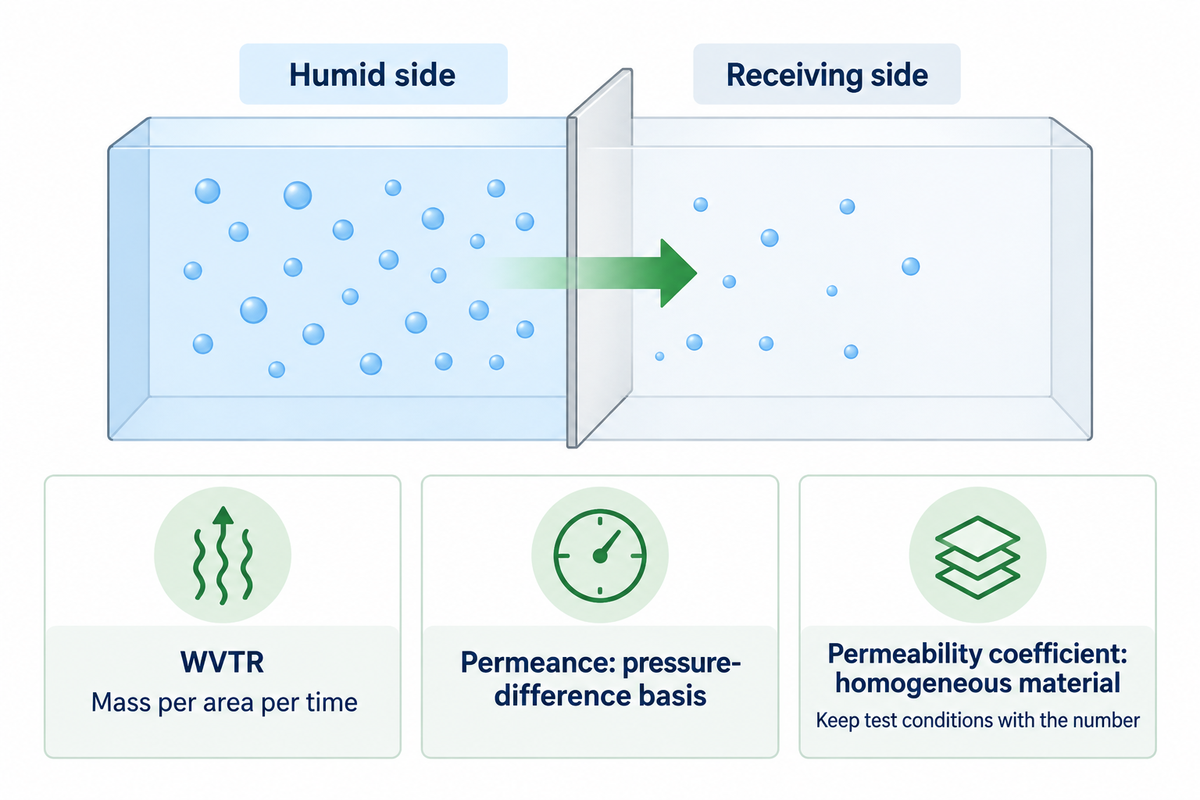
WVTR is defined as a rate of vapor movement through a barrier, usually measured in g/(m²·day). Think of it as the moisture crossing a window of film each day, rather than the water held within the plastic. Temperature, humidity difference and the tested construction belong with the number because they define the measurement.
A polymer can take up moisture through sorption while water molecules also move through it by diffusion. These help in understanding water vapor permeation. However, absorption percentages and transmission rates describe different quantities. For immersion measurements, use the separate ASTM D570 water absorption guide. The wider plastic property families also separate mechanical, thermal and barrier data.
What is water vapor permeability?
Water vapor permeability often appears as an informal name for moisture transmission. A permeability coefficient accounts for the thickness of the material and the difference in vapor pressure. Permeance describes the same thing as the previous example, but without the thickness of the material. When comparing reports, make sure to look at the quantity and the units.
ASTM F1249-25 distinguishes WVTR, film permeance and, for homogeneous materials, a water vapor permeability coefficient. Its caution matters when a quotation turns a measured film property into a general resin claim.
A buyer considering a percentage absorption result versus a g/(m²·day) result should keep both. Replacing one of the results with the other would eliminate either the moisture uptake or the measure of the passage through the specimen.
Read WVTR Units and Recalculate the Same Result
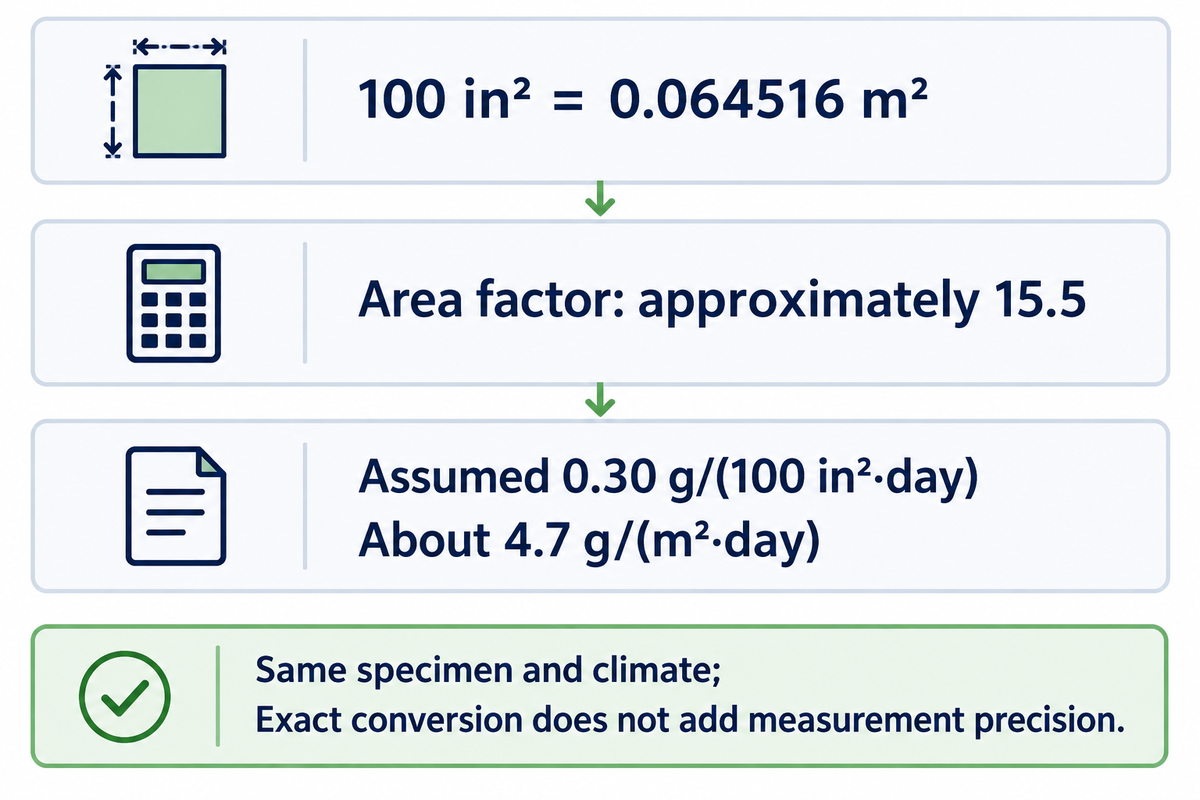
To obtain g/(m²·day) from g/(100 in²·day), multiply by 15.5 approximately, and keep the test conditions the same. This area conversion keeps the same result, but changes its expression. This doesn’t alter temperature, relative humidity, film thickness or the uncertainty of the original measurement.
The 15.5-to-1 Area Bridge is based on the NIST definition of an inch, in which 1 in = 0.0254 m exactly. Therefore, 100 in² = 0.064516 m², and the reciprocal is 15.500031…. A small reporting area produces a smaller mass-per-area number, even when the film is unchanged.
Unit and quantity checks: calculation examples, not measured film benchmarks
Given entry
Equivalent or calculation
What stays fixed
1 in
25.4 mm exactly
Length definition
100 in²
0.064516 m² exactly
Exposed area
1 g/(100 in²·day)
15.500031… g/(m²·day)
Climate and specimen
Assumed 0.30 g/(100 in²·day)
About 4.7 g/(m²·day)
Original reporting precision
1 mg/(m²·day)
0.001 g/(m²·day)
Area and time
1 g/(m²·hour)
24 g/(m²·day)
Same rate over time
1 mil film gauge
25.4 µm
Thickness, not transmission
Assumed 0.060 g over 3 days
0.020 g/day mass slope
Steady-state interval
That slope over 0.010 m²
2.0 g/(m²·day)
Exposed area and conditions
The final two rows assume a steady state gravimetric mass change with a correctly sealed, exposed test area. Divide the mass slope by area: (0.060 g ÷ 3 days) ÷ 0.010 m². A different treatment would be required if the rate stabilizes only after an initial period.
Account for report precision independently from work digits. The assumed 0.30 input yields 4.6500093… on a calculator; the table displays ~4.7. Rounding depends on the possible rounding error of the original value, per NIST conversion guidance, section B.7.2. More shown digits don’t improve accuracy.
Choose a Method for the Material Being Compared
Determine the method and appropriate measurement range around the specimen. Gravimetric methods monitor mass change over time; instrumental methods rely on transmitted moisture detection by a sensor. Various methods for water vapor transmission can operate using different fixtures, ranges and procedures and share a reporting unit. A shared reporting unit doesn’t make different methods interchangeable.
Standard test methods for water vapor measurements describe specific methodologies. Select test methods for water vapor around the barrier films being purchased, rather than assuming that a breathable membrane and a very low-transmission laminate need the same setup. Laboratories measure materials using the applicable procedure and a suitable instrument.
What is the ASTM standard for WVTR testing?
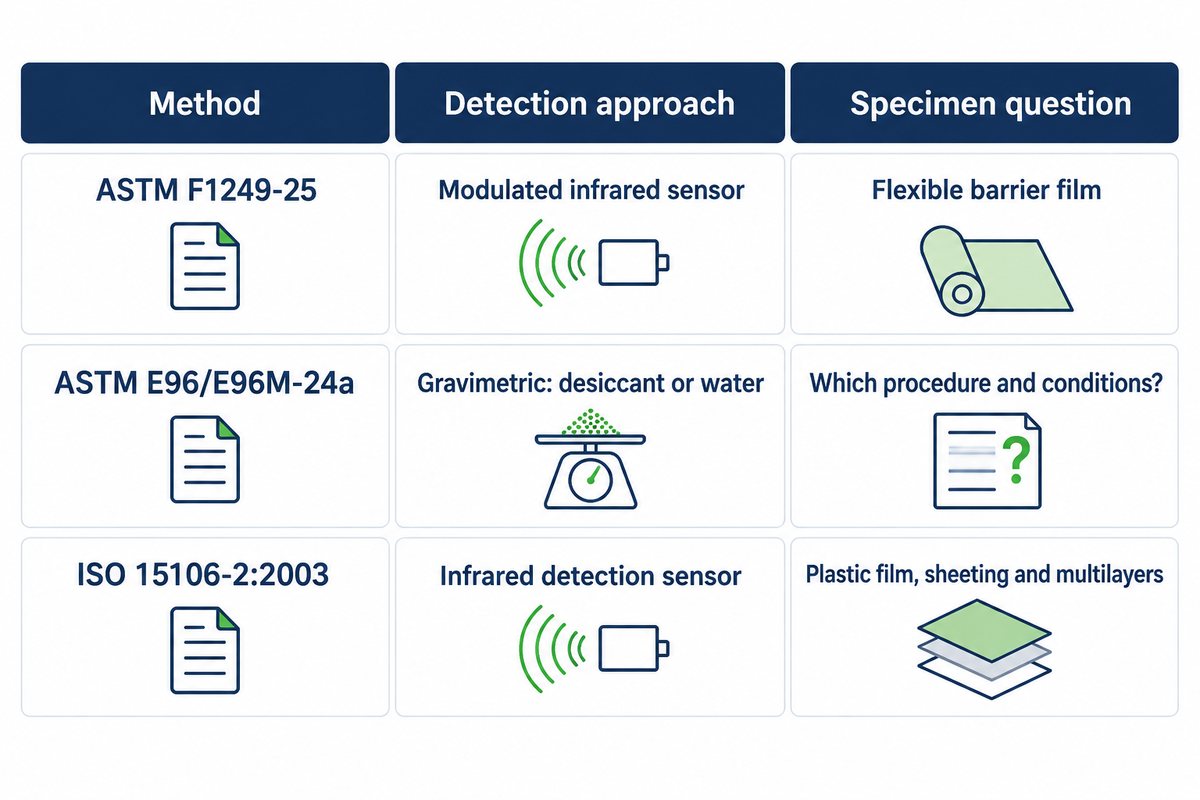
ASTM F1249 uses a modulated infrared sensor to address flexible films and sheeting. ASTM E96/E96M covers gravimetric determination across a broader material scope. The infrared-sensor method applies to sheets and films up to 3 mm thick, including multilayer and coated materials, while the gravimetric methods cover a broader material scope; neither identifier means that every laboratory used the same climate.
Publicly described method scopes, checked in October 2026
Method
Public scope and principle
Report question
ASTM F1249-25
Modulated infrared sensor; flexible barrier materials up to 3 mm, including polymer layers, foils and coatings
Was this construction within the laboratory’s demonstrated range?
ASTM E96/E96M-24a
Gravimetric methods using desiccant or water; includes films and other materials
Which method and humidity conditions were used?
ISO 15106-2:2003
Infrared detection sensor for plastic film, sheeting and multilayer structures
Does the report identify this part and its procedure?
The current public E96/E96M scope includes materials such as coatings, building materials, and plastic films. That breadth does not justify choosing a dry cup procedure without checking suitability for the particular barrier. The ISO page states the 2003 edition was reviewed and confirmed in 2023. An older publication date can still identify a current standard.
Let’s say an engineering team wants low water vapor transmission from a thin film, and the supplier only offers a generic cup-test result. Check that the proposed acceptance level for that sample sits inside a demonstrated measuring range: the ASTM infrared-sensor method, for example, was shown in its interlaboratory study to measure materials from 0.052 to 26 g/(m²·day). An inconclusive measurement range is a reason to agree on a suitable test, rather than buy on a reassuring method name.
Match Temperature and Both-Side Humidity Before Ranking Films
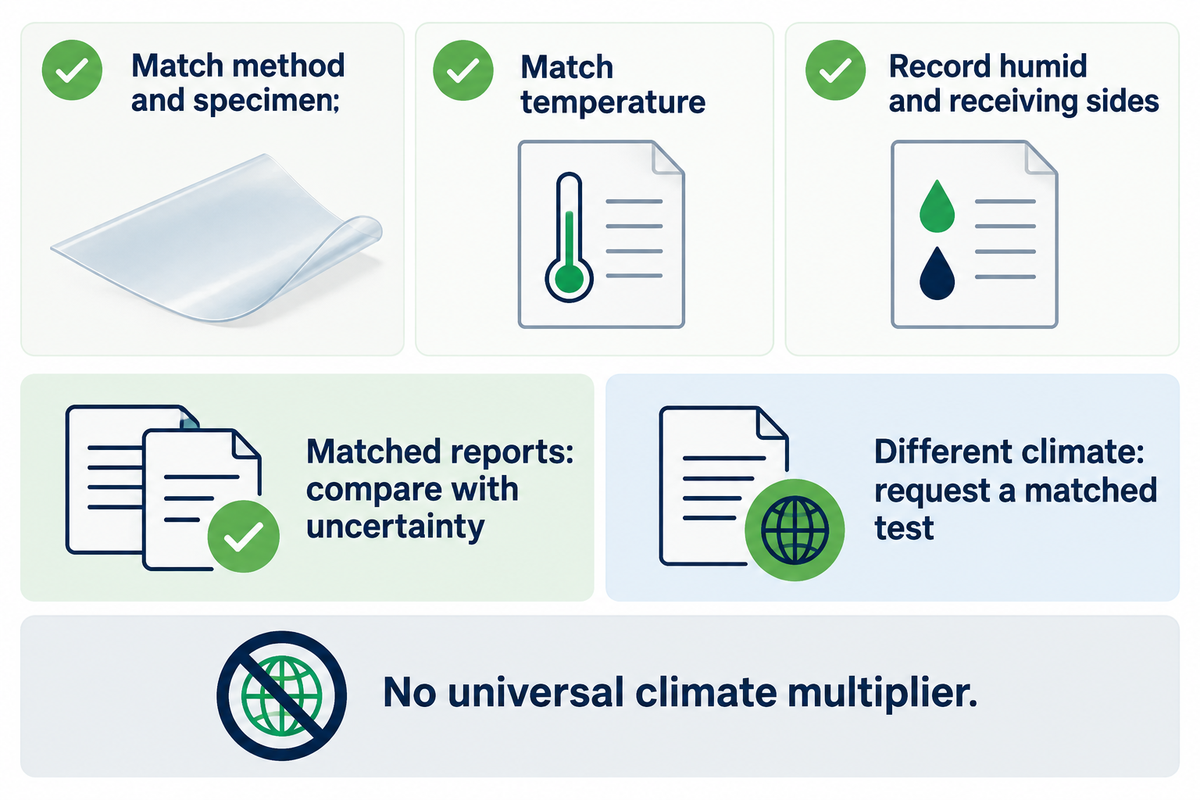
Temperature and humidity must accompany a WVTR result. Relative humidity on the humid side is only a part of the condition; the receiving side also defines the vapor-pressure difference. Even the same percentages describe different vapor pressures at different temperatures, so a change of temperature isn’t a conversion to a different area unit.
A report marked 38 °C/90% RH may use a dry receiving stream, but a catalog label alone does not establish its exact receiving-side condition. Request it. A 23 °C/50% RH result also can’t be moved to the first climate by multiplying by 90/50. Other factors, such as pressure differences and the polymer’s moisture response, also play a role.
“Values for water vapor permeance and water vapor permeability must be used with caution.”
The remainder of the note states that certain relationships, such as inverse-thickness or direct partial-pressure, may not always apply. ASTM standards provide guidelines for the named measurements; they do not provide a universal climate correction for every formulation.
Consider two hypothetical reports for the same specified construction: 1.8 and 2.1 g/(m²·day), with the same method, 38 °C, both-side RH and specimen history. Their reported rates can be compared with uncertainty taken into account prior to accepting the difference as significant. If the second result instead uses 23 °C/50% RH, keep it in a separate comparison group and request a matched test.
Compare Film Structures Without Inventing a Universal Barrier Table
Consider the actual grade and construction of the specimens offered, including its thickness and contact history. The name of the resin, e.g. polypropylene, doesn’t indicate if the coating, metallized layer, or laminate is present. The finished structure’s measured WVTR is usually more meaningful for purchase than assuming a one-thickness value from random material property data sheets.
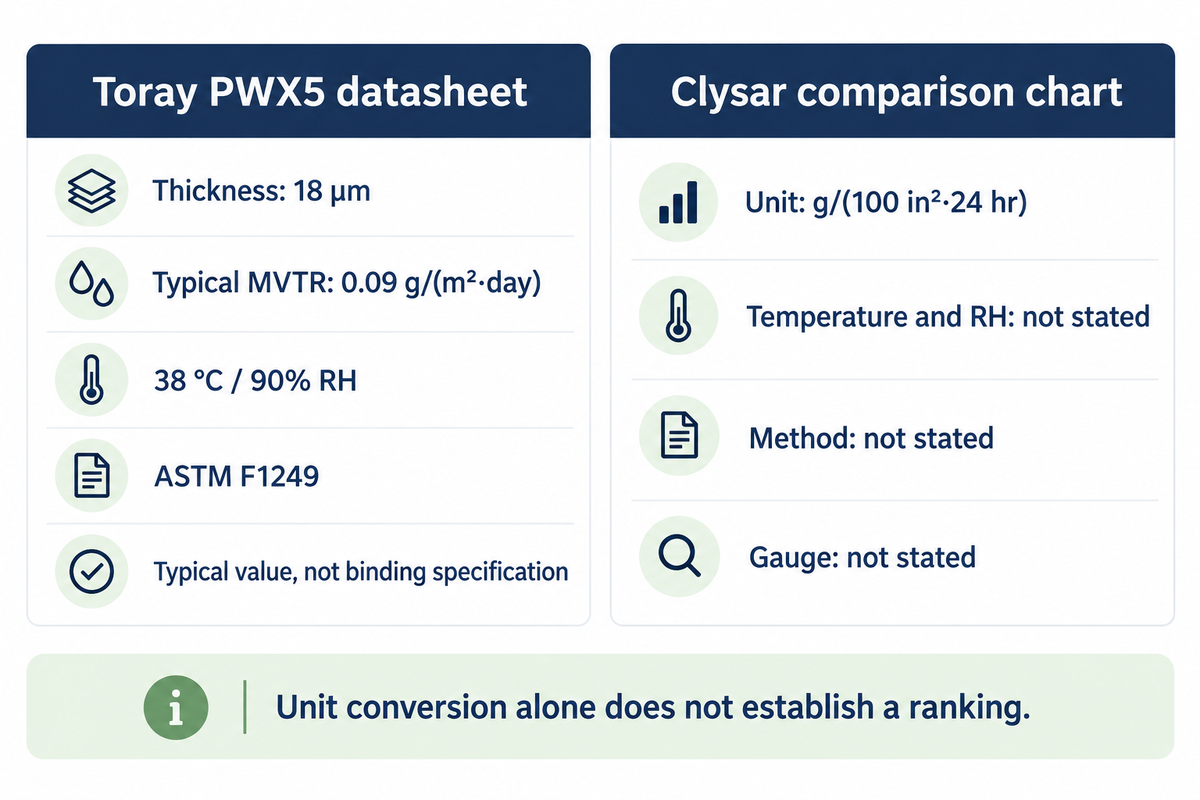
One concrete example is Torayfan PWX5. Toray’s datasheet lists an 18 µm metallized BOPP film and a typical MVTR of 0.09 g/(m²·day) at 38 °C/90% RH under ASTM F1249. Toray explicitly says its values are not binding specifications. This is a named supplier example, not a value for all biaxially oriented polypropylene film.
By comparison, Clysar’s shrink-film comparison chart uses g/(100 in²·24 hr). The chart alone doesn’t state temperature, RH, method or gauge. Changing its area units would leave those missing comparison fields unresolved. Neither document establishes which offered package gives better moisture protection for a particular product.
Homogeneous-film thickness normalization assumes a material model that may fail for a coating or metallized substrate. Poly Print’s film guidance expressly limits that normalization to homogeneous films. Don’t multiply a coated laminate’s WVTR by total thickness and call the result an intrinsic polymer constant.
Content exposure can change the material too. In a 2002 RIT thesis, Anna Romero studied three films exposed to d-limonene and observed a decrease, then an increase in WVTR as concentration rose. The experimental result supports noting the history of contact; it doesn’t provide a universal correction to other substances or films.
Check the Specimen and the Measurement Range
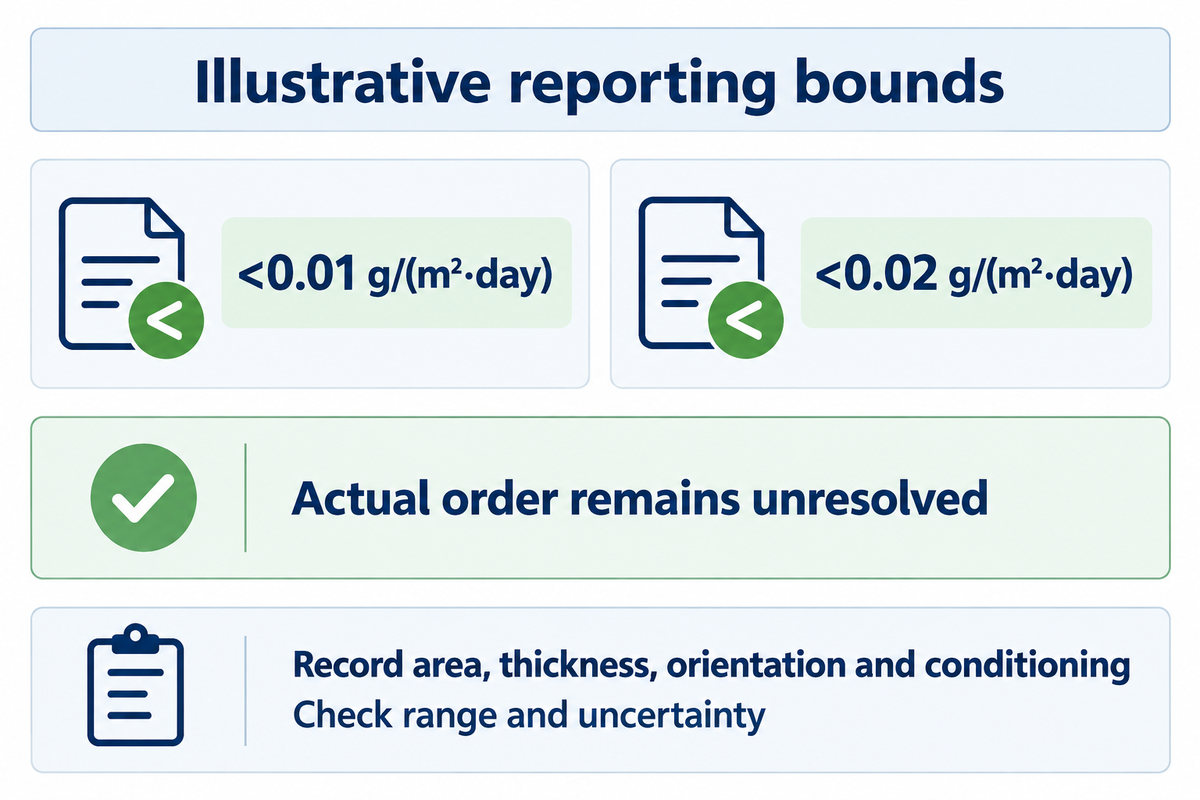
For reliable comparisons, there are several things to take into account such as usable measurements, exposed area, thickness, conditioning, humidity control, which face met the humid side, steady-state criteria and uncertainty. If a result is reported as less than a limit, keep the inequality: the number shows a reporting limit rather than an exact measured value.
For an illustrative pair reported as <0.01 and <0.02 g/(m²·day), the first report states a lower upper limit. Those entries don’t distinguish which specimen shows the lower actual transmission. Request a range that distinguishes specimens if that difference controls the purchase.
Bora and colleagues’ infrared-imaging study separated moisture behavior around sample edges from behavior through the area. Their imaging analysis excluded an edge region. Routine permeability testing must adhere to its own fixture and sealing procedure. Copying that study’s unsealed imaging arrangement would change the test.
In a public IoPP professional discussion, packaging specialist Kenneth Marsh stresses testing structures against theory, particularly thin layers. Georgia Gu points out that moisture-sensitive PA complicates a simple layer-resistance model. Michael Eastman suggests doing actual testing and checking the structures offered by the suppliers. Treat a calculation as candidate screening, then request verification on the actual construction. The film specimen and report guide is helpful in organizing records.
Translate Film Data into a Packaging Trial
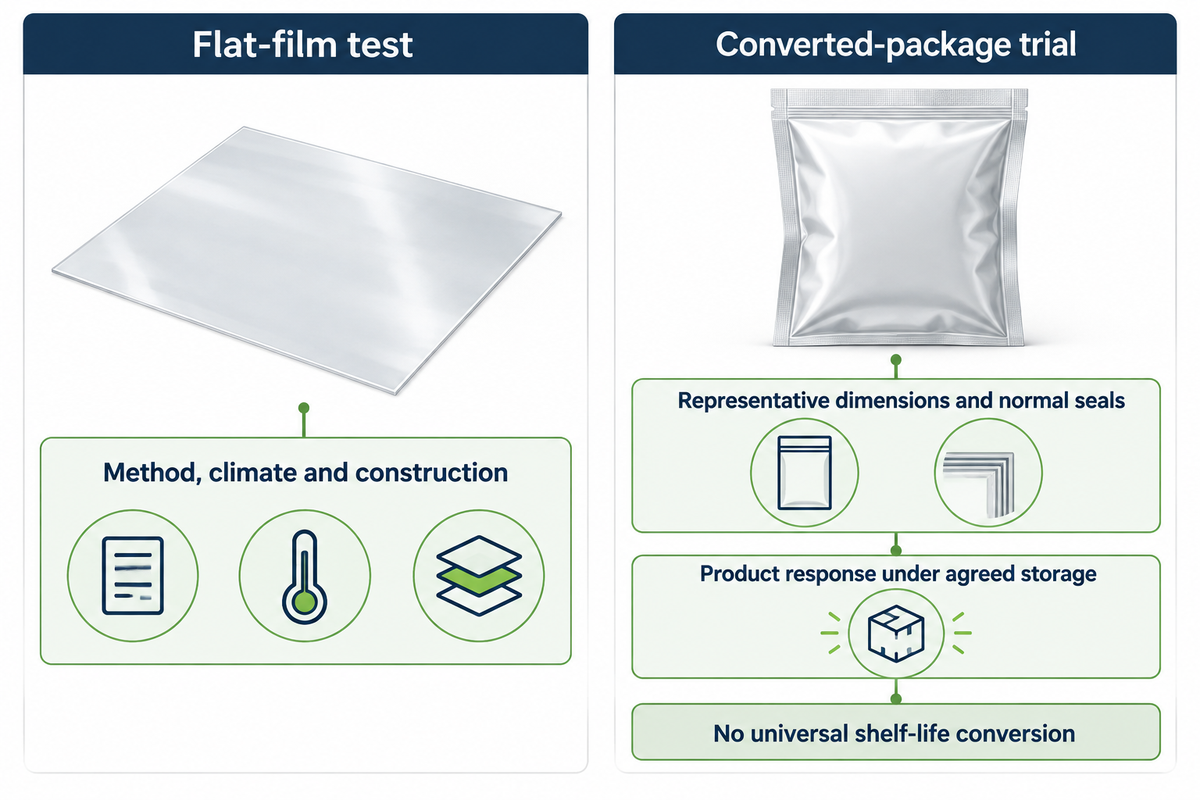
Film WVTR helps screen a moisture barrier; a packaging trial examines how the converted package and product interact. Representative seals, dimensions, storage conditions and content exposure must be used. A flat-film test does not include every route by which water vapor can enter the finished package or establish a product’s shelf life by itself.
Reinas and colleagues compared PA/PE and PVDC-coated PET/PE films with thermosealed packages of different sizes. Their abstract differentiated random leaks from the contribution of seals regularly produced in the system. Its findings concern those tested systems, not a fixed adjustment that can be added to every film result.
The barrier-testing discussion in Packaging World places transmission data in the context of the packaging system. For a moisture-sensitive dry product, the team’s next step could be a converted-pack trial that checks seal integrity and the product’s agreed moisture response over storage. If moisture can condense under the proposed exposure, include that condition in the trial discussion.
Screen comparable film data. Match the method and full exposure conditions before selecting candidates.
Convert representative packages. Include the intended dimensions and normal production seals or closure.
Check product response. Agree storage exposures and acceptance criteria for the packed product.
Ask for Comparable Supplier Data
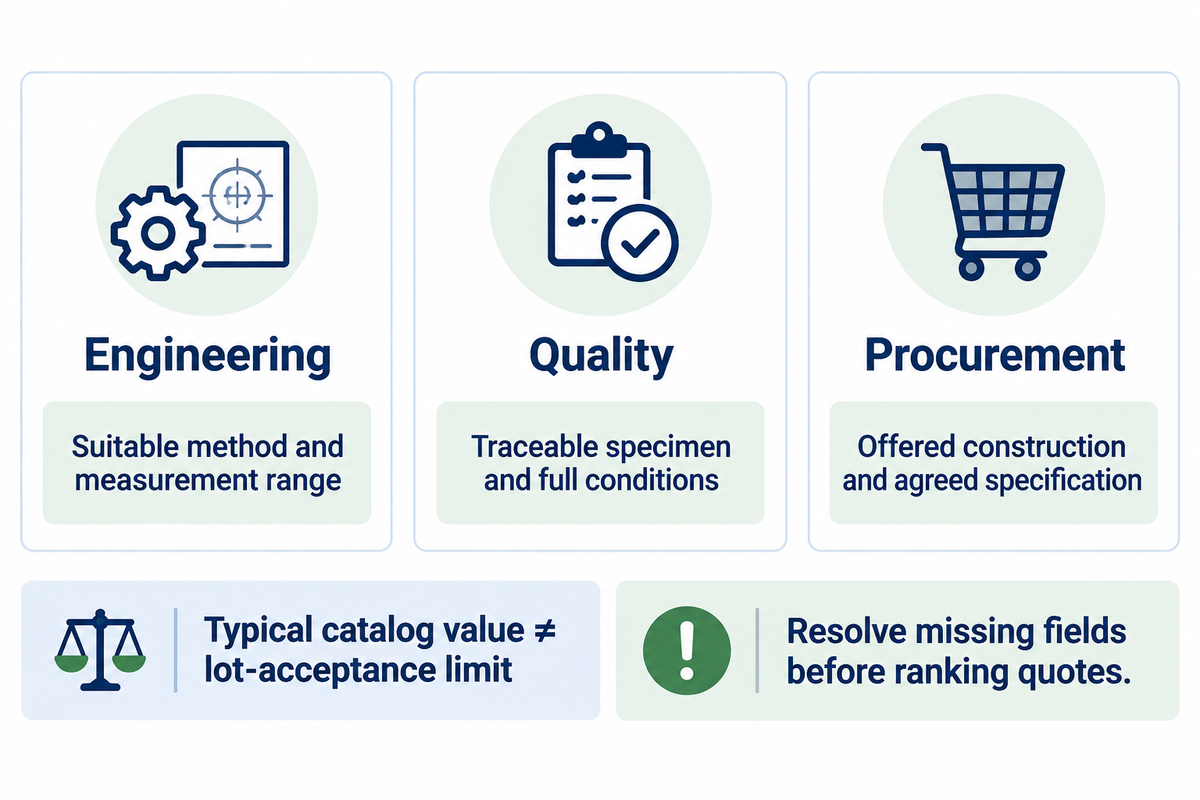
Rank quotes only after seeing the complete report. Procurement needs the offered construction and a defined specification; quality needs traceable specimens and test conditions; engineering needs a method that resolves the intended barrier level. A typical catalog value can start a discussion, but an agreed lot-acceptance limit needs its own conditions. For referee testing, the ASTM method calls for buyer and seller agreement on sampling, standardization, test conditions and acceptance criteria.
Supplier report comparison worksheet: resolve missing fields before ranking
Record field
Match or clarify
Action when missing
Reported quantity
WVTR, permeance or permeability coefficient
Ask for the quantity definition
Units
Mass, area and time basis
Convert only compatible quantities
Method and edition
Named standard and procedure
Request the test report
Temperature
Specified test temperature
Request a matched exposure
Both-side humidity
Humid and receiving-side conditions
Clarify the vapor gradient
Film identity
Grade, formulation, coating and layer structure
Confirm the offered construction
Specimen thickness
Actual tested gauge and variation
Request measured specimen data
Contact and conditioning
Storage history and product exposure
Agree representative preparation
Area and orientation
Exposed area and tested face
Clarify fixture/sample setup
Measurement quality
Range, steady state, repeats and uncertainty
Resolve an inconclusive result
Commercial meaning
Typical value or contractual limit
Agree lot acceptance separately
Use the cross-report alignment matrix to compare two reports field by field. For tensile method selection and specimen preparation, start with the plastic film testing reference. These knowledge resources assist you in drafting a clearer, more defined, and better articulated technical request to your supplier and laboratory.
Key takeaway
Compare WVTR values only after the quantity, units, climate, method and specimen are aligned. Keep the offered film’s test data separate from the finished package’s performance requirements.
FAQ
Is a lower WVTR always better for packaging?
No. Lower WVTR means less moisture permeation under the reported conditions, but the right target depends on the packed product. Compare films at matched conditions first, then consider moisture control, sealing and product response together. A highly sensitive dry product and a product that needs to release moisture can require different packaging behavior. A low catalog number alone doesn’t set the right purchasing limit.
Can a WVTR test prove a film is waterproof?
No. WVTR measures the passage of water vapor under a vapor-pressure difference. Waterproof performance concerns liquid-water exposure and may involve pressure, seams or leakage paths that the film’s vapor measurement doesn’t examine. Ask which exposure the product must withstand and choose a test for that condition. A film can resist liquid penetration while allowing vapor to permeate, so keep those requirements separate in a specification.
Is MVTR a different number from WVTR?
MVTR commonly means moisture vapor transmission rate and often describes the same measured property as WVTR. Read the underlying method, sample and units rather than assuming a difference from the initials. Two reports can use different labels for comparable quantities, or the same label for tests at different conditions. Align the reported quantity and test setup before comparing their values.
Does WVTR include oxygen transmission?
No. Oxygen transmission measures a different gas. A material’s moisture barrier result doesn’t replace its oxygen barrier result, even when both appear on the same packaging datasheet.
Can I use one value for every thickness of a coated film?
No. A coated or metallized film combines layers whose contributions cannot automatically be represented by total thickness alone. The coating, substrate and defects can affect transmission differently. Request a measurement for the actual construction and gauge rather than scaling a catalog value to every thickness. For a genuinely homogeneous film, a validated thickness relationship can be useful within its tested assumptions. ASTM F1249 still cautions that the simple inverse relationship may not always apply. If the proposed purchase changes coating weight, layer design or contact exposure, engineering should review that change before procurement treats the old result as the new specification. The comparison worksheet provides a place to record the changed construction and request its supporting test report.
UD Packaging is an integrated industry and trade enterprise focused on sustainable industrial packaging materials. Based in Jiangyin, Wuxi, Jiangsu Province, we develop and supply packaging solutions for customers who need dependable performance, practical sourcing, and clear technical guidance.
Our core range includes PET strapping, industrial stretch film, strapping seals, and manual, semi-automatic, and fully automatic strapping equipment. We use this blog to explain material properties, test logic, and packaging decisions in terms that procurement, operations, and quality teams can use.
OUR EXPERIENCE
More than a decade in plastic packaging materials, with PET strapping production and customer support across industrial applications.
OUR EXPERTISE
Material selection, tensile-property interpretation, packaging protection, and coordinated supply for medium and heavy-duty goods.