
By XCX · Updated October 2026
Properties that combine low density, stiffness and chemical resistance are polypropylene’s most attractive features, but have their tradeoffs, which are grade-dependent impact strength, heat deformation, weathering and surface adhesion. In packaging, pick a resin family and then validate the finished film, strap or molded part.
Material names are useful starting points. Poor purchase specifications. Clear films, filled moldings and oriented straps, all made from polypropylene, behave differently and so need to be considered service by service. This guide links seven property tradeoffs to attributes that are important when evaluating offers. A wider choice of polymer families can be found in our plastic materials guide.
Quick Specs
- Material: polypropylene, commonly abbreviated PP; a semi-crystalline thermoplastic.
- Typical unfilled density: approximately 0.905 g/cm³, based on the British Plastics Federation’s 905 kg/m³ value.
- Melting example: 163.61 ± 0.12°C for the virgin sample in a published 2025 experiment; not a working-temperature limit.
- Selection evidence: grade identity, finished-product report and application trial.
Numerical context: BPF’s PP overview and Zhiltsova and Oliveira, Table 3. Typical values and research samples do not guarantee the supplied product.
Polypropylene Properties at a Glance
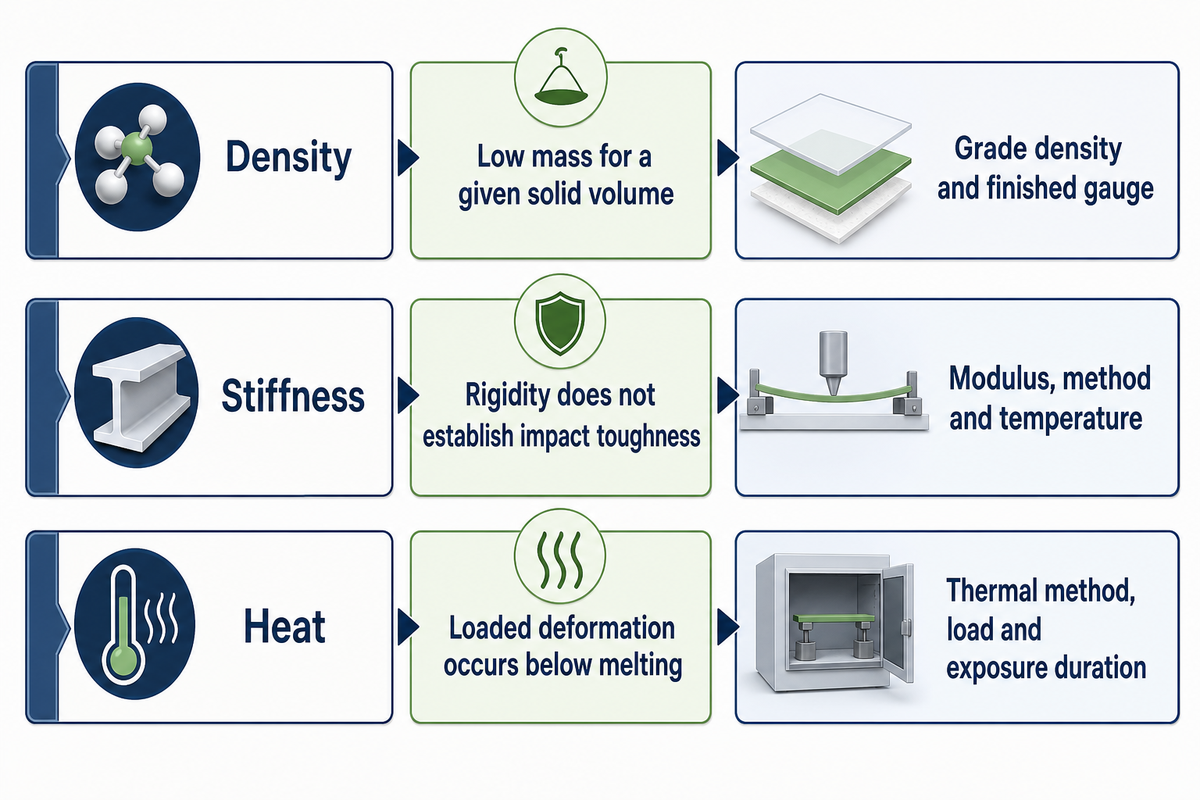
Polypropylene is a lightweight thermoplastic polymer used where stiffness and chemical resistance, and economical processing, matter. Performance depends on molecular structure, additives and orientation. Hence the comparison that matters is a named grade of a defined product form, measured under the same conditions as the alternative material.
The polymerization of propylene monomers produces PP chains. Chain arrangement and crystallinity help explain polypropylene’s rigidity; copolymerization and fillers change the balance. The versatility supports several applications of polypropylene, but also explains why one generic data sheet can’t describe every plastic product. Connecting properties and applications means verifying what a measurement actually predicts for the part purchased.
| Property | Useful characteristic | Tradeoff or limit | Ask for |
|---|---|---|---|
| Density | Low mass for a given solid volume | Fillers and construction change mass per area | Grade density and finished gauge |
| Stiffness | Shape retention in suitable parts | Rigidity does not establish impact toughness | Modulus, method and temperature |
| Impact | Can be tailored through formulation | Cold conditions can change fracture behavior | Notched or unnotched test at use temperature |
| Heat | Relatively high melting point among common packaging polyolefins | Loaded deformation occurs below melting | Thermal method, load and exposure duration |
| Chemical resistance | Useful against many aqueous chemicals | Oxidizers and specific solvents require checks | Chemical identity, concentration and temperature |
| Weathering | Stabilized grades can serve selected outdoor applications | Unstabilized PP is vulnerable to ultraviolet exposure | Stabilizer declaration and exposure evidence |
| Barrier | Useful moisture barrier properties in suitable film structures | Low water uptake does not establish oxygen barrier | Finished-film transmission report |
| Processing history | Drawing and molding tailor performance | Directions and geometry change measured properties | Product form and specimen direction |
| Traceability | Links a result to material actually supplied | A generic brochure does not identify a production lot | Grade, lot and report identification |
These are selection tendencies, not acceptance limits. The Hossain et al. review describes PP’s broad applications and its UV and bonding limitations; the exact formulation determines fitness for service.
Homopolymer, Copolymer and Filled PP Grades
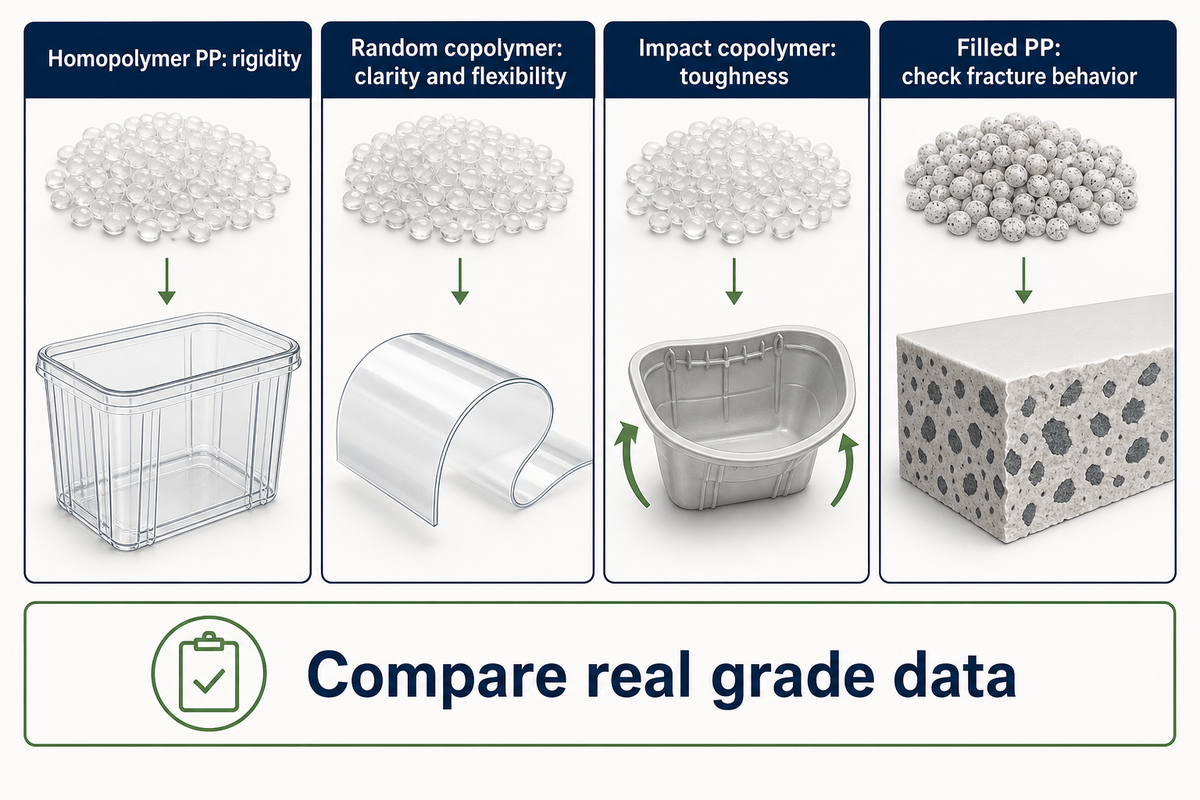
Homopolymer PP is the starting point for rigidity, and random and impact copolymers offer other balances of clarity, flexibility and toughness. Filled-grade PP requires separate consideration, because the type of reinforcement can affect density and fracture behavior. Select a family for screening, and compare real grade data.
What is the difference between a PP homopolymer and a copolymer?
A PP homopolymer has propylene based repeating units, while a copolymer has ethylene or other units. The amount, distribution, and location affect the properties. Random copolymer PP is considered for clarity and flexibility; impact copolymer PP is considered for toughness. In the BPF’s description, random copolymers typically contain 1-7% ethylene, while block copolymers incorporate 5-15% ethylene for much improved impact resistance extending below -20 °C.
Suppliers may call impact-based product families block copolymer PP. Check their exact designation. A claim of excellent impact resistance needs the test temperature, specimen condition and method. Results at 23°C can’t prove good impact behavior at −20°C.
A cold-impact balance from a filler can be different. In the study by Goto and colleagues, the increase in talc content in a filled PP shifted the ductile-to-brittle transition toward warmer temperatures. The result warrants an inquiry into the formulation, but doesn’t assign a specific transition temperature to all filled plastic.
For a molded tray, use the family around the likely failure, i.e. excessive bending, cracked corners, and loss of clarity. Have the supplier verify the family with the relevant test. A high modulus resin will only address the first of those failure modes. Different formulations of polypropylene materials are available for specific applications; the family label narrows the choice.
Polypropylene Density, Moisture and Barrier Performance
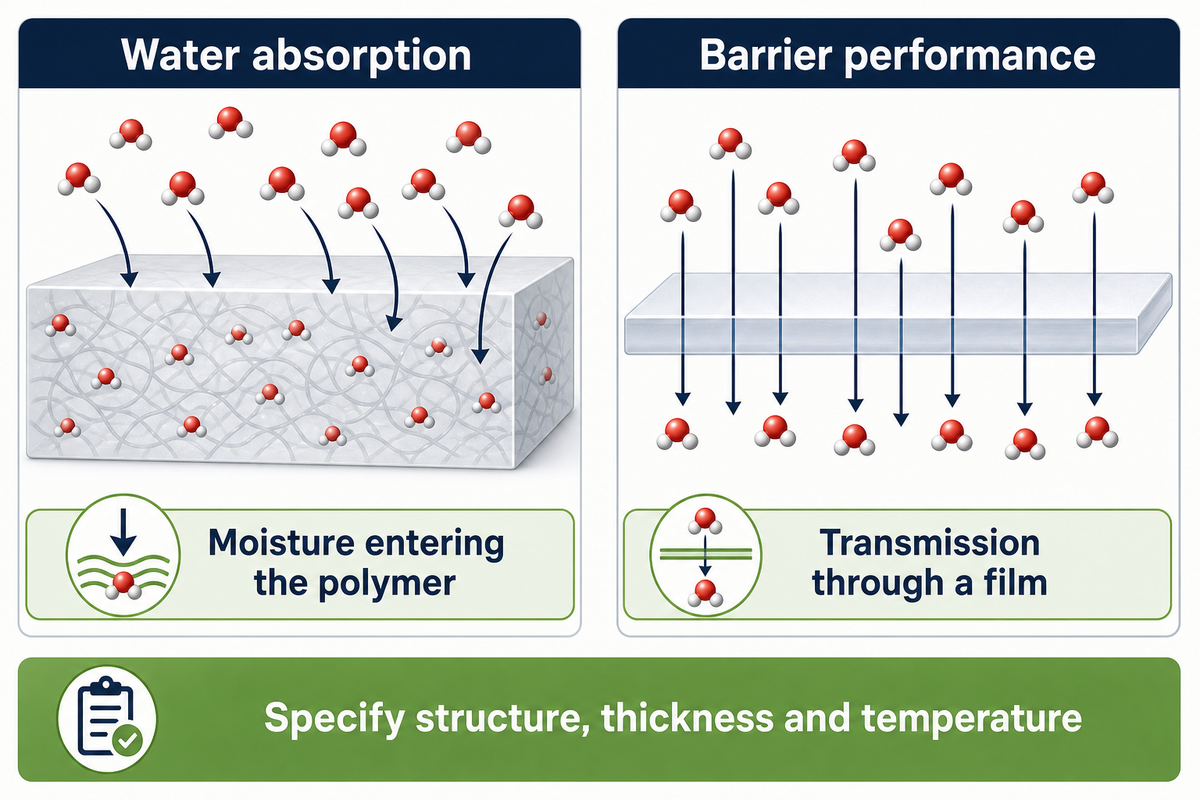
Polypropylene density is approximately 0.905 g/cm³ in the BPF’s typical material comparison. Low density can reduce weight, but film yield also depends on thickness and construction. Low water absorption describes moisture entering the polymer; barrier performance describes transmission through a film. Those measurements address different questions concerning the package.
Compare quotes by usable area as well as mass. A lower-density material at greater thickness may consume more material per package. Fillers, coatings and multilayer constructions make a generic resin-density comparison less useful. Ask for actual gauge tolerance before assuming a less-expensive price per kilogram means a cheaper wrapped load.
Food packaging also needs conditions attached to its barrier properties. Yaptenco, Kim and Lim’s film study tested 40 μm PP at 10, 15 and 17°C. Microperforated film behaved differently from non-perforated film. Its lesson for purchasing is practical: specify structure, thickness and temperature on the transmission report, rather than asking only whether PP resists moisture.
Polypropylene Strength, Stiffness and Long-Term Loading
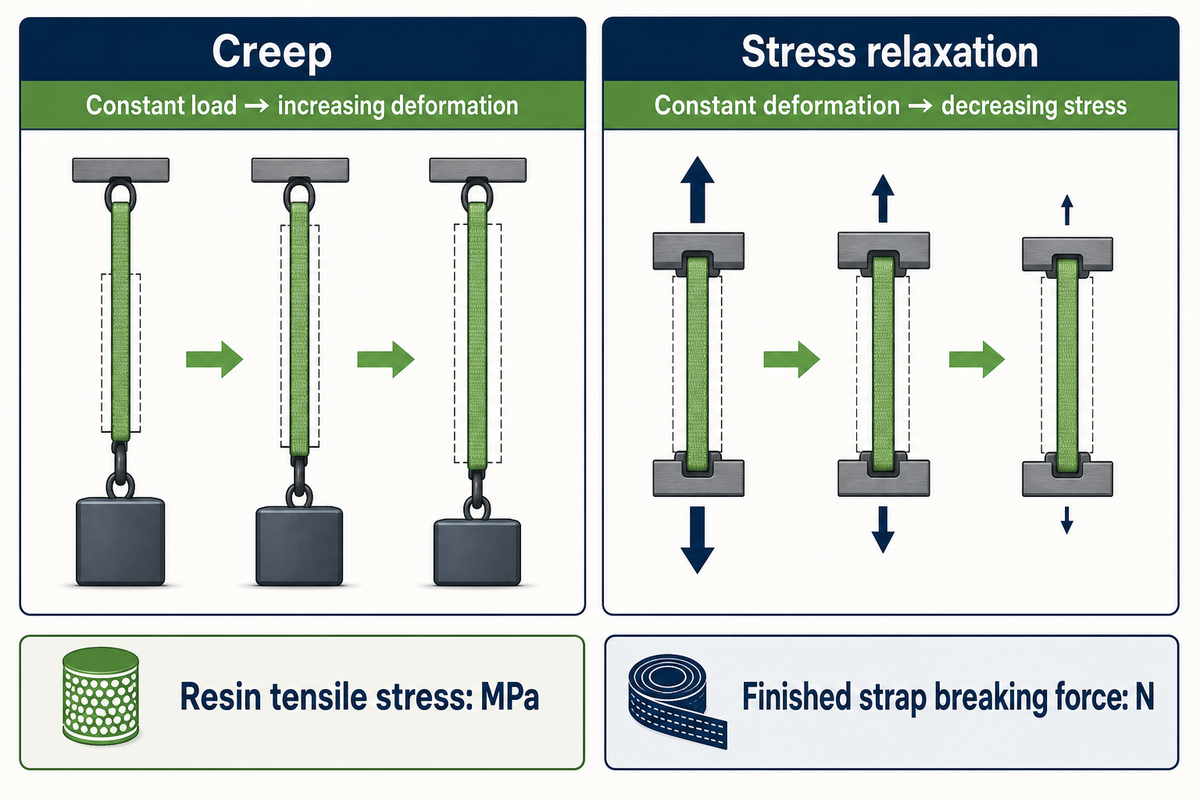
Polypropylene tensile strength, stiffness, impact resistance and creep describe different responses to loading. A tensile yield value in MPa doesn’t determine the break strength in N, or the tension after storage, of a finished strap. Compare the same property, the same specimen form and test conditions before accepting a stronger-material claim.
These mechanical properties answer different questions. Modulus is a measure of resistance to deformation in a defined test. Elongation means extension. Creep is increasing deformation under constant load; stress relaxation is decreasing stress under constant deformation. These become important when a package stays strapped for days compared to a quick laboratory pull test. To read these measurements together and understand what they mean, see our guide to plastic material properties.
For film, ASTM D882 covers thin sheeting below 1.0 mm and identifies several conditions that affect tensile results. In its discussion of stiffness comparisons, ASTM states:
“specimens of identical dimensions must be employed”
For nonmetallic strapping, ASTM D3950-23 addresses the strap and joining methods, including breaking strength and joint strength where applicable. A report on an oriented strap is thus more valuable to a packaging buyer than a molded-resin tensile value. Long-term load retention still requires application evidence.
Polypropylene Melting Point and Loaded Temperature Limits
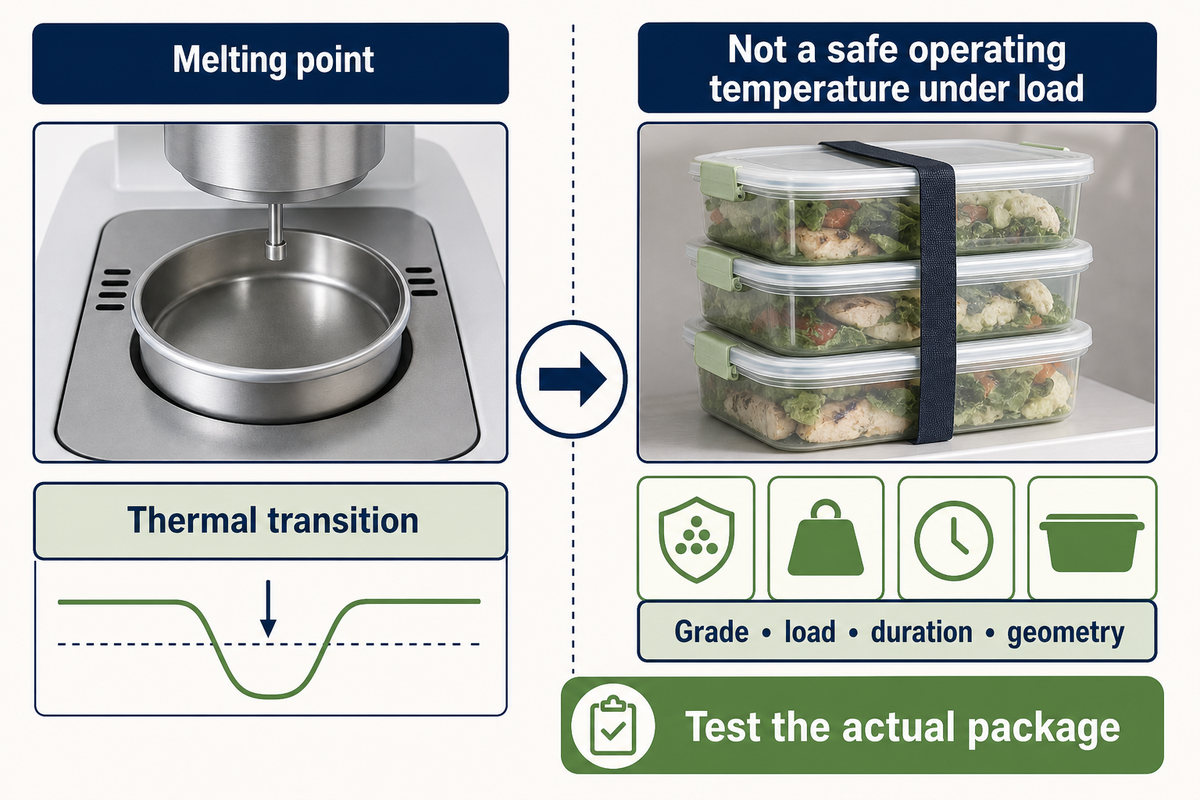
Polypropylene melting point specifies a thermal transition and not a safe operating temperature under load. Heat deflection measures deformation under particular test conditions and a service decision also depends on exposure time and product geometry. A package can lose shape and/or holding performance well before its polymer reaches the specified melting point.
What is the temperature range of polypropylene?
The British Plastics Federation lists a maximum continuous use temperature of 80 °C for typical polypropylene. At the cold end, the BPF notes a glass transition around 0 °C that brings embrittlement, which copolymerisation or rubber blending can alter; grade, load, duration and product shape set the usable limits. Thermal behavior can be evaluated by analyzing melting points, but hot filling and cold transport as well as loaded storage require separate analysis. Evidence should be provided at the actual extreme conditions that the package will experience.
A claim that PP plastic can withstand high temperatures needs to have a defined load and duration. As a thermoplastic material, PP deforms under load well below melting: the BPF’s typical heat distortion temperature for homopolymer is 105 °C at 0.45 MPa and 65 °C at 1.80 MPa.
The 2025 virgin/recycled PP experiment measured a fusion temperature of 163.61 ± 0.12°C for a virgin specimen by differential scanning calorimetry (DSC). DSC is a technique used to measure the heat flow that’s generated or absorbed by a specimen during a physical or chemical transformation.
The result doesn’t sanction a tray, seal or strap for use near that temperature.
Illustrative heat decision: The buyer believes the filled container will experience a 60°C environment for 24 hours. The supplier states a melting point of above 160°C. The buyer asks if the actual container has been tested under the stack load for 24 hours. The quality defines the allowable deformation and the operations will provide the stacking arrangement and cooling history. If those details are missing, the buyer requests a representative trial before releasing the order. The temperatures and duration in this example are fictitious, and no recommended limits are implied. No successful trial is implied.
ASTM D648 also cautions against predicting high-temperature endurance using heat-deflection results. As it says in Note 3, ISO 75-1 and ISO 75-2 results should not be compared against heat-deflection results. Matching the label “heat resistance” is not sufficient; methods should also be the same. The plastic properties comparison hub offers more options to keep methods and specimens aligned.
Polypropylene Chemical Resistance, UV Exposure and Surface Treatment
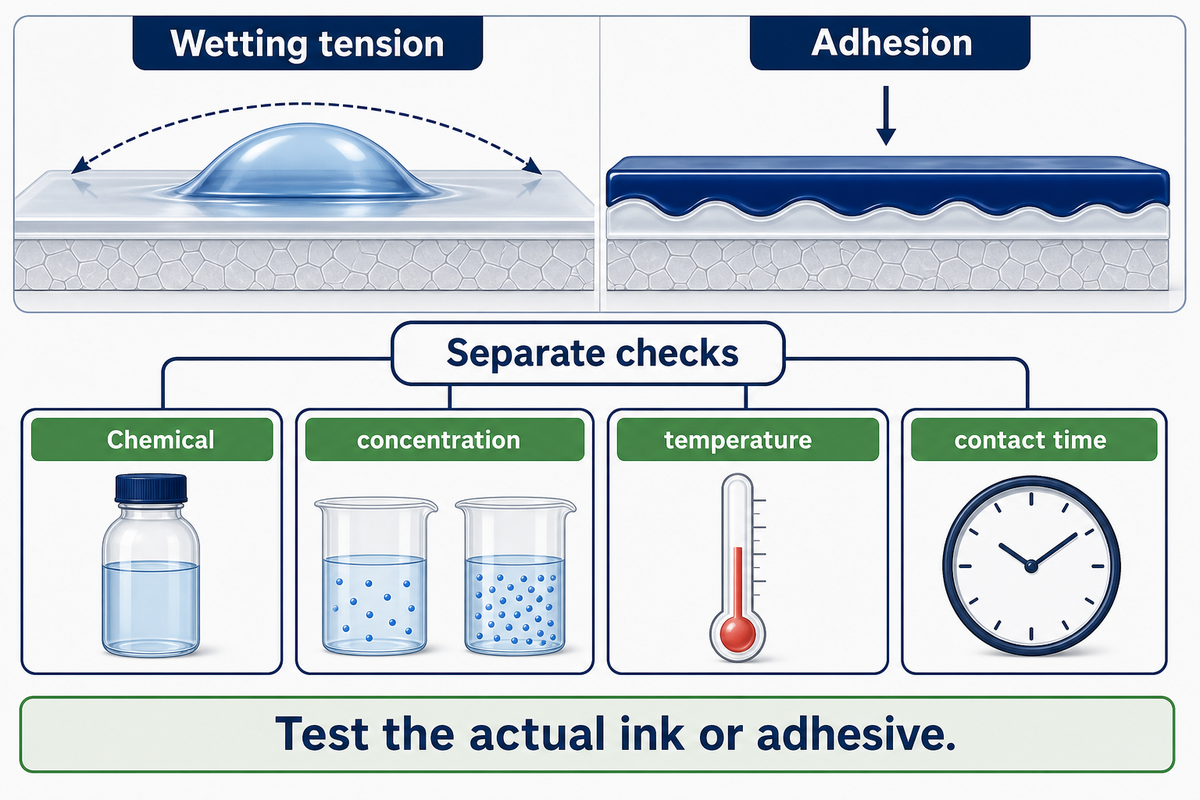
Polypropylene chemical resistance is useful in many packaging applications, but compatibility is affected by chemical, concentration, temperature and contact time. Outdoor durability is affected by stabilization and exposure. Printing adds yet another requirement. The surface must accept and retain the actual ink or adhesive, not just pass the wetting check.
When a supplier says “high chemical resistance,” there should be a check of the compatibility of the contents and the cleaning agents. These should include oxidizing cleaners and also cover accidental spills and elevated temperatures. For outdoor applications, also request which stabilized grade or additive package is provided and what’s the evidence of exposure. In general, PP descriptions can’t warrant a fixed outdoor lifetime.
Low surface energy makes printing and bonding more difficult. Improvements to wetting can be seen in corona treatment or other surface modifications, but treatment level is only part of the process. The intended ink, coating or adhesive must be tested with the supplied film using the actual storage interval and conversion conditions.
ASTM D2578-23 distinguishes wetting tension from adhesion. As a starting point, one corona-treater maker’s general guidelines list 38-44 dynes/cm for water-based inks in PP flexographic printing and 38-40 for solvent inks. Agree an adhesion acceptance test with the converter; do not copy a polyethylene threshold onto a PP order.
Polypropylene vs Polyethylene and PET
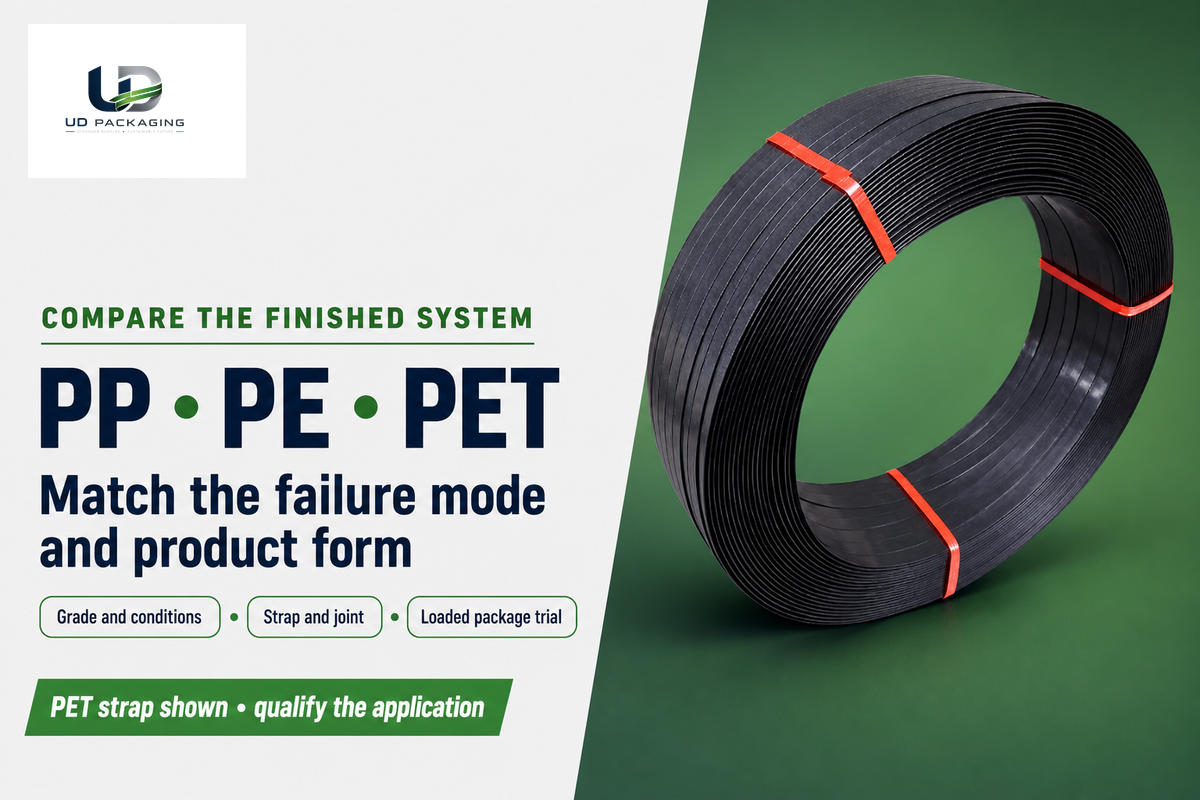
Polypropylene, polyethylene, and PET should all be compared against the same failure mode. They should also be compared against the same product form. PP may suit a rigidity-led molding, while a flexible film or a loaded strap poses different demands. Again, polymer-family rankings can’t replace the testing of the actual converted product and grade comparisons.
Which is stronger, PP or HDPE?
There’s no clear superiority of either PP or HDPE in every useful sense. Tensile yield, stiffness, impact behavior, and sustained loading resistance are some of the differences that are dependent on the grade, temperature and geometry. Say what type of failure is critical and compare reports using the same method and conditions rather than using a general ranking of strengths.
For rigid plastic parts, evaluate the modulus and impact evidence together. For flexible packaging, evaluate film thickness and direction, puncture behavior and sealing requirements. For PET versus PP strapping, request finished strap breaking force and joint performance, and evaluate the retained tension under the conditions of intended use and storage. For demanding loads, PET is a candidate, and not all packaging systems should be approved with PET.
Illustrative strap decision: A warehouse is considering two 12 mm straps for a pallet. One quote gives resin tensile stress in MPa. The other quote gives finished strap breaking force in N. The procurement team can’t evaluate or compare the two. The quality team requests both suppliers to provide the actual thickness of the strap and give the test method and joint result. The operations team identifies the tensioner and seal or weld arrangement. The buyer then compares matched reports and arranges a loaded pallet test. The 12 mm width is an example only and isn’t a recommendation. The scenario demonstrates no load capacity.
The jointly useful reference is product scope in ASTM D3950, which includes non-metallic strappings and jointing methods. It gives the package usage as a reference, not an unconnected resin number.
Polypropylene Film and Strapping: A Specification Checklist
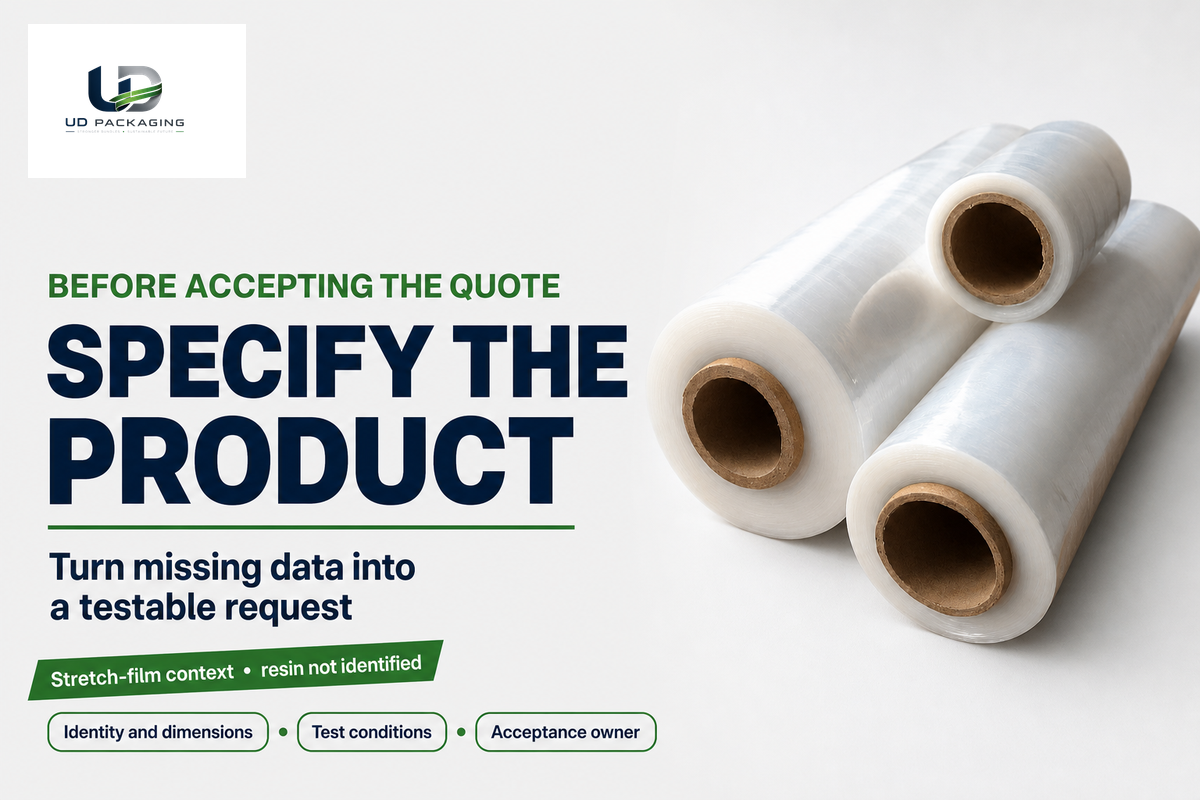
A helpful polypropylene specification describes product form, dimensions, test conditions and application acceptance. Film buyers need direction, barrier and sealing evidence; strap buyers need breaking, joining and machine-compatibility evidence. Assign each missing item to a supplier or internal owner so a quotation can become a comparable, testable offer.
PP serves various industries in various ways, depending on their qualification needs. The packaging industry uses it in containers and films. The automotive industry uses it in selected grades in automotive components. Injection molding produces containers and living hinges. Extrusion produces films and other profiles. Electrical insulation properties support selected housings in industrial applications. Those insulation properties, similar to durability requirements for automotive parts, depend on the formulation. A grade described as suitable for medical applications requires product-specific qualification before any medical-device claim can be accepted.
| Required field | Film example | Strap example | Owner / missing-data action |
|---|---|---|---|
| Product identity | Uncoated PP film; identify orientation | PP strap; identify grade and lot | Supplier: resolve before comparing offers |
| Nominal dimension | 40 μm thickness | 12 mm width; thickness pending | Procurement: obtain tolerance and missing dimension |
| Mechanical report | Direction-specific tensile results | Finished-strap breaking force | Quality: require method and specimen details |
| Orientation / surface | Machine and transverse direction; treated side | Surface and embossing declaration | Supplier: identify actual supplied construction |
| Joining | Seal-layer construction and lab seal data | Proposed joint and compatible equipment | Operations: confirm on the intended machine |
| Critical endpoint | Adhesion or seal integrity as applicable | Joint result and retained tension | Quality: define acceptance separately |
| Exposure | Contents, temperature and storage interval | Load, duration and transport environment | Operations: supply actual route conditions |
| Recycled content | Declared blend and change-control process | Declared formulation and batch evidence | Supplier: document changes before substitution |
| Release evidence | Representative conversion trial | Representative loaded-pallet trial | Quality: hold release until criteria are met |
Film reports must distinguish machine and transverse directions. For the tensile test, use our thin-film tensile testing guide to develop comparable requests.
Illustrative film decision: A converter is using 40 μm PP film to make printed pouches for a sample run. The wetting check looks acceptable, but the buyer still needs ink adhesion and sealing evidence. Operations records the treated side, storage interval and machine settings. Quality separates the questions: does the ink remain attached, does the seal carry the required force, and is the finished pouch continuous at the seam? Procurement keeps the order conditional until the missing results are supplied. This is a suggested sequence for a film decision; this doesn’t state that the film has passed or failed the test. The nominal thickness by itself doesn’t answer these questions.
ASTM F2029-16(2021) presents techniques for preparation of heat seals in a laboratory. It does not cover hot tack, seal continuity, or validation of the production equipment. Keep these separate on the trial sheet. One favorable result from the laboratory test does not replace the entire package process.
Who Should Supply Polypropylene Test Data
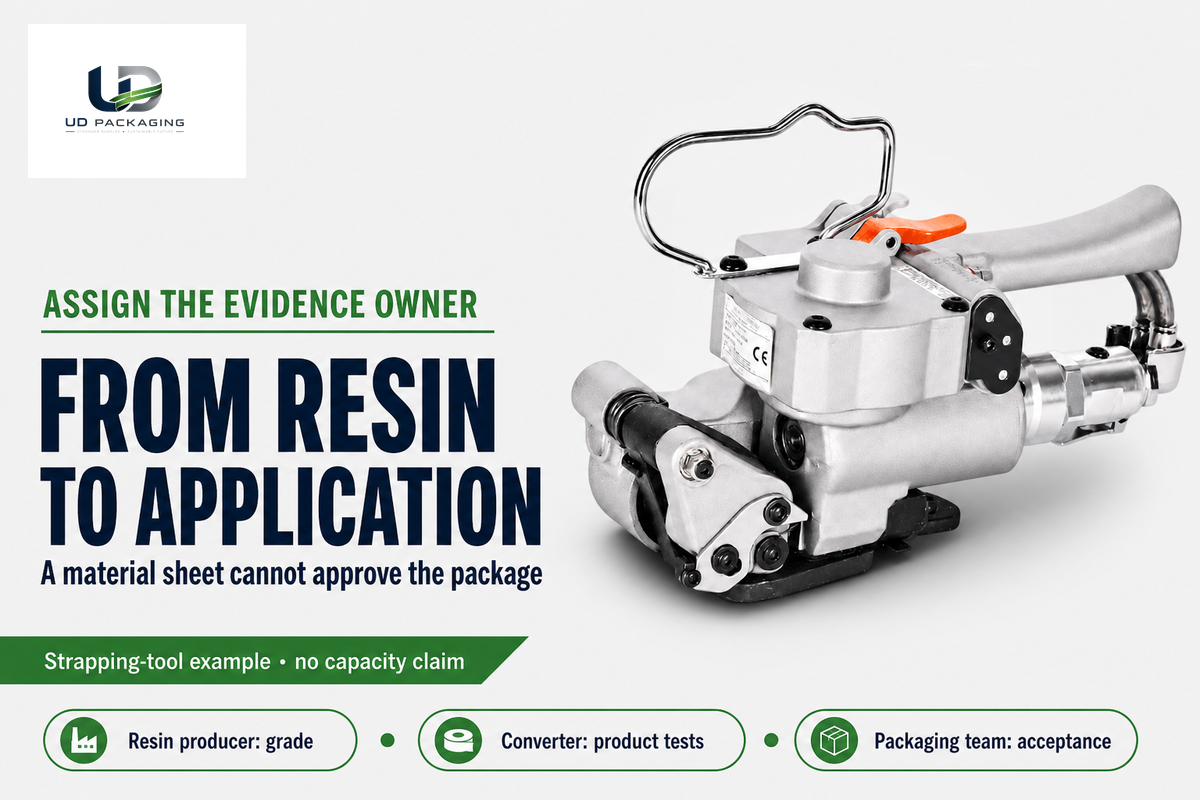
The resin producer should identify the grade, the converter should document the finished product, and the packaging team should establish application acceptance. These are evidence layers connected to each other. A supplier may integrate them, but a resin data sheet doesn’t provide evidence of film seal or that a pallet, strapped for shipment, stays intact during transport.
3-Layer PP Evidence Check
The 3-Layer PP Evidence Check matches the claim to the identification of the resin, the measurements of the converted product and the evidence of application acceptance, prior to the purchase order.
| Layer | Evidence owner | Example received | Buyer decision |
|---|---|---|---|
| Resin identity | Resin producer / supplier | Named PP grade sheet | Identify the material; do not approve the package yet |
| Converted product | Film or strap converter | No directional film or joint report | Ask for the missing product test |
| Application | Quality and operations | No trial under intended conditions | Define acceptance and complete the trial before release |
This is an editorial checklist, and not a recognized test method. Distinction is made in the product-specific scopes of ASTM D882 and D3950. Before comparing film reports, agree on conditioning the film specimens as well as direction and dimensions.
Key takeaway
A 3-layer evidence check keeps resin identity, finished-product performance and application acceptance connected without treating one report as proof of all three.
Recycled Polypropylene: Qualify the Blend, Not Just the Percentage
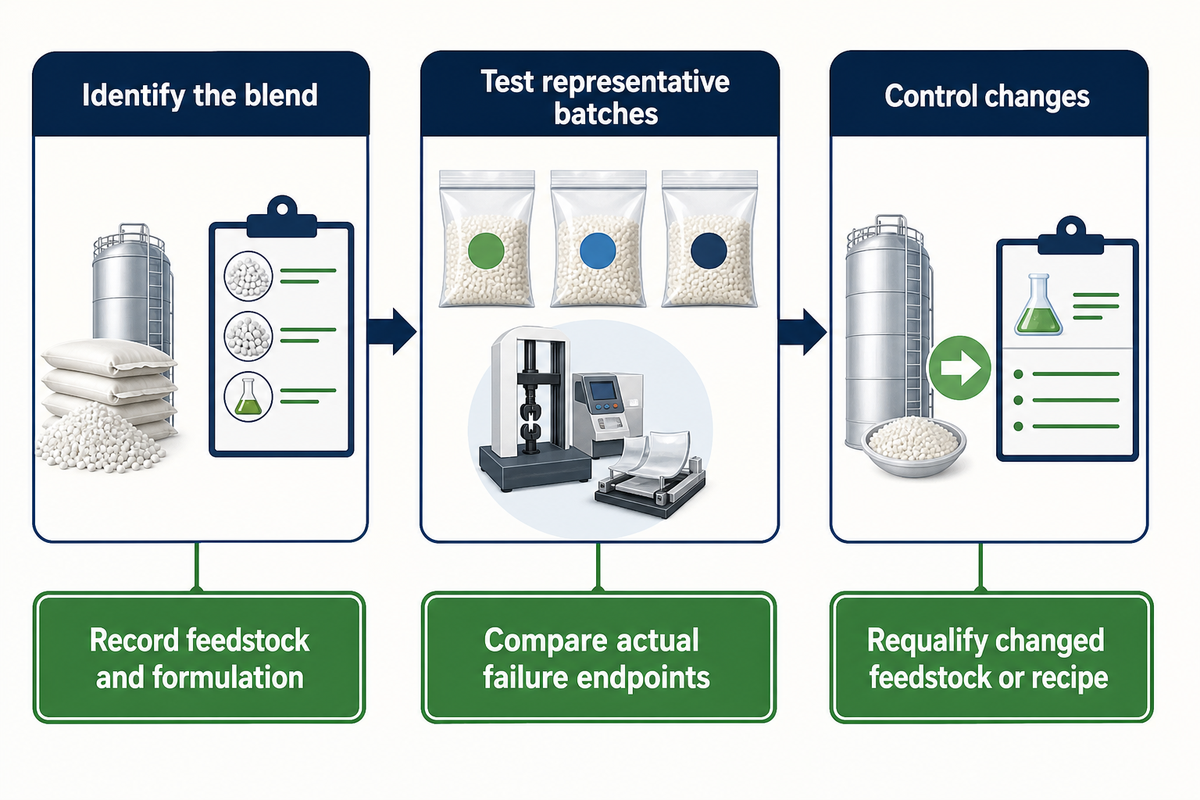
Recycled polypropylene requires formulation-specific qualification. Feedstock and processing history impact performance. A recycled-content percentage identifies part of the composition; it does not establish mechanical consistency, odor or suitability for food contact. Compare typical batches. Implement change control when the blend or source changes.
In the 2025 Virgin/recycled PP study, a blend of 25% recycled PP retained 96% of the virgin material’s elastic modulus and 101% of its yield strength. Those figures characterize that study. They don’t say 25% is an optimum for every film, molded part or strap. Other properties that were measured varied in different ways as the recycled content increased.
- Identify the blend: record the recycled feedstock and declared formulation.
- Test representative batches: compare the endpoints that control the actual packaging failure.
- Control changes: agree when a new feedstock or recipe requires renewed qualification.
PP is a recyclable material in suitable collection and processing systems; that does not guarantee acceptance of every local packaging format. For recycled plastics intended for food contact, FDA guidance focuses on the recycling process and intended use. Request evidence of actual construction, not general “food-safe PP” statements.
Frequently Asked Questions
Is polypropylene a metal or a plastic?
Read the answer
Polypropylene is a plastic, specifically a thermoplastic polymer made from propylene. It can be melted and formed into products such as films, containers and molded parts. Its exact behavior depends on the resin grade, additives and processing history, so the word polypropylene alone does not define a finished product specification.
What are the downsides of polypropylene plastic?
Read the answer
Common limitations include sunlight sensitivity without suitable stabilization, reduced impact performance in cold conditions for some grades, and creep under sustained load. Its low surface energy also complicates printing and adhesive bonding. These are selection factors rather than universal failures: the grade, formulation, product geometry and service conditions determine their significance.
What happens to polypropylene when wet?
Read the answer
Polypropylene absorbs little water: SpecialChem’s water-absorption table lists 0.01-0.10% by weight for PP homopolymer and copolymer, so wet conditions usually cause less dimensional change than in more absorbent polymers. That does not prove a package is watertight or sterile. Seams, seals, holes and contamination still matter, while water-vapor transmission must be assessed separately for the finished film at stated test conditions.
Is polypropylene biodegradable?
Read the answer
Conventional polypropylene isn’t readily biodegradable. Recycling depends on the product format, local collection system, contamination and available processing facilities, not its resin name alone.
Is PP food-safe?
Read the answer
A PP product can be suitable for food contact when its formulation and intended use meet the applicable requirements. Request the supplier declaration for the exact grade and finished construction, including additives and any recycled content. Check the intended food, contact time and temperature. A recycling code identifies a material family; it doesn’t establish food-contact compliance. Likewise, food-contact suitability alone doesn’t establish that an item is safe for microwaving or repeated steam sterilization.
Discuss your industrial packaging application
UD Packaging supplies PET strapping, industrial stretch film and supporting packaging consumables and equipment. Share the load, dimensions, storage conditions and machine details so the team can discuss a suitable packaging proposal.
References & Sources
- British Plastics Federation: Polypropylene
- Hossain et al.: Research and application of polypropylene
- Goto et al.: Impact Properties of filled Polypropylene
- Yaptenco et al.: Gas transmission rates of commercially available polyethylene and polypropylene films
- Zhiltsova and Oliveira: Virgin and recycled polypropylene blend study, 2025
- ASTM D882: Thin plastic sheeting tensile properties
- ASTM D3950-23: Nonmetallic strapping and joining methods
- ASTM D648: Deflection temperature under flexural load
- ASTM D2578-23: Film wetting tension
- ASTM F2029: Laboratory heat-seal preparation
- FDA: Recycled Plastics in Food Packaging
Research checked October 9, 2026. Standards references use publicly available scope and significance information; consult the applicable full standard for test execution.