
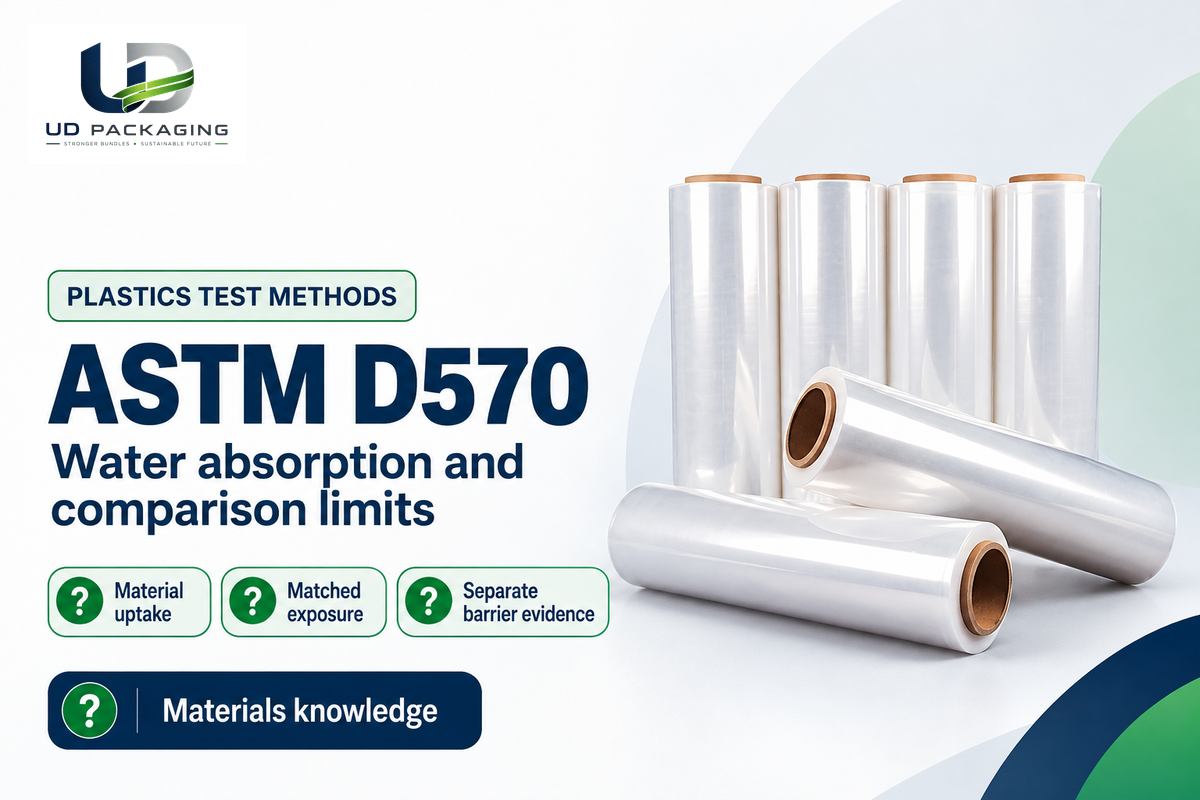
ASTM D570 quantifies water uptake by plastic specimens during immersion. The key distinction for packaging buyers is between water held up in a material and moisture transmitted through a film. Confusing those quantities can lead a material comparison to the wrong test before anyone even speaks of price.
Updated October 2026
ASTM D570 measures immersion water absorption in plastics. Results are commonly expressed as percentage mass gain relative to the dry specimen. Use matched exposure conditions for material comparisons and a separate vapor-transmission test for film barrier performance.
Quick reading guide
- Low immersion uptake and low water vapor transmission are different things.
- The stated sheet scope starts at 0.13 mm, equivalent to 130 µm.
- A 24-hour endpoint and a saturation endpoint address different questions.
- Always keep the test method, material form and exposure in relation to every percentage.
What ASTM D570 Measures
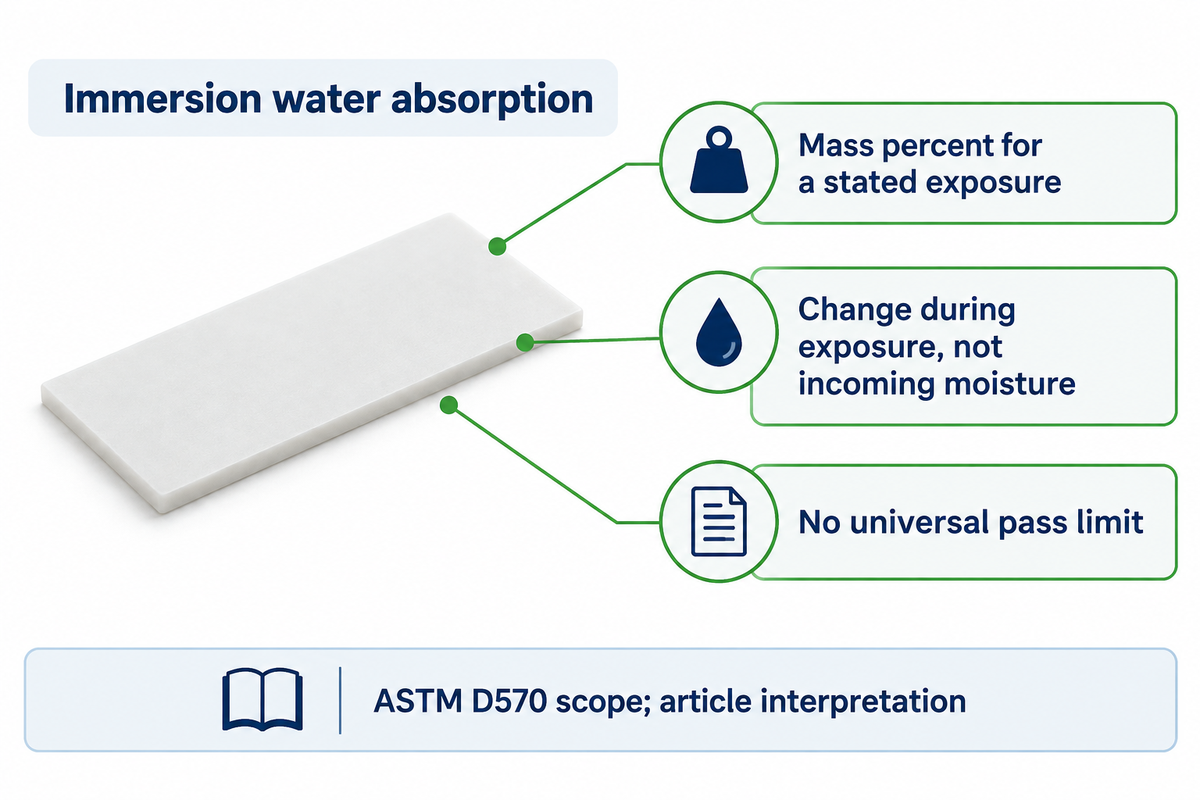
ASTM D570 describes the relative absorption of water by plastic materials during immersion. Measured changes help define uptake under a specific exposure and can be used to check product consistency. Its sheet scope starts at 0.13 mm thickness and the identity of the material and specimen form are part of the result.
What is ASTM D570?
ASTM D570 is the Standard Test Method for Water Absorption of Plastics published by ASTM International. D570-22 is listed as active by the publisher up to October 2026. Its coverage includes cast, hot-molded and cold-molded plastics, and allows for homogeneous and laminated plastics in the specified forms.
Water can alter dimensions or mechanical properties in a polymer. The relationship to performance needs to be established for that material and exposure. A mass measurement does not supply a strength, flexural modulus, or hardness result. A tensile test or measurement of flexural properties addresses the mechanical response after the exposure. ASTM discusses these uses, as well as the effects of specimen geometry, in its D570 importance and scope.
Identify the property that matters after wetting or exposure to humid conditions in a purchasing specification. A component that must retain its fit must include dimensional specs; a film that protects dry contents must have criteria for moisture transport. An absorption value can be included with either specification without replacing the acceptance measurement.
At 0.13 mm and above, a sheet meets the thickness portion of ASTM D570’s stated sheet scope. Meeting the scope still requires the correct specimen and procedure. A named material, such as polyamide, does not identify the form or exposure of the material being tested.
Water Absorption Is Not Water Vapor Transmission
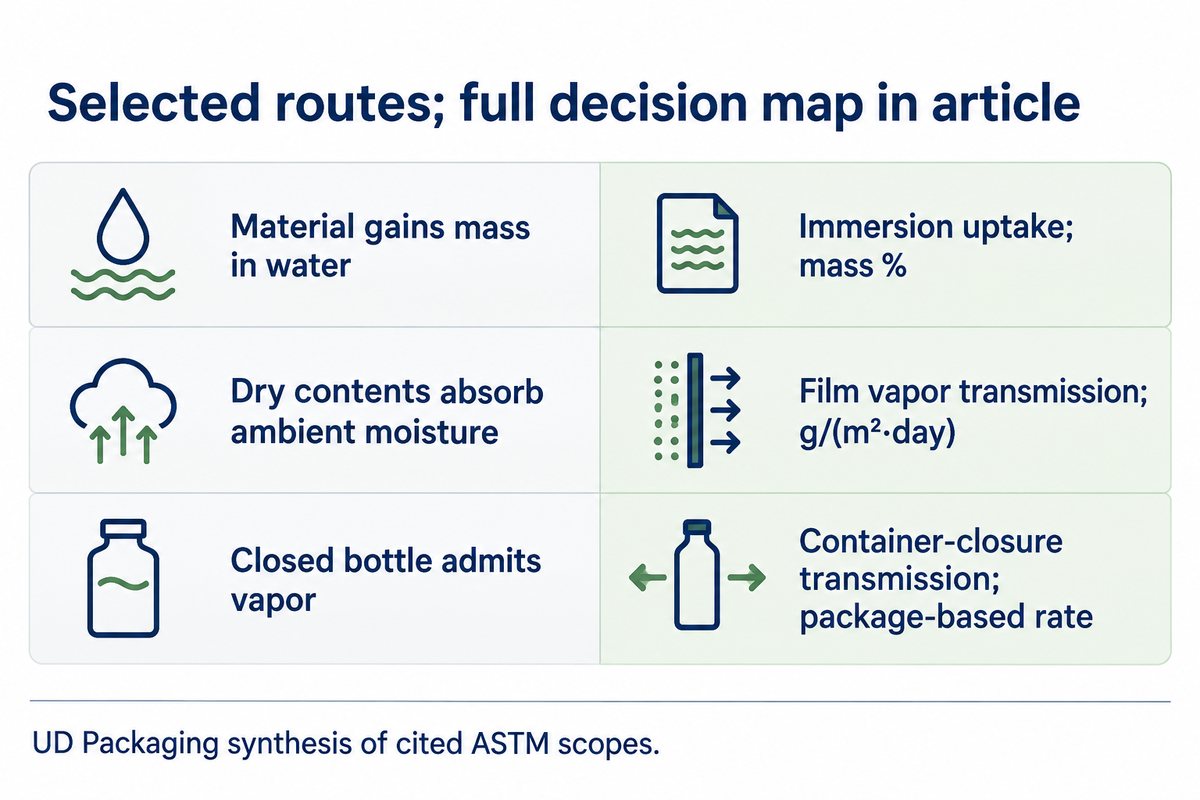
The quantity of water absorbed by a specimen is described by water absorption. Water vapor transmission describes the transport of water vapor through a barrier. A percentage of mass gain cannot be converted directly into g/(m²·day). A finished package adds a performance boundary, because moisture can still enter via the container and its closure.
ASTM F1249-25 addresses vapor transmission through flexible barrier materials, including single-layer and multilayer films. Its scope includes films and sheets up to 3 mm thick. Sorption and diffusion both affect transport, so the amount a material holds is only part of the mechanism.
Absorb-or-Transmit Decision Map
The Absorb-or-Transmit Decision Map directs a moisture problem to the measured quantity and specimen that can address it.
| Decision trigger | Measurement route | Owner and next decision |
|---|---|---|
| Material gains mass in water | Immersion uptake; mass % | QA: compare matched specimens. |
| Dry contents absorb ambient moisture | Film vapor transmission; g/(m²·day) | Procurement: compare barrier grades at matched humidity. |
| Closed bottle admits vapor | Container-closure transmission; package-based rate | QA: evaluate the assembled system. |
| Liquid escapes at a seam | Package integrity or leakage assessment | Process engineering: investigate the seal. |
| Part swells after wetting | Dimensions after the relevant exposure | Process engineering: judge fit directly. |
| Strength after moisture exposure matters | Mechanical testing paired with moisture history | QA: apply the mechanical requirement. |
| Resin arrives wet before processing | Incoming moisture-content measurement | Process engineering: address the received material. |
| A coating or layer construction changes | Transport test on the revised film | Procurement: qualify the purchased construction. |
| Supplier percentages use different endpoints | Matched-exposure absorption comparison | QA: separate fixed-time and equilibrium results. |
UD Packaging’s synthesis of the cited ASTM measurement scopes formed the basis of the decision routes.
As an example, ASTM D7709 tests closed pharmaceutical bottles and blisters and gives bottle results in mg/bottle-day. This shows a package-level output, not a universal prescription for all packaging.
A film result in g/(m²·day) expresses transport over area and time, whereas a bottle result in mg/bottle-day represents a closed system. Remember this when a supplier quotes an absorption percentage to demonstrate that a packaged product is kept dry during storage.
Calculate Water Absorption Without Losing the Test Context
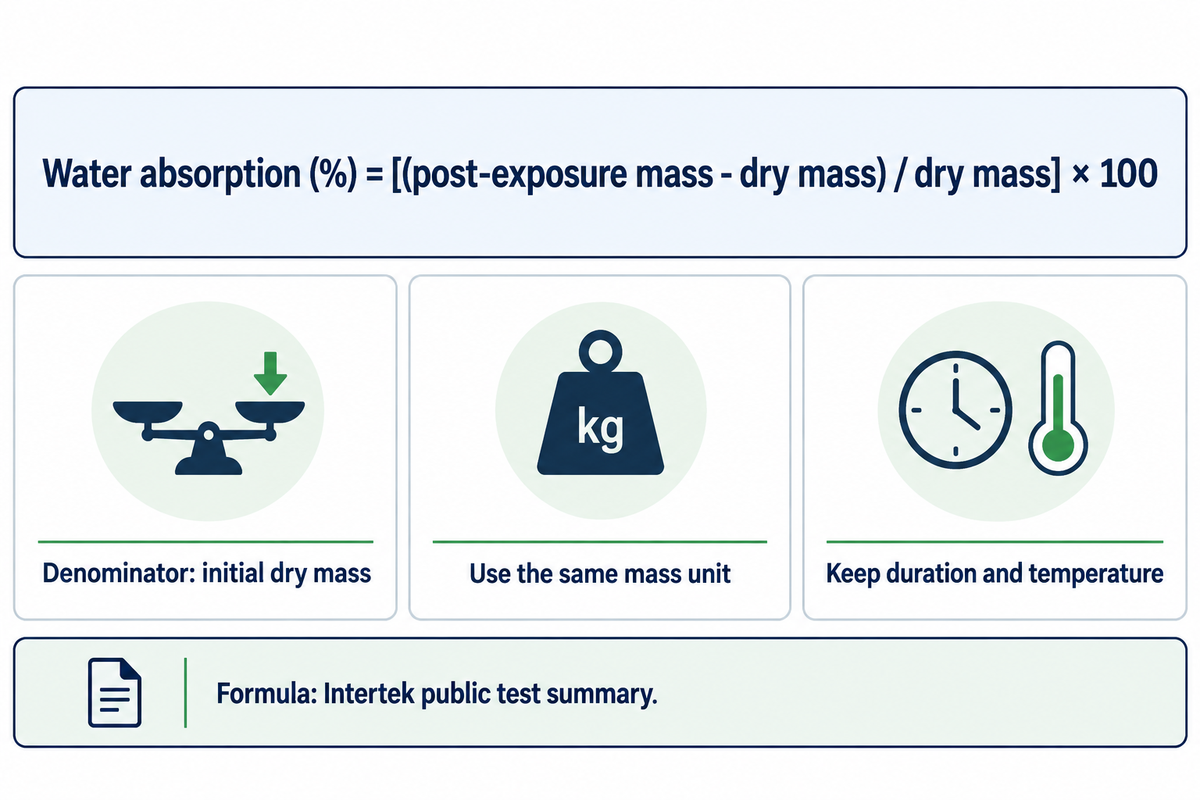
The percentage mass gain is calculated by subtracting the initial dry mass from the final mass, dividing by the initial dry mass and multiplying by 100. Both masses are expressed in the same unit. The answer describes uptake at the recorded exposure endpoint, and, therefore, the time of exposure and the calculation are provided together.
Intertek’s public test summary gives this expression:
Water absorption (%) = [(post-exposure mass – dry mass) / dry mass] × 100.
How to perform a water absorption test?
A water absorption test determines the dry mass of a specimen, exposes it to water under specific conditions and measures the mass after exposure. Intertek details the process of drying, cooling, weighing, immersion in water and removal of surface-water and reweighing. A balance is the measuring instrument in this gravimetric approach.
- Establish the baseline. Record the prepared specimen’s dry mass.
- Apply the exposure. Retain the selected duration and temperature.
- Measure the change. Remove surface water as prescribed, reweigh and calculate.
Example: a QA reviewer receives a worksheet with a dry mass of 20.000 g and a post-exposure mass of 20.100 g. The difference is 0.100 g. Dividing 0.100 g by 20.000 g and multiplying by 100 gives 0.500%. The arithmetic is correct, but the summary page has dropped the exposure label. Procurement wants to compare the number with another supplier’s equilibrium value. The reviewer keeps 0.500% attached to the original worksheet and retrieves its endpoint before ranking the materials. Changing the denominator to 20.100 g would answer a different mathematical question; changing the label to equilibrium would change the scientific claim.
The 0.100 g increase in the water-absorption calculation indicates a net mass change. If material is lost during exposure, the apparent gain and absorbed water can be different. If correction is applicable, retain it with its basis in the report rather than changing a negative result to zero.
Why 24-Hour and Saturation Results Differ
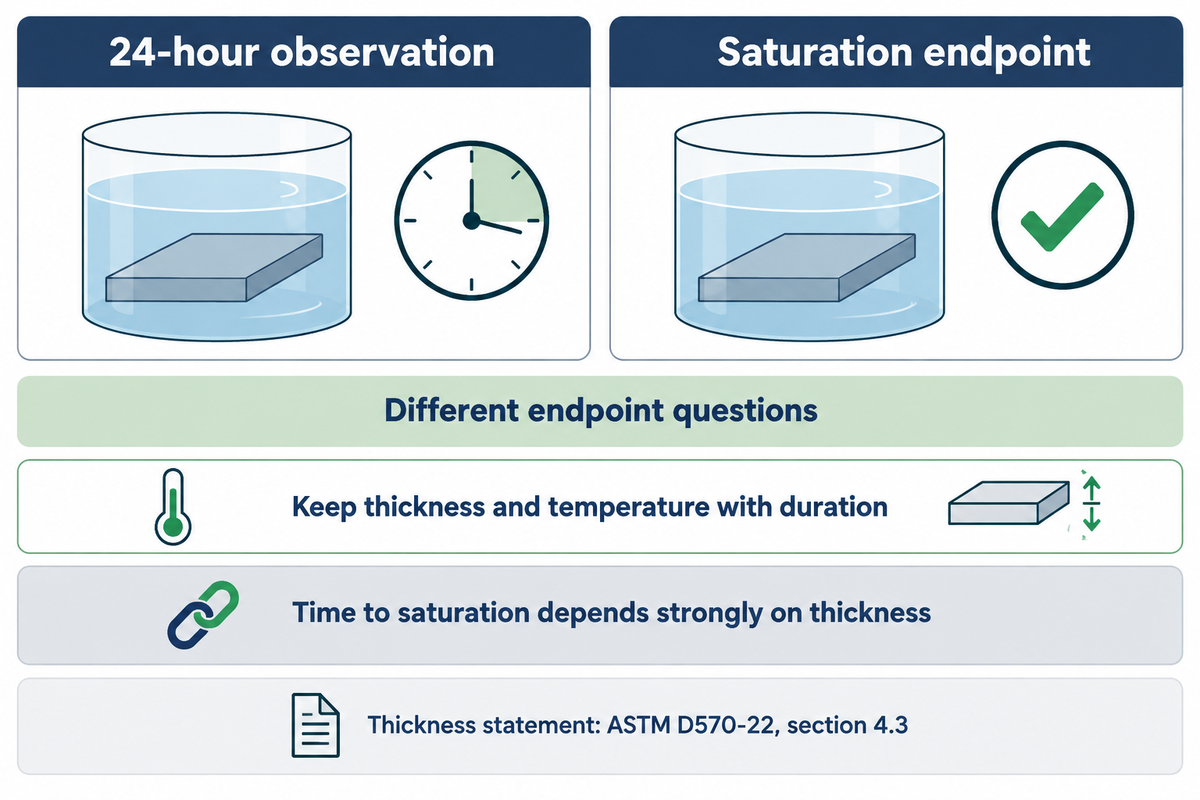
A 24-hour result and a saturation result report observations based on different endpoints: a fixed duration and the endpoint of uptake under defined conditions, respectively. They may concur for a given specimen, but are different bases of report. Thickness of the substrate affects the time required to attain the uptake equilibrium, while temperature and exposed surfaces affect the rate of water uptake during immersion.
“Time to saturation is strongly dependent on specimen thickness.”
According to ASTM, ideal diffusion is a function of the square root of immersion time. This, however, does not permit multiplying a 24-hour value to estimate a saturation value. In Yi and Pellegrino’s 2002 study on polypropylene, accounting for the resistance at the liquid-water interface improved the agreement between the diffusion model and the experimental data.
Final amount and uptake rate require different treatments. Vogt and colleagues’ 2004 study showed thickness-dependent kinetics, but thickness-independent equilibrium absorption in 3-200 nm polyelectrolyte films exposed to saturated vapor. These research systems demonstrated that neither a universal final-uptake rule nor a universal time-rule follows from thickness alone.
When considering two suppliers of the same resin family, fixed-time absorption values of one comparison group should be kept separate from equilibrium values of the other group. Faster rate of absorption isn’t the same as greater final uptake. Geometry and exposure must be the same before either group of samples supports a material ranking.
Comparing 24 h with 96 h changes the observation window. Comparing either to saturation changes the endpoint question. Keep thickness and temperature alongside duration, and use the recorded equilibrium criterion where relevant; a shared polymer name doesn’t make those conditions interchangeable.
ASTM D570 and ISO 62: Read the Equivalence Condition
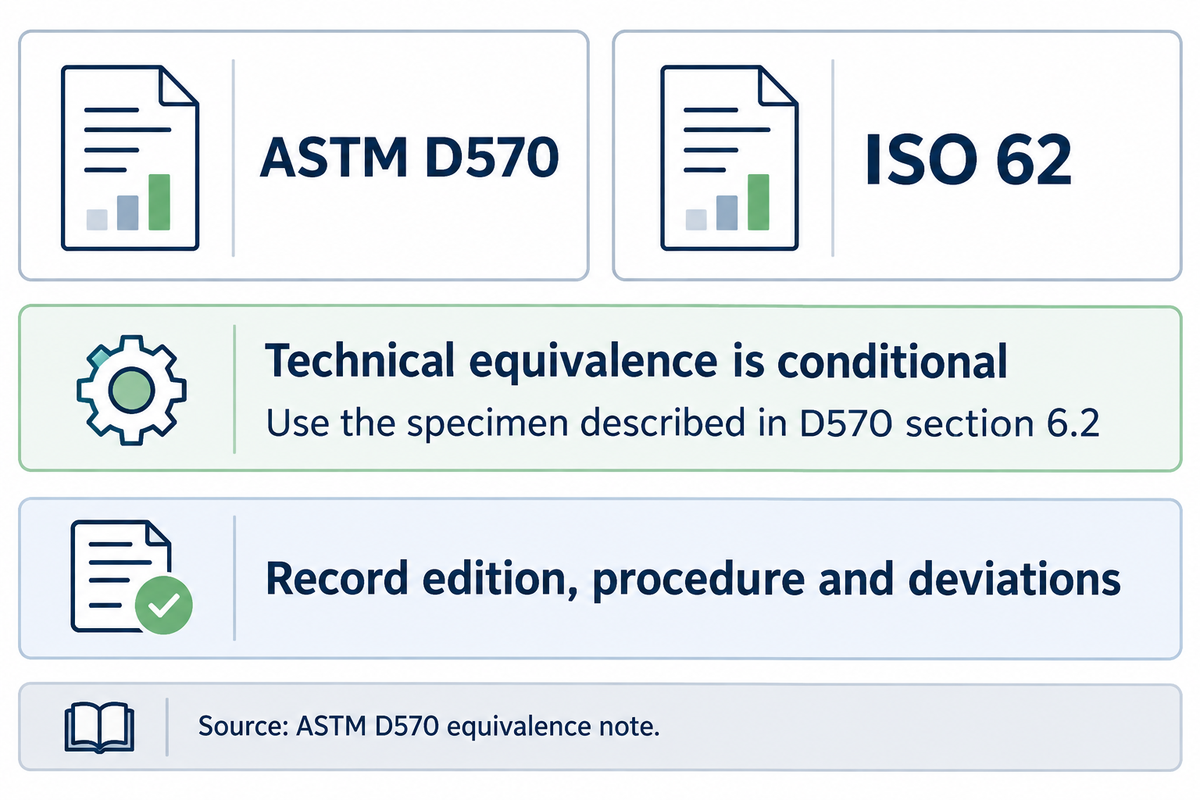
ASTM D570’s technical-equivalence statement for ISO 62 is conditional on using the specimen described in D570 section 6.2. A combined D570/ISO 62 label therefore needs its specimen context. Matching standard names is the starting point of comparability for exposure conditions and the reported quantity.
ISO 62:2008 covers water absorption with solid plastics (defined water or humid air exposures). The scope excludes cellular plastics and granulates and does not include powders. The ISO web page states the 2008 edition was confirmed in 2021; a review does not by itself create a new edition.
A supplier can use a combined label to describe aligned test methods but a buyer should maintain the method edition and specimen descriptions for comparisons. Reports with different initial moisture states or endpoints describe different experiments. The conditions described in ASTM’s note are case specific and do not represent general equivalence across the procedures in both standards.
The practical outcome is a shared comparison basis agreed before testing. Keep film conditioning records with that basis rather than recreating a conditioning procedure from the material name.
Thin Films and Laminates: Check the Specimen Scope
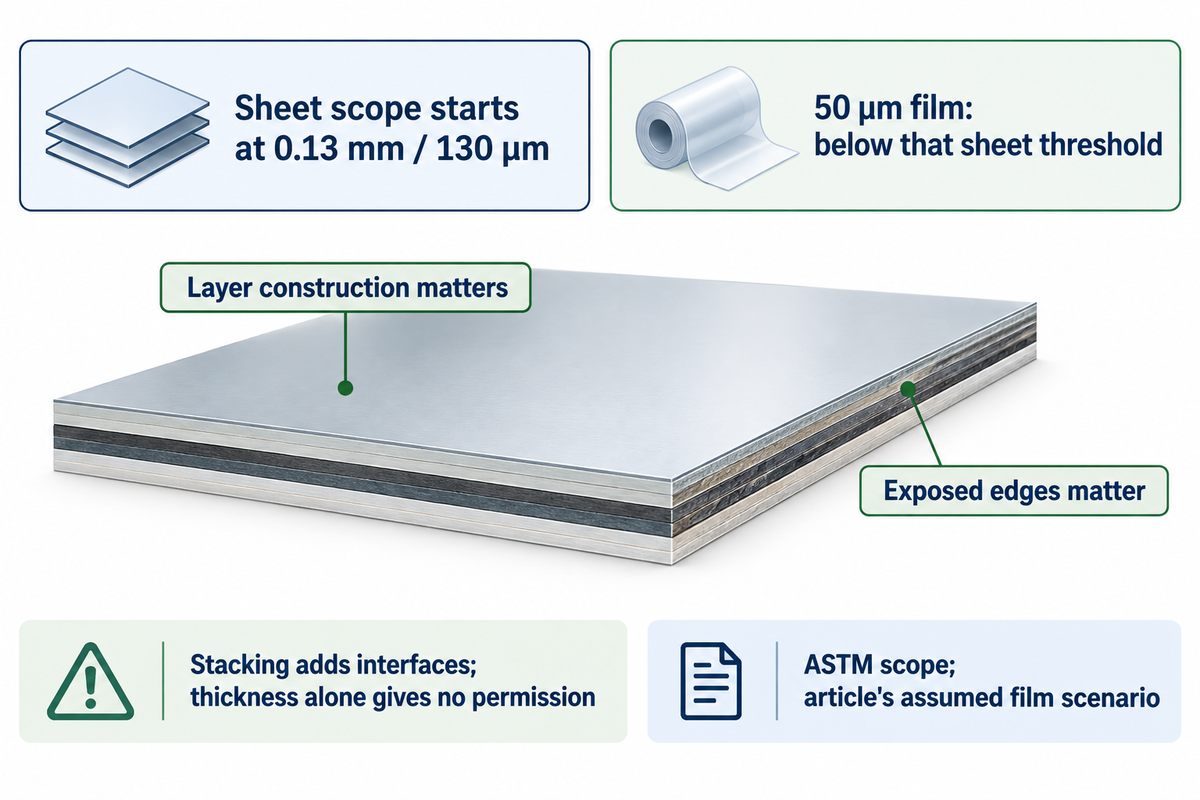
The stated ASTM D570 sheet scope begins at 0.13 mm, or 130 µm. A 50 µm film is thinner than that threshold. Edge exposure and layering are also considerations for a laminate, as moisture can also enter through other paths besides the face of the film.
Imagine a user selecting a 50 µm packaging film for a dry product. One offer provides an absorption measurement on a thicker resin specimen; the other provides a vapor transmission result for the finished film. The process engineer interprets the resin result as material context and the film result for the moisture barrier case. Stacking thin pieces to reach 130 µm would introduce interfaces and a different specimen construction; the thickness arithmetic alone gives no permission to do so under D570. If a multilayer film is substituted, its full structure becomes the comparison, including the layers or coating that provide the barrier.
A study of PLA-based multilayer materials published in Scientific Reports used both vapor sorption and permeation methods to study the interactions of layers and the effect of humidity. Its coatings of hydrophilic polysaccharides were studied as part of its layered construction. This wasn’t a D570 immersion study. A practical lesson from the study is that a combination of layers can affect moisture transport differently than the individual constituents.
Another reason to keep the supplied film identity is orientation. The structure discussed in biaxially oriented polypropylene is more specific than a generic polypropylene resin label. ASTM also mentions that cut edges and molded surfaces can absorb differently, even in otherwise homogeneous materials.
Compare Plastic Datasheets on the Same Basis
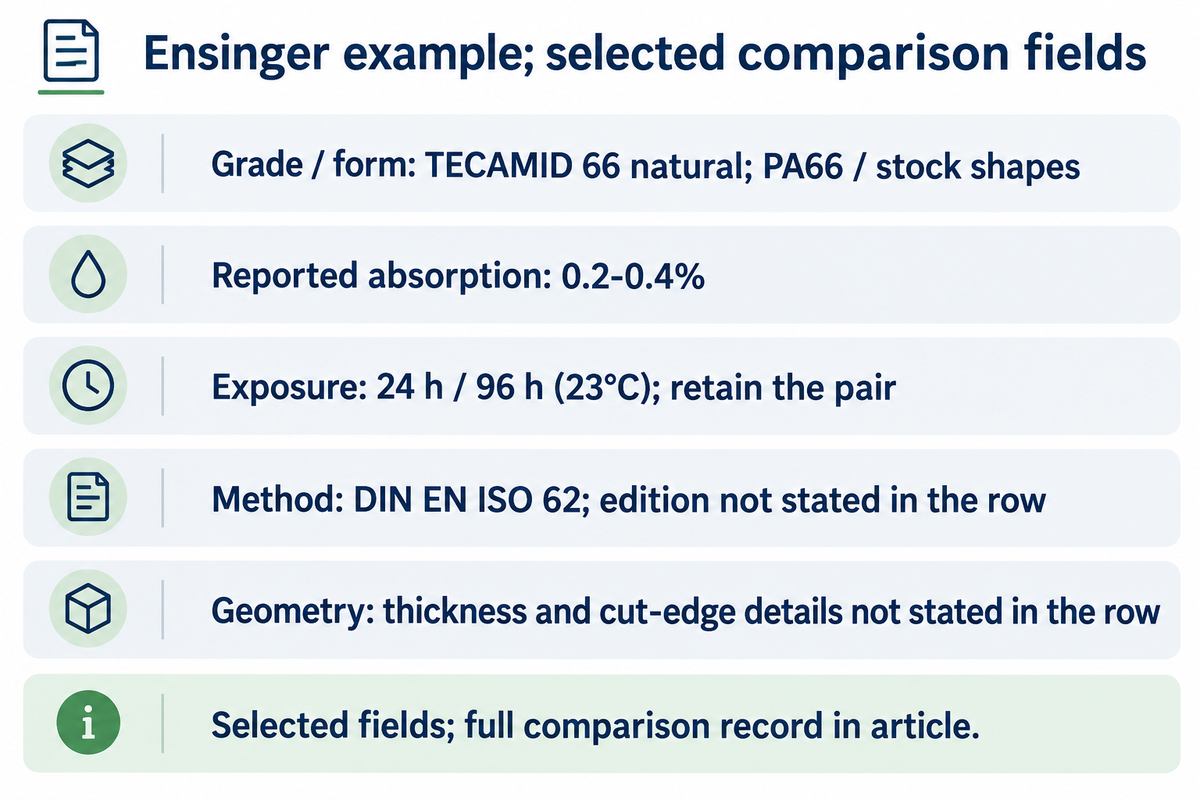
Compare plastic datasheets only after aligning the grade, tested form, exposure and calculation basis. Ensinger lists TECAMID 66 natural PA66 stock shapes at 0.2–0.4% with 24 h / 96 h at 23°C under DIN EN ISO 62. Keep those fields together when transferring the row into a comparison.
Matched-Exposure Comparison Record
The Matched-Exposure Comparison Record separates an available material value from the additional fields needed for a defensible comparison.
| Comparison field | Ensinger example / record entry | Decision it controls |
|---|---|---|
| Grade identity | TECAMID 66 natural; PA66 | Procurement matches the named grade. |
| Supplied form | Stock shapes | Separate stock-shape and packaging-film decisions. |
| Reported absorption | 0.2–0.4% | Retain as a supplier-reported range. |
| Exposure pairing | 24 h / 96 h (23°C) | Keep the pair intact; do not assign endpoints. |
| Method and edition | DIN EN ISO 62; edition not stated in the row | QA identifies the applicable procedure. |
| Test geometry | Thickness and cut-edge details not stated in the row | Match test specimens, not catalog dimensions. |
| Initial condition | Preparation history not stated in the row | QA retains the dry-mass baseline. |
| Composition and denominator | Record whole-specimen dry mass and layer/filler composition | Separate whole-material and resin-only percentages. |
| Lot and value status | No lot-specific acceptance statement in the row | Procurement separates reference data from purchase limits. |
| Application quantity | Material uptake; film transport assessed separately | Process engineering selects the relevant performance test. |
Source of the grade row: Ensinger’s TECAMID 66 natural stock-shape data. Additional fields are UD Packaging’s editorial comparison framework.
Composition matters because the denominator includes the entire dry specimen. For composite materials, adding a layer or filler changes that mass basis as well as potentially changing moisture behavior. Comparisons of polymeric materials therefore need the composition alongside the percentage. Comparability also motivates ISO 10350-1:2025, which addresses the acquisition and presentation of comparable data for moulding materials.
Also, retain this discipline when reviewing a polyethylene melting-point value: even the label high density polyethylene (HDPE) requires a grade and measurement context in order to interpret a property number and support a product decision.
Ensinger’s 0.2–0.4% entry stays paired with 24 h / 96 h at 23°C and DIN EN ISO 62. Treating that range as a saturation value or a batch tolerance changes its meaning. Transferring it to a packaging film changes the tested product as well.
What to Request Before Selecting a Packaging Material
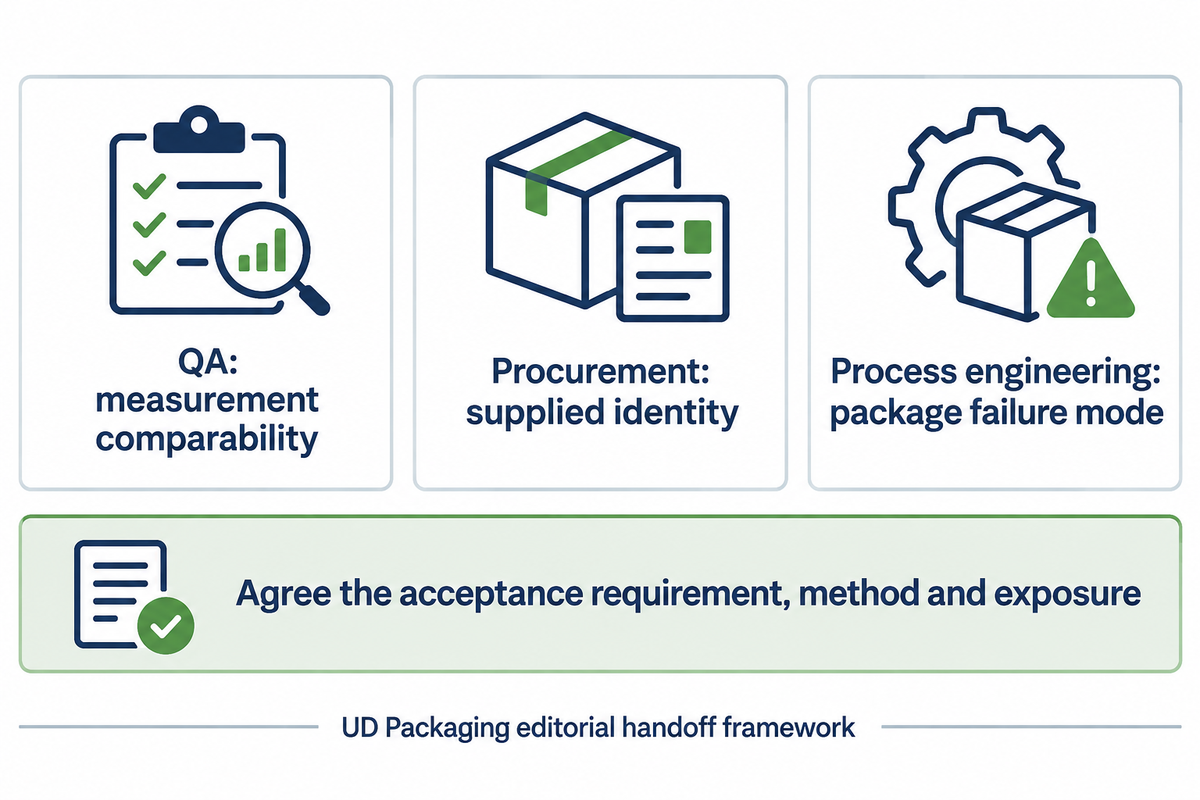
Request a report that ties the test material to the purchase decision: named grade and construction, method edition, specimen details, exposure and calculation basis. Then determine the acceptance quantity. QA owns measurement comparability, procurement owns the supplied identity and process engineering connects the outcome to the package’s failure mode.
A packaging team is considering replacing the current laminate because the pack’s dry contents gain moisture during storage. Procurement gets a low absorption percentage and favors the cheaper option. QA identifies the absorption number as a result for an immersed material specimen. The product problem concerns moisture entering a sealed pack. The process engineer maps the likely routes through the film and closure. The team accepts the absorption value for material characterization. The team compares the candidate films under the same vapor conditions and assesses the complete package against the product requirement. Then, price comparison is made after performance evaluation. That is, they determine which test result is relevant based on the performance requirement.
Ask for the raw masses, units, and any corrections performed; confirm the endpoint, temperature, and specimen thickness; and describe the initial condition of the specimen before the test. Report the layer structure and any differences from the method selected. The reporting context is covered in the specimen identity and result traceability guide.
Key takeaway
Choose the measurement before comparing the number: immersion uptake for the material, vapor transport for the film and application-relevant performance for the closed package.
Use UD Packaging’s plastic test methods for moisture measurements to address the moisture question for your materials specification.
Frequently Asked Questions
What is the unit of water absorption?
Water absorption is commonly reported as mass percent for a stated exposure.
The mass increase is divided by the initial dry mass and multiplied by 100. Grams cancel when both measurements use grams, so the result is a percentage. Its meaning still includes the exposure duration and temperature. A vapor-transmission result uses a different unit, such as grams per square metre per day, because it measures transport over area and time.
Does ASTM D570 define a universal pass limit?
ASTM D570 supplies a measurement method, not one pass limit for every plastic and application.
The purchase specification sets the acceptance requirement together with the method and exposure conditions. A material used for a dimensionally sensitive part can have a different requirement from a material selected for another purpose. A supplier’s typical datasheet value is also different from a guaranteed maximum. Keep the agreed value type and sampling basis in the purchasing documents.
Can a small mass gain prove that a film is waterproof?
A small mass gain describes low uptake in the tested specimen, not waterproofness of the finished package.
Water can move through a film or enter around a seal without producing the same result as an immersion absorption test. Define waterproofness through the intended liquid exposure and package-integrity requirement. For protection against ambient moisture, use vapor-transmission evidence at the relevant conditions. Neither route should silently replace the other when the packaged product has more than one moisture-related failure mode.
Is the dry mass or wet mass the denominator?
The initial dry mass is the denominator in the usual percentage mass-gain calculation.
Subtract dry mass from post-exposure mass first. Dividing by the wet mass instead produces a different percentage.
Does a water absorption result measure moisture already in a resin?
An immersion absorption result measures a change during exposure, rather than the resin’s incoming water content.
Initial moisture is part of the specimen history. Incoming material may have experienced storage conditions different from those used to prepare the test specimens. Where extrusion or another process requires control of moisture already present, the relevant result is a moisture-content measurement on the received material. A datasheet absorption row describes a material property under its test conditions; it cannot replace a lot-specific incoming measurement or the processing instructions for the named resin grade.
Must two ASTM D570 reports use the same edition?
Not necessarily: using the same edition simplifies comparison, and reports on different editions need a review of the relevant provisions.
Record the edition, procedure and deviations in both reports. A shared D570 designation alone does not align specimen preparation or exposure.
Does low absorption guarantee dimensional stability?
Low absorption alone does not guarantee dimensional stability during service.
Dimensional response involves the material, part geometry and exposure. A fit requirement needs a dimensional measurement after the relevant moisture and mechanical conditions. For example, changing a laminate construction can change more than its total absorbed-water percentage. The useful acceptance question is whether the part remains within its allowed dimensions under the specified conditions. Keep that requirement separate from a mass-based limit rather than converting the absorption percentage into an unsupported dimensional tolerance.
References & Sources
- ASTM D570-22: Standard Test Method for Water Absorption of Plastics, ASTM International.
- ASTM F1249-25: Water Vapor Transmission Through Plastic Film and Sheeting, ASTM International.
- ASTM D7709-12(2023): Water Vapor Transmission of Pharmaceutical Bottles and Blisters, ASTM International.
- Water Diffusion in Polypropylene, Yi and Pellegrino, 2002, National Institute of Standards and Technology publication record.
- Moisture Absorption and Absorption Kinetics in Polyelectrolyte Films, Vogt and colleagues, 2004, National Institute of Standards and Technology publication record.
- ISO 62:2008: Plastics, Determination of Water Absorption, International Organization for Standardization.
- Water vapor transport properties of bio-based multilayer materials determined by original and complementary methods, Scientific Reports, hosted by PubMed Central.
- ISO 10350-1:2025: Comparable Single-Point Data for Moulding Materials, International Organization for Standardization.