

Plastic creep is the gradual change in a polymer’s shape while stress remains applied. Part of that change can recover after unloading. For packaging, an initially tight strap can also lose force through stress relaxation, joint movement or changes in the load itself.
By XCX · Updated October 2026
- Match the material, loading mode, conditioning, duration and acceptance endpoint before comparing test reports.
- Separate increasing extension from falling force at fixed extension.
- Test the finished strap and joint; a molded-resin curve can’t qualify a pallet.
- Record package movement before choosing a stronger or thicker strap.
Long-term loading changes how buyers test the properties of plastics and interpret time-dependent mechanical properties. A short tensile test can’t give the buyer a complete view on how a part would behave while in long-term storage. A better question would be how the material would behave under the conditions the package will be subjected to.
What Plastic Creep Means Under Sustained Load
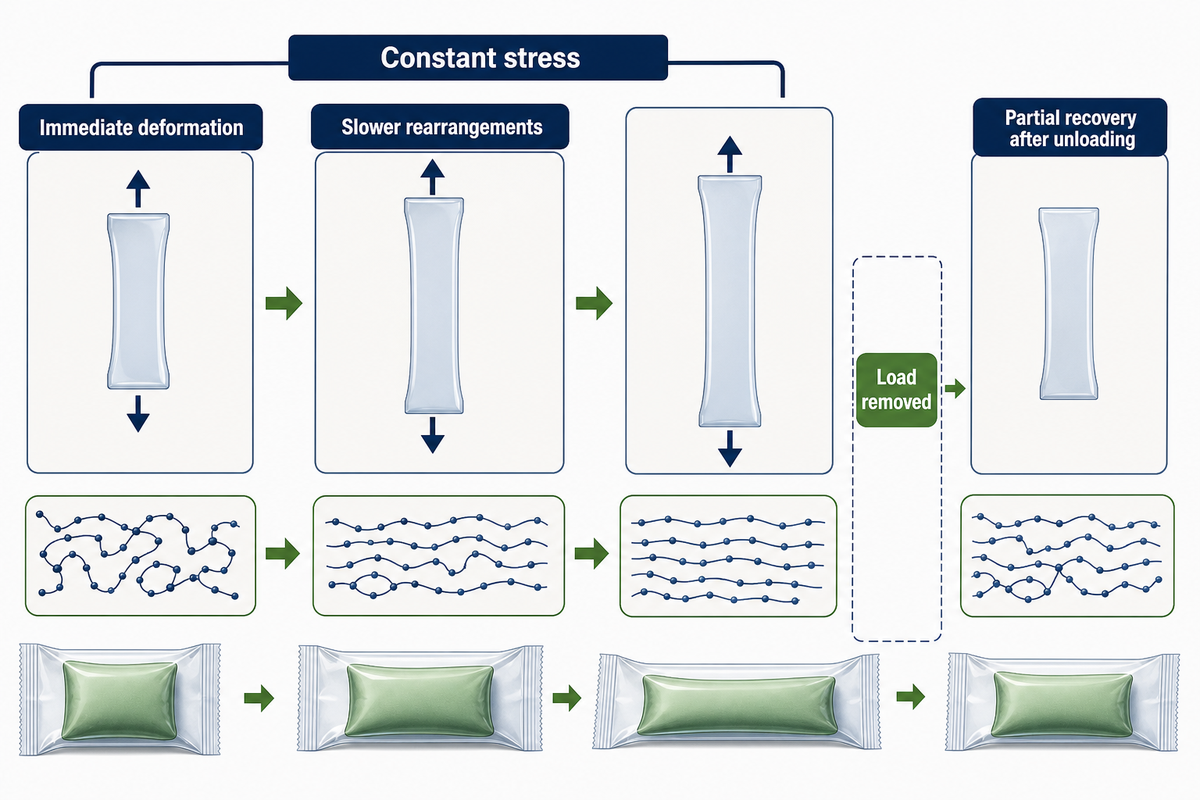
Plastic creep describes time-dependent deformation under constant stress, including loads below a material’s short-term yield strength. A polymeric material can deform immediately and continue moving after the load stops changing. The material can retain recoverable and irrecoverable strain after the load is removed. The name “plastic” doesn’t make all deformations irreversible.
Polymer chains respond through molecular motions that occur over different timescales. An elastic response appears quickly, and slower rearrangements contribute to strain in the creep process. Penn State’s explanation of creep and stress relaxation distinguishes this response from an instantaneous elastic deformation and describes partial recovery after unloading. Unloading can also result in partial recovery.
In material science, plastic deformation means an irreversible change. Creep in plastics is a broader time-dependent process. Calling it “cold flow” also doesn’t mean the material must be near its melting point or be cold. Creep can occur during ordinary storage.
Measurements can sometimes be taken too soon after unloading. The time of unloading should be noted as well as the time of subsequent observations. Do not classify the change as permanent deformation before observing recovery, especially when distorted plastic components are rejected or a supplier claims the shape will disappear without providing a recovery curve.
Creep vs Stress Relaxation: Match the Boundary Condition
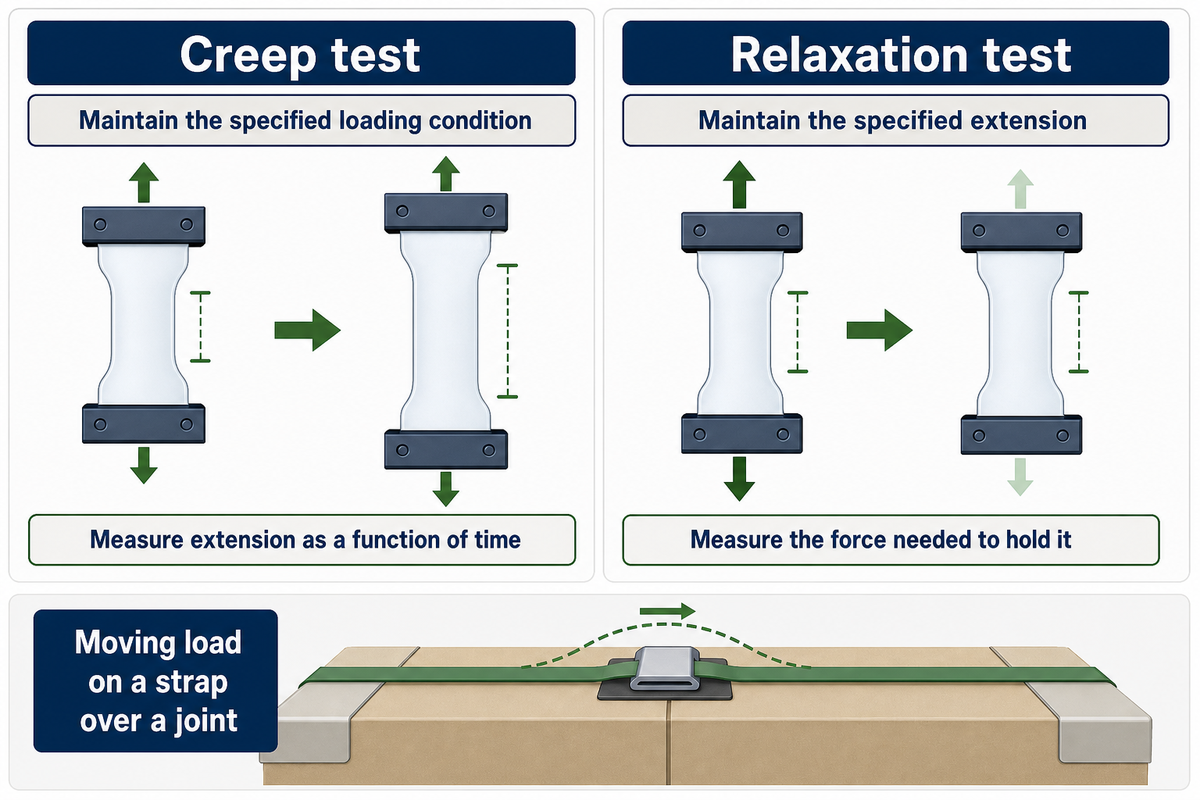
Creep and stress relaxation in polymers require different tests. Stress relaxation testing follows a changing stress at a fixed strain, while creep testing follows changing strain under a sustained load. Thus, a restrained polymer may lose force without changing length. Packaging combines a deformable strap, a joint and a moving load, so its restraint can differ from either ideal laboratory arrangement.
Creep test
- Maintain the specified loading condition.
- Measure extension as a function of time.
- Report stress definition and temperature.
Relaxation test
- Maintain the specified extension.
- Measure the force needed to hold it.
- Report starting strain and temperature.
Nominal engineering stress is defined as the stress calculated using the original cross-sectional area of a material; true stress changes if the cross-section changes. A test report should state the convention, instead of treating load and stress as equivalent.
Consider an illustrative fixture holding a polymer strip at 101 mm after stretching it from 100 mm. Its overall engineering strain is 1%. A falling force while the strip is held at those dimensions indicates relaxation, not an extra millimeter of creep extension. On a pallet, the restraint is less controlled: cartons can compress, corners can move and a seal can shift. Measuring only final strap length does not capture changes. The practical response is to record force and geometry together, then choose a test that reproduces the relevant condition. This example explains the measurement choice; it supplies no allowable tension.
Reading Creep Curves, Strain and Time to Failure
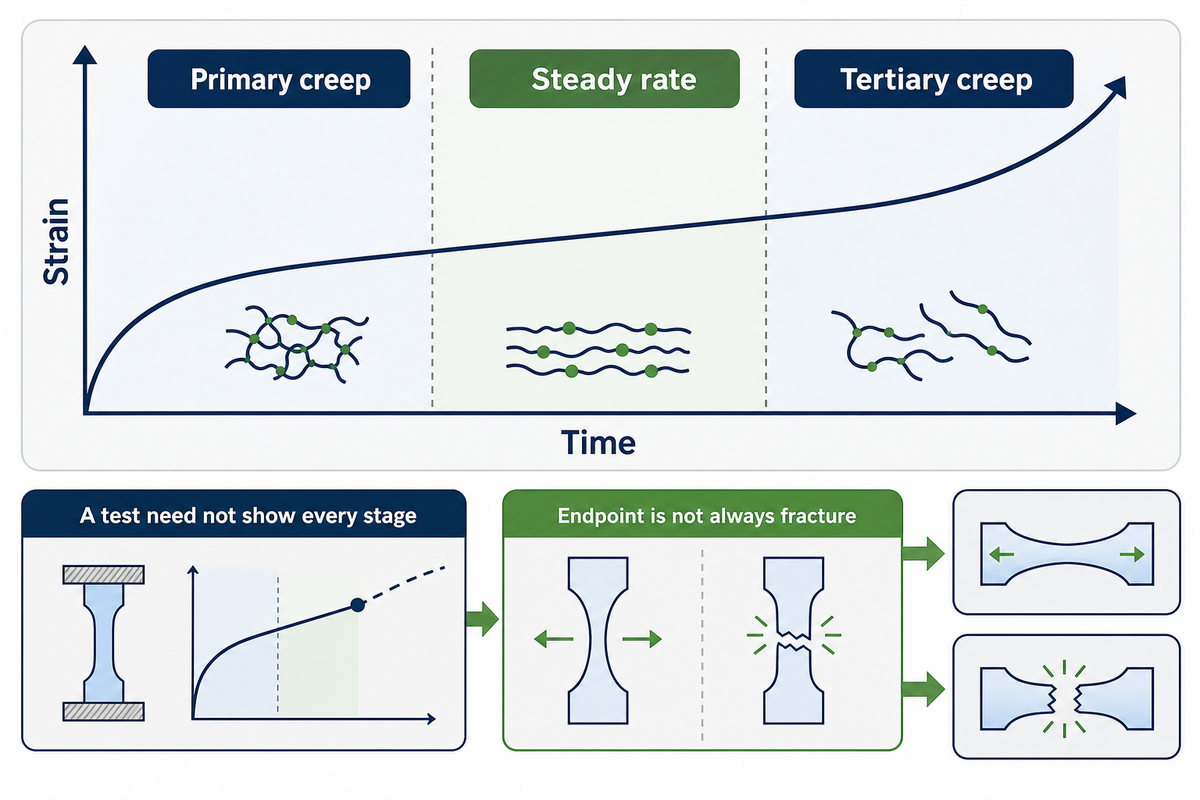
In measuring viscoelasticity, creep curves plot strain against time for a specified set of stress levels and environmental conditions. Their slope gives the creep rate, a strain rate, while an endpoint identifies excessive deformation or rupture. A curve that stops at a chosen strain does not necessarily show fracture, and a short observation window does not establish a service life.
Primary creep slows with time. The second stage of creep has a more or less steady rate of deformation and tertiary creep accelerates towards failure. A test need not illustrate all three phases. In Slouf and colleagues’ 2023 creep study, the selected low-stress tensile experiments showed primary creep only. To understand creep at different levels of stress, it’s recommended to read the entire curve as opposed to assigning a stage from a strain reading.
What is creep strain measurement?
Creep strain measures a specimen’s change in gauge length due to expansion/contraction over time with a given load and temperature. Engineering strain equals the length change divided by the initial gauge length. The report has to indicate if the plotted strains incorporate the immediate extension when the load was applied, or if they only account for the subsequent increment.
For an arithmetic illustration, a 100 mm gauge that becomes 101 mm has total strain of (101 − 100)/100 = 0.01, or 1%. If the first loaded reading was already 100.4 mm, the later increase is 0.6 mm, equivalent to another 0.6% of the original gauge length. These values are examples, not material test results. The engineering stress, strain calculator helps with unit conversion; it doesn’t predict time to failure.
Otsuki and colleagues stopped their 2025 PP experiments at nominal strain 0.3 when that endpoint was reached. That is 30% strain. When assessing creep failure in plastics, a buyer needs to distinguish such a method-defined stopping point from a cracked specimen, an unacceptable dimensional change or a failed joint.
How Temperature, Stress and Structure Change Creep Behavior
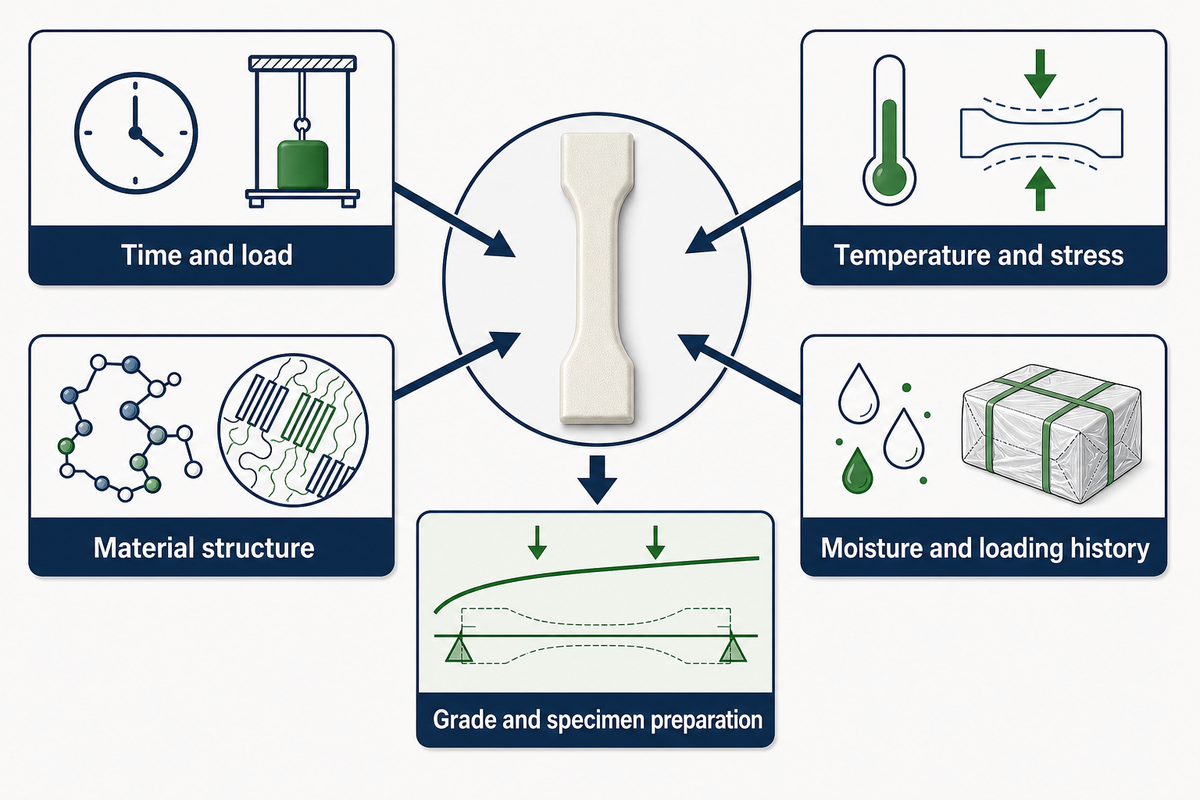
Viscoelasticity makes the response depend on time as well as the load. Temperature and stress change the speed and extent of polymer creep. Material structure, moisture conditioning and the history before loading also affect the response. Matching a resin family alone leaves these variables uncontrolled. A report intended for material selection should identify the grade, specimen preparation, exposure environment and applied load.
How Does Temperature Affect Creep in Polymers?
Higher temperatures can increase molecular mobility and accelerate delayed deformation in a viscoelastic material. How much molecular mobility changes depends on the polymer and its condition. Higher temperatures may accelerate deformation, so judge behavior at elevated temperatures with creep data measured at the intended service temperature, not a room-temperature curve or the melting temperature.
Otsuki et al.’s 2025 study of molded polypropylene used six materials, with test stresses between 2 MPa and 16 MPa selected by material. The temperatures were 40 °C, 50 °C and 60 °C. Standard tests lasted 1,000 minutes; selected conditions continued to 15,000 minutes. Those are experimental settings, not recommended packaging limits.
Another factor of time is physical aging. A NIST-hosted study of amorphous PEN found that longer aging changed the response and defeated simple time-aging superposition under the studied conditions. Instead of borrowing a prediction of PEN, a different polyester from PET, for a strap, the focus should be to capture the time, preparation and conditioning of the strap prior to loading.
The PP study used specimens 3 mm thick, with an 80 mm gauge length and 10 mm width. Its dimensions and molding history belong with its curves. An oriented packaging strap needs its own evidence even when the supplier’s resin designation also says polypropylene.
Choosing Creep-Resistant Plastic Materials
Better creep resistance means less relevant deformation under matched conditions, not a permanent ranking of polymer names. Grade, reinforcement and processing can change the result. Buyers choosing creep resistant plastics should compare usable curves at the required stress, temperature and duration, then check whether the measured endpoint matches the part’s function or the package’s restraint requirement.
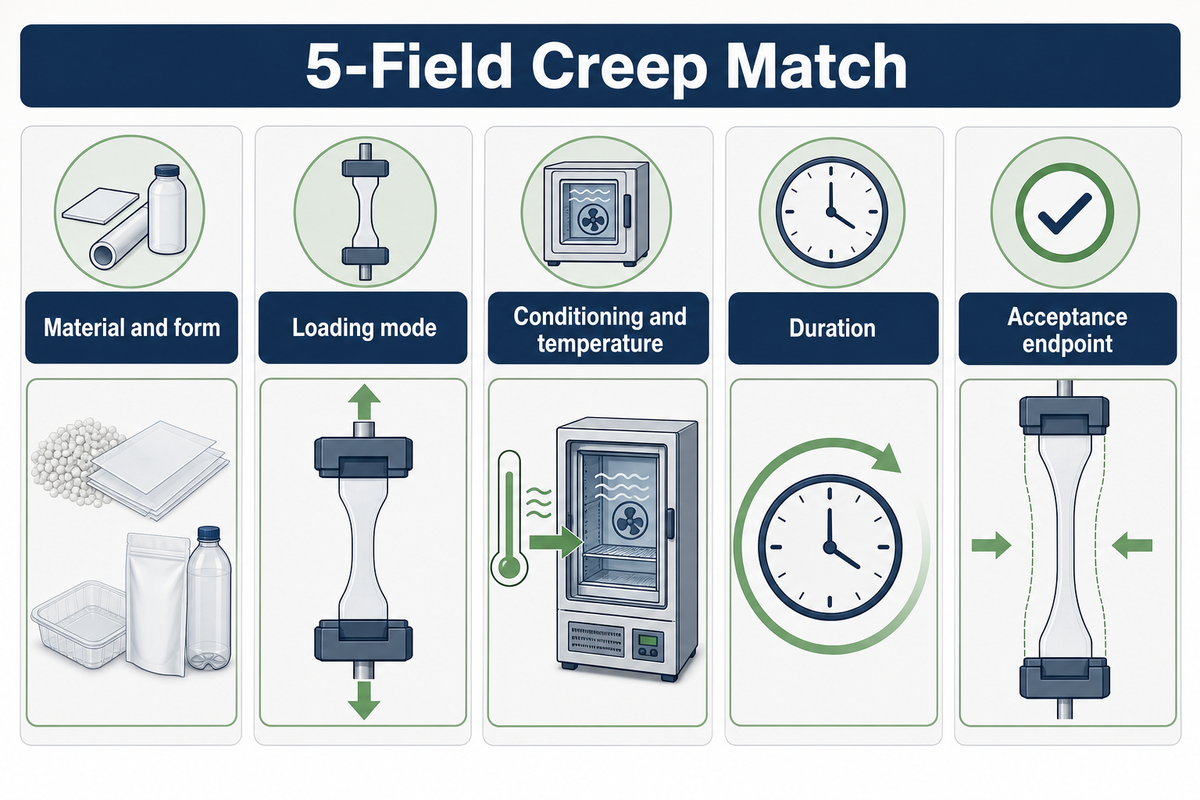
5-Field Creep Match
Compare five fields: material and form, loading mode, conditioning and temperature, duration, and acceptance endpoint. Conditioning includes moisture, thermal history and age before loading. This is a screening worksheet. Even five matched fields do not prove that two products will perform identically.
| Check | Buyer action | Limitations / Not suitable for |
|---|---|---|
| Resin grade | Match the exact formulation and filler state. | Family names alone do not identify the tested material. |
| Product form | Request finished-strip data for strapping. | A 3 mm molded coupon is not an oriented strap. |
| Stress basis | Identify nominal or true stress and cross-section. | Equal force does not mean equal stress. |
| Restraint | Separate constant-load and fixed-length results. | Relaxation force loss is not added creep strain. |
| Temperature | Compare curves whose measured temperatures match. | A 40 °C curve does not establish a 60 °C result. |
| Conditioning | Record humidity, preparation and aging time. | Equal loading time does not imply equal prior history. |
| Duration | Identify measured data versus extrapolation. | 1,000 minutes is not 1,000 hours. |
| Strain baseline | Identify total strain versus delayed increment. | Immediate extension can change the comparison. |
| Endpoint | Define dimensional limit, force floor or fracture. | A 30% research cutoff is not a universal limit. |
| Assembly | Check strap, joint and load together. | Specimen data alone cannot establish pallet restraint. |
The test-condition checks follow the ISO 899-1 public scope and cited research methods; the decision worksheet is an editorial synthesis. For a broader resin comparison use the site’s polypropylene properties guide, then return to grade specific long term data.
For a filled comparison, consider the published PP experiment: molded PP specimen; sustained nominal tensile stress; 40 °C for one tested condition; 1,000 minutes; a 0.3 nominal-strain stopping endpoint. Now compare an illustrative purchasing request: finished PET strap; fixed-length relaxation; 50 °C; 720 hours; a buyer-defined minimum retained force. Every field differs. Reject the report as evidence for the purchasing specification. It serves only as background research. The purchasing conditions are invented to illustrate the comparison, not recommended conditions or reported product results.
A “high creep resistance” label with no stress and duration leaves the purchasing decision unresolved. Request the missing data points before agreeing to accept the comparison. A grade intended to resist creep still needs finished-product data. More filler or a higher short-term modulus alone does not prove that the product meets its dimensional requirement.
Plastic Creep Testing: Method, Specimen and Report
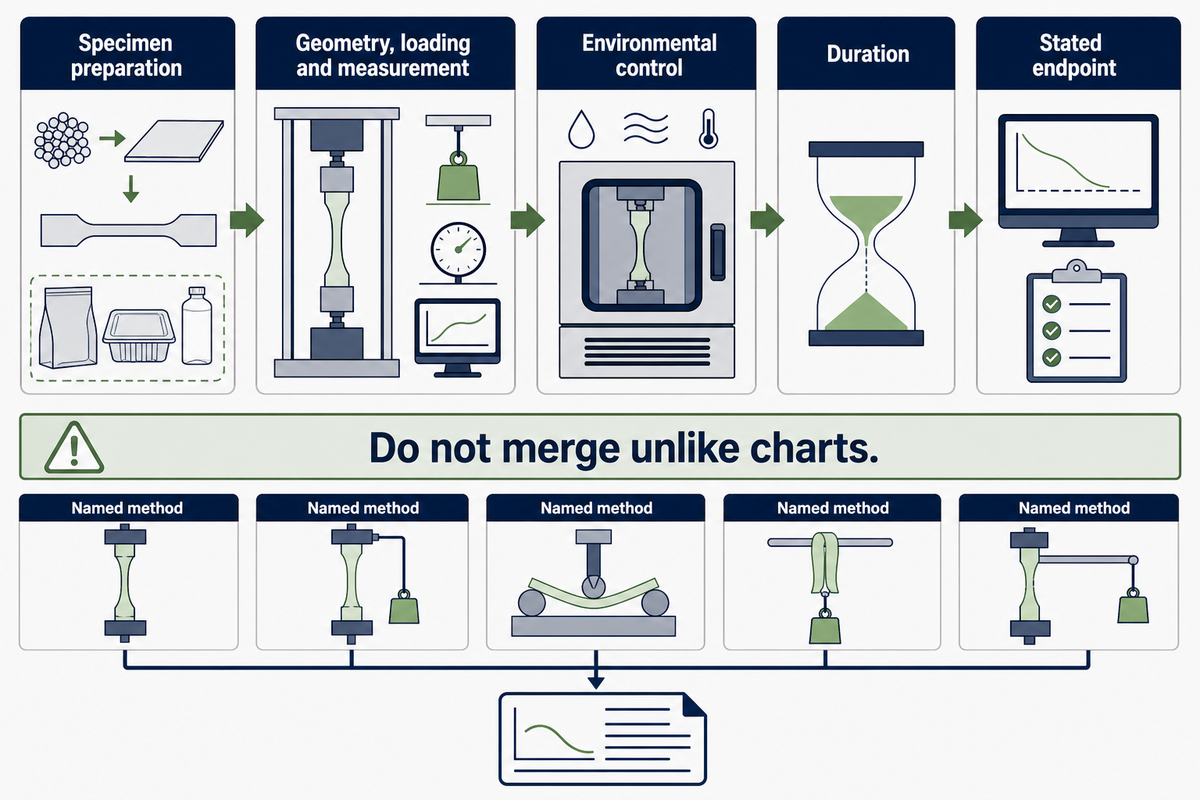
Plastic creep testing requires a named method, precise specimen preparation and a stated endpoint. ASTM D2990 covers tensile, compressive and flexural approaches within its scope; ISO 899-1 concerns tensile creep. Before values from various methods can be used to make the same selection, their reports need a technical comparison.
The public ASTM site indicates that D2990-17(2025) is an active standard. ISO’s Determination of creep behaviour , 899-1:2017, Edition 3, remains current after confirmation in 2022. Confirmation does not make it a new 2022 edition. Both public ASTM and ISO catalog pages were checked for this article; public scopes do not indicate that any supplier has performed these tests.
“results cannot be directly compared between the two test methods”
ASTM makes that distinction explicitly when discussing ISO 899 Parts 1 and 2. Ask the laboratory to explain differences in geometry, loading and measurement rather than merging two charts because both headings contain “creep.” The report should include individual test conditions, specimen count and the treatment of specimens that reached an endpoint early. Ensure that the units, figure captions and method descriptions are in agreement prior to pulling a number.
You should request a laboratory’s published creep capability and confirm the exact testing site prior to booking. Check the method on the site’s accreditation scope if required results are to be attributed to accreditation; a group-wide claim isn’t adequate. Ask about the duration of the test, control of the environment, and preparation of the specimen, and also whether any work will be subcontracted. The laboratory and the purchaser should agree to the above requirements before samples are dispatched.
ISO also distinguishes engineering measurement using an extensometer from other less precise methods such as grip distance measurement, which can be used for other assessments. Select a laboratory which has the equipment and capability to provide the result at the required level. The site’s plastic test methods overview helps separate specimen properties from packaging-level evidence.
PET and PP Strapping: Investigate Lost Tension
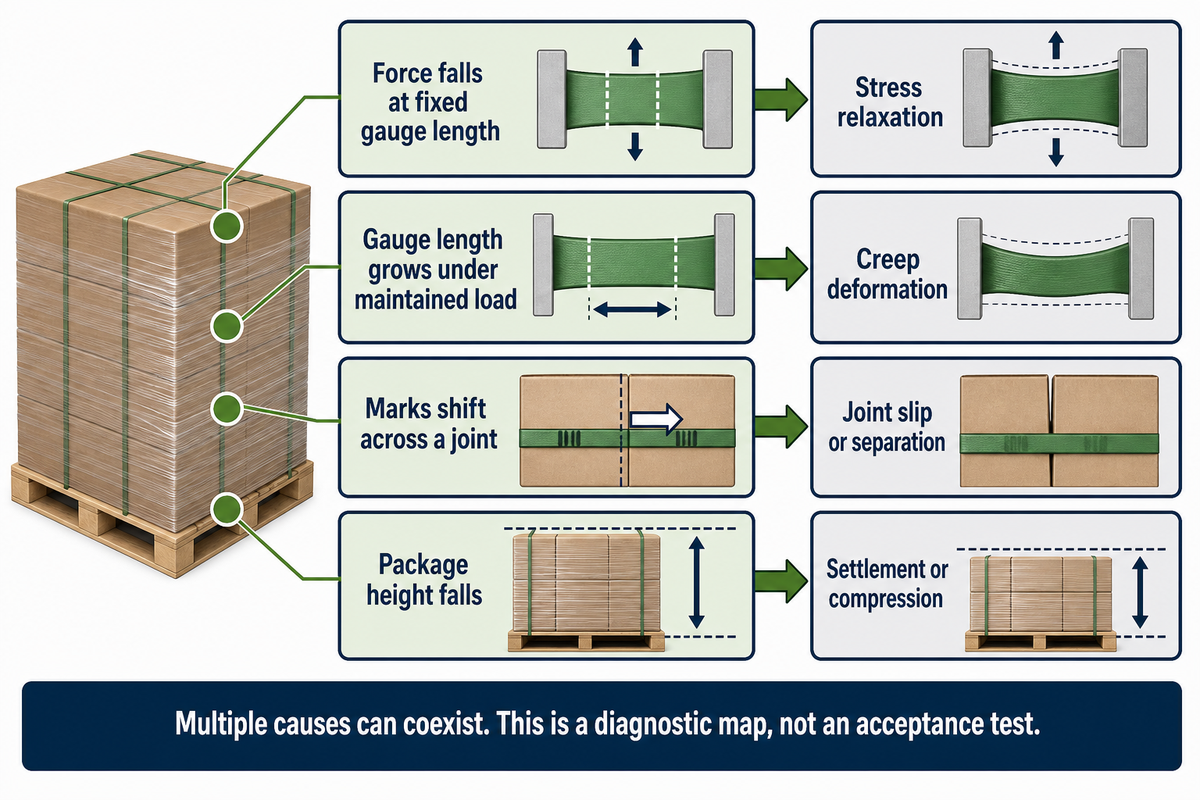
PET and PP strapping should be assessed as part of the package, with separate observations of strap force, gauge length, joint movement and load dimensions. A loose loop does not identify one creep mechanism. Initial applied tension, retained tension after joining, and subsequent force readings represent different states of the system.
The public preview of ASTM D4675’s strapping guide recognizes expanding, rigid, and settling packages. It also explains why strap recovery can not exceed prior extension. Low force decay alone therefore does not establish that a strap can take up substantial package shrinkage.
| Observation type | Possible explanation | Next measurement |
|---|---|---|
| Force falls at fixed gauge length | Stress relaxation | Force versus time at controlled extension |
| Gauge length grows under maintained load | Creep deformation | Strain versus time and temperature |
| Marks shift across a joint | Joint slip or separation | Relative joint displacement |
| Package height falls | Settlement or compression | Height and perimeter during storage |
| Force drops when the tool is removed | Application or joint-setting loss | Applied versus initial retained tension |
| Changes follow heating and cooling | Thermal and time-dependent effects | Temperature with force and dimensions |
| Movement concentrates at a corner | Local indentation or damage | Corner geometry and local strap condition |
| A joint looks sound but fails early | Insufficient joint performance | Application-specific joint testing |
| The loop is slack, history unknown | Several mechanisms remain possible | Repeat a controlled, instrumented trial |
This matrix organizes observations; it is not a validated acceptance test and multiple causes may coexist. ASTM D4675 supports the package and joint distinctions. ASTM D3950-23 separately addresses nonmetallic strap properties and applicable joint strength.
A good application example comes from the Cotton Council’s posted PET bale-tie specifications. For the specified gin universal-density bale application, average strap breaking strength must reach at least 2,400 lbf, average joint strength at least 2,200 lbf, and elongation at 1,000 lbf tension should not exceed 4%. Each value answers a different question. A purchasing comparison that shows only breaking strength doesn’t answer the other two questions. The specification also binds the strap to the joint system, and specifies manufacturing location and approved-list requirements. These are application-specific requirements, not generic pallet limits or evidence that UD Packaging is approved for that program.
Published strapping comparisons also need care. US5772944A’s oriented-strapping patent compares particular products under unequal stresses. Its observations belong to that disclosed process and test context. They don’t establish a universal material ranking or describe UD Packaging’s own measured performance.
How to Minimize Creep Without Guessing a Service Life
Reducing creep starts with the stresses, temperatures and geometries that govern movement. A lower working stress, better-supported plastic parts or a suitable material grade can help address deformation. The change still needs testing against the end point. Increasing the initial strap tension can add compression or joint loading and may not solve the issue.
Do
- Measure the variable that defines failure.
- Test the intended material and joint.
- Keep environmental and loading records.
Don’t
- Use tensile strength as a lifetime prediction.
- Apply an unrelated resin ranking to a strap.
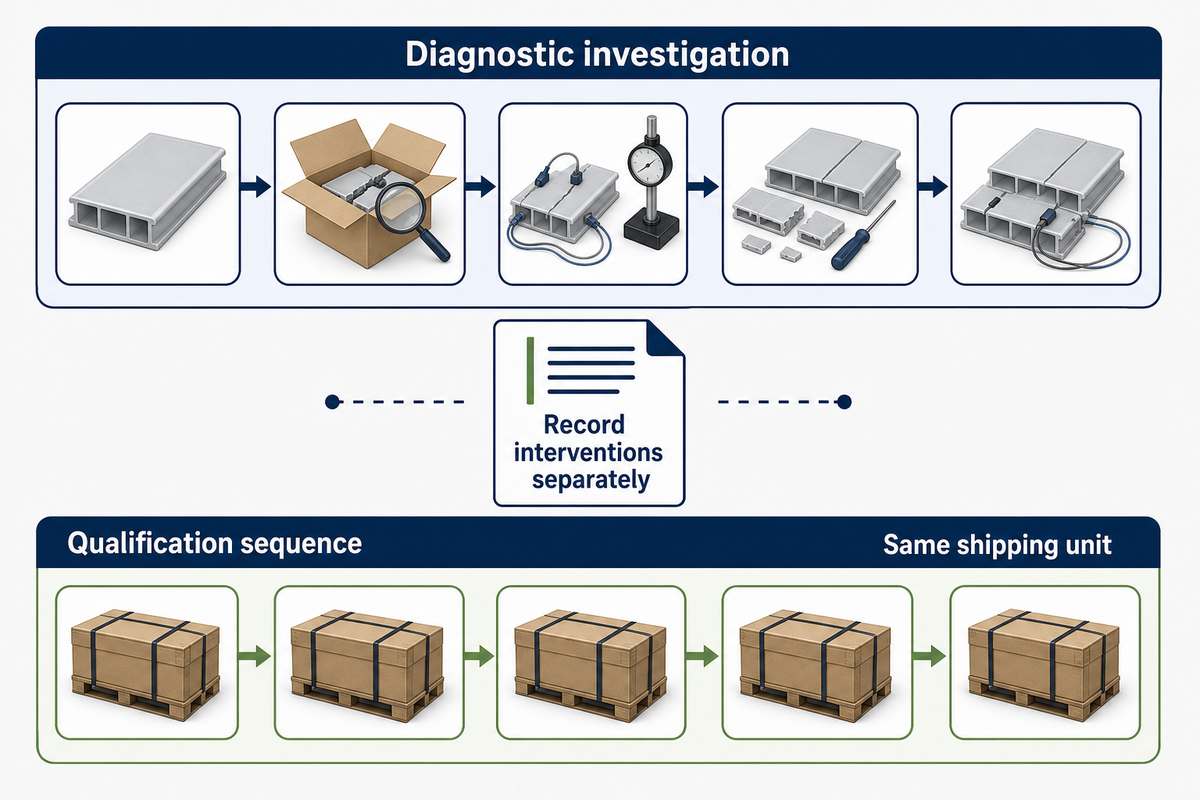
- Retension a trial without recording the intervention.
Results That Do Not Justify a Material Change
An apparent improvement after retensioning, an interrupted loading history, may give a false sense of security. An increased breaking load may not represent the gradual deformation process for the working load. A fitted curve outside its measured temperature and time range needs a justified extrapolation method. Check both a simulation and a hand calculation against measured force or deformation, even when the two agree. Verify premature failure against the original loading record prior to using a substitute material.
In failure analysis, a development team can inspect a settled package, measure its changed perimeter and rebuild an instrumented trial. A formal distribution performance test, for example, as described in ASTM D4169’s public guidance, calls for the sequence to use the same shipping unit, which must be left unopened until the test is completed. Opening the package midway can prevent evaluation of closure effects. Diagnostic interventions must be documented separately from a qualification sequence. Have the laboratory decide the test plan. The outcome from the rebuilt package must not be substituted for the interrupted one in silence.
Turn a Creep Requirement into a Testable RFQ
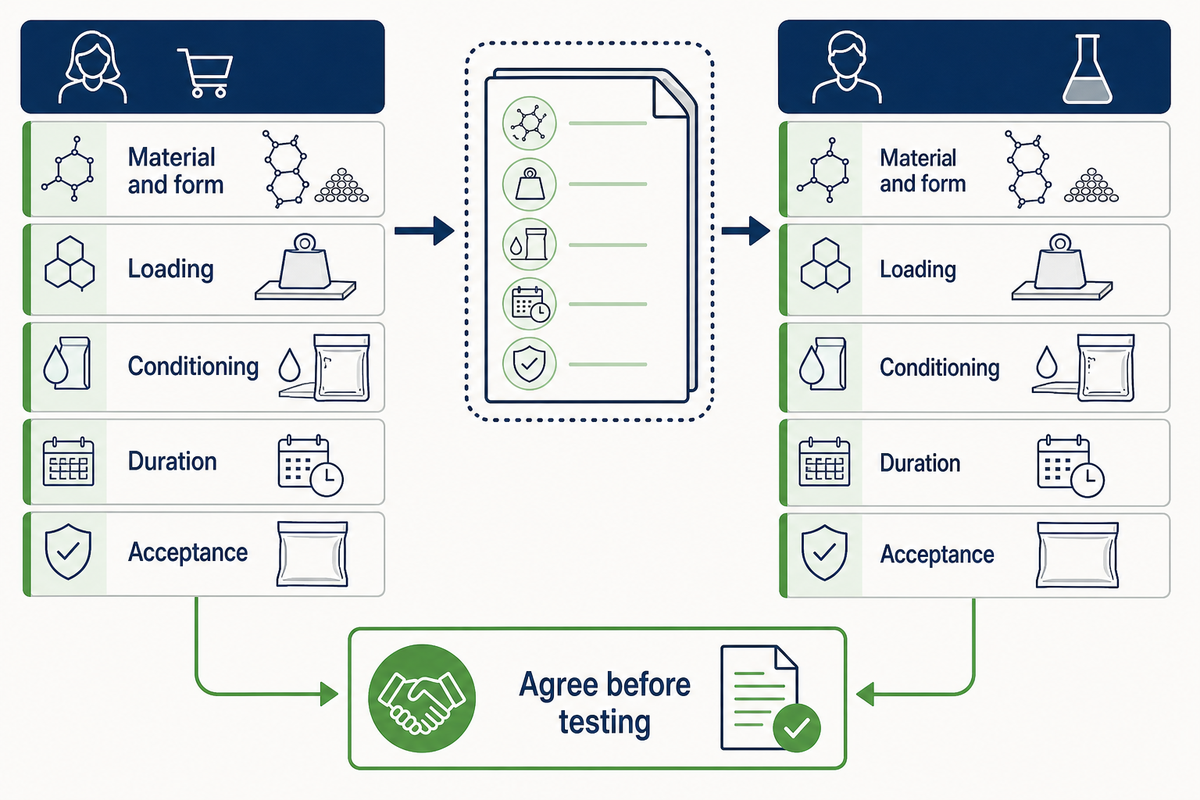
A testable quotation request names the finished product, expected loading and the result that must remain acceptable. A PET strap price is only comparable when the product and the scope of the test are defined. Procurement needs comparable reports; quality teams need measurable endpoints; plant teams need a repeatable application. Defining those brings missing evidence to the attention of the potential supplier prior to agreeing to a material change or production trial.
Copy the five fields into a request using the actual application values, with preparation and measurement conditions informed by the ISO 899-1 method scope. No generally recommended range is applicable to all pallet loads.
| Parameter | Recommended range | Why it matters | How to verify |
|---|---|---|---|
| Material and form | Exact grade; finished width and thickness in mm | Processing and geometry affect response | Identify the tested product and batch |
| Loading | Project-specific N or MPa; fixed-load or fixed-length condition | Separates creep from relaxation | Check fixture and recorded force |
| Conditioning | Actual °C and humidity interval; aging time | Controls environmental and history effects | Review preparation and exposure records |
| Duration | Required storage and transport hours | Separates measured coverage from extrapolation | Request timed curves and raw endpoints |
| Acceptance | Application-specific mm movement or N force floor | Defines the function being protected | Agree specimen and whole-package checks |
Illustrative buyer request: “For our proposed PET strap, quote a fixed-length force-retention trial at 50 °C for 720 hours. Report starting and final force, joint movement and the entire time record. Provide coupon data separately; identify finished-strap and joint specimens; propose a whole-package validation plan for our load. We will agree the required minimum force and package-movement limit with the laboratory before testing.” These settings are purchaser-defined examples. An incomplete report with no agreed acceptance limit cannot establish a pass.
Use the evidence checklist to identify and organize supporting documents. UD Packaging offers PET straps and other industrial packaging materials. Share the load, joint method and storage conditions to discuss suitable samples and the evidence required for a trial.
Check out UD Packaging’s plastic materials or contact them to discuss your strapping application.
Frequently Asked Questions
Is creep plastic deformation?
Partly: creep in a plastic can include recoverable strain and irreversible plastic deformation, and Penn State’s materials course notes that a polymer usually keeps some permanent deformation after unloading.
The word plastic identifies the material in this phrase. It does not mean that every part of the time-dependent response is permanent. An unloaded polymer can recover immediately and then continue recovering more slowly. Compare the loaded curve with a timed recovery record before describing the remaining change as permanent set. Recovery depends on the material and loading history.
What is creep rupture?
Creep rupture is fracture after a period of sustained loading.
The test must define the applied stress, temperature and recorded fracture time. A sample that reaches a chosen deformation limit has not necessarily ruptured. Likewise, a loose strap can indicate lost restraint while its material remains intact. Report fracture, dimensional failure and loss of required force as separate endpoints when they represent different functions in the application.
How long does creep last?
Creep can continue for as long as the load stays on, at a rate set by the material and loading conditions.
A test lasting 1,000 minutes establishes observations over that interval, not a guaranteed lifetime. Deformation can continue during sustained loading, and delayed recovery can continue after unloading. State the intended service period and acceptable movement before requesting data. Longer predictions require a justified model and validation, especially when temperature, moisture or the loading history will change in service.
Do all plastics creep?
Yes, to some degree: Penn State’s materials course names creep as a time-dependent property of polymers, but its engineering importance differs by grade and conditions.
When creep occurs, the relevant question is whether measured movement exceeds the application’s limit. A material described as resistant to creep still needs a stated stress, temperature and duration. Use its long-term curve rather than assuming that the label guarantees zero deformation.
Why is laboratory creep testing important?
Laboratory creep testing measures time-dependent behavior that a short tensile test cannot establish.
Controlled loading and temperature let a laboratory compare specified materials and distinguish immediate extension from later movement. The report should identify preparation, conditioning, gauge measurement and the endpoint. Ask which observations were measured and which were extrapolated. For packaging, extend the evidence to the finished strap, its joint and the intended load. A laboratory specimen result is useful input to that decision, but it does not by itself show how a complete pallet will behave through a distribution sequence.
Is Creep Harmful?
Creep becomes a problem when time-dependent movement prevents the part or package from doing its job.
Small movement can be acceptable within a defined allowance. Excessive deformation can change fit, alignment or restraint. Define the limit in a measurable quantity, such as displacement or retained force, rather than rejecting every detectable change in shape as a failure.
What is an example of creep?
A polymer specimen that continues to lengthen under a maintained tensile load is an example of creep.
For an illustrative measurement, a gauge initially 100 mm long that reaches 102 mm has 2% total engineering strain. The immediate loaded reading is needed to separate the delayed increment. A package strap getting loose is less specific: relaxation, joint movement and package settlement can produce a similar visible result. Track force and geometry before assigning a cause. Neither this arithmetic example nor a photograph supplies the material curve needed to predict future movement under the intended loading conditions. Request both the loading curve and the recovery record from the same defined specimen as the next step.
References & Sources
- Penn State: Creep and Stress Relaxation
- Slouf et al.: Indentation and Tensile Creep of Polymers, 2023
- Otsuki et al.: Polypropylene creep research, 2025
- National Institute of Standards and Technology: Physical Aging Behavior of Amorphous PEN Film Measured by Creep
- ISO 899-1:2017 public scope and status
- ASTM D2990: public scope and significance
- ASTM D4675: Selection and Use of Flat Strapping Materials, public preview
- ASTM D3950-23: Nonmetallic Strapping and Joining Methods
- National Cotton Council: Specifications for Bale Ties
- US5772944A: Oriented Strapping, public patent record
- ASTM D4169: Shipping Container and System Tests
Evidence Behind This Guide
XCX prepared this guide for UD Packaging using published creep research, public standard scopes and packaging guidance. The comparison worksheets translate those sources into questions for material selection and testing. UD Packaging’s role here is an industrial packaging supplier; this article reports no company creep trial, customer failure rate or laboratory certification. Illustrative dimensions are labeled separately from published measurements.