
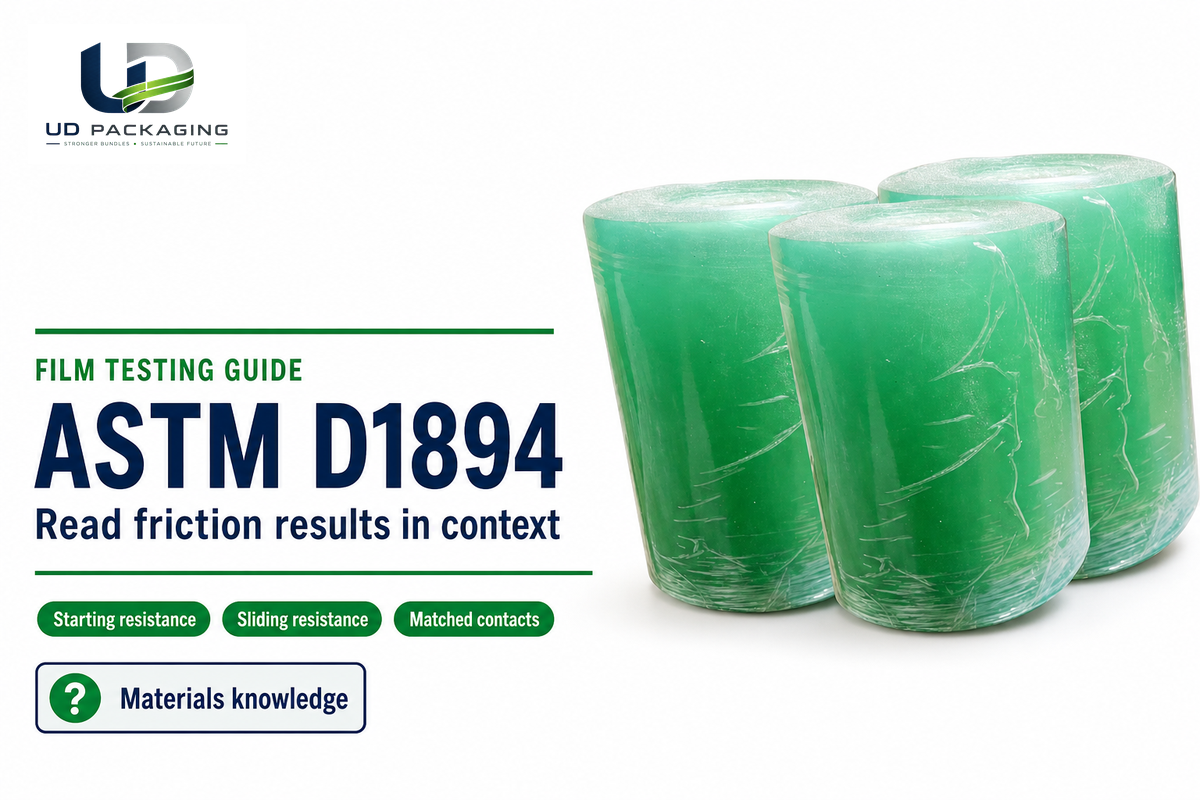
ASTM D1894 measures resistance as plastic film begins to move and continues to slide against another surface. A supplier’s coefficient means little until you know which film faces touched, how they moved, and how the laboratory extracted the result.
Updated October 2026
ASTM D1894 is a standard test method for static and kinetic friction of plastic film and sheeting. Static describes starting resistance; kinetic describes sliding resistance. Compare results only after checking the method, contacting surfaces and conditions.
Quick Specs
- Scope: plastic film and sheeting when sliding against itself or another substance.
- Outputs: static and kinetic coefficients, both dimensionless.
- Calculation basis: frictional force divided by normal force, using matching force units.
- Current listing: ASTM International identifies D1894-24 as active.
TL;DR
- Lower friction doesn’t automatically mean better packaging performance.
- Film-to-film results can’t substitute for every film-to-machine contact.
- Starting resistance and sliding resistance need separate readings.
- ASTM D1894 and ISO 8295 results are not directly interchangeable.
What ASTM D1894 Measures
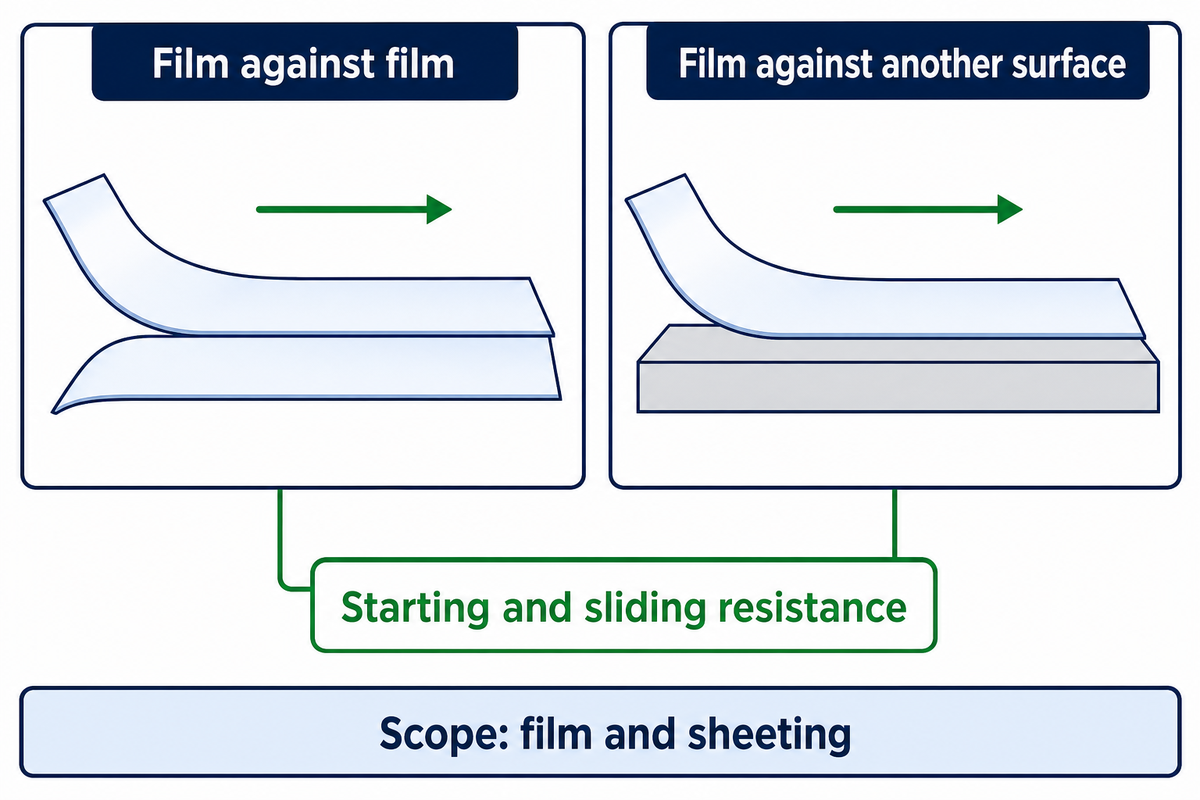
ASTM D1894 assesses the resistance to sliding of plastic film and sheeting against itself or other substances at specified test conditions. The test measures the resistance of a surface to starting movement as well as the resistance to continuous movement. The scope of the test is limited to film and sheeting, regardless of the testing equipment used.
The ASTM publisher’s current listing identifies D1894-24 as active. The method for static and kinetic friction produces empirical results: coefficients of friction of plastic depend on the tested contact. Friction in plastic packaging is therefore not one fixed property of a resin name. Use film testing methods and their measured properties to separate friction from tensile or barrier questions.
Has ASTM D1894 been discontinued?
ASTM D1894 remains available in its active D1894-24 edition. A standard search for ASTM D1894-14 refers to an older version of the standard; this does not prove the entire standard has been withdrawn. If a supplier cites the D1894-14 standard test method, resolve the requested edition before accepting the report.
When a laboratory states, “per ASTM”, the designation and edition must also be provided. Deviations from the standard should also be stated. Check that the test specimen and test conditions in the report meet the requirements of your request, rather than relying on the standard name.
Static and Kinetic Friction on a Force Trace
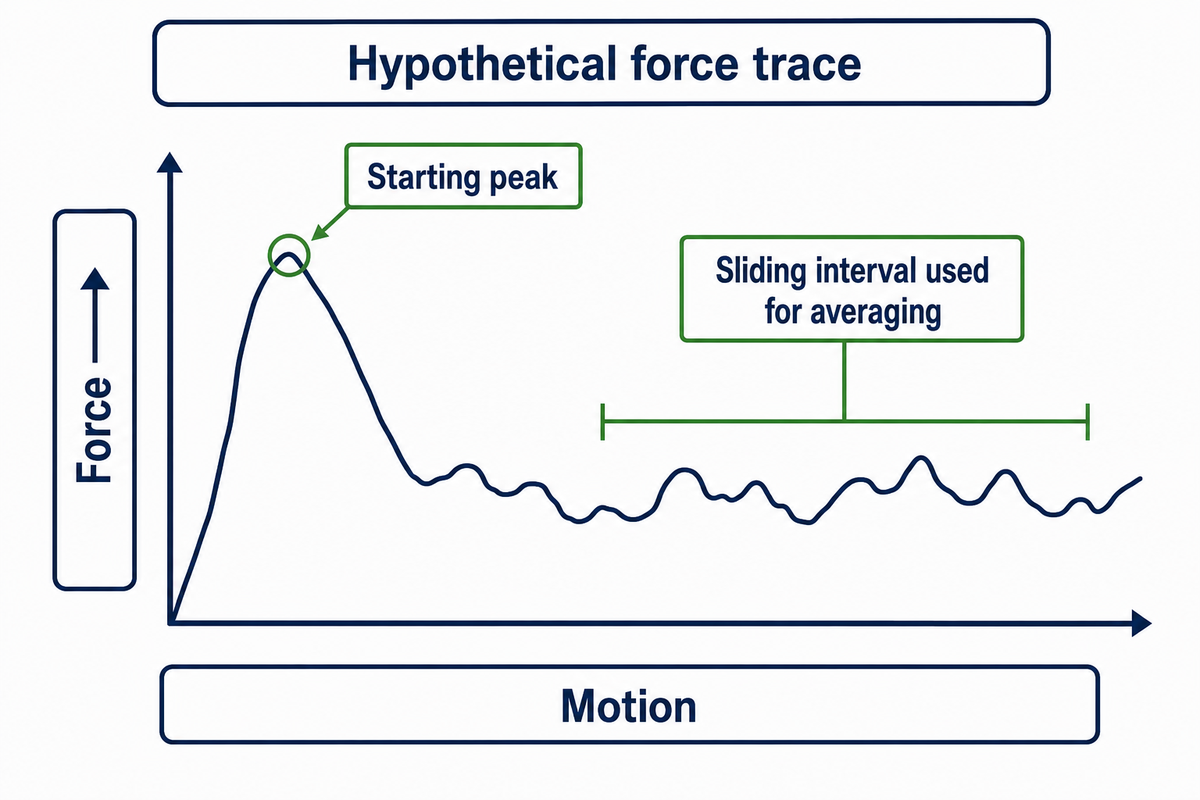
The difference between static friction and kinetic friction is that static friction refers to the force required to initiate sliding while kinetic friction is the force that arises during sliding. A force trace separates the starting peak from the sliding interval used for averaging. Reports that identify neither interval leave the reader unable to reconstruct which resistance the reported coefficient describes.
A coefficient of friction tester uses a load cell to record pulling force. ASTM’s public guidance identifies controlled motion between the two surfaces as an influence on results.
Hypothetical scenario: A converter receives two traces with the same 0.40 N sliding average. Trace A starts at 0.60 N, and trace B starts at 0.80 N. Both averages were calculated over the same declared sliding interval, with equal normal loads. The procurement staff states the films can be treated as equivalent because the kinetic friction coefficients are the same. The quality staff doesn’t agree and retains the starting peaks. They ask for the pre-motion contact time and the unfiltered trace before deciding whether the difference belongs to the film or the test setup. Two traces with the same sliding average don’t mean the starting behavior and the line performance of the films are the same.
Test events can happen rapidly. A high data capture rate can help retain key peaks and troughs. To measure the peak accurately, acquire and filter the data to preserve the peak, as opposed to using parameters to find and remove the peak. Different coefficient of friction values, including the coefficients of starting and sliding friction, can be attributed to different stages of starting and sliding friction. Static resistance need not always exceed kinetic resistance.
Calculate the Coefficient of Friction Correctly
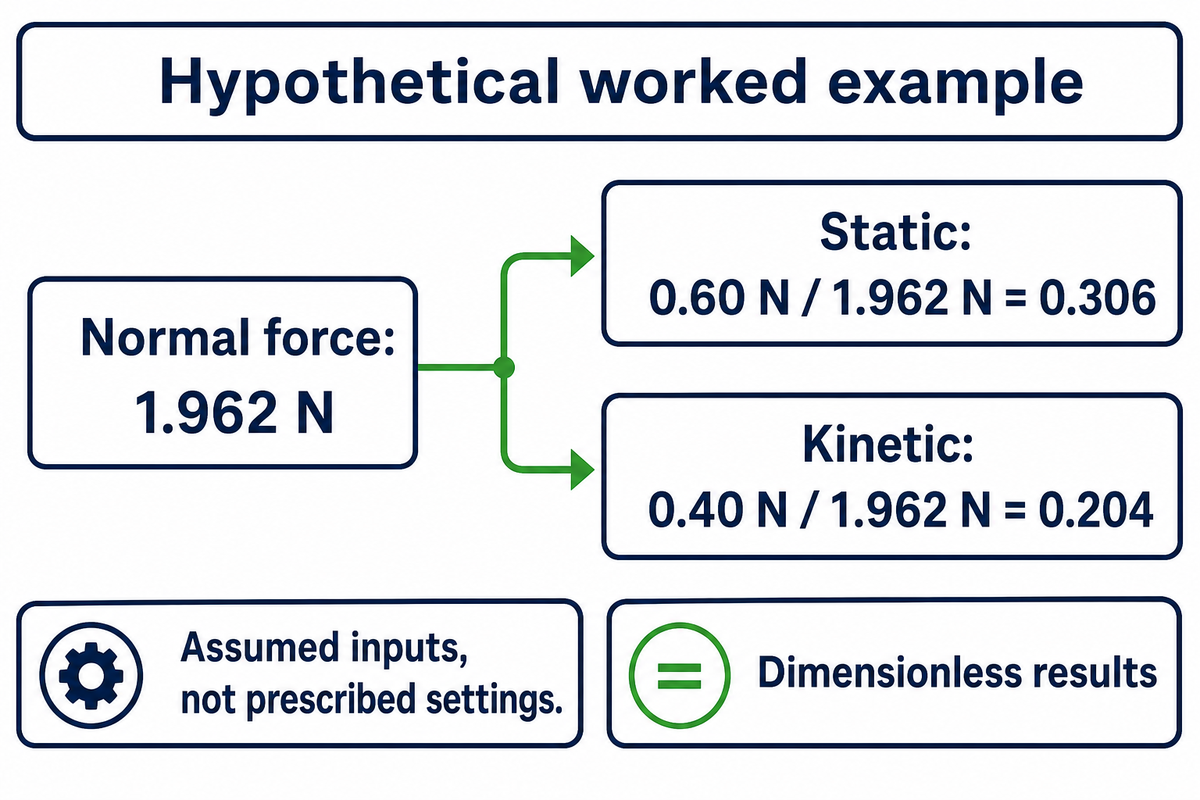
The coefficient of friction is the ratio of the force of friction required to move one surface over another to the total force applied normal to those surfaces, making it a dimensionless number. Both quantities should be expressed in the same units of measurement. For a level arrangement supported by gravity, calculate normal force from the total supported mass and gravitational acceleration; dividing a reading in newtons directly by grams gives the wrong quantity.
How is the ASTM D1894 coefficient calculated?
The static coefficient of friction is calculated by dividing the starting force by the normal force. The kinetic coefficient of friction (kinetic COF) is calculated by dividing the sliding average force by the normal force. The ratio is dimensionless.
Hypothetical worked example: A technician reviews a level sled arrangement with an assumed total supported mass of 0.200 kg. Using gravitational acceleration of 9.81 m/s² gives a normal force of 0.200 kg × 9.81 m/s² = 1.962 N. The starting peak is assumed to be 0.60 N, and the average over the laboratory’s declared sliding interval is 0.40 N. Dividing each force by 1.962 N produces 0.306 static and 0.204 kinetic, rounded to three decimal places. Neither coefficient has a force unit. The technician records the interval alongside the average so another reviewer can reproduce the calculation. These inputs illustrate arithmetic; they aren’t customer measurements or a prescribed sled mass.
| Output | Numerator | Denominator | Result |
|---|---|---|---|
| Static | Starting peak: 0.60 N | 1.962 N | 0.306 |
| Kinetic | Sliding mean: 0.40 N | 1.962 N | 0.204 |
Source: editorial arithmetic with assumed inputs, illustrating the outputs named in ASTM’s public method description. Grams-force (gf) measure force; grams (g) measure mass. Confirm the tester’s unit before transcribing coefficient of friction values.
Specify Film Surfaces and Test Direction
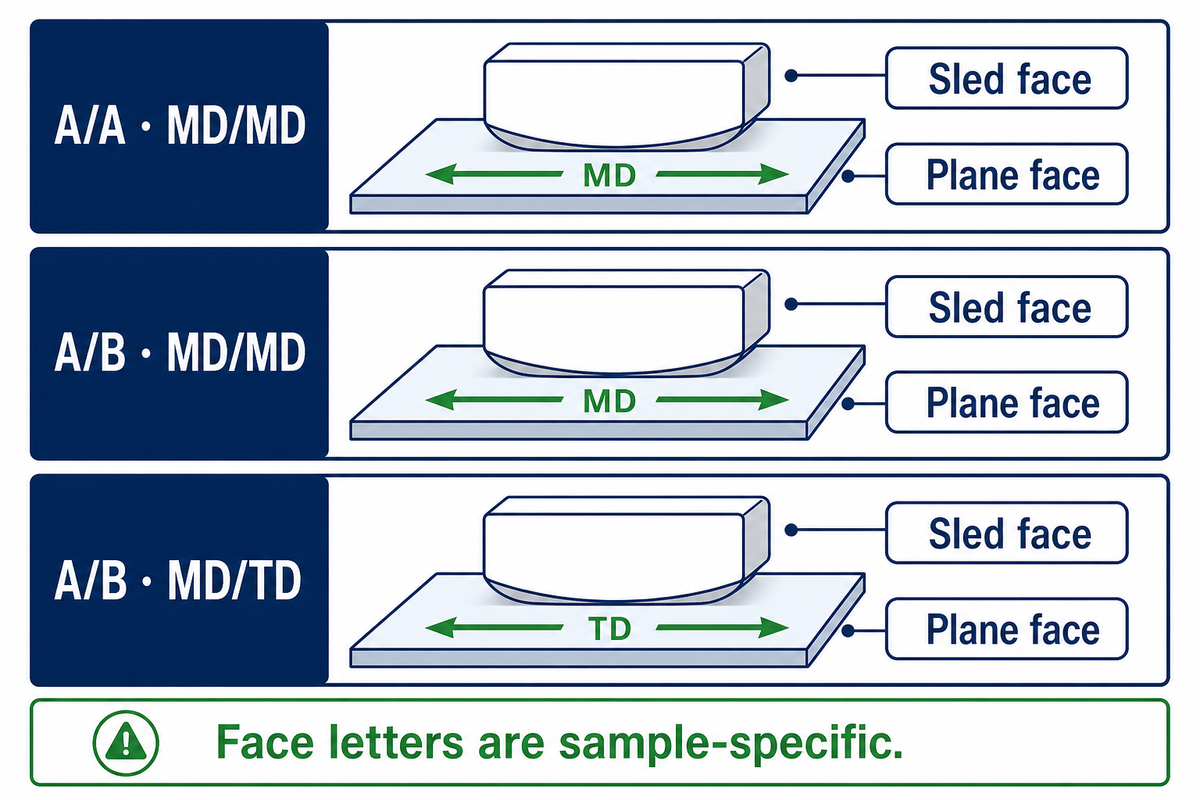
Resolving unresolved fields is important before determining which supplier’s material has the lower friction coefficient. Record the two contacting faces and the sliding direction on each specimen. For the unresolved fields ‘outside MD,’ outside doesn’t define treatment or chemistry of the layers. One directional label also doesn’t define sliding for both specimens.
Mark faces A and B on each film’s own identification sketch. Record machine direction and transverse direction on both specimens relative to sliding. In their 2021 study of biodegradable films and polyethylene, Sikora, Majewski and Puszka reported directional differences and substantial result scatter. Their ISO-based study supports this caution, not ASTM setup requirements.
Contact-Pair Comparison Ladder
The Contact-Pair Comparison Ladder is an editorial tool to classify reports according to the method, contacting faces, directions and conditions prior to numerical comparison.
| Type | Declared contact | Review action | Limitations / Not suitable for |
|---|---|---|---|
| Matched film pair | A/A; MD/MD | Check conditions next | No automatic cross-film equivalence |
| Cross-face pair | A/B; MD/MD | Keep separate | Not interchangeable with A/A |
| Reverse cross-face | B/A; MD/MD | Preserve sled/plane order | Cannot silently relabel A/B |
| Other face pair | B/B; MD/MD | Confirm face chemistry | Face letters are sample-specific |
| Cross-direction pair | A/B; MD/TD | Separate from MD/MD | Not a pooled direction result |
| Transverse pair | A/A; TD/TD | Retain direction label | Not a substitute for MD/MD |
| Metal contact | A/steel; MD/plate | Identify finish and cleanliness | Not film-to-film contact |
| Unmapped faces | Outside/outside; MD/MD | Request the face key | Treatment remains unknown |
| Incomplete direction | A/A; MD/not reported | Clarify opposing orientation | No directional comparison yet |
Source: The editorial classification relies on ASTM’s contact scope and the cited direction study. Passing each check makes a report eligible for closer scrutiny; it does not provide validation for this framework or ensure its reproducibility.
Why the Same Film Can Give Different Results
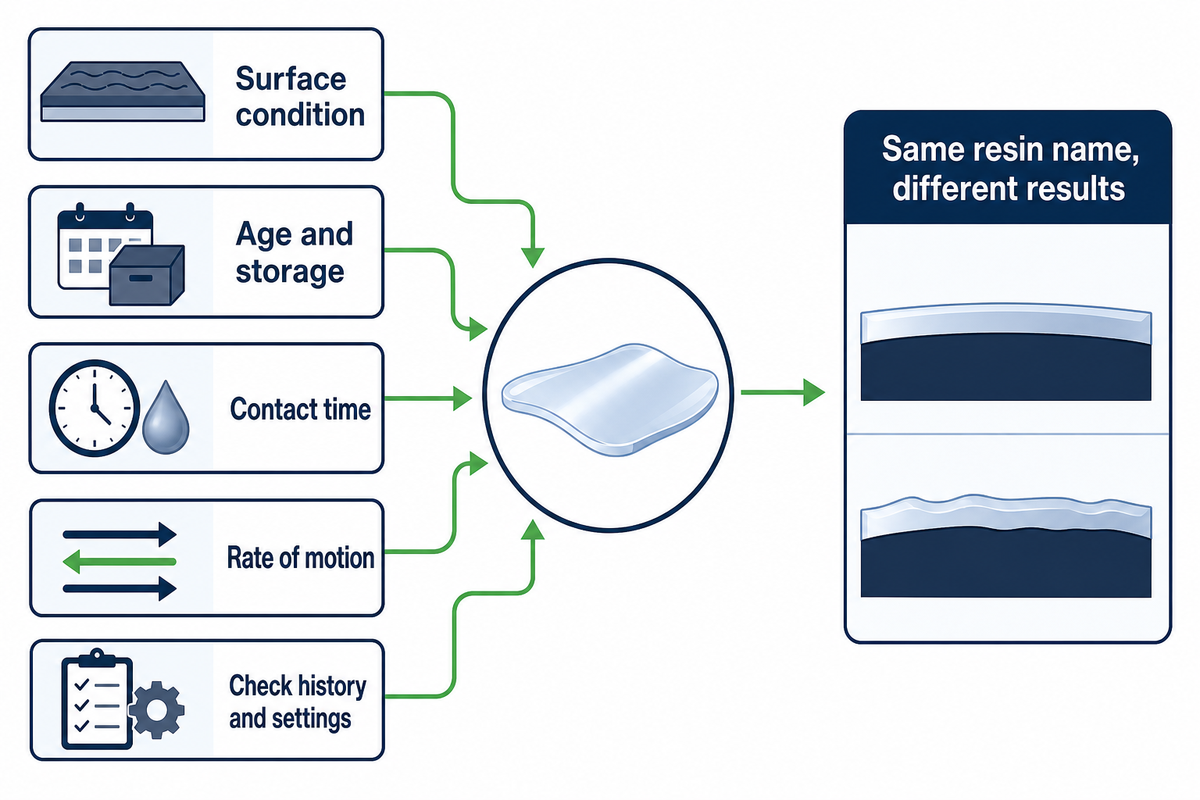
The frictional properties of plastic film can change with many variables including: surface condition, age, and previous contact history. Two films with the same resin name can therefore give different results; ASTM notes surface properties follow the equipment and its running conditions, even between machines using one process. Discrepancies between test dates will require a review of the film specimen history and the apparatus settings before film production can be blamed for the change.
ASTM’s public guidance identifies time-dependent additive blooming, imperfect surface uniformity and sensitivity to the rate of motion. Pre-motion contact time can affect starting resistance due to blocking. Sliding friction of plastic film requires control of the uniformity of the rate, as opposed to an operator’s assessment of steady hand movement.
Slip properties can develop when additives migrate to the surface. In the 2006 article on polyolefin slip agents published in Plastics Technology, S. Savargaonkar of additive supplier Ampacet described migratory and non-migratory approaches. Savargaonkar notes that with amide slips, most of the COF reduction in LDPE and LLDPE films occurs within the first day, so COF is usually measured 24 hr after extrusion.
Migration also need not proceed only outward. For example, in the publicly available abstract of Shuler, Janorkar and Hirt’s 2004 erucamide study, the authors describe a three-layer POP/LLDPE structure exposed to 55°C. Most of the observed reduction in surface erucamide came from migration back into the film, with a smaller contribution from decomposition. The temperature of 55°C describes an experimental exposure and isn’t a suggested friction-testing condition.
Keep conditioning and storage history with the film report. Record production date and surface handling separately. Friction values for a given sample can reflect its history; cleaning without a defined procedure may alter the surface being evaluated.
The example of 55°C erucamide limits any claim that older film must always become more slippery. A supplier explaining changed frictional properties should identify the formulation and exposure history behind the explanation. Without these facts, the change should remain an observation from one time period to the next, and a migration mechanism shouldn’t be assigned.
ASTM D1894 vs ISO 8295: Keep Results Separate
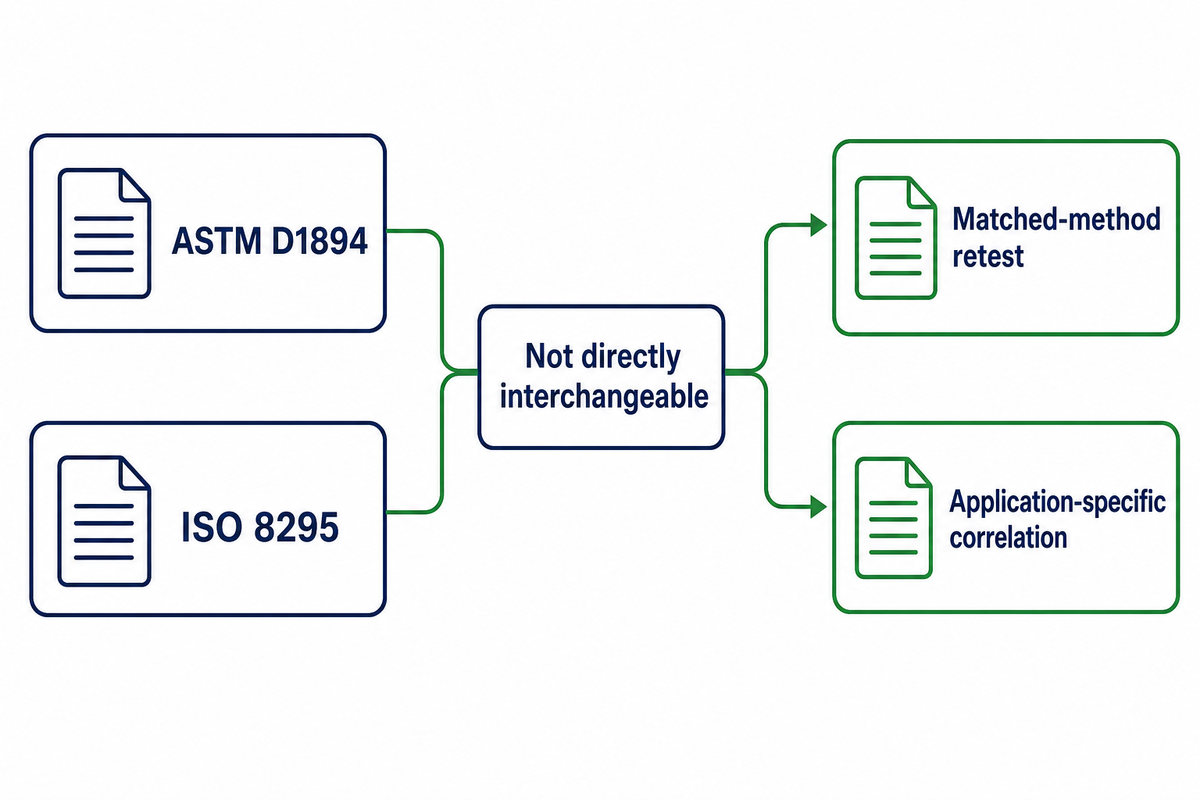
ASTM explicitly states that D1894 is not equivalent to ISO 8295:1995 and that results cannot be compared directly. Similar designs in fixtures and coefficient labels do not change this. For an ASTM request coupled with an ISO report, a matched-method retest or a justified and application-specific correlation should be requested.
ISO’s current publication record says ISO 8295:1995 was reviewed and confirmed in 2026. Confirmation does not make it a 2026 edition. Both test methods yield empirical data, and an internationally recognized method still needs an explicit edition in the purchase specification.
| Reports received | Disposition |
|---|---|
| Same method, edition and stated conditions | Review face identity, trace and scatter before comparison |
| ASTM request; ISO result | Request matched testing or a documented application-specific correlation |
| Method or edition missing | Resolve the omission before ranking results |
Source: ASTM’s published non-equivalence statement; dispositions are editorial guidance. One cannot purchase a testing machine that provides both types of measurements and expect to receive a conversion factor.
Build a Comparable Film Friction Test Request
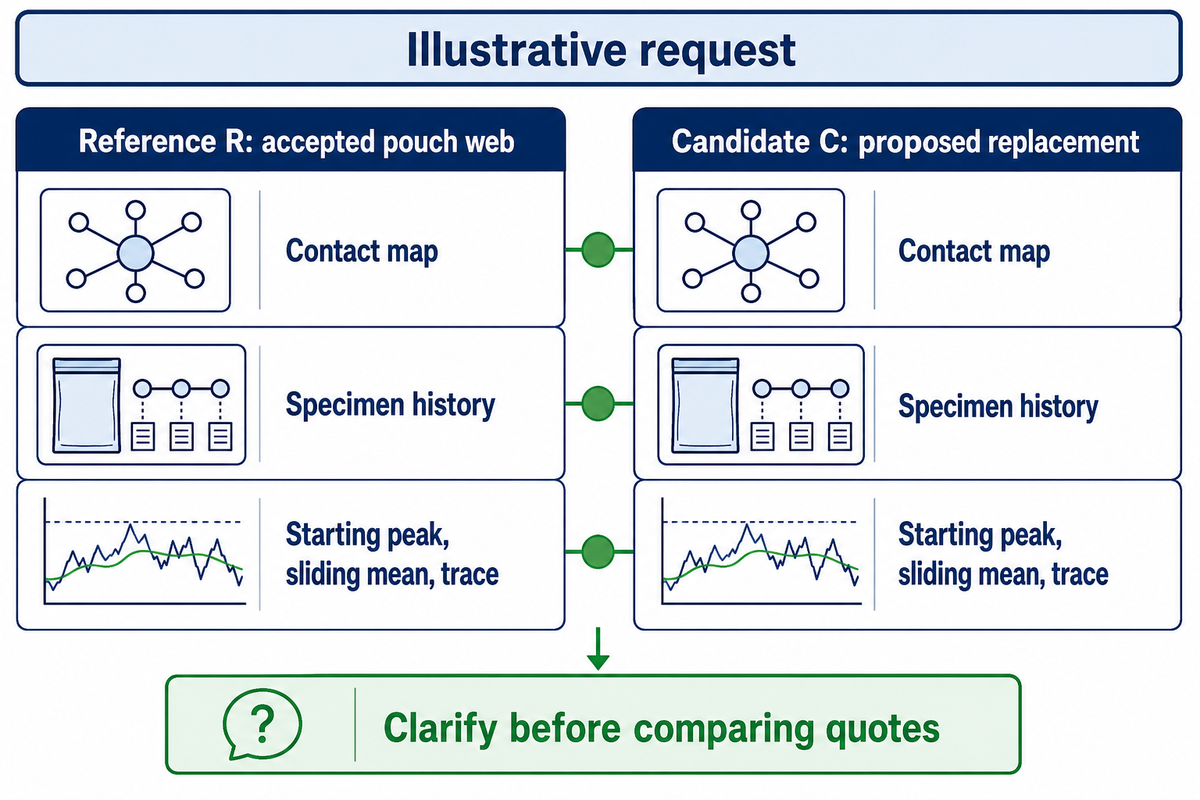
A useful film friction request identifies an accepted reference before asking a laboratory to examine candidates. Provide the contact map and specimen history and request that the laboratory confirm its settings and reporting fields. Missing information should prompt clarification before procurement treats the lowest quoted coefficient as the winning result.
Reference-First Friction Request Sheet
The Reference-First Friction Request Sheet is an aid to clear communication to identify a reference, candidate and the unresolved comparison fields.
| Field | Reference R | Candidate C | Action / limitations |
|---|---|---|---|
| Sample identity | R: accepted pouch web | C: proposed replacement | Illustrative IDs; attach lot records |
| Requested method | D1894-24 | D1894-24 | Laboratory must confirm procedure |
| Contact order | Sled A / plane A | Sled A / plane A | Match face function, not letters alone |
| Face identity | A: outside; treatment not reported | A: outside; treatment not reported | Obtain layer/treatment maps |
| Sliding directions | MD/MD requested | MD/MD requested | Confirm both specimens |
| Age and storage | Not reported | Not reported | Supply dates and exposure records |
| Environment and dwell | Not reported | Not reported | Request actual conditions and contact time |
| Load, speed, deviations | Not reported | Not reported | Laboratory confirms against edition |
| Requested outputs | Starting peak; sliding mean; trace | Same outputs and interval | No measured results supplied |
| Replicates and scatter | Count and individual results requested | Same reporting requested | Agree sampling; no universal count implied |
We synthesized the stated sensitivities in the ASTM documents with observations in the Sikora Study, which reported 5 repetitions and comparison-limiting scatter. The sheet is not an ASTM reporting checklist or a validated acceptance protocol.
Hypothetical scenario: A buyer requests COF testing for replacement pouch film C after reference R has run acceptably on the intended line. One quotation includes only a kinetic average; another includes starting resistance but leaves the contacting face unnamed. The buyer uses this sheet to obtain the same outputs from both labs prior to price comparison. The production team provides the face sketch and storage date, while the quality team defines the contact the investigation is about. The lab verifies the analysis method and conditions. At this stage, the finance team is in a position to compare quotes on the same work, even though neither quote provides evidence that candidate C will run acceptably. A production run, under control, remains necessary to provide evidence that candidate C will run acceptably.
See the specimen identification and report field guide for attachments. Define your quality testing needs before comparing laboratories’ testing solutions. UD Packaging’s knowledge site doesn’t provide laboratory services.
Use Friction Results in Packaging Decisions
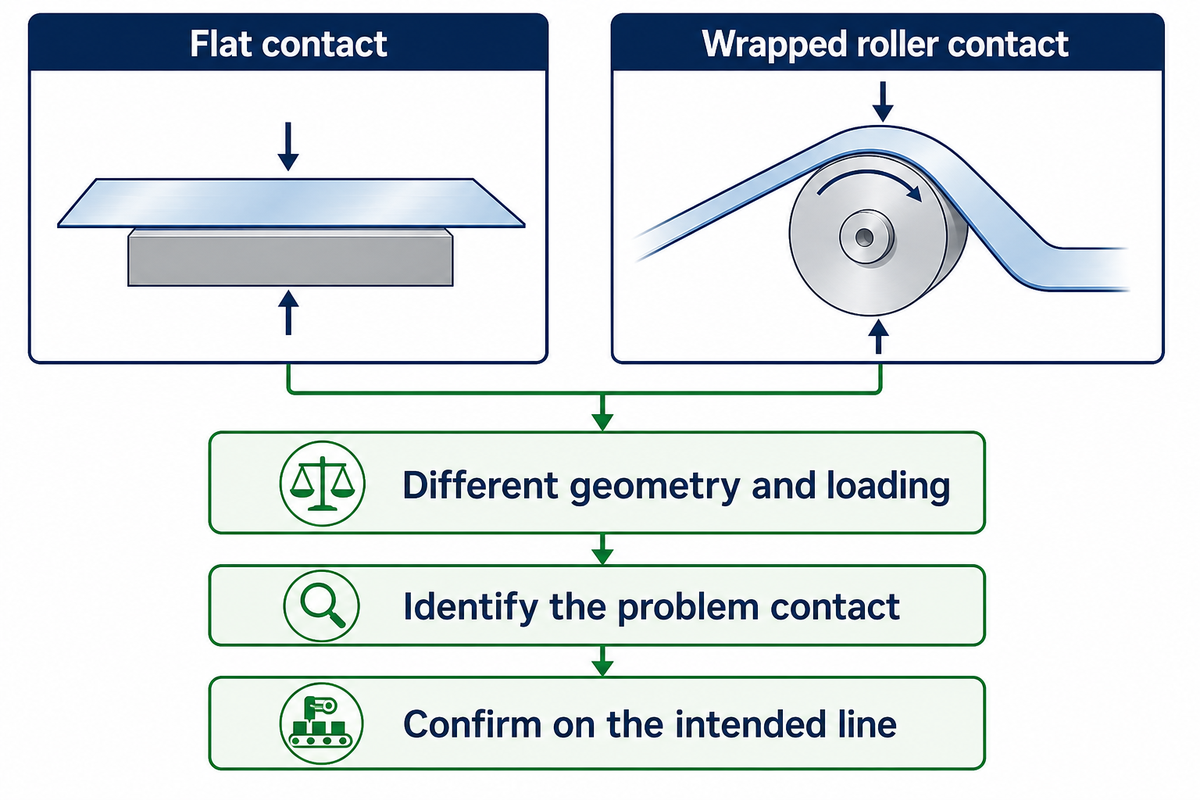
Lower friction can aid one sliding operation while reducing control in other operations in a packaging line. Identify your target (contact and failure) and compare candidates to a known running reference. The lowest coefficient of friction can’t determine suitability for unwinding, roller traction or finished pack handling.
Common failure modes when selecting by friction alone
For flexible packaging, Duane Smith of equipment supplier Davis-Standard explains inner-layer slippage and telescoping in his Plastics Technology winding article in 2015. Savargaonkar makes the same point for roll stock: slower slip diffusion is needed so the COF does not fall too quickly and cause winding difficulties and telescoping of rolls.
A flat film-to-metal result can’t fully explain web wrapped around a roller. ASTM G143-23 looks at friction between web and roller. Wrapped geometry and loading differ from a flat sled contact, even when the materials share the same names. Investigate roller slip or steering with an appropriate method and line evidence.
“Serves primarily for quality control”
ISO says friction is just one of many factors that determines machinability and does not assess it completely. Problems in the packaging industry may be related to the slip properties of films, but each contact needs investigation. For multilayer film, BOPP orientation and surface-layer roles help identify the contacting layer.
Do
- Identify the problem contact.
- Compare reference and candidate traces.
- Confirm handling on the intended line.
Don’t
- Rank every film by minimum friction.
- Pool different faces or directions.
- Substitute flat contact for roller geometry.
Frequently Asked Questions
Film friction questions are often of the form: what does a report allow you to conclude? Keep the stated scope of ASTM apart from instrument capability, sampling and acceptance policies. The answers below address those boundaries so a familiar method number does not become an unsupported promise about the finished package.
What environmental conditions should a film friction test use?
The method is based on 23°C; its option for other temperatures heats or cools only the plane while the sled stays at ambient, and the material specification can add conditions.
Record actual temperature, humidity and conditioning duration, rather than relying on the phrase room temperature. Ask the laboratory to identify deviations and distinguish conditioning from the environment during measurement. A heated plane also needs an explicit description: its temperature doesn’t establish that every part of the fixture or specimen has reached the same temperature.
Can a friction tester test materials other than plastic film?
A friction tester may accept other materials, but that does not expand ASTM D1894’s scope.
Check whether the tester is designed for the fixture and material you intend to assess. Paper or textile testing may require a different procedure even on the same instrument. Ask the laboratory to name the appropriate method before ordering work, and avoid treating a supported accessory or software preset as evidence that the chosen standard applies.
How often should film friction testing be performed?
Set testing frequency through your quality plan, customer specification and process-change risk.
A new lot, altered surface treatment or changed storage interval may justify additional checks. Quality control laboratories should keep comparison conditions consistent and retain a reference film history. Agree the sampling plan before ordering routine work, then review whether production changes warrant revising it. The method designation alone doesn’t set your factory’s sampling schedule.
Where can I get the ASTM D1894 standard?
Obtain the required edition from ASTM International or an authorized standards provider.
The publisher’s public page identifies the method and summarizes its scope. Obtain the complete procedure for a conformity claim. Equipment guides and this article help interpret reports, but they can’t replace the edition specified in your contract or test request.
What is a good coefficient of friction for packaging film?
For polyolefin film, amide slip additives let processors select a COF between 0.1 and 0.4; the right target follows from the contact and packaging operation.
Sliding across a guide plate, unwinding a roll and keeping finished packs stable involve different demands. Start with a film that runs acceptably on the intended line and record its contact map and test conditions. Compare candidates on the same declared basis, then confirm performance in the application before setting a numerical acceptance window. Preserve separate limits where contact pairs differ. A value copied from another resin, machine or published example can’t establish suitability for your packaging operation.
Does a higher starting peak mean the film is stronger?
No. A higher starting peak describes greater resistance to initiating sliding in that contact arrangement, not film strength.
The peak doesn’t measure tensile strength, puncture resistance or seal strength. Increased adhesion during contact time can affect starting resistance. Review the force trace and pre-motion dwell before interpreting the difference as a change in the film’s bulk strength.
Can I replace a production trial with a friction test?
A laboratory friction test can screen candidates, but it cannot reproduce every production contact.
A packaging line adds its own speeds, temperatures, surfaces and handling conditions. Use laboratory comparisons to narrow the candidate list, then assess the chosen film under the relevant operating conditions. Record the observed handling result beside the laboratory report so later purchasing decisions retain the application context. Where roller traction is the problem, investigate the wrapped contact separately. A matched flat-sled result remains useful evidence, but it can’t by itself establish acceptable roller behavior or finished-package handling.
Key takeaway
A film friction result belongs to a defined contact pair and test history. Establish those facts before comparing coefficients, then verify that the comparison addresses the production problem.
Next time you perform a film comparison, pick the accepted reference, mark both contacting faces and complete the request form with your laboratory. Use the UD Packaging plastic testing knowledge hub to correlate your friction results to other material testing and determine what report fields your purchasing decision is still contingent on.
The examples and comparison tools are editorial aids based on public sources. They contain no UD Packaging laboratory measurements and do not replace licensed standards or application testing. Historical studies are identified by year because their findings apply to the materials and conditions studied.
References & Sources
- ASTM D1894-24: Standard Test Method for Static and Kinetic Coefficients of Friction of Plastic Film and Sheeting, ASTM International, public scope and significance.
- Modern Biodegradable Plastics, Processing and Properties Part II, Sikora, Majewski and Puszka, Materials, 2021.
- Slip Agents: Extended Performance Range for Polyolefin Films, S. Savargaonkar, Plastics Technology, 2006; author affiliated with Ampacet.
- Fate of erucamide in polyolefin films at elevated temperature, Shuler, Janorkar and Hirt, Polymer Engineering & Science, 2004; public abstract.
- ISO 8295:1995: Plastics, Film and sheeting, Determination of the coefficients of friction, International Organization for Standardization, public abstract and publication status.
- Overcome the Challenges in Winding Flexible Packaging Film, R. Duane Smith, Plastics Technology, 2015; author affiliated with Davis-Standard.
- ASTM G143-23: Standard Test Method for Measurement of Web/Roller Friction Characteristics, ASTM International, public scope and significance.