Conditioning plastic film testing is the controlled preparation and documentation of a film sample before testing. Two reports can indicate that sampling conditioning has been completed, yet the sampling histories, the governing regulations, the environments, the duration of sampling, the interval between sample transfers, and the starting conditions may be entirely different.
The governing regulation determines the sample’s state of readiness, and conditioning is completed under that regulation. The regulation dictates control of the sample. It may be necessary to complete multiple conditioning runs to control the sample for transfer to the instrument. Completing this procedure allows the reporting of results. Equilibration of a sample does not, by itself, make the reported results comparable.
Conditioning Plastic Film Testing: The Short Answer
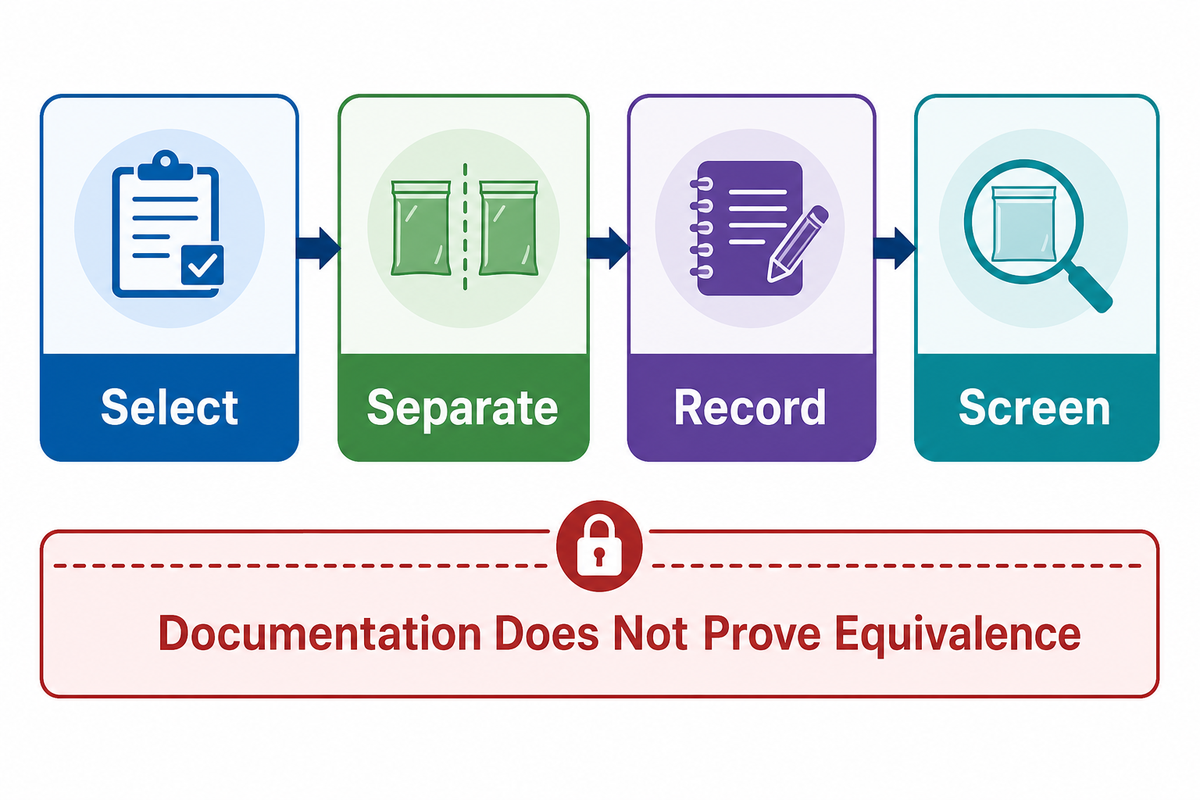
Documentation of a conditioning process does not prove that the film materially changed or became equivalent to another sample.
1. Select
Find the governing method, specification, contract, and approved procedure.
2. Separate
Keep prior exposure, routine conditioning, transfer, and test atmosphere distinct.
3. Record
Capture required values, actual observations, timestamps, excursions, and unknowns.
4. Screen
Check the full comparison chain before ranking results.
It is indicated in ASTM D618-21’s public document that “properties of plastic materials are influenced by atmospheric conditions of temperature and relative humidity.” On the other hand, ISO 291:2008 offers a generally constant atmosphere framework; however, it does not address special cases of atmospheres in a given test condition, material, or simulated climate.
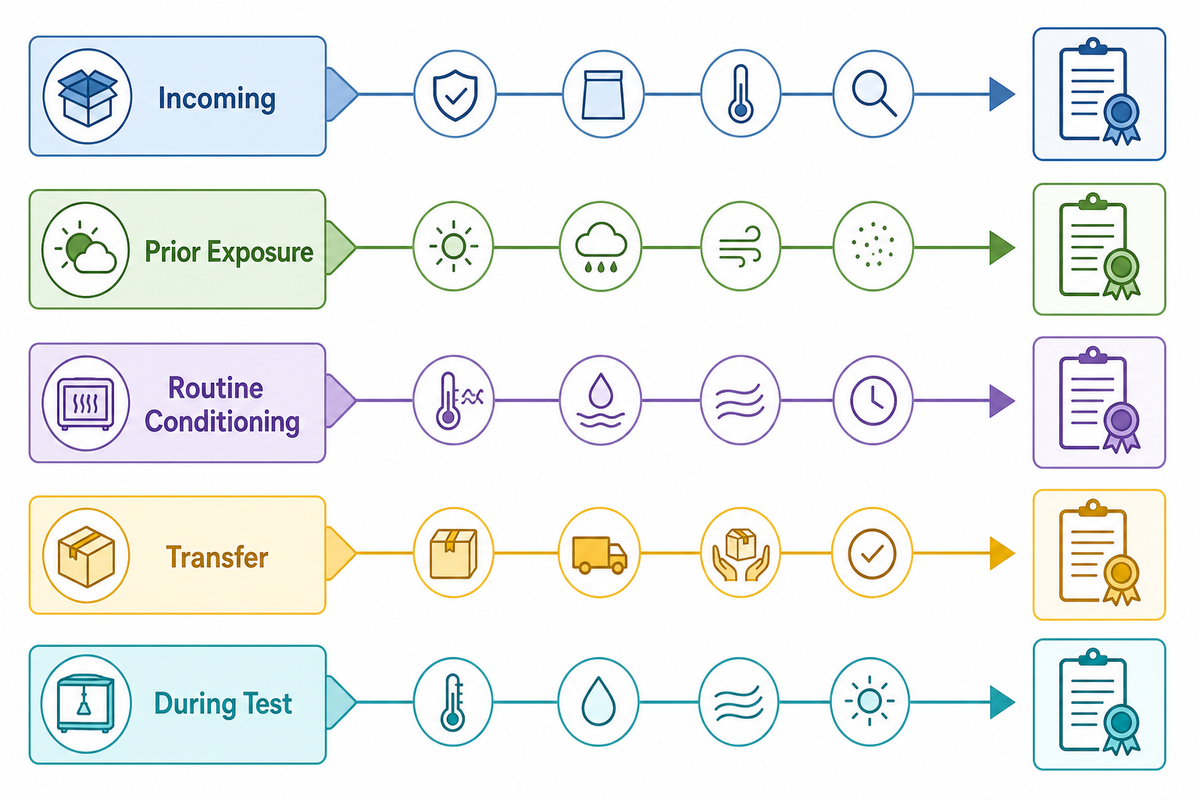
Film Condition Chain
The governing regulation and the identity of the sample determine the conditioning process.
The process is aborted if the governing regulation, the identity of the sample, or prior conditioning isn’t known.
What this guide does not decide
The guide does not decide whether an environment is appropriate for a specific film sample, approve a packaging material for a package, establish film quality, or replace the governing method, product specification, contract, and qualified laboratory procedure that define the actual test.
Start With the Governing Rule, Not a Default Number
That boundary matters: a standard temperature, humidity, or duration does not define the conditioning route, and assuming it does creates a comparison risk. Generally, conditions can vary based on the material or product specified. In such cases, precedence needs to be determined prior to constructing a record.
Publisher check: Confirm the current catalog record from ASTM International or the International Organization for Standardization, then obtain the licensed procedure your laboratory is authorized to use.
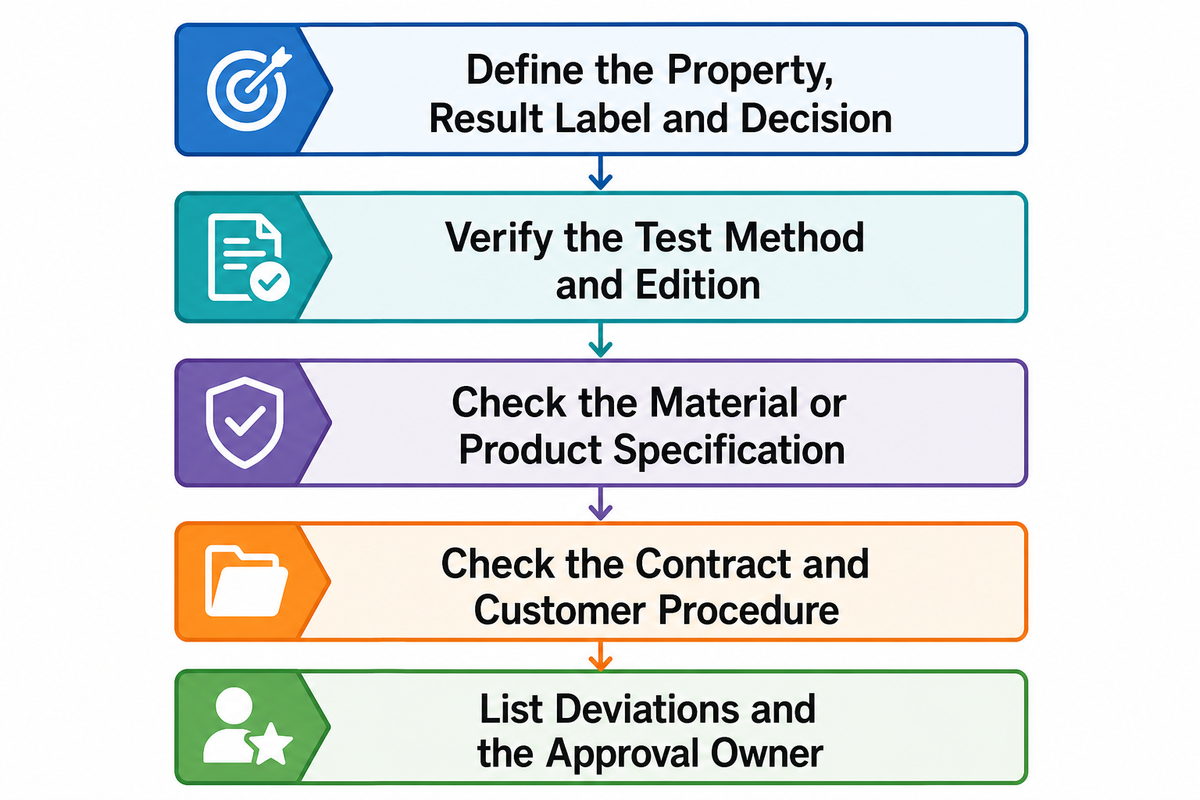
Define the property, result label, and decision.
Verify the test method and edition.
Check the material or product specification.
Check the purchase specification, contract, and customer procedure.
List deviations and the individual who can approve them.
Make the process documented in the license available at the site of use.
The ASTM D618-21 catalog page shows both cases of specifying material precedence and the variation in conditioning, especially in relation to service behavior. A record built to the incorrect specification creates an incorrect basis for comparison.
Separate Five Different Environmental Histories
A laboratory can describe routine specimen conditioning, but the specimen’s prior history may remain unknown. Unknowns remain.
State
Record
Do not call it
Incoming
Storage, transport, packaging, age, known excursions
Selected atmosphere, duration or endpoint, arrangement
Proof that earlier effects were erased
Transfer
Removal, handling, interim container, waiting time
Part of the chamber run
During test
Test-room atmosphere and required monitoring
Automatically identical to conditioning
Prior history creates a comparison risk because it can alter the specimen provided for testing. How the specimen responds depends on many factors including the property to be measured.
Material note: “Plastic film” is not one polymer condition. Formulation, additives, construction, thickness, conversion, and history can all limit how far a result may be generalized.
Build the Film Condition Chain Before the Clock Starts
Maintain specimen identity as long as the path to the sampled location can be reconstructed. Once specimens are cut and bagged, it becomes difficult to determine the actual history of the sample. Assumptions will have to be marked as unknown when the identity chain breaks.
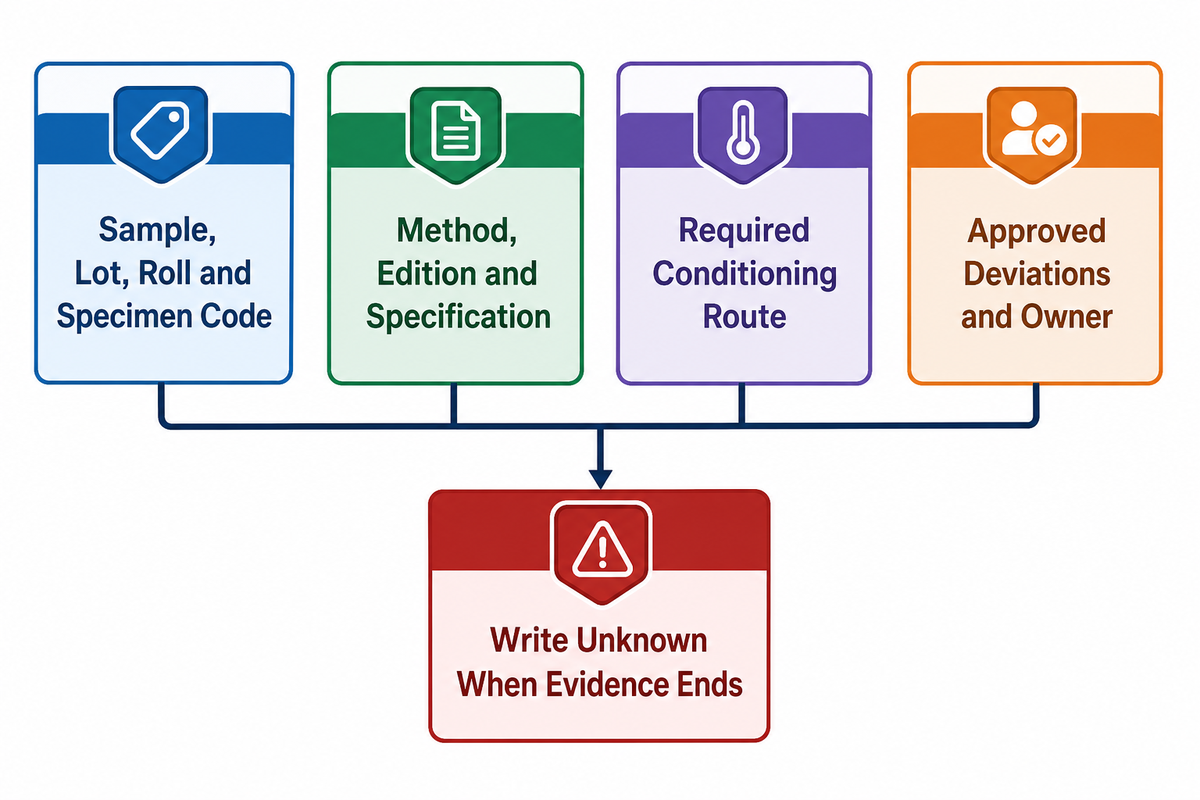
Copyable Conditioning State Card
Sample, lot, roll, and specimen code
Sampling point and film construction
Material designation, where known
MD, TD, or other orientation
Dimensions and thickness route
Incoming packaging and storage
Transport history and known excursions
Prior heat, moisture, cold, or UV exposure
Conversion or aging history
Method, edition, and specification
Required conditioning route
Approved deviations and owner
Record Rule: When evidence ends, write “unknown” to indicate the condition of the evidence is unknown. Do not make assumptions from absent casework labels, estimates, or staff memory.
The direction and thickness of the specimens, how they were prepared, and the test speed should be documented. While this document focuses on the conditioning of specimens, these elements of the test should be captured and identified as such. They are important when specimen comparisons are made.
Keep the scope boundary visible
While many variables can affect a tensile test, conditioning records don’t replace the tensile method or define tensile strength and other mechanical properties. For thin plastic films and flexible films, the extended conditions record should capture film thickness, material properties, the test machine, grips, extension system, specimen geometry, other test equipment, applicable standard test methods, and mechanical testing requirements.
Scope note: The same separation applies to flexible packaging and packaging film work: this guide supports material testing and packaging testing records without becoming a general catalog of test methods.
Run Conditioning as a Controlled State Change
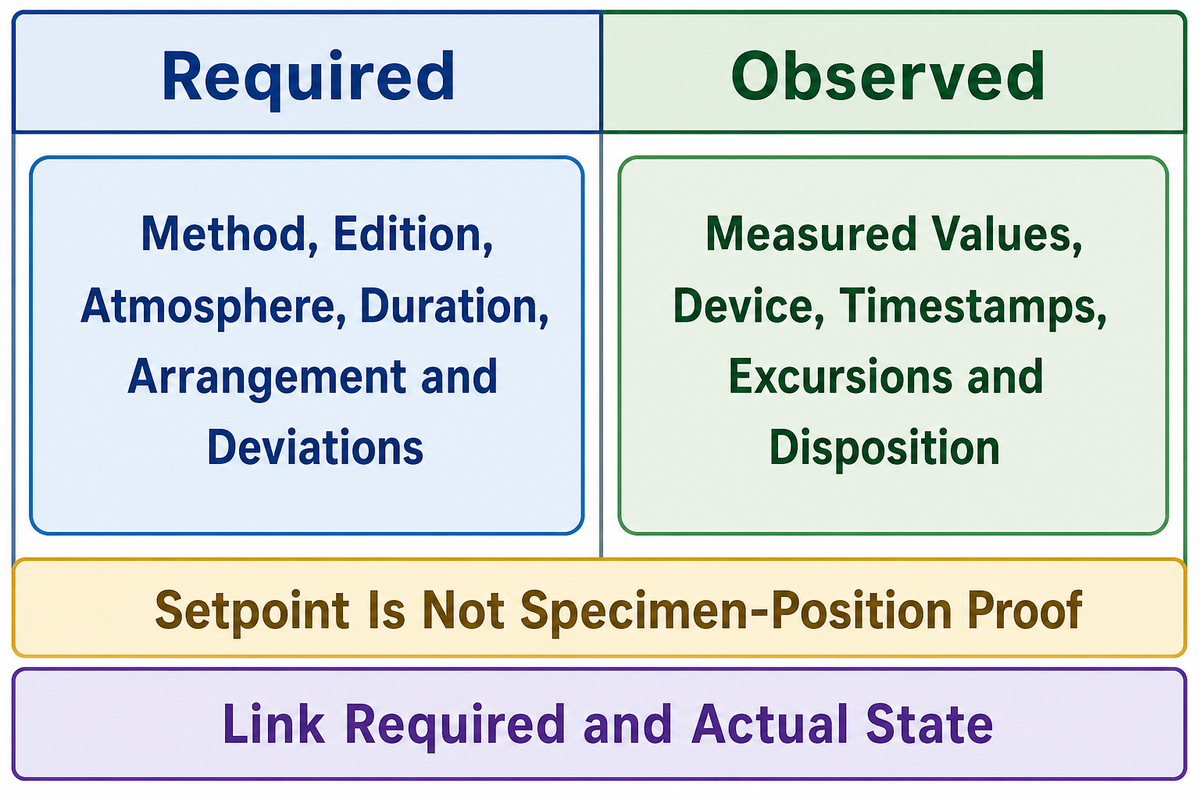
Condition records should link the test sequence to the required and actual state so testing data and testing accuracy limits remain visible. For example, a condition record for a specimen included in a batch should capture the specimen’s arrangement and how it was handled by staff as well as the specimen conditioning device’s state; a worked field format may show 23 °C, 50% RH, 25 µm, or 10 N without making those values universal requirements. A condition record for a specimen being withdrawn from a setpoint should capture the specimen conditioning device’s state and why it was removed, while a 15 min handoff or 500 mm/min test speed remains tied to the governing procedure.
Required
Method and edition; atmosphere; duration or endpoint; arrangement; circulation or packaging instructions; permitted deviations.
Observed
Measured values; device and location; start and end; excursions; access events; recovery; interruptions; disposition.
According to ASTM D618’s public information, conditioning to equilibrium may not always be necessary, and for some materials, conditioning to equilibrium may be time-consuming. Therefore, a report cannot conclude that every specimen reached equilibrium or materially changed merely because the specimen was recorded as conditioned.
Control the Conditioning-to-Test Handoff Clock
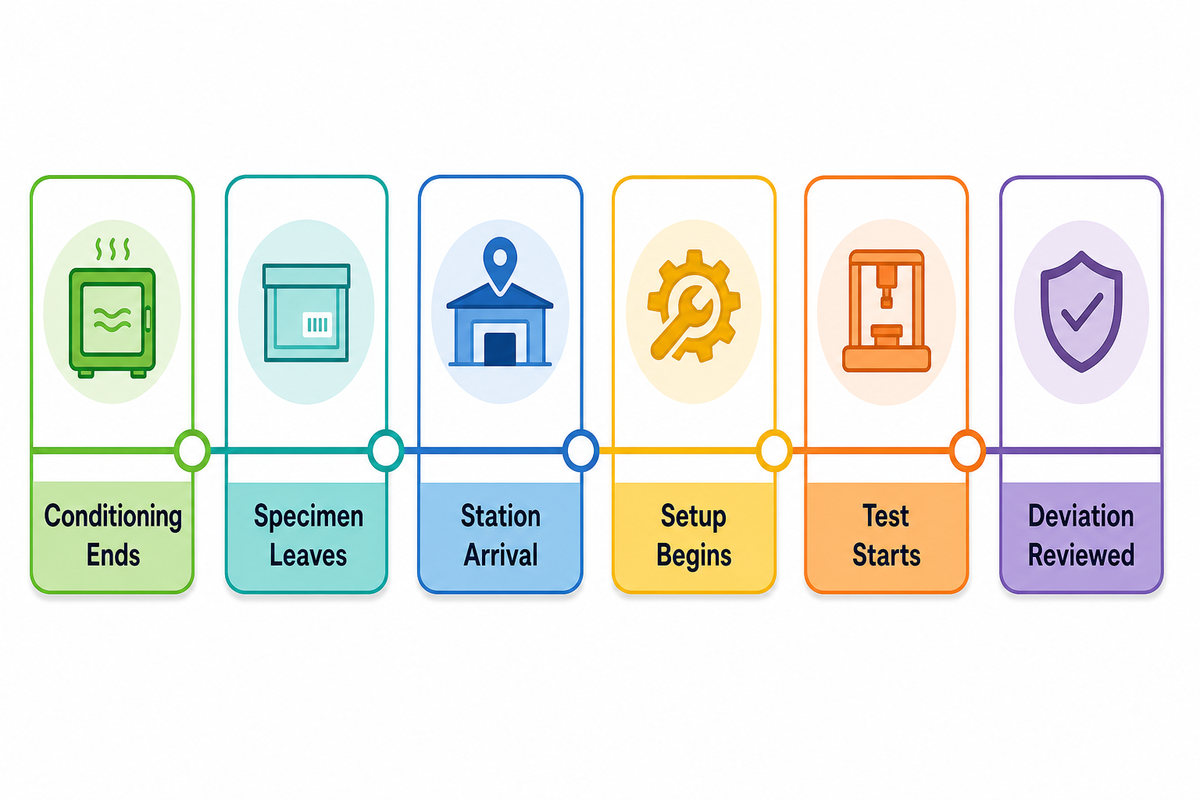
The handoff clock covers the interval between the end of controlled conditioning and test start, including storage and handling.
Conditioning-to-Test Handoff Clock
Conditioning ends
Specimen leaves
Station arrival
Setup begins
Test starts
Deviation reviewed
Deviation flag: record waiting, uncontrolled exposure, interim storage outside the required state, or deliberate reconditioning for review.
Record the test environment separately when the governing procedure requires it, because timestamps alone cannot capture atmospheric drift. Operational time limits must come from the governing procedure, material or product specification, contract, or validated laboratory procedure. Generic blog rules are not operational time limits.
Record Prior Exposure Without Calling It Conditioning
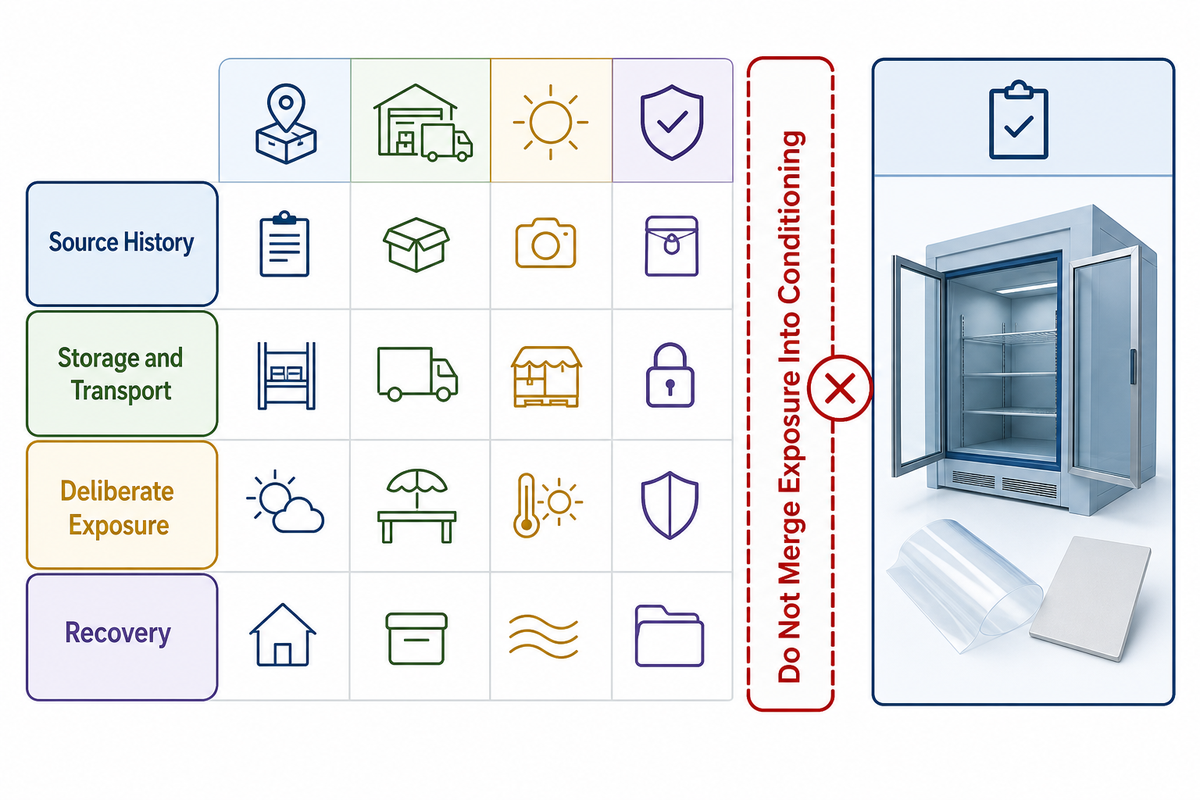
Past treatment (i.e. routine conditioning) does not prove that the effects of prior use and storage (i.e. aging) were removed; assuming otherwise creates a comparison risk because exposure history and conditioning answer different questions. If an Exposure History Ledger is used, capture the sample history in the ledger before the sample undergoes routine conditioning.
Exposure History Ledger
Field
What to preserve
Source history
Manufacturing or conversion information supplied with the sample
Storage and transport
Known temperature, humidity, duration, sealed/open state, excursions
Deliberate exposure
Heat, moisture, cold, UV, weathering, cycle, orientation, site
Recovery
Dates, periods, packaging state, and unknown fields
A peer-reviewed study on weathering across several polyethylene films shows why exposure features (i.e. location, duration, and environment) should not be commingled with routine conditioning descriptions.
Use the Comparison-Ready Condition Lock
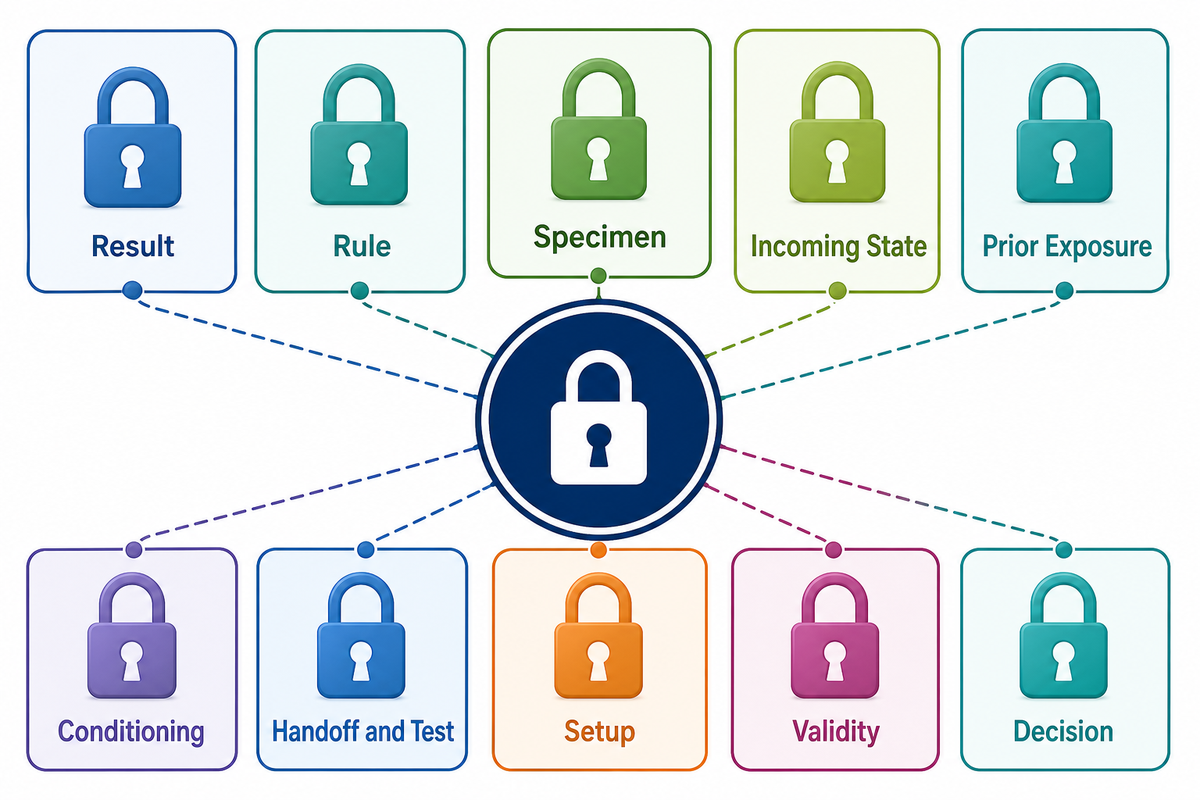
The Comparison-Ready Condition Lock does not mean that the reports are equivalent. Other conditions must be defined and aligned, or explicitly bounded, before comparison is justified.
10-Field Comparison Lock Matrix
Check type
Unlock evidence
Keep locked when
1. Result
Same property definition and exact label
Names only look similar
2. Rule
Method, edition, specification, deviations align
Routes or precedence differ
3. Specimen
Construction, thickness band, population, direction align
Identity or sampling is unclear
4. Incoming state
Storage, packaging, transport, age align or are bounded
History is absent or materially different
5. Prior exposure
Aging, weathering, heat, moisture, and recovery align
Prior exposure is merged into routine conditioning
6. Conditioning
Atmosphere, duration, arrangement, endpoint align
Only temperature/RH labels match
7. Handoff and test
Transfer interval, handling, and test atmosphere align
Tearing or invalid failures are mixed with normal breaks
10. Decision
Statistics, uncertainty, acceptance rule, and authority align
Averages are ranked without a shared decision rule
ASTM D882-26 covers tensile properties of plastic film and sheeting less than 1.0 mm thick. It includes several factors that limit exact comparisons. It states tearing failures can be erratic and should not be averaged or ranked in comparison with normal (tensile) failures.
Turn the Record Into a Buyer-Readable Handoff
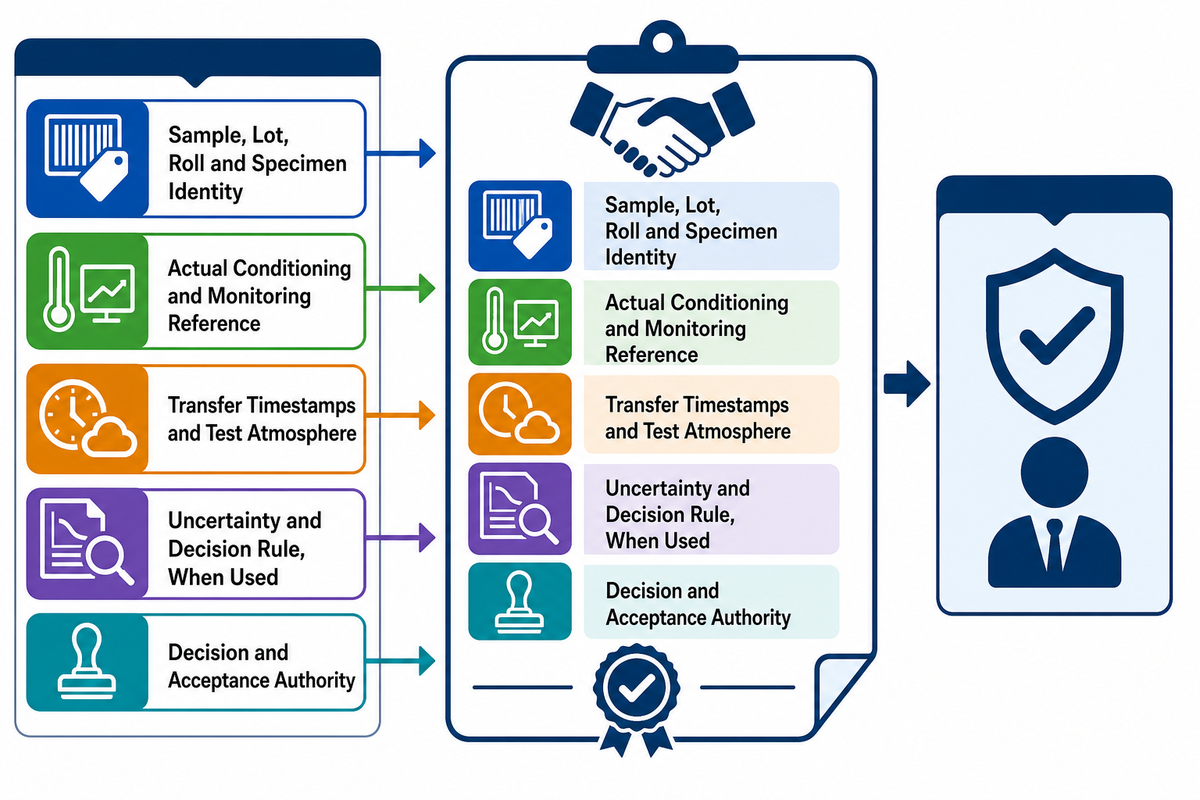
Using the comparison lock, a technical file should show a buyer what was tested, what remains unknown, and which differences matter. The condition chain should be included with the result, not hidden in a file or report name, so buyers can review testing data, film performance limits, and whether the record supports reliable test results.
Condition Report Handoff Sheet
Decision and acceptance authority
Sample, lot, roll, and specimen identity
Method, edition, specification, deviations
Incoming storage and prior exposure
Actual conditioning and monitoring reference
Transfer timestamps and test atmosphere
Test setup reference and result labels
Individual values and summary statistic
Exclusions, replacements, failure modes
Laboratory, reviewer, date, and version
Uncertainty and decision rule, when used
Open questions labeled as unknown
According to JCGM VIM 2.41, an unbroken chain of calibrations and associated uncertainty must be documented. NIST further states that traceability doesn’t necessarily ensure fitness for purpose. Hence, conditioning ledgers by themselves don’t ensure metrological traceability.
A test result should be communicated with the evidence on which it was based (e.g. specimen identity and method) so the result can be evaluated. Example: if a test result does not provide the information needed to support an acceptance decision, communicate the limitation instead of implying compliance.
Decision note to place above the results
“The reviewed result should not be interpreted as proof that the test met the specified requirements or acceptance criteria, or as proof of equivalence with a report produced under a different method.”
Film Condition Chain Shows the state sequence.
Handoff Clock Shows the transfer interval.
Exposure Ledger Keeps prior history visible.
Condition Lock Screens a proposed comparison.
Where UD Packaging Fits
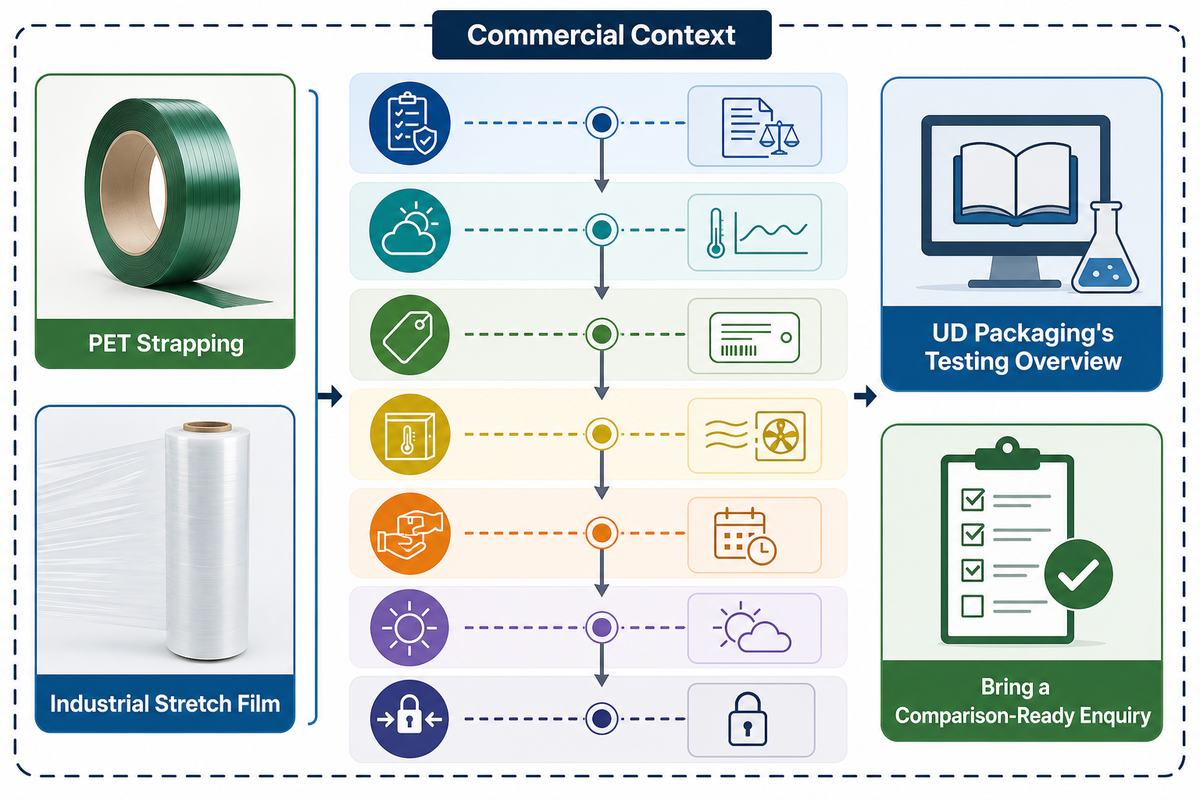
For commercial context, UD Packaging provides PET strapping and industrial stretch film. The company’s literature states that products of theirs are subjected to quality control and SGS testing. Quality control and testing do not necessarily guarantee that the proper procedure was followed; assuming they do creates an overclaim risk because the governing ASTM or ISO procedure and its records must be checked separately.
It also does not establish that a complete plastic-film test record exists.
Bring a comparison-ready enquiry
For commercial context, review UD Packaging’s testing overview. Include film identity, lot or roll, method edition, conditioning record, original report, decision, and every unresolved field.
The questions below reflect related searches, NEURONwriter’s question data, research gaps, and best practices for plastic film recordkeeping. Since the paid search returned no ‘People also ask’ sections, these questions are not presented here as sourced Google PAA questions.
What conditioning is required before plastic film testing?
Follow the stipulated guidelines of test method (competent authority). If the product or material specifications, purchase description, contract, or specified test procedure are restrictive, follow these. Note down actual values of environmental conditions (temperature and relative humidity) prevailing during the test. Describe the arrangement of the test specimens. State the reason for any gap in the test. Explain why a given reference environment or condition was selected. If a reference environment or condition is taken from another procedure, name the procedure and state the reason for selection.
How long should plastic film specimens be conditioned?
The test method is specific to films of different thicknesses, materials, and histories; it does not set one universal duration. ASTM D618-21’s public scope notes state that for some materials, attaining substantial equilibrium may require significantly longer time periods. Conversely, a given specification may require that an endpoint be fixed. Report the basis, along with the time, intervals, and disruptions; describe the reasons for, and nature of, interruptions, excursions, access, and reconditioning. Do not use the elapsed time to assess if equilibrium has been achieved.
Why do plastic film test results vary between laboratories?
Members of the same broad method family are not automatically comparable with each other when execution details differ. Consider that differences may exist in the population sampled, the direction of the test, the thickness and/or route of conditioning and/or test, the atmospheric condition of the test, the speed of test, the type and extension of the grips, how invalid test results were treated, the type of statistics, and how test results were interpreted and reported. Prior to making a conclusion regarding a material difference, it may be prudent to review the complete test record and request clarification from the testing laboratories regarding any differences. It may also be appropriate to have the testing laboratories address differences that are most critical to making a decision.
Does conditioning erase previous heat, moisture, or storage exposure?
No; routine pre-test conditioning establishes a defined state for a given test procedure, but doesn’t demonstrate that the effects of prior exposure to various conditions (e.g. heat, moisture, UV, cold, etc.) have been eliminated. With respect to the buying decision, whether a given effect is reversible (or partly reversible) for a given product form and construction, the conditioning history doesn’t determine if that effect will matter to the buyer. A stable reading without a defined endpoint doesn’t prove that the sample returned to an earlier state or became comparable with another sample. Provide for unknown and inconsistent prior conditions, and determine the state of repair (packaging) and any recovery period, and take the action that’s justified by the evidence and the rule.
Can two reports be compared if both list the same temperature and humidity?
In the absence of other information, no, matching atmospheres don’t ensure equivalence. The same is true for other aspects of procedure, including methodology, duration, endpoint, transfer, test conditions, and result/statistics reports. Use Comparison-Ready Conditioning Locks when significant procedure discrepancies exist, and document the rationale for any comparisons made and the rules which govern the comparison of results.
Conclusion: Preserve the Chain Before Comparing Results
Procedure governs, specimen state is recorded, conditioning is controlled, the handoff is documented, and the comparison lock is applied before equivalence is considered. This process provides a record of proceeding, but it should be understood that the state of equivalence may not have been achieved.
Recommended commercial context: UD Packaging’s Testing Overview. This outlines critical elements for understanding the test (commercial) data package.
UD Packaging is an integrated industry and trade enterprise focused on sustainable industrial packaging materials. Based in Jiangyin, Wuxi, Jiangsu Province, we develop and supply packaging solutions for customers who need dependable performance, practical sourcing, and clear technical guidance.
Our core range includes PET strapping, industrial stretch film, strapping seals, and manual, semi-automatic, and fully automatic strapping equipment. We use this blog to explain material properties, test logic, and packaging decisions in terms that procurement, operations, and quality teams can use.
OUR EXPERIENCE
More than a decade in plastic packaging materials, with PET strapping production and customer support across industrial applications.
OUR EXPERTISE
Material selection, tensile-property interpretation, packaging protection, and coordinated supply for medium and heavy-duty goods.