

Comparing high vs. low density polyethylene starts with chain structure: generally, HDPE provides a stiffer film while LDPE offers a softer and more flexible film. The right purchasing question is which converted film meets the bag’s handling, puncture, barrier and sealing requirements at the lowest cost per accepted package.
Quick comparison
- HDPE: less-branched chains and closer packing; often selected for stiffness.
- LDPE: more branching and lower density; often selected for flexible film.
- Film tensile: compare thickness, direction, test speed and the same endpoint.
- Named-grade example: ExxonMobil HD 6207FL data use 25 µm film.
- Selection basis: accepted bags and actual failures, rather than resin price alone.
High density polyethylene vs low density polyethylene is a comparison of structure and film behavior. HDPE usually feels stiffer; LDPE usually bends more easily. Select the finished bag using matched film tests and a production trial.
Key takeaways
- Tensile, tear and puncture tests each apply a different load, so rank films on each test separately.
- Machine direction and transverse direction can give very different results.
- A melting point is a material property; a sealing window is a process result.
- Equal film area and thickness still give different mass when density changes.
HDPE vs LDPE: The Film Differences That Matter
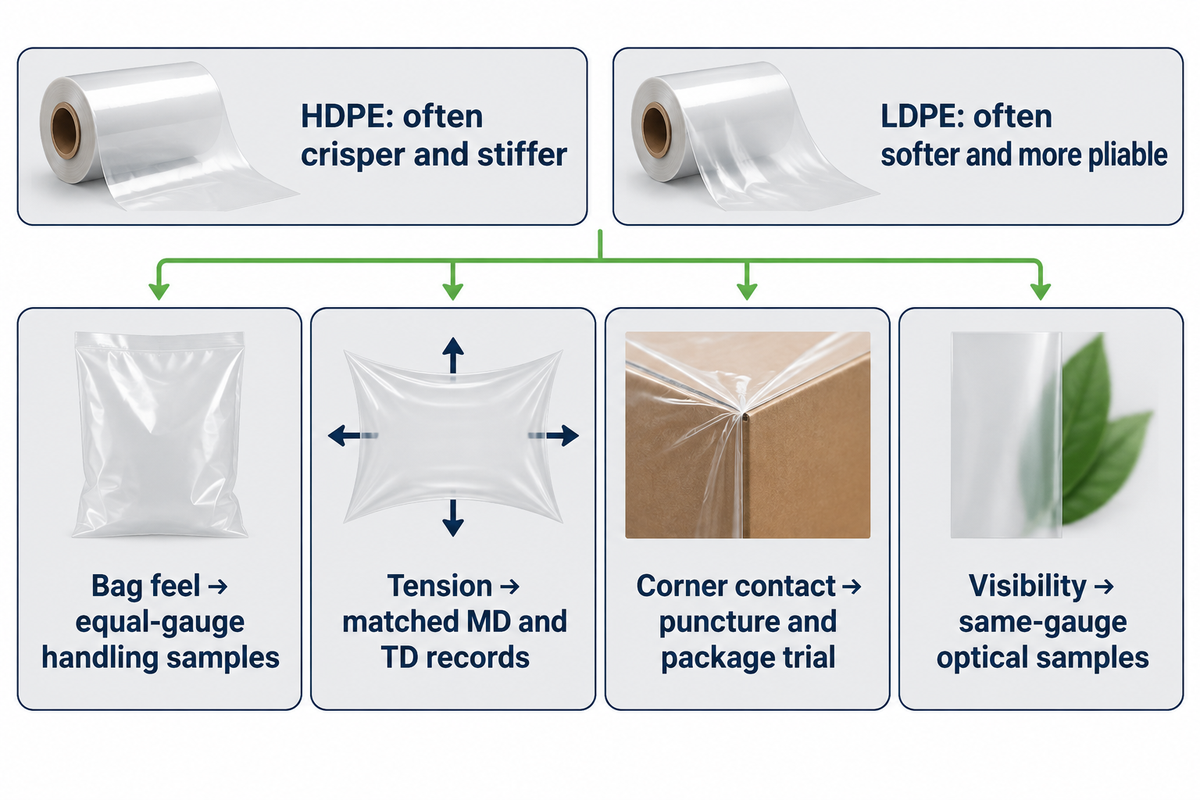
HDPE and LDPE are common types of polyethylene with different balances of stiffness, flexibility and processing behavior. For plastic bags, the critical comparison is the finished construction at its specified gauge. A grade selected for a rigid container can behave differently when converted to a thin film, a blend or a multilayer structure.
When buyers ask “What’s the difference?” it’s often useful to provide a short list, rather than another generic property chart. What’s the difference for your plastic bags? Start with the package: a crisp grocery sack, a soft liner, and a pouch seal layer all ask different things of the same polymer family. Westlake’s LDPE film directory, for example, separates grades for clarity, heavy-duty bags and other film applications.
| Selection question | HDPE starting point | LDPE starting point | Decision evidence |
|---|---|---|---|
| How should the bag feel? | Often crisper and stiffer | Often softer and more pliable | Equal-gauge handling samples |
| Must the film carry tension? | Review the actual film grade | Review the actual film grade | Matched MD and TD tensile records |
| Will corners contact the film? | Screen the converted structure | Screen the converted structure | Puncture and filled-package trial |
| Is product visibility important? | Check haze and construction | Check haze and construction | Same-gauge optical samples |
HDPE is also used in rigid food containers and injection molding, while LDPE is used in flexible packaging material and coatings. The difference between HDPE and LDPE becomes useful when it changes a package decision. Compare polyethylene materials through our plastic property families guide when the material choice extends beyond PE.
Branching, Density and Crystallinity in Polyethylene
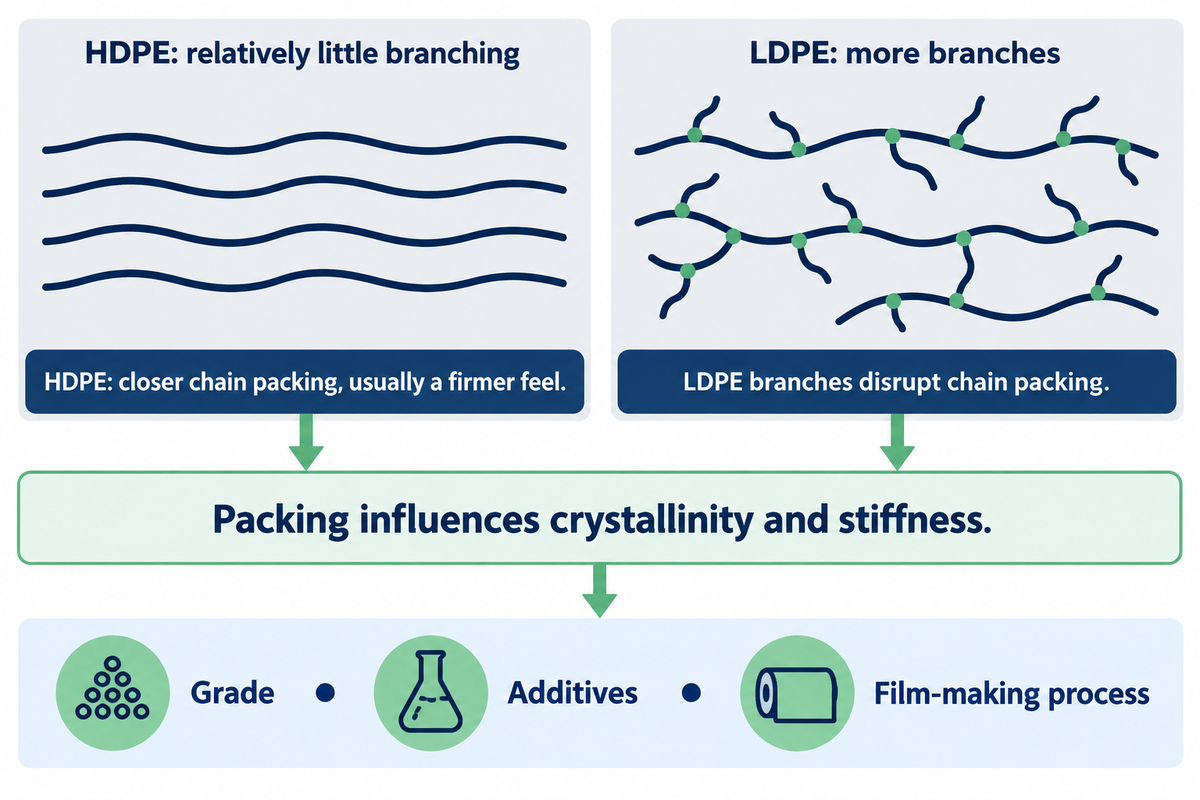
Branching affects how closely polyethylene chains can pack. This, in turn, impacts crystallinity, density and stiffness. HDPE has a linear structure with relatively little branching; LDPE contains more branches, including long branches. Both contain regions of crystallinity and amorphous regions, and, as such, shouldn’t be described as completely crystalline or completely amorphous.
What are the differences between LDPE and HDPE plastic?
High-density polyethylene has more closely packed chains and usually a firmer feel than low-density polyethylene. The longer branches found in LDPE disrupt packing along the polymer chain, perhaps explaining why it’s lower density and has a softer response. Molecular weight, additives and the film-making process then influence the final product, and as such, structure should be viewed as an explanation of the observed behavior rather than the whole explanation.
The Open University describes the relationship between branching, crystallisation and modulus, and distinguishes high pressure LDPE production from catalytic routes that produce more linear HDPE. LLDPE uses another branching architecture, which isn’t the same as LDPE.
| Producer-published example | Density | How to use it |
|---|---|---|
| ExxonMobil HD 6207FL, HDPE | 0.961 g/cm³ | Named-grade mass and material context |
| Dow LDPE 220M | 0.921 g/cm³ | Named-grade mass and material context |
| Resin-family labels | No single guaranteed value | Obtain the intended grade record |
At the manufacturer’s published densities, a 1 m² 30 µm thick sheet contains 30 cm³ of polymer. The expected mass is 28.83 g and 27.63 g, respectively. Density affects purchased mass before a supplier changes thickness; it doesn’t determine which bag survives a sharp corner.
Compare Tensile Strength at Matched Thickness and Direction
Film tensile strength becomes useful when specimen preparation, thickness, direction, test speed and extension measurement are comparable. Record yield stress, break stress, elongation and modulus separately. A force in newtons, a stress in megapascals and a strain in percent describe different things, even when they come from the same tensile test.
“When different materials are being compared for stiffness, specimens of identical dimensions must be employed.”
What is the difference between high density polyethylene (HDPE) and low density polyethylene (LDPE) in terms of strength, hardness and thermal resistance?
Generally, HDPE gives a stiffer material response. LDPE, on the other hand, flexes more readily. In cases where film strength is in question, compare the specified grade and converted specimen in both directions. Hardness and thermal response are separate properties. On the thermal side, a reference table of common plastics lists a melting temperature of 130 °C for HDPE and 110 °C for LDPE; a high tensile strength result still doesn’t set the sealing temperature.
The following producer records show why conditions belong beside the number. ExxonMobil reports HD 6207FL film properties at 25 µm, a blow-up ratio of 2.5:1 and extrusion at 200°C. Dow’s LDPE 220M product page lists tensile values without identifying the corresponding film gauge. Treat these as two named-grade records, rather than a matched strength contest.
| Manufacturer’s typical record | HD 6207FL | LDPE 220M |
|---|---|---|
| MD break tensile, ASTM D882 | 60 MPa | 19 MPa |
| TD break tensile, ASTM D882 | 31 MPa | 19 MPa |
| Film gauge attached to record | 25 µm | Not published |
| Data status | Typical properties, not specifications | Typical values, not specifications |
The values for ExxonMobil’s film-grade sheet and Dow’s LDPE product were used for this table. No family-wide strength ratio is documented in this table.
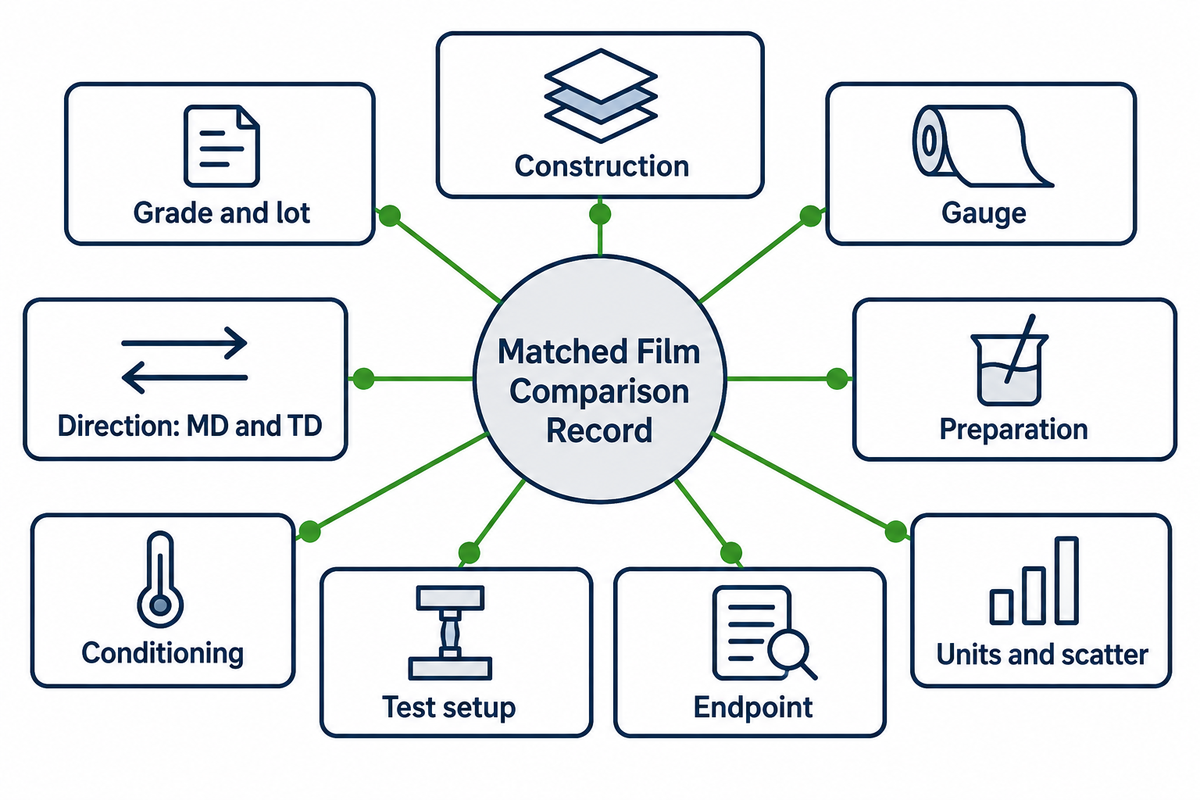
Matched Film Comparison Record is the record to request with competing samples. Fill one column for each film; retain the original report with its lot identity.
| Record field | What to retain | Decision it protects |
|---|---|---|
| Grade and lot | Resin, blend, recycled fraction and film lot | Repeatability across deliveries |
| Construction | Monolayer or each functional layer | Equivalent product comparison |
| Gauge | Measured thickness and variation, in µm | Stress and material-yield basis |
| Direction | MD and TD as separate results | Orientation effects |
| Preparation | Blown/cast route and specimen cutting | Process-linked differences |
| Conditioning | Temperature, humidity and time | Comparable specimen state |
| Test setup | Speed, grips and extension measurement | Comparable loading and strain |
| Endpoint | Yield, break or specified secant modulus | Like-for-like property |
| Units and scatter | MPa, %, sample count and variation | Readable acceptance decision |
When testing a 25 µm film trial, keep both suppliers at that nominal gauge before screening a thinner alternative. If the proposed saving requires 20 µm, treat it as a new construction trial. For more information, consult our plastic film tensile setup guide.
Tear, Puncture and Impact Resistance Need Separate Tests
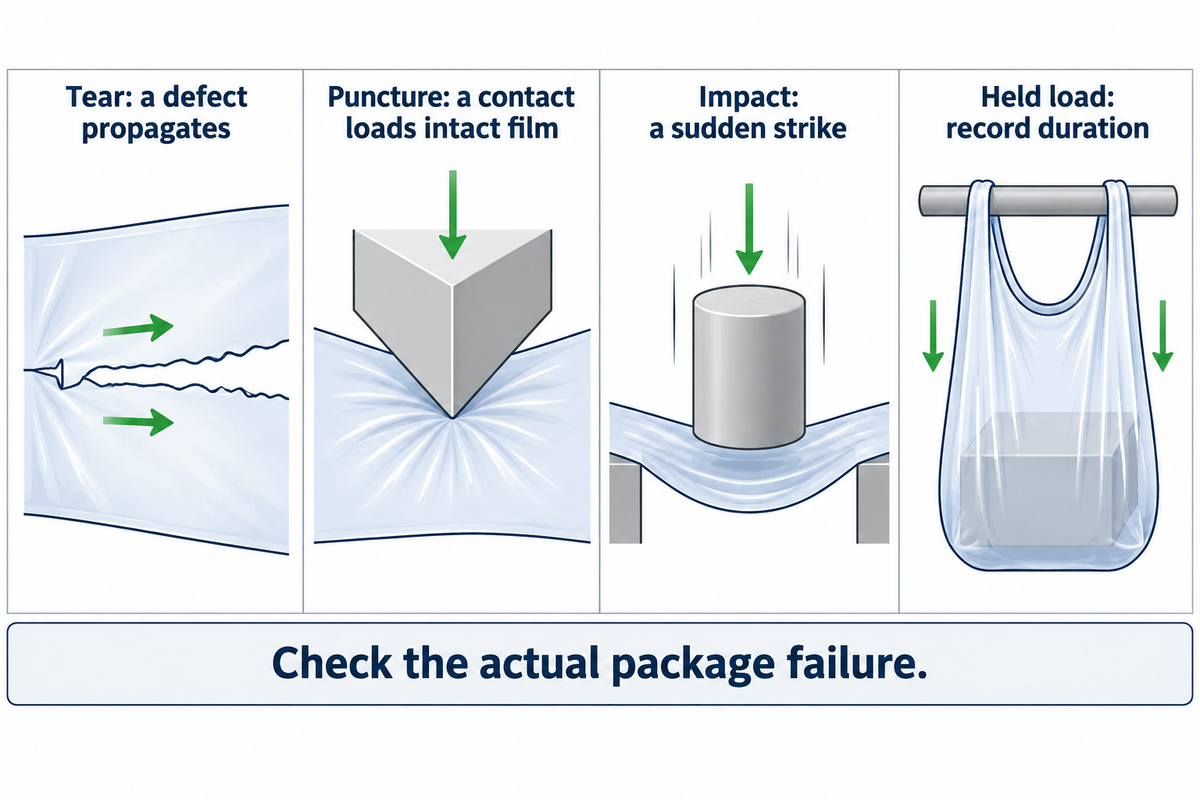
Tear resistance, puncture resistance and impact resistance answer different failure questions. Tearing propagates a defect; puncture loads a contact; a dart test introduces an impact. Choose the test that reproduces the package’s weakest point and compare films of the same gauge, direction and method.
Ren and colleagues‘ 2019 LLDPE study found that orientation and comonomer type affected tear behavior even among resins with similar density and molecular weight. This study is relevant to LLDPE and not a direct comparison of HDPE vs. LDPE. Its practical lesson is to retain processing and direction information instead of ranking tear from density alone.
| Failure observed | Useful evidence | Keep separate |
|---|---|---|
| Split starts at a nick | Directional tear results and bag geometry | MD versus TD |
| Product corner pierces a wall | Puncture setup and filled-bag contact | Probe geometry and support |
| Dropped contents damage film | Impact screen and actual package trial | Film specimen versus complete package |
| Handle stretches before failure | Load, extension and duration | Short pull versus sustained load |
Illustrative application: A converter is examining two 30 µm liners for boxed components. Both clear the strip-tensile threshold, but one consistently fails where a metal corner contacts the wall. Reordering the films by tensile stress leaves the actual failure unchanged. A useful next trial holds bag dimensions and contents constant, records the corner contact, and compares puncture response before checking filled-package handling. If a reinforced contact zone solves the problem with less material than a thicker whole bag, purchasing has a different option to price. The trial record should distinguish a puncture through intact film from a tear that began at a cut edge.
At 25 µm, ExxonMobil HD 6207FL sheet lists separate tensile, Elmendorf tear and dart results. Separate columns matter because each test applies a different load. A bag damaged at a sharp corner needs its own puncture and package checks, even when the strip-tensile result meets the agreed target.
Moisture Barrier and Clarity: Compare the Same Film Conditions
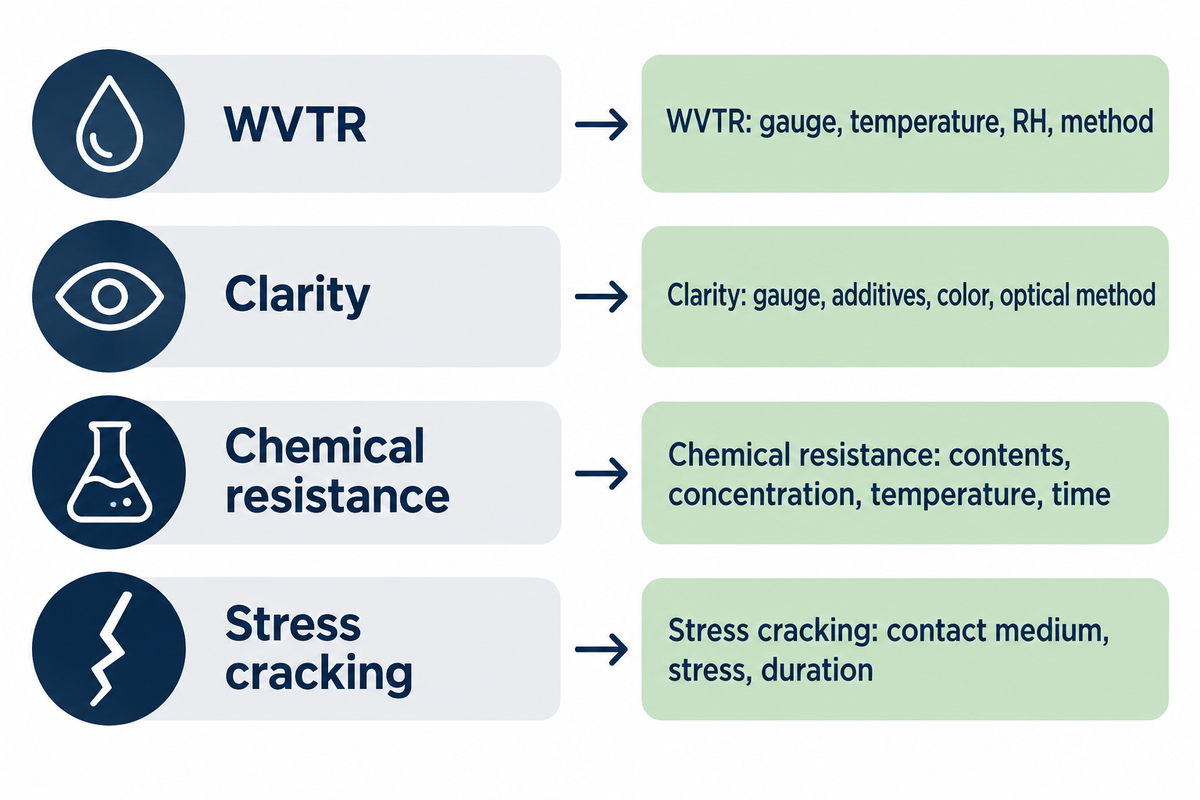
Moisture barrier and clarity should be assessed at the intended film thickness and construction. Water-vapor transmission results should show the temperature and relative humidity, and reporting units. Haze and visibility need optical samples at the same gauge. A transparent bag can still have the wrong moisture performance, and a low transmission result can hide unsuitable viewing quality.
ASTM F1249-25 describes water-vapor transmission testing and cautions against assuming that transmission always varies inversely with thickness. The purchaser and seller must agree on test conditions and acceptance criteria. A published packaging-film study, for example, screened WVTR at 38°C, with 100% relative humidity outside and 0% inside: those are that study’s conditions, not universal settings for every film.
| Property | Comparison record | Buyer consequence |
|---|---|---|
| Water-vapor transmission | Gauge, temperature, RH on both sides, method, g/m²/day | Compare the same moisture challenge |
| Haze and visibility | Gauge, additives, color and optical method | Check product presentation |
| Chemical resistance | Actual contents, concentration, temperature and exposure time | Screen compatibility separately |
| Stress cracking | Contact medium, stress and duration | Evaluate the relevant failure mechanism |
A “same barrier at half the thickness” proposal deserves a matched measurement at the thinner gauge. Measurements should be made on 30 µm and 15 µm barrier samples, and both transmission and conversion should be studied. Acceptance shouldn’t be obtained by simply halving or doubling table entries.
Heat Sealing: A Melting Point Is Not a Line Setting
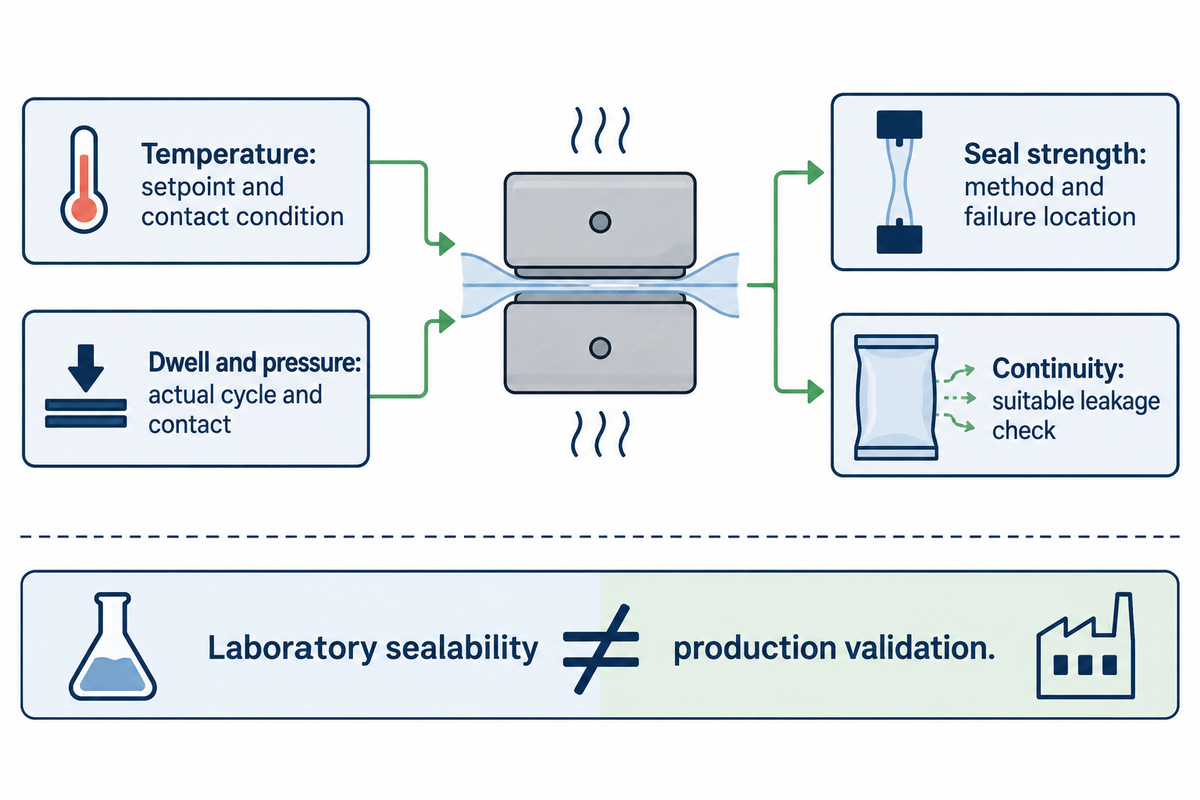
Heat sealing is related to contact temperature, contact time, and pressure and the construction of the sealant. The melting point of a resin describes the thermal behavior, and in a production setting, seals must be formed at the speed required by the process. Check seal strength, hot tack where relevant, and seal continuity as separate acceptance questions.
Sealability is determined in a lab. ASTM F2029 distinguishes laboratory sealability curves from production-equipment validation and excludes seal-continuity evaluation. Ilhan and colleagues’ 2023 study of talc-containing PP/LDPE films also links required dwell time to heat conduction and polymer movement. Its settings belong to those compound films; they are not a recipe for neat HDPE or LDPE bags.
| Trial input | Record | Acceptance observation |
|---|---|---|
| Temperature | Setpoint and contact condition | Seal develops without film damage |
| Dwell and pressure | Actual cycle and jaw contact | Stable results at intended speed |
| Seal strength | Method and failure location | Agreed mechanical target |
| Continuity | Suitable leakage check | No unacceptable channel or leak |
Illustrative Line Trial: A buyer gets two 40 µm pouch films, and tries the old jaw setting on both. One gives a satisfactory pull after cooling, but shows leakage at a folded corner. Raising the controller temperature by itself may conceal a poor contact, and/or may create distortion in other areas. In the next trial, the layer facing the jaw, dwell time, and pressure, and fold geometry will be recorded, and strength and leakage will be evaluated separately. Production, however, depends on the machine’s ability to provide a stable operating window. Some films require a slower machine; in that case, the quotation must give the throughput trade-off.
For thermal-property context, see the separate polyethylene melting point and grade guide.
Choose a Bag Structure with a Short Acceptance Trial
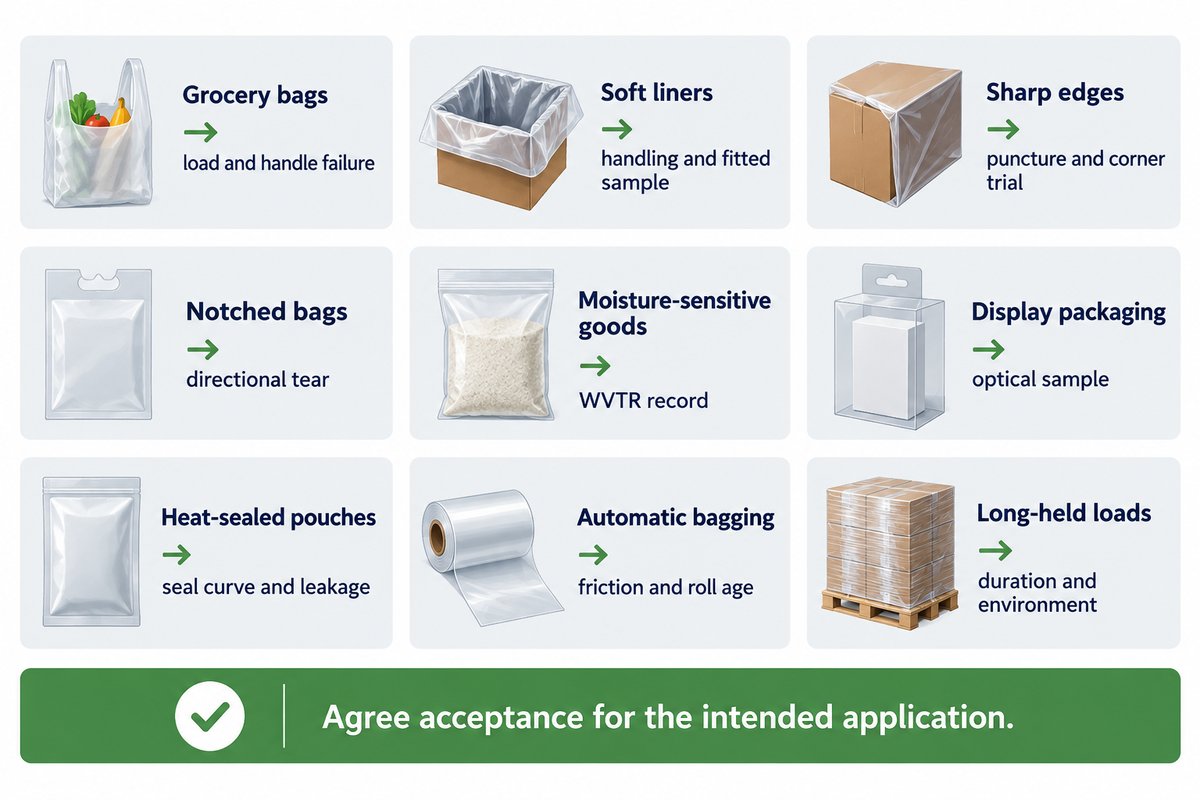
A short acceptance trial should screen the actual bag, contents and converting line before buying, and compare total costs. Start with the observed failure and assign the evidence needed to address it. Extend the trial when the application involves sustained loading, storage or exposure; a quick pass is a screening result rather than a lifetime prediction.
What should you consider when choosing HDPE and LDPE?
Choose around the contents, bag dimensions, handling load, contact edges, visibility, moisture exposure and sealing process. Match the requirements to the film construction and test records. For load held over time, consider its duration and storage. For a fast sealing line, consider the feed, and the age of the rolls; match these to the seal records and process.
The Bag Trial Responsibilities matrix below enables production, quality and purchasing to begin at the same point. It doesn’t set universal pass values. Enter the intended load and agreed acceptance threshold and compare suppliers.
| Application class | Primary question | Evidence to request | Decision owner |
|---|---|---|---|
| Grocery bags | Does the loaded handle hold? | Bag load and handle failure | Quality and buyer |
| Soft protective liners | Does the liner flex around contents? | Handling and fitted sample | Production |
| Sharp-edged components | Where does first damage begin? | Puncture and corner-contact trial | Quality |
| Notched or perforated bags | Does a defect grow in use? | Directional tear and cut geometry | Converter |
| Moisture-sensitive goods | Is transmission acceptable? | Conditioned WVTR record | Product quality |
| Display packaging | Can the product be seen? | Same-gauge optical sample | Product team |
| Heat-sealed pouches | Are strength and continuity stable? | Seal curve plus leakage check | Production and quality |
| Automatic bagging | Does aged film feed consistently? | Friction, surface and roll-age record | Line operator |
| Long-held loads | Does deformation grow with time? | Load, duration and environment | Application engineer |
ASTM D1894-24 notes that migration of slip-additives and film age can affect friction results. When making the comparison, provide the date of roll production and storage; our interpretation of results of film friction, states the same. ASTM D2990 addresses creep under long-term loads, and is a different concern from the quick tensile pull.
For an illustrative 5 kg bag application, record the 5 kg contents, contact geometry and required holding period before testing alternatives. A short lift test screens for immediate failure. Storage with that load adds the time dimension to evaluate deformation, while leakage and friction remain separate checks with their own acceptance limits.
Compare Cost per Accepted Bag, Not Only Price per Kilogram
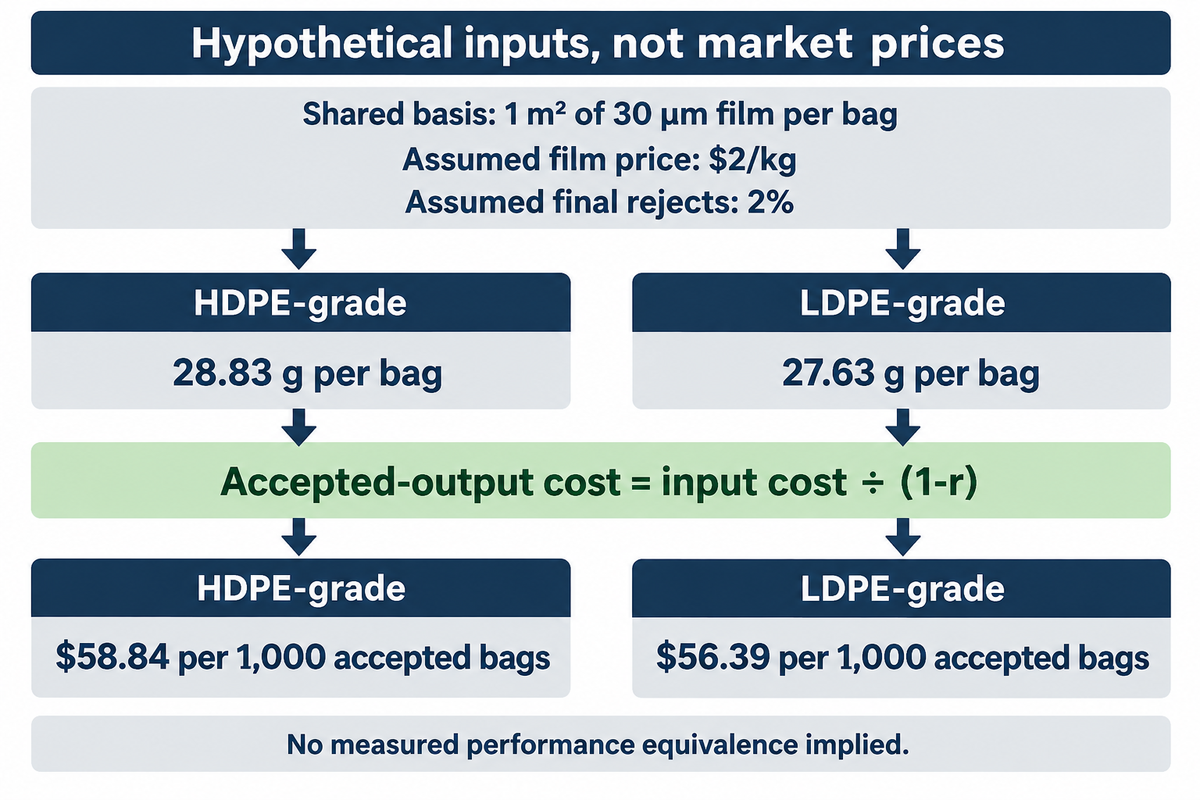
The cost per accepted bag accounts for material consumption and conversion losses and cost for making usable output. At the same area and thickness, density changes mass. At different gauges, thickness may dominate. Compare the full construction that meets acceptance, then include conversion, inspection, rejects and measured recovery credits on the same output basis.
ISO 14051 connects physical material flows with associated costs; ASQ treats scrap and rework as quality costs. The calculation below uses hypothetical commercial inputs and the two published grade densities to illustrate the calculation.
Worked example: assume each bag consumes 1 m² of 30 µm film, including both walls and all allowances. With density in g/cm³, mass in grams is area in m² × thickness in µm × density. The HDPE-grade example is 1 × 30 × 0.961 = 28.83 g; the LDPE-grade example is 27.63 g. Assume both cost $2/kg, and final rejects are 2% of input bags. Material cost per 1,000 accepted bags is mass per bag × $2/kg ÷ 0.98, after converting grams to kilograms and multiplying by 1,000. Results are $58.84 and $56.39. No measured performance equivalence or supplier saving is implied.
| Illustrative input or result | HDPE-grade density | LDPE-grade density |
|---|---|---|
| Film mass per bag | 28.83 g | 27.63 g |
| Assumed film price | $2/kg | $2/kg |
| Assumed final reject fraction | 2% | 2% |
| Material per 1,000 accepted bags | $58.84 | $56.39 |
| If final rejects instead reach 8% | $62.67 | $60.07 |
For a final reject fraction r, divide input cost by 1-r. Add labor, energy, downtime, and disposal, subtract actual recovery credits to arrive at the broader net cost. Only count accepted bags once. A thin film gauge may earn consideration, as long as the bag meets the same standards as a control sample; density, alone, won’t earn it.
Industry Outlook: Why Blends and Oriented PE Films Change the Comparison
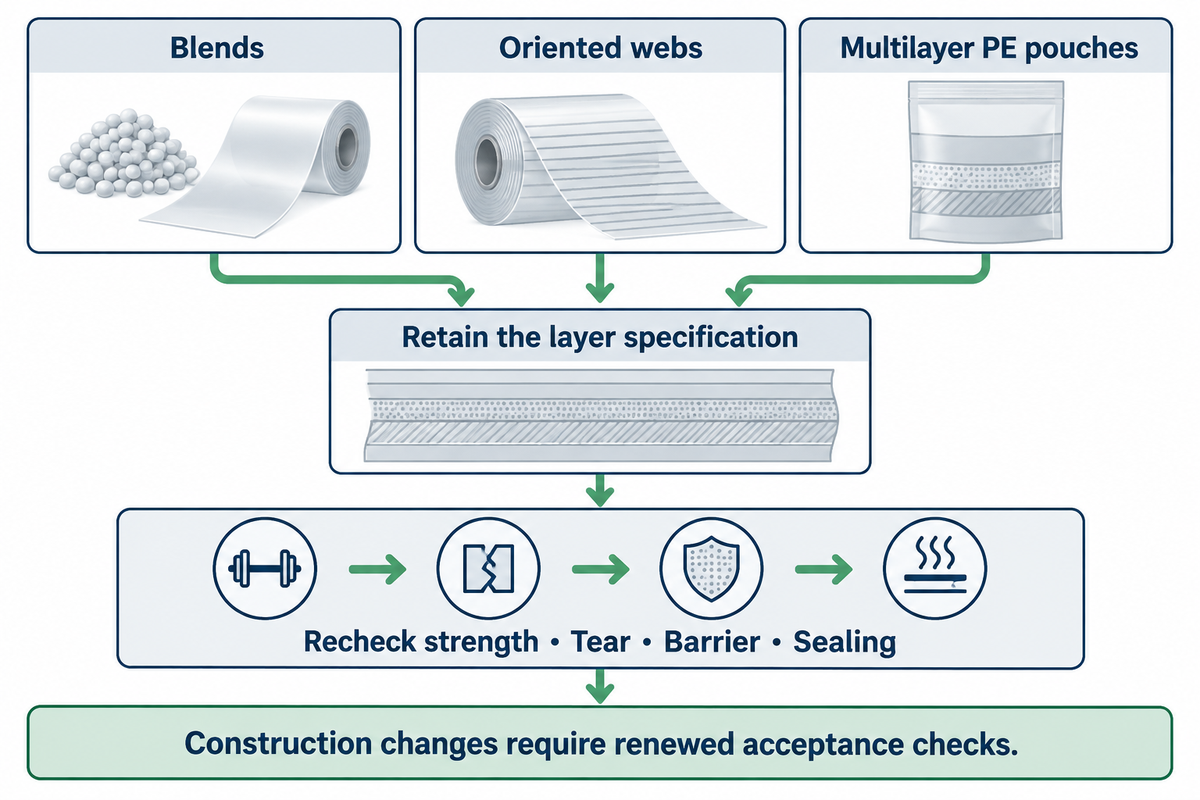
The resin-family label, traditionally useful for purchasing, is less reliable due to varying film constructions. Blends, oriented webs or multilayer PE pouches can combine functions that monolayer films separate. When a supplier changes that structure, retain the layer specification and repeat the acceptance checks that matter to the package.
H.B. Fuller’s March 2026 supplier commentary identifies mono-material structures and barrier redesign as directions for flexible packaging. Bill Pardo, NOVA Chemicals’ food packaging market manager, describes oriented HDPE webs paired with PE sealing layers in a 2024 Packaging Strategies article. Both provide technical context with a commercial viewpoint; neither establishes that every PE pouch is accepted by a local recycling system.
A specific example is US20250075044A1, published March 6, 2025, an application filed by TotalEnergies Onetech SAS describing a biaxially oriented polyethylene film and method of production. It describes the use of architecture of resins and stretching, together. It isn’t a UD Packaging patent or a performance guarantee; it is a third-party patent disclosure.
Linear low density polyethylene (or LLDPE) can provide a different toughness-processing balance in blends. ExxonMobil’s HD 6207FL sheet expressly discusses blends with LDPE, LLDPE and metallocene LLDPE. A versatile material family gives converters additional choices, but a new blend ratio also changes the qualified product.
For 2026 procurements, include the present method revision and construction identifier on comparative evaluations. ASTM currently lists D882-26a and F1249-25; the existence of a newer version is a reason to check the report basis, not a claim that an old film suddenly changed properties. For a 25 µm oriented web replacing a 30 µm unoriented one, recheck directional strength, tear, barrier and sealing rather than transferring the thicker film’s acceptance.
LDPE and HDPE therefore remain useful starting categories. The useful next step is a construction-specific record: grade, layers, gauge, orientation, conditions and the package outcome. Maintain this information with the purchase description to allow substitutions to be assessed against the same requirements.
Frequently Asked Questions
What is the difference between low and high-density polyethylene?
View answer
HDPE has less-branched, more closely packed chains and usually feels stiffer. LDPE has more branching and a softer, more flexible response. For bags, compare the actual grade, thickness and construction because additives, orientation and layer design also affect behavior. Density and tensile data describe part of that comparison; tear, puncture and sealing need separate evidence.
What is the disadvantage of HDPE?
View answer
For flexible bags, HDPE’s stiffness can work against applications needing a soft feel or easy conformity around contents. Optical appearance and directional tear can also be important trade-offs. HDPE is also a broad family: use the proposed film’s gauge, processing history and trial results rather than treating those concerns as guaranteed defects in every grade.
What is the difference between the melting points of low-density polyethylene (LDPE) and high-density polyethylene (HDPE)?
View answer
HDPE generally melts at a higher temperature than LDPE because its chains pack more closely; a reference table of common plastics lists 130 °C for HDPE and 110 °C for LDPE. Compare the actual grades using the same thermal test and the same reported endpoint. A melting peak, softening temperature and seal-initiation temperature describe different events. Select jaw settings through a sealing trial that includes dwell, pressure, strength and continuity.
Does high density polyethylene float in water?
View answer
Unfilled HDPE generally floats in water. The British Plastics Federation lists HDPE density at 0.944 to 0.965 g/cm3, below the density of water. Fillers, attached components and trapped air can change a finished object’s behavior.
HDPE vs. LDPE Poly Bags: Which is Best for My Product Packaging?
View answer
Start with HDPE when a crisper, stiffer film is useful and with LDPE when softness and conformity matter. Choose between actual bag structures through the same acceptance trial: contents, load, corner contact, seal integrity, visibility and moisture needs. Compare cost only after both candidates meet those requirements. A lower price per kilogram can lose its advantage through greater material consumption or rejected bags. Keep wall thickness, bag dimensions and the filling operation constant during the first comparison. If a candidate requires a different gauge, rerun the package checks with that construction before calculating accepted-unit cost.
What specifically is the difference between LLDPE and LDPE?
View answer
LLDPE is an ethylene copolymer with short-chain branching. Conventional LDPE also contains long branches. These different chain architectures affect processing and film behavior; blends require their own finished-film tests.
Can high density polyethylene (HDPE) and low density polyethylene (LDPE) be distinguished without using testing lab analysis equipment?
View answer
Feel, stiffness and appearance can suggest HDPE or LDPE, but they don’t reliably identify a blended, filled or multilayer film. Compare the supplier’s grade and construction records first. If identity matters to acceptance or recycling, use an appropriate identification method rather than an informal burn test or visual guess. For this type of plastic, retain the grade name, lot number and layer declaration alongside any identification result. A recycling code identifies a broad material category, while an acceptance record connects the supplied film with its intended package and test conditions.
Bring the comparison back to your package. Send the intended use, film construction, gauge and available test reports to UD Packaging. Use the material selection and test-data context to organize the questions before discussing a packaging option.
Technical scope: This guide synthesizes publicly available summaries of standards, named manufacturers’ typical grade sheets, and research. Illustrative case examples and costs are not based on user tests.
References & Sources
- Open University: polyethylene structure, branching and crystallisation.
- ASTM D882-26a: thin plastic sheeting tensile properties, public summary.
- ASTM F1249-25: water-vapor transmission, public summary.
- ExxonMobil HD 6207FL: typical grade data and film conditions.
- Dow LDPE 220M: product data; Westlake: LDPE film-grade directory.
- Ren et al., 2019: tear strength and orientation of LLDPE films.
- Characterizing Mechanical, Heat Seal, and Gas Barrier Performance of Biodegradable Films, 2022.
- ASTM F2029: laboratory heat seals, public summary; Ilhan et al., 2023: dwell-time study in PP/LDPE compound films.
- ASTM D1894-24: film friction; ASTM D2990: creep and creep rupture, public summaries.
- ISO 14051: material flow cost accounting; ASQ: cost of quality.
- Shruti Chakraborty, H.B. Fuller: flexible packaging trends, March 2026.
- Bill Pardo, Packaging Strategies: oriented HDPE films, October 2024.
- US20250075044A1: biaxially oriented PE film, TotalEnergies Onetech SAS.