
Updated October 2026
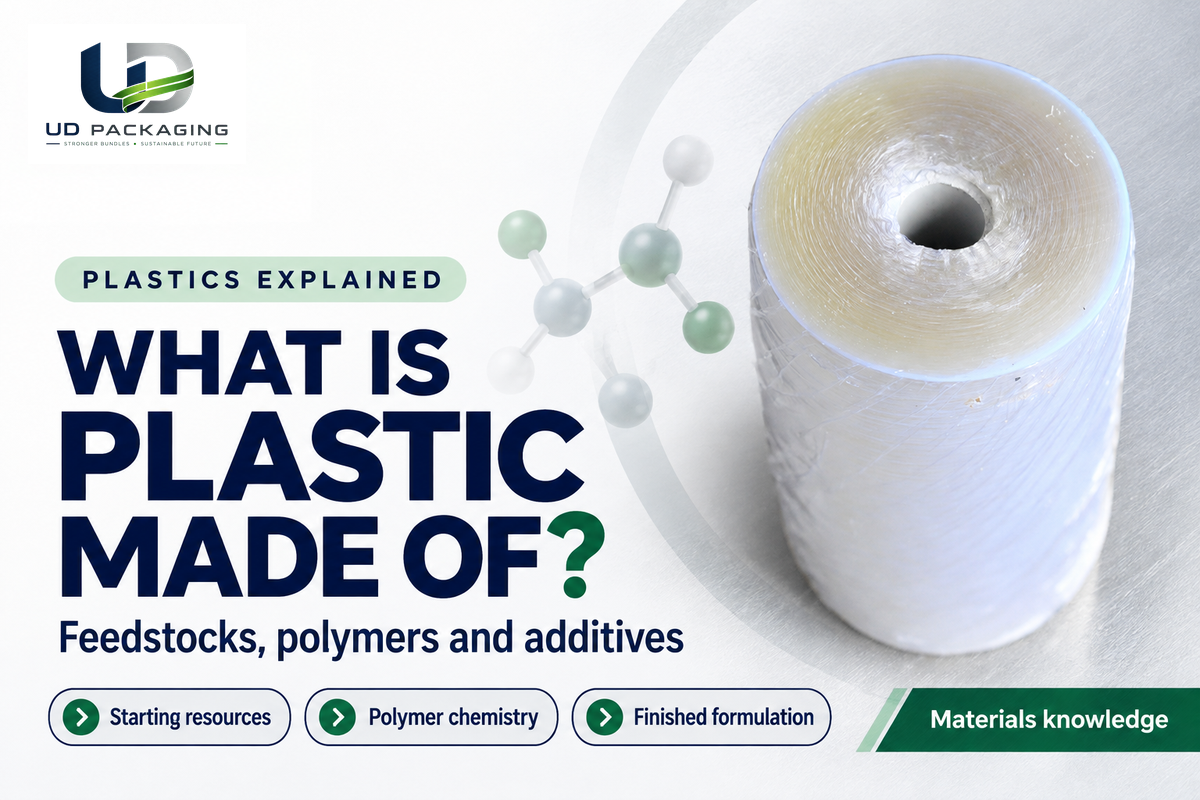
Plastic is made mainly of polymers: larger molecules built of smaller units. Source materials of oil, natural gas, and biological resources can provide starting chemicals. A useful answer to “what is plastic made of?” also explains the additives mixed into the resin and the different materials layered into a finished package.
Plastic contains a polymer base and, commonly, additives. Its raw materials can come from oil, natural gas or biological resources. Polymer chemistry defines the material family; formulation and processing help determine the finished product.
Plastic composition at a glance
- Bio-based describes origin. It doesn’t automatically mean biodegradable.
- Polymer means the large molecules. A plastic formulation can also contain pigments, stabilizers or other ingredients.
- A resin name describes a family. Two polyethylene films can use different grades, recipes and layer structures.
- Pellets are an intermediate form. Both virgin and recycled resins can be supplied as pellets.
What Is Plastic Made Of? Polymers and Formulations
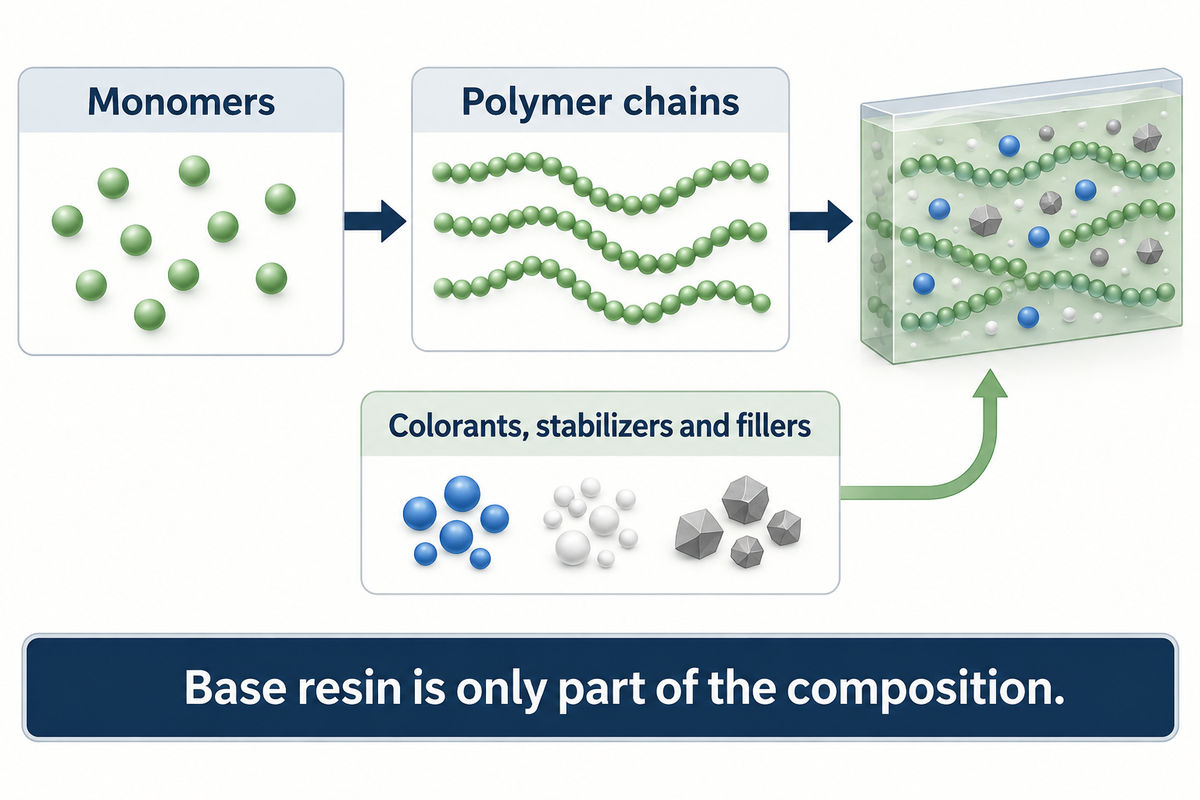
Polymers form the framework of a material, and other components change specific properties of the plastic. A polymer is made up of repeating units of the same molecular structures. Those units link to form long chains or a network. The completed formulation can include colorants, stabilizers, and fillers. Identifying the base resin of a formulation answers only a part of the composition question.
Small molecules called monomers are starting units. A chemical reaction links the units into long chains called polymers. Polyethylene is one example, as the name suggests, a material built primarily from ethylene. Later addition of a pigment can make polyethylene blue, but it doesn’t change its identity.
The NIST explanation of plastic composition separates starting molecules, chains, branches and other components. These details explain how polyethylene is used in both thin bags and rigid containers.
A clear food container, a bottle cap and a disposable bag present different material questions. The container may need to be transparent, the cap needs sufficient rigidity to hold its shape, and the bag needs flexibility. Appearance alone doesn’t explain the chemical structure or ingredient list. The plastic material families provide a broader classification.
Is plastic completely man-made?
Most people are familiar with synthetic plastics manufactured through controlled chemical reactions. However, polymers can also be found in nature. Cellulose in plants and natural rubber from latex are some examples of polymers. Some early plastics were made by modifying natural materials, while the first fully synthetic plastics were made by reacting smaller chemicals.
The American Chemical Society’s history of celluloid and Bakelite provides a useful distinction. Celluloid contained cellulose nitrate and camphor. Bakelite was made from phenol and formaldehyde. Celluloid could also harden at room temperature and soften enough to be moldable when heated. Early substitutes were designed to mimic materials such as ivory. Natural origin and human manufacture are therefore distinct questions: a starting material derived from a natural source can undergo significant industrial chemistry.
Where Plastic Raw Materials Come From
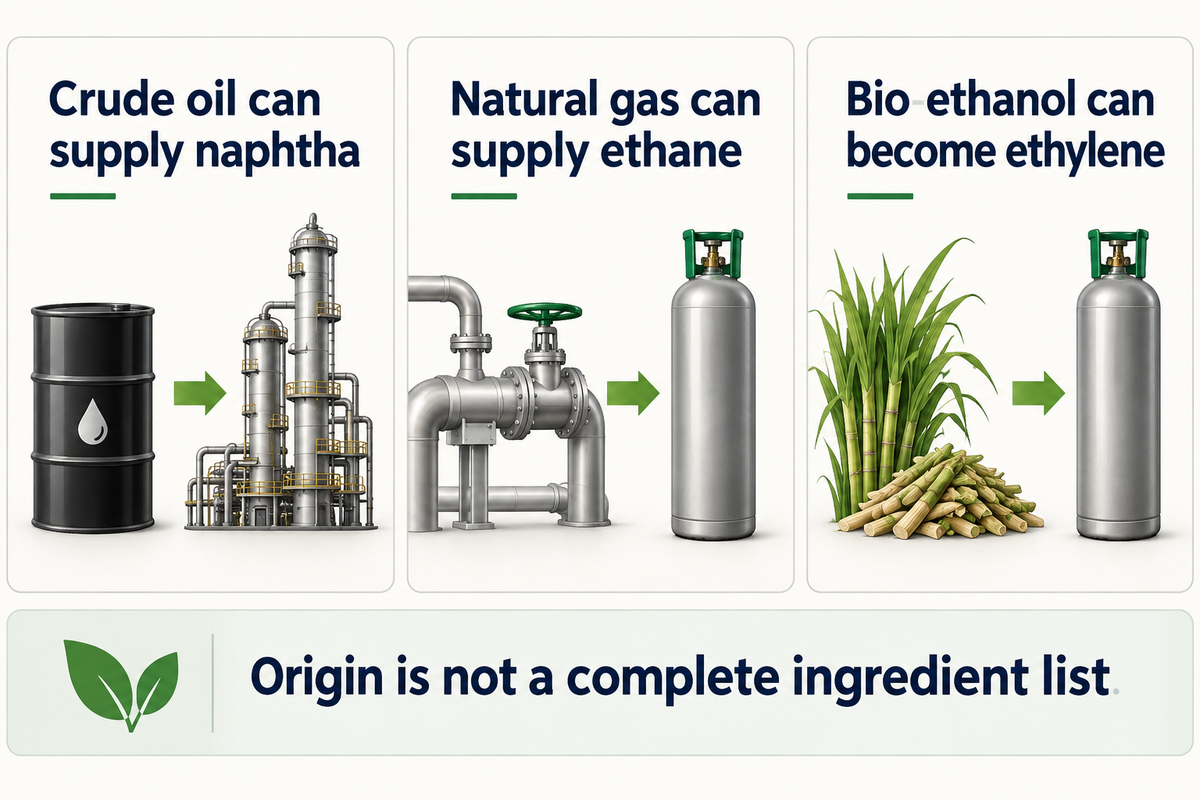
Crude oil and natural gas are the main feedstocks for plastic. Biological resources can provide other feedstocks as well. A feedstock is the material that enters a chemical process. Refining and separating processes are done to obtain useful feedstocks. The same oil or gas that was used to produce the feedstock isn’t poured into a mold to produce the product.
Natural gas processes can separate hydrocarbon liquids such as ethane. Petrochemical plants can convert ethane to ethylene, a starting chemical for polyethylene. Refining crude oil can produce naphtha, which can be processed in a cracker to smaller chemicals. These conventional inputs are derived from fossil fuels. Feedstock describes the use of the material, while fuel describes the use of the material to provide energy.
Regional context is important. The U.S. Energy Information Administration’s plastics feedstock FAQ notes crude oil isn’t the major feedstock source for plastics production in the U.S. It mentions natural gas, gas-processing streams, and refinery streams. The agency doesn’t identify the actual amounts or sources of all inputs used by plastics manufacturers.
Read the resource and route together
- Identify the starting resource.
- Follow the intermediate chemical.
- Identify the polymer produced.
Avoid these shortcuts
- Treat every plastic as solidified oil.
- Apply a U.S. feedstock statement worldwide.
- Use a carbon source as a complete ingredient list.
For a packaging buyer wondering if a film is petroleum-based, the relevant information is the film’s raw materials. For a converter wondering how a resin will flow during extrusion, the grade and molecular structure are more relevant. For a processor, different feedstock origins can lead to the same polymer family, while a change in grade can alter processing behavior.
Materials derived from renewable resources can enter the chemical chain too. Sugars can become fermentation feedstocks and bio-ethanol can become ethylene. These paths can explain plastic made from plants without needing to consider every plant-based material the same substance.
How Monomers Become Polymer Chains
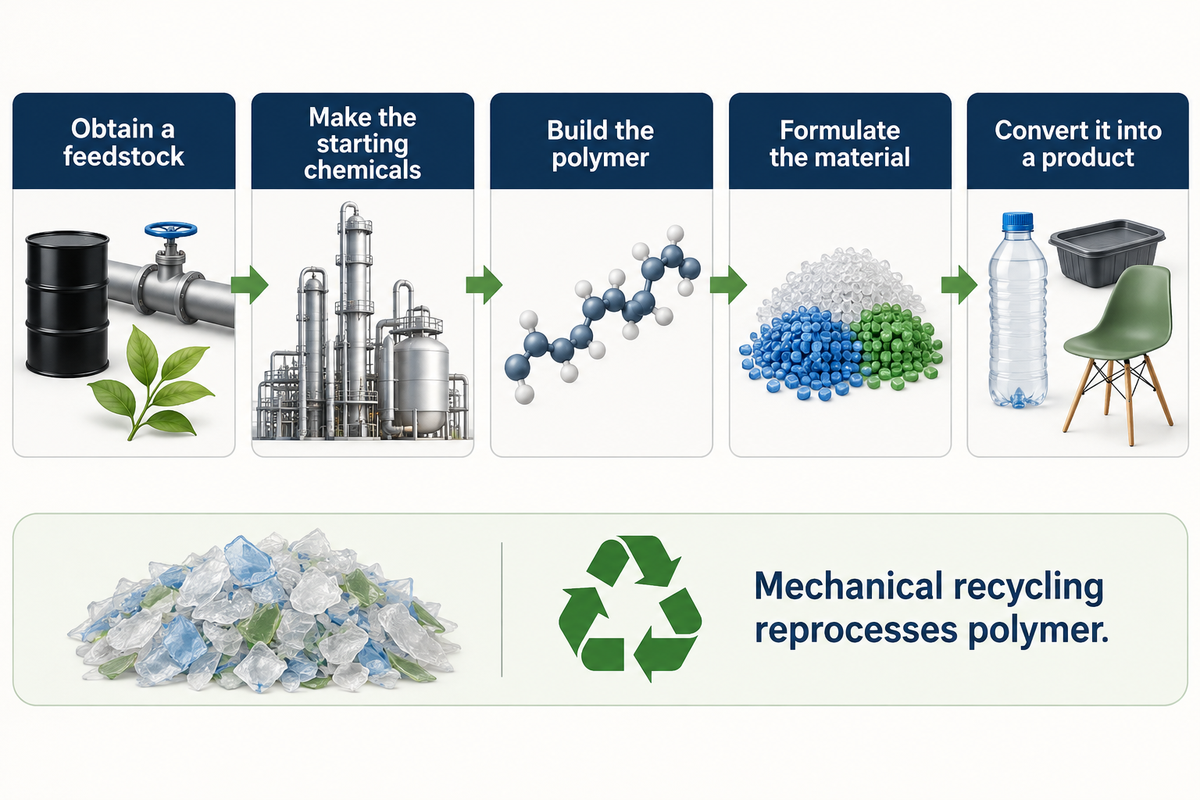
Joining molecules together to form chains or networks through chemical bonds is achieved through polymerization. The selected monomers and the selected route define the chemistry of the polymer. Compounding, or adjusting the composition, then changes the formulation. Shaping, or conversion, then gives the material its final useful form. It’s one thing to melt a pellet of resin to create film, and it’s an entirely different thing to create that resin.
Consider monomers as links. A polymer is a connected chain. Ethylene molecules can link to make polyethylene. The reaction is more than hardening a liquid. Catalysts or initiators modify how the reaction proceeds, but their identity and operating conditions change with the polymer and process.
5-Stage Feedstock-to-Film Pathway
The 5-Stage Feedstock-to-Film Pathway tracks new-polymer manufacture from the resource, through monomer chemistry, polymer production, formulation and final conversion.
- Obtain a feedstock. Recover a suitable oil, gas or biological resource.
- Make the starting chemicals. Produce and purify the monomers or other reaction inputs.
- Build the polymer. Chemically link the chosen molecules into resin.
- Formulate the material. Blend the resin with selected ingredients or other polymers.
- Convert it into a product. Extrude, mold or otherwise shape the material, then cool or cure it as required.
Mechanical recycling follows a shorter branch, whereby the recovered polymer is reprocessed for reformulation or conversion without requiring a monomer production step. Chemical recycling routes can also enable recovered material to be returned to earlier feedstock or chemical stages.
The British Plastics Federation’s manufacturing explanation distinguishes polymerization from compounding and processing. In practice, these stages can involve different companies. A film converter can buy finished resin and formulate or shape it without synthesizing the base polymer.
Not all materials follow the same reaction. Addition polymerization can build polyethylene from ethylene. Condensation routes use reacting functional groups and can release small molecules. PET, for example, is produced from a combination of an alcohol component and an acid component. A simple “heat and add a catalyst” description fails to depict all the variations.
Resin granules are already well beyond the raw resource stage when they’re loaded in a truck. Pellet shape provides a convenient form for storage and feeding, but doesn’t indicate if the resin is virgin, recycled, or bio based. Heating and mixing the granules in an extruder prepares them for shaping. Many resins melt and soften again at elevated temperature as explained in the guide to why thermoplastics soften again.
What Common Plastics Are Made Of Chemically
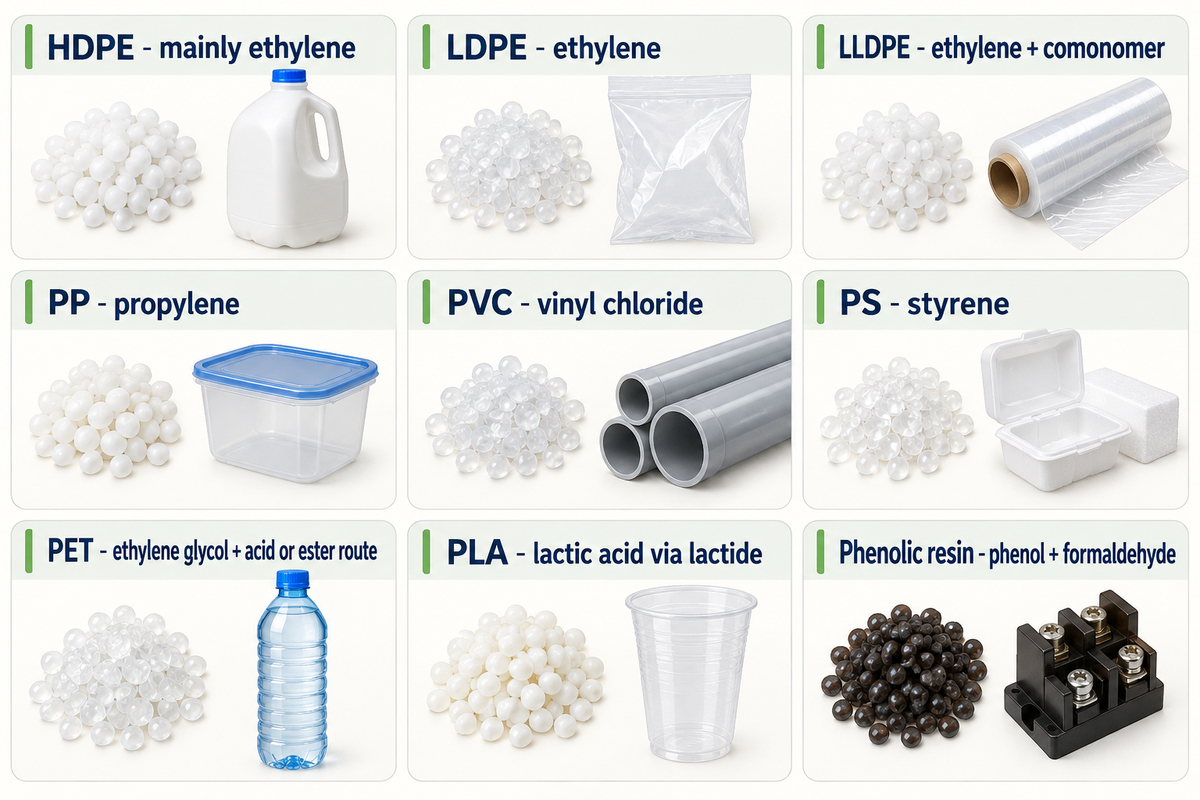
The starting molecules of different plastics can vary, in spite of having similar sounding names. Polyethylene mainly contains carbon and hydrogen; PVC also contains chlorine, while PET contains oxygen in its polyester structure. Further variations in molecular weight, branching, and formulation create differences in a given family of plastics.
The American Chemical Society’s PET profile indicates that ethylene glycol and terephthalic acid are PET’s two condensation partners. The commercial route using dimethyl terephthalate is also available. Thus PET is more uniquely defined as chemically different from polyethylene.
| Material | Starting chemistry | What distinguishes it | Familiar example |
|---|---|---|---|
| HDPE | Mainly ethylene. | Relatively little branching and closer chain packing. | Milk jug. |
| LDPE | Ethylene. | More branching and less compact chain arrangement. | Flexible bag or wrap. |
| LLDPE | Ethylene with an alpha-olefin comonomer. | A mostly linear backbone with short branches. | Stretch film. |
| Polypropylene, PP | Propylene. | Methyl side groups on a carbon-chain backbone. | Container or film. |
| Polyvinyl chloride, PVC | Vinyl chloride. | Chlorine forms part of the polymer’s chemical structure. | Pipe or formulated flexible sheet. |
| Polystyrene, PS | Styrene. | Aromatic side groups. | Rigid or foamed packaging. |
| PET | Ethylene glycol plus terephthalic acid, or a related ester route. | Oxygen-containing polyester linkages. | Soft drink bottles or polyester fiber. |
| PLA | Lactic acid, commonly through a lactide intermediate. | A polyester often made using fermented plant sugars. | Formed packaging or fiber. |
| Phenolic resin | Phenol and formaldehyde. | A cured network, as in Bakelite. | Electrical components. |
Suppose a buyer wants to compare a stiff polyethylene bottle to a soft polyethylene bag. Both can be made from the same main monomer, but the finished products behave differently. Chain branching affects how closely molecules are packed. Wall thickness changes how easily an article bends. A bag’s flexibility doesn’t point to a specific plasticizer recipe. A useful comparison starts with resin grade and product construction, then examines added ingredients. Looking only at polyethylene doesn’t provide the information the buyer needs to evaluate if a substitution of one package for another is appropriate.
Heat response adds another distinction. Thermoplastics can soften and flow when heated, while a cured thermoset network doesn’t remelt in the same way. Grade and structure also affect polyethylene melting behavior; a material-family label isn’t a single processing temperature.
Why Plastic Additives Change the Final Material
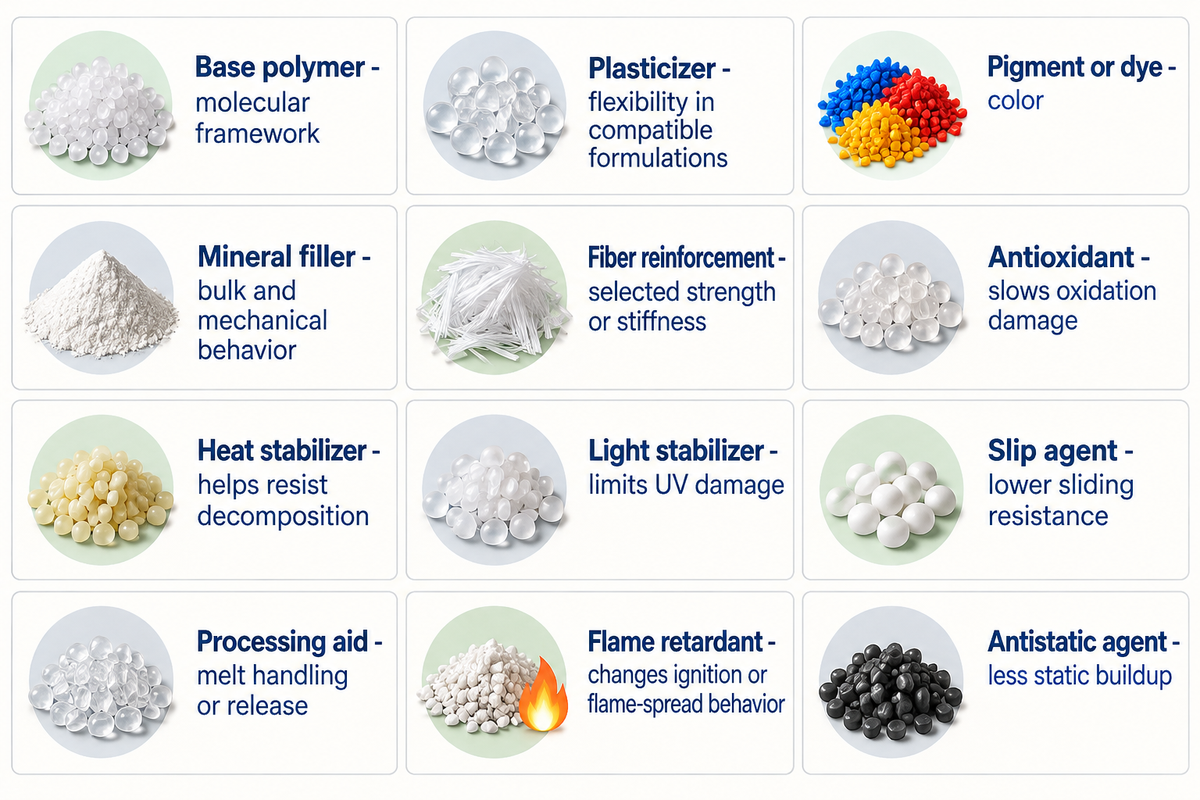
There are various additives that can change color, resistance to oxidation, surface friction, and flexibility in a given polymer formulation. Plasticizers can soften suitable PVC formulations, while polyethylene films also gain flexibility from resin structure. Softness doesn’t indicate what additives a given formulation may contain.
A formulation can include a concentrated masterbatch, which is a carrier resin with ingredients dispersed in it. A converter blends that concentrate with other materials. The British Plastics Federation’s additives guide describes compounds, masterbatches, and the roles of different ingredient groups.
“Even though a bottle says ‘2,’ it’s not just HDPE.”
Plastic Ingredient and Function Matrix
The Plastic Ingredient and Function Matrix relates constituents of a formulation to the properties they modify and the questions they help to address.
| Component | Main function | Useful comparison question |
|---|---|---|
| Base polymer | Forms the material’s molecular framework. | Are the family and grade the same? |
| Plasticizer | Increases flexibility in a compatible formulation. | Is softness coming from formulation, resin structure or both? |
| Pigment or dye | Adds color; pigments can impart opacity. | Is the requirement color, light screening or visibility? |
| Mineral filler | Changes bulk and mechanical behavior. | How does the filled grade differ from the unfilled resin? |
| Fiber reinforcement | Increases selected strength or stiffness properties. | Is a reinforced material being compared with an unreinforced one? |
| Antioxidant | Slows oxidation-related damage. | Is the concern processing exposure or service aging? |
| Heat stabilizer | Helps resist thermal decomposition. | What heat exposure is the formulation designed for? |
| Light stabilizer | Limits damage associated with ultraviolet exposure. | Will the product be used indoors or outdoors? |
| Slip agent | Reduces film sliding resistance. | How does the surface interact with film and machinery? |
| Processing aid or lubricant | Changes melt handling or release behavior. | Which conversion problem is the ingredient addressing? |
| Flame retardant | Changes ignition or flame-spread behavior. | Is the finished formulation intended for a specified fire-performance requirement? |
| Antistatic agent | Reduces buildup of static charge. | Does charge interfere with handling or surface cleanliness? |
Imagine a converter creating printed plastic bags from polyethylene. The film needs to slip over equipment. The same surface must accept treatment and ink and provide a reliable seal. Additional slip isn’t always better. Migrating slip ingredients move toward the surface, and excessive levels can interfere with those other operations. The trade off is described by Ampacet for polyolefin films. A quality team comparing two rolls of film needs to separate sliding from printing and sealing, and identify poor sealing or incomplete treatment. While polyethylene is the major constituent, slip additives can help modify the interfacial behavior. The measurement question for assessing plastic film friction is provided in the attached guide.
What Plant-Based and Recycled Plastics Are Made From
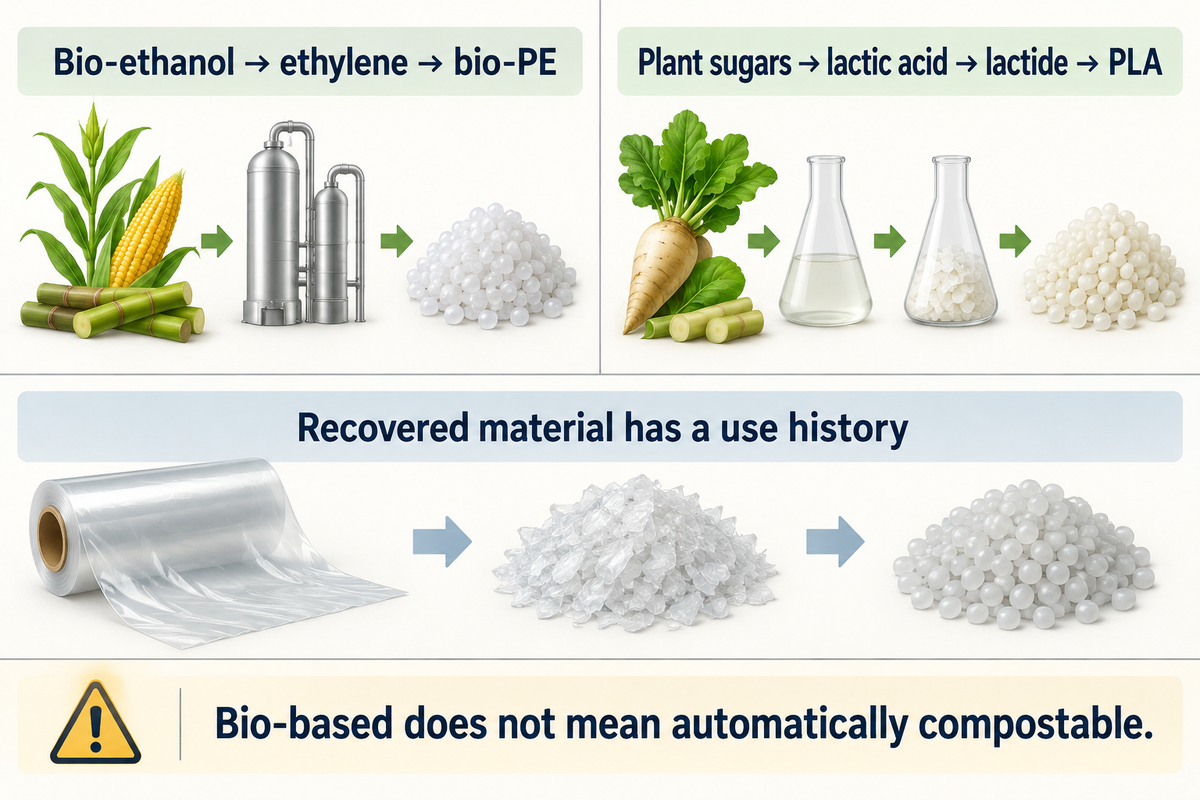
Plant-based plastics use biological resources for some or all of their starting material. Recycled plastics use materials derived from earlier uses or from a manufacturing stage. These terms describe the origin or history of the materials. Biodegradability describes behavior of a material under particular conditions and must be separated from the source of carbon.
An example is bio-based polyethylene (bio-PE). Bio-ethanol can be converted to ethylene and polymerized to bio-PE. Braskem describes this route for its sugarcane-based PE. Polymerized PE remains PE; changing the carbon source doesn’t transform it to PLA or give it automatic compostability.
Another example is PLA. Plant sugars can be fermented to lactic acid, and the commercial route often uses a lactide intermediate and polymerization. Integrated production of lactic acid and lactide with polymerization is described by NatureWorks. Therefore, the feedstocks can be biological, while the polymers have different chemical properties and end-of-life behavior.
What are bioplastics?
Bioplastics is an all-encompassing term for materials described as bio-based, biodegradable or both. A more accurate description should state the polymer and the attribute that it possesses. Bio-based PE and PLA are different polymers, and a biological feedstock doesn’t tell the user where the finished article breaks down.
Definitions of bio-based, biodegradable and compostable provided by the European Commission help make the distinctions. Biodegradable plastics, for example, require specific conditions. Compostable products require an appropriate collection and treatment route. It shouldn’t be assumed that a product intended for industrial composting would also compost in a home composting system, a landfill or the ocean.
When choosing between a bio-based PE wrap and PLA package, the label “made from plants” is of little assistance in determining the more relevant comparison. While the PE wrap retains PE chemistry, the PLA article is a different polyester. Each package has its own thickness, formulation, and structure. The collection route may also be part of the comparison: an item that resembles a conventional plant-based package may require a different disposal route. Consideration should also be given to the energy consumption, greenhouse gas emissions and environmental impact, which include more than the feedstock.
For determining the origin of a compound, ASTM D6866-24a is the active, or currently used, catalog version of the radiocarbon method for determining biobased carbon content. Its scope does not include environmental impact or product performance. Another composition question is the history of a recycled compound. The FDA’s recycled-plastics chemistry guidance discusses the presence of unknown contaminants which may remain after material is recycled. This is different from intentionally added ingredients to a formulation.
From Resin Pellets to Packaging Film
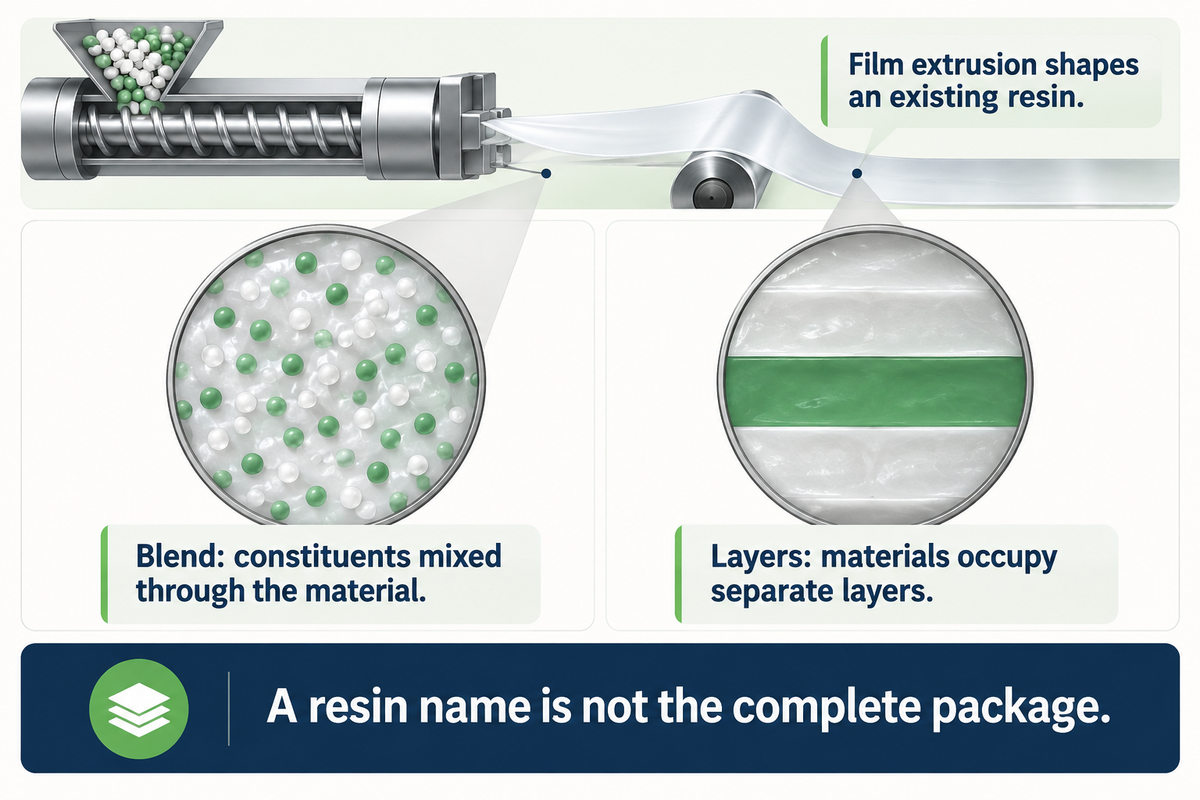
The conversion of a formulated resin into a thin sheet or tube creates packaging film. Each stage of this process, from resin selection to cooling, impacts the final outcome. A packaging structure can include one or more polymer families, blends, or layers. The composition of a completed package includes more than what’s printed on the bag of resin.
In film extrusion, the material is heated and extruded through a die. The subsequent cast-film and blown-film processes determine the shape before the plastic cools. Injection molding fills a mold with material while blow molding forms hollow articles. These processes give a material its desired shape rather than rebuilding every polymer chain from monomers. Stabilizers help suitable formulations resist degradation during high temperature processing.
Finished structure may be altered by stretching and orientation during the processing of a film. A layered film is different from a blend: distinct materials occupy separate layers rather than simply being mixed throughout one material. This helps explain the need for a complete knowledge of the conversion process for description of biaxially oriented polypropylene film.
In a signed technical article on film-processing conditions, an expert from NOVA Chemicals, Asjad Hossain, describes how processing has a profound effect on the molecular alignment and crystalline nature of the polymer. Multi-material packaging layers are described for some films containing PE, BOPP and PET.
A team purchasing a clear film will likely encounter different types of polyethylene (PE) film descriptions. One description may refer to a single PE film while the other may pertain to the PE sealing layer of a laminate. Comparing these descriptions as if they were complete recipes won’t reveal the other components of the package. The team needs to determine the resin type, additives, and the layer structure before they can compare the film thickness, for example. The task of one of the team members then becomes clearer: they have to check the behavior of the completed construction rather than to interpret that the PE resin in the two examples is the same and therefore the two components may be interchanged.
The price of a raw material can fluctuate based on grade of resin, additives and recycled inputs, and converting requirements. The price of the base resin and the price of the finished package describe different purchase points. The durability and usability of the converted article remain part of the comparison.
Industry Outlook: What Is Changing in Plastic Feedstocks?
Plastic feedstock development is extending the ways to obtain polymer-making chemicals, including the use of biological resources and recovered waste. The important question is which way supplies which polymer and completed product. A new source, a recycling process and different polymer chemistry describe different things, even if presented as alternatives to fossil inputs.
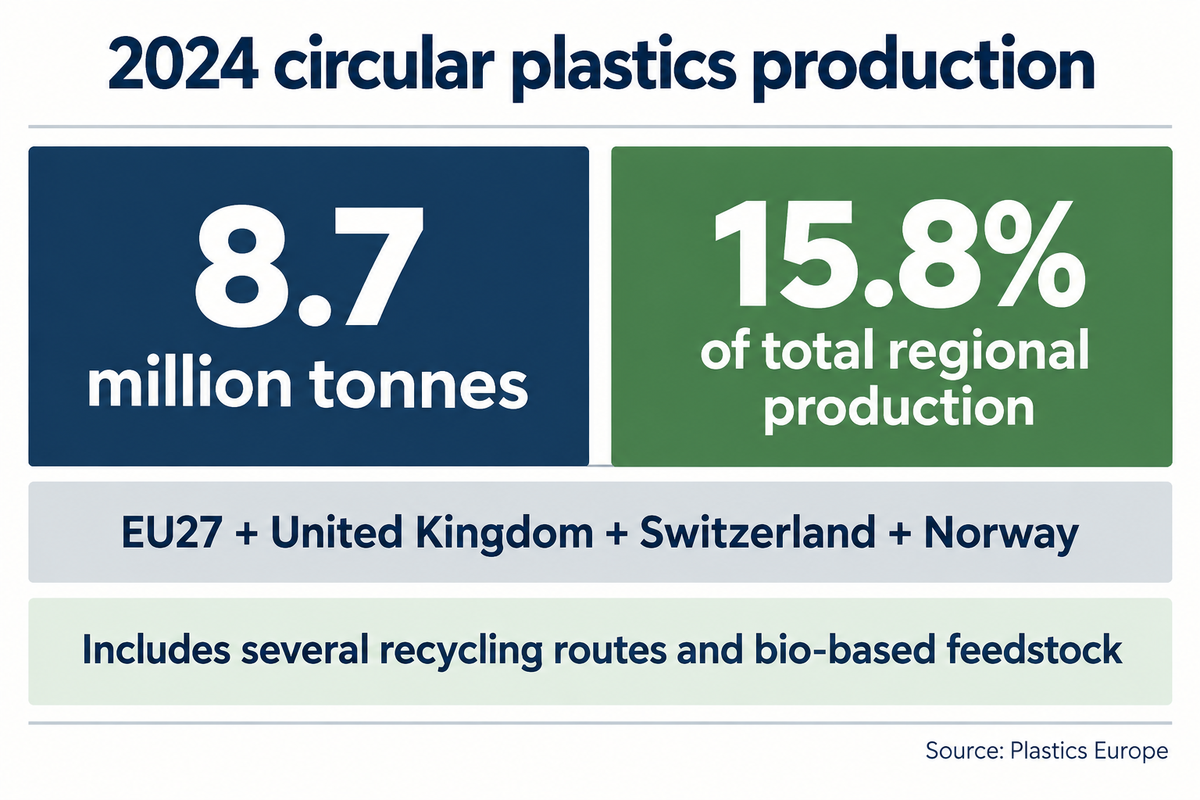
Plastics Europe’s 2026 circular-economy report summary puts circular plastics production at 8.7 million tonnes, or 15.8% of total production, in 2024 across the EU27, United Kingdom, Switzerland and Norway. Its circular category includes several recycling routes and bio-based feedstock, so that figure is broader than mechanically recycled plastic alone.
Another pathway returns waste plastic to chemical feedstock. Dow’s announcement of its March 2025 Xycle investment described support for a planned plant to make pyrolysis oil to produce plastic. The announcement had a projection for the future operation date. Mechanical recycling reprocesses recovered polymer, and it doesn’t always mean returning it to its original monomers.
Keep the order of description for new materials the same: source, polymer, formulation, converted structure and anticipated recovery route. A renewable source explains the origin; it doesn’t by itself determine product performance, pollution or how to dispose of the package.
Frequently Asked Questions
Can all types of plastic be recycled?
No. Recyclability depends on the material, construction and available collection process.
Thermoplastics can often be reprocessed by melting, but that doesn’t mean every finished item is accepted by a recycling program. Different polymers, additives, colors and layers create sorting and processing challenges. Cured thermosets behave differently from melt-processable resins. Collection systems also distinguish formats such as bottles and flexible film, so a resin identification code isn’t a promise that a particular item can be collected locally.
What plastic are Ziploc bags made of?
Ziploc identifies its conventional storage bags as polyethylene; Endurables are silicone.
SC Johnson’s U.S. Ziploc FAQ distinguishes polyethylene storage bags from the brand’s reusable Endurables products, which use platinum silicone. Those are different material families, even though both carry the Ziploc name. Polyethylene identifies the base polymer of the conventional bags rather than a complete additive recipe. Product names and use instructions remain relevant when comparing different items within a brand’s range.
What is PLA made of?
PLA is a polyester made from lactic-acid chemistry, commonly using fermented plant sugars.
Industrial production can ferment sugars into lactic acid and use a lactide intermediate to produce the polymer. PLA therefore differs from bio-based polyethylene, which follows an ethanol-to-ethylene route before becoming PE. Both can begin with biological resources, but the resulting molecules are different. The formulation and finished article also matter when describing compostability; the PLA name alone doesn’t specify a disposal route for every product.
What is Bakelite made of?
Bakelite is based on phenol-formaldehyde resin.
Phenol and formaldehyde react to form a thermosetting network. The cured resin can be formulated with other ingredients for a finished article. Unlike ordinary melt-processable PE, cured Bakelite doesn’t simply soften and remelt into new products.
Can plastic be made without oil?
Yes. Natural gas, biological resources and recovered materials provide alternative starting routes.
Natural-gas-derived ethane can supply ethylene for polyethylene, while biological sugars can support routes to PLA or bio-based PE. Recycled material can also become an input for new plastic products. These routes don’t all produce the same polymer, and a product made without crude-oil feedstock isn’t automatically biodegradable. Natural gas is still a fossil resource. Mechanical recycling retains much of the existing polymer, whereas some chemical-recycling routes return material to smaller chemical feedstocks. “Without oil” describes one part of the supply chain. Polymer identity, formulation, processing and end-of-life management still need their own descriptions. Reuse, suitable collection and recovery address different parts of the material’s life.
Connect the chemistry to the packaging material
Start with the polymer family, then examine grade, formulation and finished construction. The UD Packaging guide to plastic materials and grade selection connects these distinctions with packaging applications.
Pathways and ingredient tables describe material families and ingredient functions. They don’t describe a fixed formulation of a finished commercial package.
References & Sources
- Plastic composition and sorting, National Institute of Standards and Technology.
- Leo Baekeland and the invention of Bakelite, American Chemical Society.
- Plastics feedstocks in the United States, U.S. Energy Information Administration.
- How plastic is made, British Plastics Federation.
- Poly(ethylene terephthalate), American Chemical Society.
- Plastics additives, British Plastics Federation.
- Bio-based, biodegradable and compostable plastics, European Commission.
- D6866-24a biobased-carbon test methods, ASTM International.
- Use of recycled plastics in food packaging: chemistry considerations, U.S. Food and Drug Administration.
- High-barrier resins and processing conditions, Asjad Hossain, Packaging Strategies.
- Circular-economy report summary, 2026, Plastics Europe; 2024 regional data.