
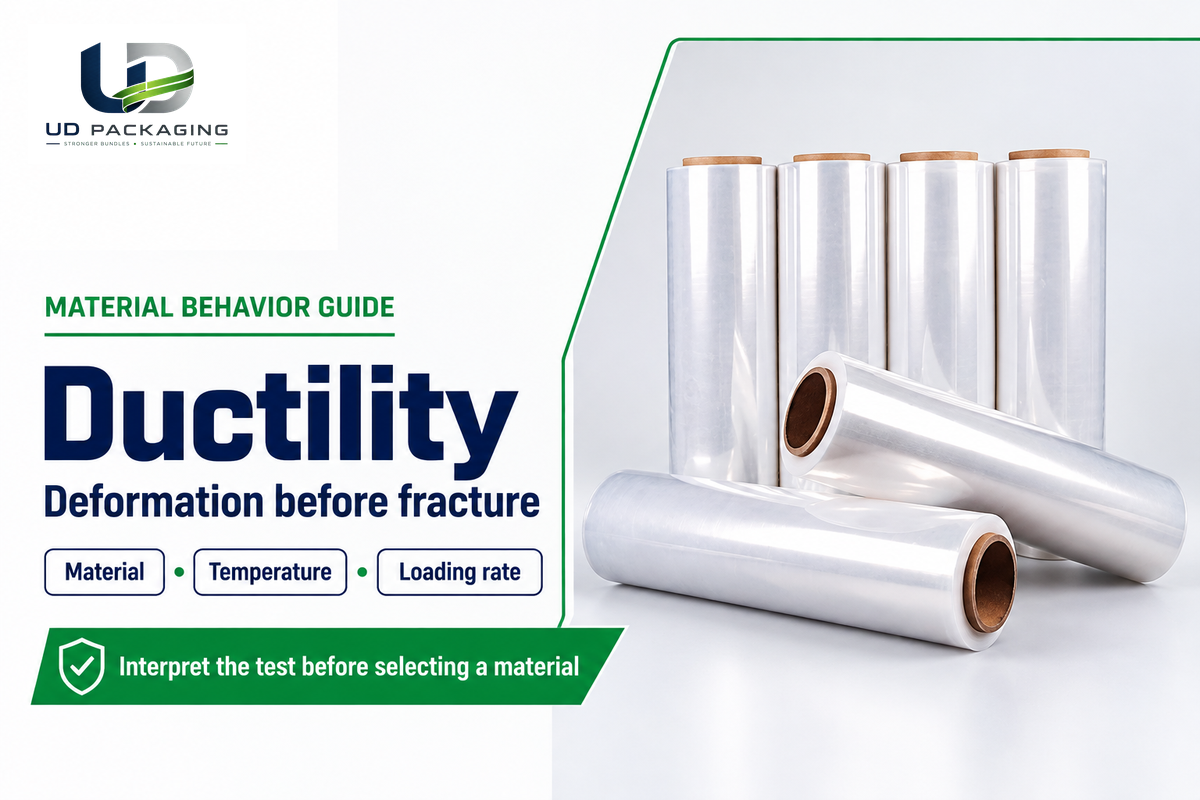
In conventional materials science, ductility is the ability of a material to sustain appreciable plastic deformation before fracture. Copper drawn into a wire is the familiar example. Plastics can also stretch, yield and form a neck, but the same polymer may break abruptly when its temperature, loading speed or geometry changes.
Ductility describes deformation before failure. Report elongation or reduction of area with the specimen and test conditions. For a plastic part, compare the failure mode at the intended temperature and loading rate.
At a glance
- A long extension can include recoverable strain; it isn’t automatically permanent stretching.
- Ductility measures deformation capacity. Toughness also depends on the stress sustained.
- A notch, faster load or different formulation can change a plastic’s failure behavior.
- ASTM D638 and the ISO 527 series have defined specimen and reporting requirements.
What is ductility?
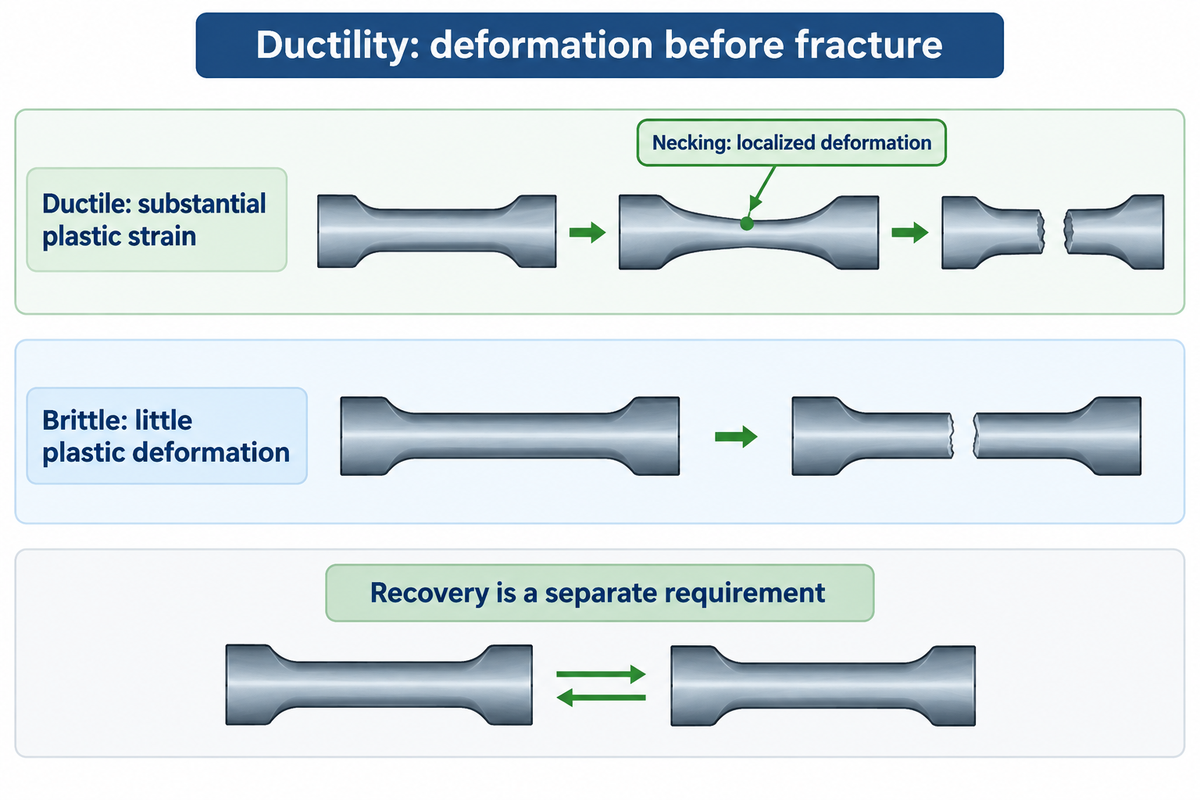
A ductile material accommodates substantial plastic strain before it fractures; a brittle material fractures with comparatively little plastic deformation under the same stated conditions. The difference is more about the mode of failure rather than how hard the surface of the material feels or how much load the material can initially withstand. Princeton’s ductility glossary describes the conventional definition and its two familiar sample measurements.
Percent elongation records the increase in a sample’s measured length. Percent reduction of area records how much the cross-sectional area decreases at the fracture location. Ductility is measured using these different sample responses, with the method retained alongside each result. Elongation and necking can occur together, concentrating deformation locally rather than uniformly along the sample’s length.
Copper and aluminium products, mild steel, and some stainless-steel grades are included in examples of ductile materials. Glass, ceramics and many cast iron grades provide the brittle contrast, or low ductility under the stated conditions. Alloying, process and test conditions accompany the results. “Ductile” is a description of behavior and isn’t a separate class of metal and applies to nonmetallic materials.
Why is ductility useful?
Ductility allows a material to deform plastically during drawing or other fabrication without immediately cracking. It also explains why a specimen changes shape before breaking. For a finished component, however, permanent deformation may already mean that a clip no longer holds, a cover no longer fits or a strap no longer performs its intended function.
Recovery is a separate requirement from deformation, as described by ductility. A specimen that survives one large extension has answered a different question from a spring-like feature that must recover after repeated use.
Ductility vs toughness, malleability and flexibility
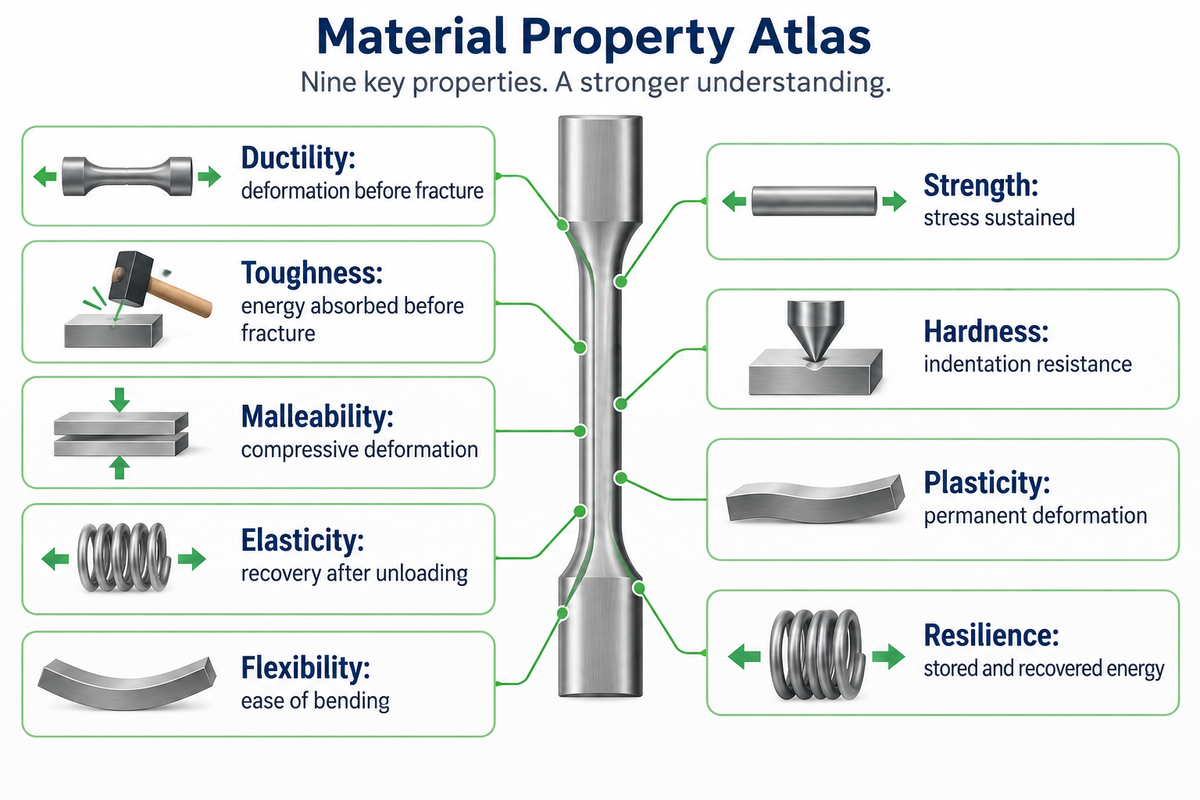
Ductility addresses deformation before fracture. Toughness addresses the energy absorbed before break. A malleable material can be shaped under compression, while flexibility describes how readily an object bends.
| Property | Question it answers | Useful distinction |
|---|---|---|
| Ductility | How much deformation occurs before fracture? | Commonly described through tensile strain or elongation. |
| Toughness | How much energy is absorbed before fracture? | Both stress and strain contribute. |
| Malleability | Can the material deform under compressive loading? | Rolling or hammering into sheet differs from drawing into wire. |
| Elasticity | How does the material recover after unloading? | Recovery and permanent deformation are different responses. |
| Flexibility | How easily does this object bend? | Geometry and stiffness affect the answer. |
| Strength | What stress does the specimen sustain? | Yield, maximum stress and stress at break name different events. |
| Hardness | How does the surface resist a specified indentation? | Strength and hardness do not measure deformation capacity. |
| Plasticity | Can permanent deformation occur? | Ductility is the tensile manifestation considered here. |
| Resilience | How much energy can be stored and recovered? | It differs from energy absorbed through failure. |
Penn State’s explanation of resilience and toughness notes that highly ductile unreinforced polymers can still have small toughness. On a tensile stress–strain curve, an extended low-stress response can therefore absorb less energy than a shorter response at much higher stress. Tensile toughness, impact energy and fracture toughness should retain their test definitions.
In polymer science, the term “ductility” is sometimes used to denote an energy based index. In an EPFL study of an acrylic adhesive, high energy-based ductility indices accompanied strain that almost fully recovered after 48 hours. That result does not erase the conventional plastic-deformation definition; it shows why the reported index and recovery interval matter.
Which plastics are ductile, and when?
Polyethylene and unfilled polycarbonate are familiar candidates for investigating ductile behavior. Several thermoplastic polymers show considerable deformation but a family name of the polymer alone doesn’t indicate if the part retained its ductile regime state with a change in the loading condition. A reinforced grade, an oriented film, and an un-filled part, for example, may show different behavior.
Acrylic and polystyrene are useful brittle contrasts under many ordinary test conditions. Other processed, filled or impact modified versions need individual data.
An MIT study of polycarbonate and rubber-modified polycarbonate makes that qualification concrete. Unnotched and mildly notched specimens showed ductile failure, while more severely notched specimens, and moderately notched specimens tested at 100°C, showed brittle failure. The finding belongs to that experiment; 100°C isn’t a universal boundary for polycarbonate.
In practice, the comparison is between the relevant processed grades. For a snap-fit, examine the root of the clip and the assembly motion. For film, study its orientation and if there’s uniform or localized extension. A candidate may prove less ductile in the finished feature even when a different specimen produced a larger extension at break.
A more general plastic material properties guide is provided, which describes how different properties correlate to one another. Use this to assess overall property profile and compare to other plastics, as opposed to picking the highest elongation percentage.
Why do temperature and strain rate change failure?
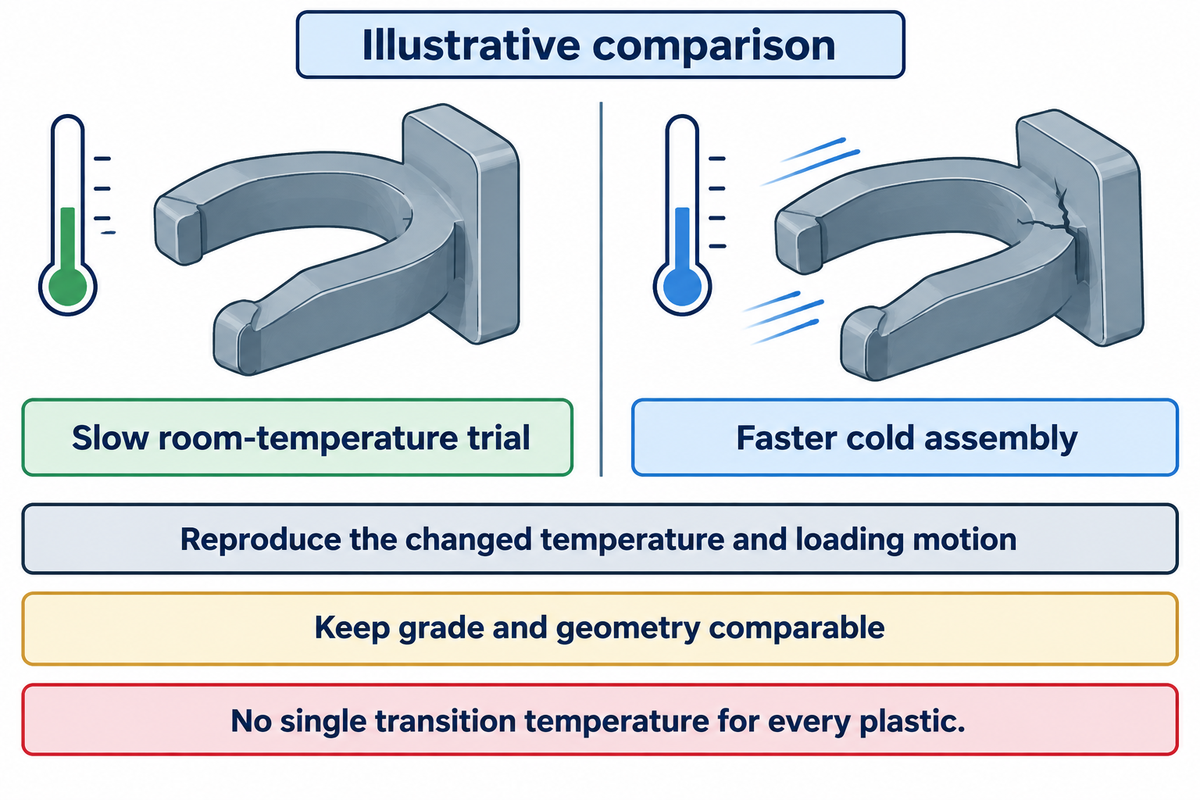
Loading rate and temperature play a role in the level of rearrangement of polymeric molecules as a load develops. Colder conditions or faster loading may shift the response from ductile deformation toward brittleness in a material that yields under another set of conditions. This is dependent on the history and stress state of the polymer, and is material dependent. It isn’t the same for every polymer, and it isn’t a single fixed temperature for every plastic.
Princeton’s fracture teaching example shows polypropylene behaving ductilely at a low strain rate and brittly at a higher rate at the same temperature. For example, a slow, deliberate hand bend can display a different behavior as compared to a rapid assembly or a sudden impact.
“The rate of loading for a plastic material is a key component of how we perceive its performance.”
Sepe’s instrumented impact example shows a PVC compound tested at 5 feet per second, which took about 20 milliseconds to occur and absorbed about 32 Joules. At 15 feet per second, the test failed in about 3 milliseconds and absorbed about 21 Joules, with a brittle response. Again, this is for that compound and test arrangement, not limits for all PVC or tensile elongation values.
Illustrative situation: a clip assembles during a slow room-temperature trial but cracks during a faster cold assembly. The next comparison should reproduce the changed temperature and loading motion. Choosing a resin with a larger room-temperature extension at break may miss the cause.
The glass transition temperature also requires another level of explanation. It describes a molecular relaxation region measured by a specified thermal or mechanical method; it is not automatically the ductile-to-brittle transition of a notched part. The site’s glass transition temperature explanation discusses this thermal property separately.
How do you measure ductility without mixing test results?
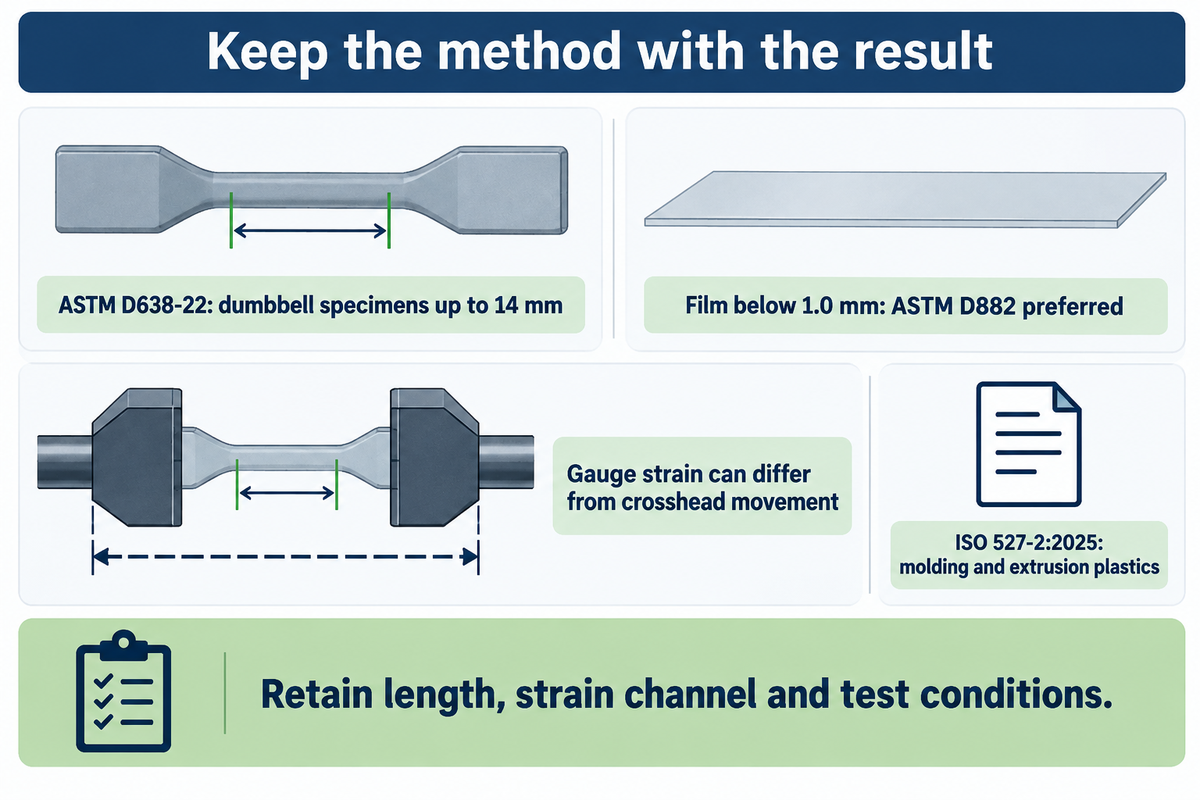
Use tensile testing to record deformation and load as a specimen is stretched, and keep the measurement length, strain channel, and test conditions for each result to avoid confusion in measurements. For metals, percent elongation, and percent reduction in area are other traditional methods to measure ductility. Plastic specimens usually report defined strain or elongation results at yield and break.
The public scope of ASTM D638-22 covers standard dumbbell specimens of unreinforced and reinforced plastics up to 14 mm thick. For thin sheeting (including film) below 1.0 mm, it identifies ASTM D882 as the preferred method. The same page warns that specimen preparation, speed and environment affect tensile properties and that D638 and ISO 527-1 differ in technical content.
ISO 527-2:2025, published as its third edition in June 2025, specifies test conditions for molding and extrusion plastics. ISO’s public summary describes updated specimen references aligned with ISO 20753 and the names A1 and A2. A result produced under one procedure should retain that procedure’s designation when compared with another.
Are ductility and elongation the same?
Elongation is a measured increase in length; ductility is the behavior being characterized. Differences in gauge-length strain and nominal strain can occur, especially if a neck develops or the machine and grips contribute displacement. ASTM’s public notes expressly caution that crosshead movement and strain between gauge marks can differ.
Use the existing engineering stress and strain calculator to calculate stresses and strains. The plastic film tensile testing guide covers the separate operating task. Here the question is which of the reported deformations corresponds to the specimen being compared.
What makes a normally ductile plastic crack?
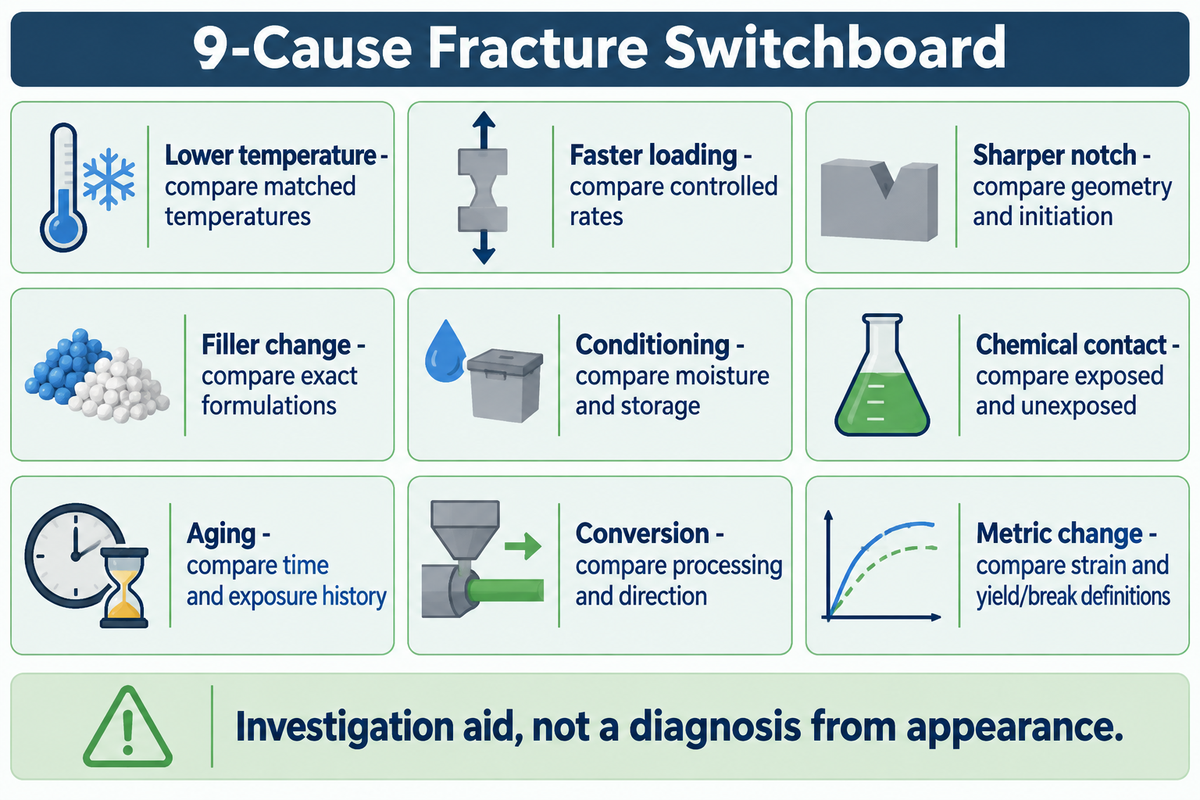
A change in loading condition, specimen feature or the state of the material can change a ductile response to a brittle fracture. Determine what change occurred between the working specimen and the failed specimen. The 9-Cause Fracture Switchboard is a suggestion for a comparison framework. The following 9-Cause Fracture Switchboard is an investigation aid: it connects a visible change to a focused comparison rather than assigning a cause from the appearance of one broken part.
| Changed condition | What to compare | Decision the comparison supports |
|---|---|---|
| Lower temperature | Same grade and geometry at the two relevant temperatures. | Whether the operating environment changes the failure mode. |
| Faster loading | Controlled loading rates with the same specimen state. | Whether a slow trial represented the actual event. |
| Sharper notch or corner | Feature geometry and fracture initiation location. | Whether the local stress state needs attention. |
| Different filler or reinforcement | Exact grade and formulation, not only the resin family. | Whether a stiffness substitution changed deformation capacity. |
| Different conditioning history | Moisture, drying and storage state of paired samples. | Whether the comparison starts with equivalent material states. |
| Chemical contact | Exposed and unexposed specimens under the relevant load history. | Whether the exposure needs a separate compatibility investigation. |
| Aging or degradation | Time and exposure history, with material characterization where needed. | Whether the current part still matches the original qualification sample. |
| Changed conversion or orientation | Molding, joining or film direction and the fracture location. | Whether the finished product behaves like the original test specimen. |
| A different reported metric | Gauge strain, nominal strain and the point labeled yield or break. | Whether the apparent material change is a measurement mismatch. |
The comparisons of temperature and rate, and the effect of notches, are supported by the MIT polycarbonate study, Princeton case and Sepe’s case. Chemical exposure and ageing may require a different set of tests from a short tensile pull.
Stress whitening or a drawn neck or a fracture surface may provide some leads, but a visible clue doesn’t provide sufficient evidence to draw a conclusion about the mechanism. A glossy, jagged or whitened region should be correlated with the loading history and the material history. The absence of a yield strength data field in a data sheet doesn’t mean that the material was fractured before yielding.
Illustrative substitution: replacing an unfilled grade with a reinforced grade may meet a stiffness target while changing the response of a narrow clip root. Compare the two grades in that feature before treating the substitution as an equivalent material change.
Choose ductility for the part, film or strap
Choose deformation capacity alongside the function the product must retain. A part intended to hold its shape needs a different balance from material intended to draw during conversion. For packaging film or strapping, extension at break describes only one part of behavior; recovery, creep, joining and the finished package can determine whether the intended function is maintained.
For a clip, define whether the assembly motion should stay recoverable or may leave a permanent set. For a formed part, specify the region that must deform without a crack. For film, distinguish the load direction from the direction of the test. These choices allow a preference for “high ductility” to be made specific.
Illustrative packaging decision: two straps can both survive a long tensile extension, yet differ in how they retain tension over time or how their joints perform. Selecting the larger break-strain number doesn’t answer those separate questions. Keep the joint and long-duration requirements in the packaging evaluation.
ASTM D638’s significance-and-use section advises against using a short term test for widely different load-time scales and environments. The separate creep guide for plastics covers time-dependent behavior of deformation under sustained load. Ductility and strength are still relevant, but don’t replace the remainder of the property profile.
Plastic tensile testing: cost, turnaround and providers
How much does a plastic tensile test cost and how long does it take?
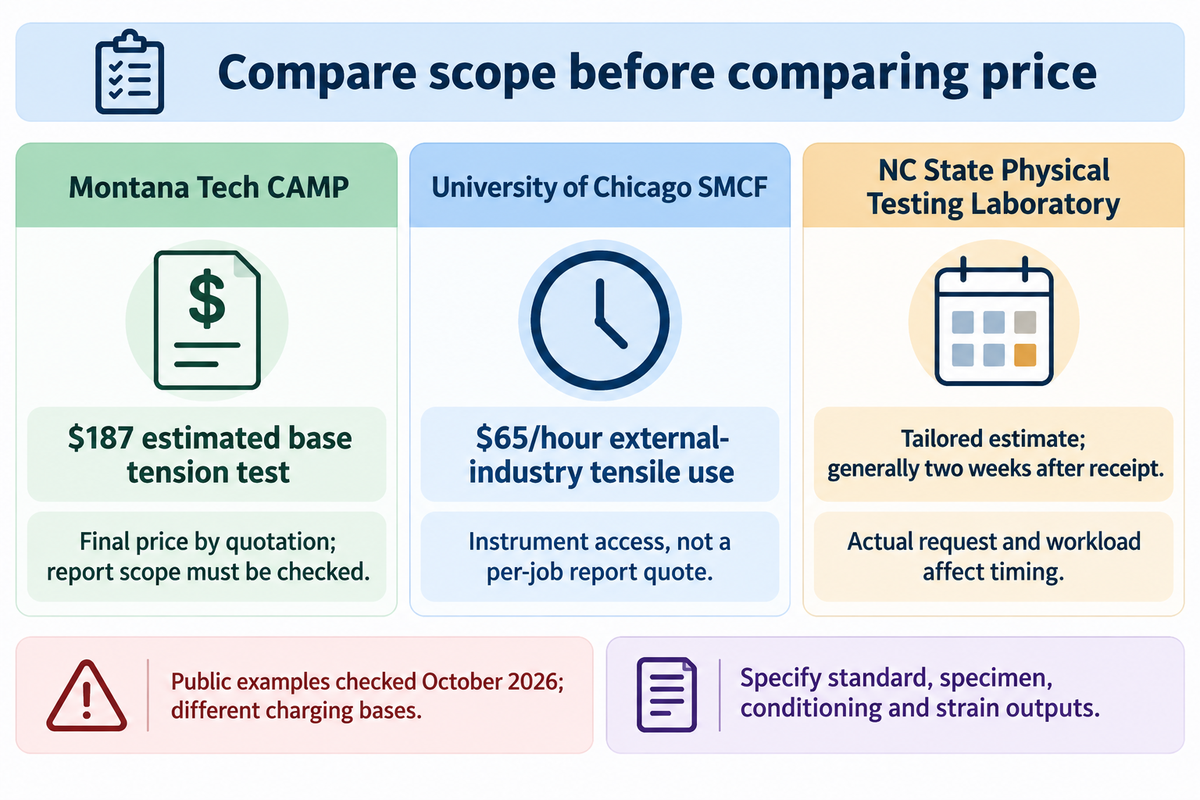
Published university examples include a $187 estimated base tension test at Montana Tech and $65 per hour for external-industry tensile instrument use at the University of Chicago, while NC State’s Physical Testing Laboratory generally advises allowing two weeks after samples arrive, and time is affected by their workload, sample count and requested tests. Prices use different bases for charging.
| Public example, checked October 2026 | Published basis | How to use it |
|---|---|---|
| Montana Tech CAMP | $187 tension testing; $297 with modulus; $344 with Poisson’s ratio. | Estimated base prices, finalized by quotation. The page does not define a complete elongation-report package. |
| University of Chicago SMCF | $65/hour external-industry tensile use; new-user training/consulting $127/hour plus instrument fee. | Facility rates effective July 1, 2026, rather than a per-job laboratory report quote. |
| NC State Physical Testing Laboratory | Tailored estimate; generally two-week turnaround after receipt. | Lists ASTM D638 and D882. Educational priorities and the actual request affect scheduling. |
Who can test a plastic resin’s ductility using ASTM D638 or ISO 527?
A lab with the applicable method, specimen prep and strain-measurement capability can do the job. NC State is one publicly listed ASTM D638/D882 example. For a quote, give the specific standard you need, the material form, the specimen count, the temperature and conditioning, and state if you need yield strain, break strain and the full curve as opposed to strength.
Compare total quoted scope before comparing price. Specimen machining or molding, conditioning, and access to and use of equipment and staff are some of the items that may appear in a proposal. Accreditation may be required for your customer; identify the performing facility and the specific method in its current scope rather than assuming that a laboratory name covers every test.
What is changing in ductile polymer design?
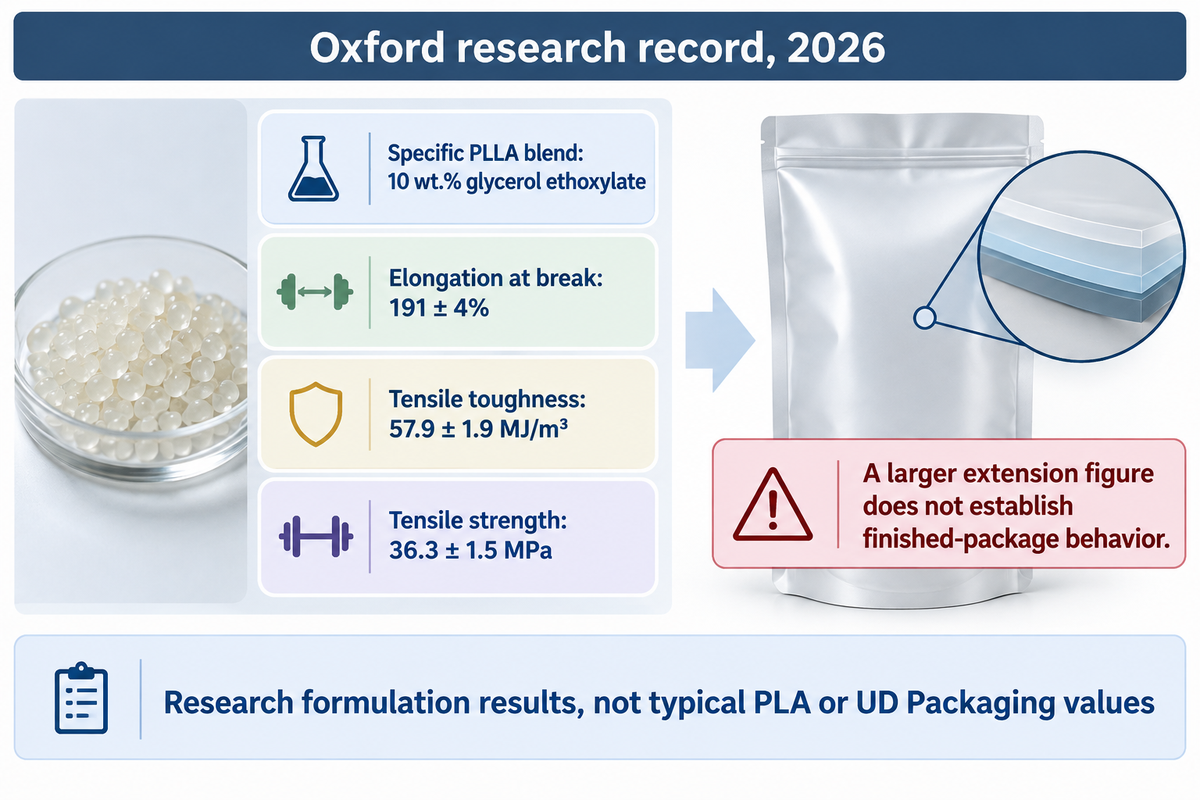
Recent research on polymers has enhanced combinations of elongation, toughness and recyclability in a given formulation. Transition models are becoming more explicit for temperature and rate. For a user, the important result is a more definitive property profile of the given material. The behavior of a given end-product package isn’t established by the presence of a new additive or a larger extension figure.
A 2026 Oxford research record reports a PLLA blend containing 10 wt.% glycerol ethoxylate with elongation at break of 191 ± 4%, tensile toughness of 57.9 ± 1.9 MJ/m³ and tensile strength of 36.3 ± 1.5 MPa. A pair of these measurements describes the formulation being studied; they aren’t typical values for PLA or UD Packaging products in general.
Separately, Ginzburg, Gendelman and Zaccone’s 2026 transition-model record examines selected amorphous polymers and reports that the brittle-to-ductile transition is often, but not always, associated with the beta-transition. When a formulation is changed, include its strength, deformation, thermal and processing properties in the comparison.
Frequently asked questions
What is ductility in metals?
View answer
Ductility describes how much permanent tensile deformation a metal can sustain before fracture. Copper wire and many mild steels provide familiar examples, while the result still depends on alloy, heat treatment and test conditions. The term doesn’t mean that every metal bends safely in every part geometry, or that a material has a particular strength.
What are the differences between ductile and brittle materials?
View answer
A ductile specimen develops appreciable permanent deformation before it fractures; a brittle specimen fractures with comparatively little plastic deformation under the stated conditions. This describes observed behavior, rather than an unchanging label for every grade. Temperature, loading speed, a notch and the material's processing history can move a plastic from one response to the other.
What does toughness mean?
View answer
Toughness concerns the energy absorbed before fracture. In a tensile stress–strain record, both the stress sustained and the strain reached contribute to that energy. Ductility emphasizes deformation capacity, so two materials with similar extension at break can absorb different amounts of energy. An impact result also belongs to its particular specimen and loading method.
What is ductile deformation?
View answer
Ductile deformation is a material’s capacity to change shape plastically before it fractures. A drawn neck is a familiar tensile example.
Does ductility increase with temperature?
View answer
Many polymers can deform more before fracture when warmer because molecular motion becomes easier, but the response depends on grade, temperature range, loading rate and specimen geometry. Heating also changes stiffness and strength, so a greater extension doesn’t necessarily make the part suitable. Compare tests at the intended temperature and rate rather than converting a glass transition temperature into a universal ductility limit.
Does ductility have a unit?
View answer
Common ductility metrics are dimensionless percentages. Percent elongation and percent reduction in area describe different sample changes, so retain the measurement name.
Does ductility include elastic deformation?
View answer
The defining idea is plastic deformation before fracture, which remains after unloading. A reported total elongation can contain elastic and time-dependent components as well. This distinction matters for elastomers: a long extension that recovers isn’t the same event as a permanently drawn neck. Read the curve and the strain definition, and use a separate recovery measurement when the design needs the part to return to shape.
Discuss a packaging material requirement
Send UD Packaging the intended film or strapping use, material identity and the behavior needed for comparison. Provide an existing test report, if available, particularly where break strain, recovery or creep are of concern. The enquiry can then focus on packaging.
How this material explanation was prepared
UD Packaging publishes this resource to assist readers to understand and interpret ductility, polymer failures and packaging-related test data. Examples are derived from cited universities, standards and technical literature. Illustrative examples show reasoning; they aren’t customer test cases. Research formulations and laboratory facilities are attributed to their original institutions.
References & Sources
- Ductility glossary Princeton University.
- Malleability and ductility and resiliency and toughness Penn State.
- Fracture: temperature and strain-rate examples Princeton University.
- ASTM D638-22 public scope and significance ASTM International.
- ISO 527-2:2025 public edition and scope International Organization for Standardization.
- Polycarbonate deformation and fracture thesis abstract Michael DeShawn Johnson, MIT, 2001.
- The Strain Rate Effect Michael Sepe, Plastics Technology, updated 2022.
- Ductility, recovery and strain rate dependency of an acrylic structural adhesive Angelidi, Vassilopoulos and Keller, 2017.
- CAMP estimated testing prices Montana Tech.
- Soft Matter Characterization Facility rates University of Chicago, effective July 2026.
- Physical Testing Laboratory capabilities and service questions NC State.
- Glycerol-ethoxylate-modified PLLA research record University of Oxford, 2026.
- Predicting the Brittle-to-Ductile Transition in Amorphous Polymers Ginzburg, Gendelman and Zaccone, 2026.